← Misc · September 2023
Rainbows, Adele and Zzyzx
A Labor Day weekend in Las Vegas, driven both ways on I-15: storm and sunset going up, floodwater and an oasis coming down.
Los Angeles → I-15 → Las Vegas → I-15 → Zzyzx → Los Angeles
About 550 miles of interstate · two rainbows at once · one Adele concert · one turn of the High Roller · one tilting Cirque stage · one giant LED ball, four weeks before its opening night · one road with the last name in the atlas
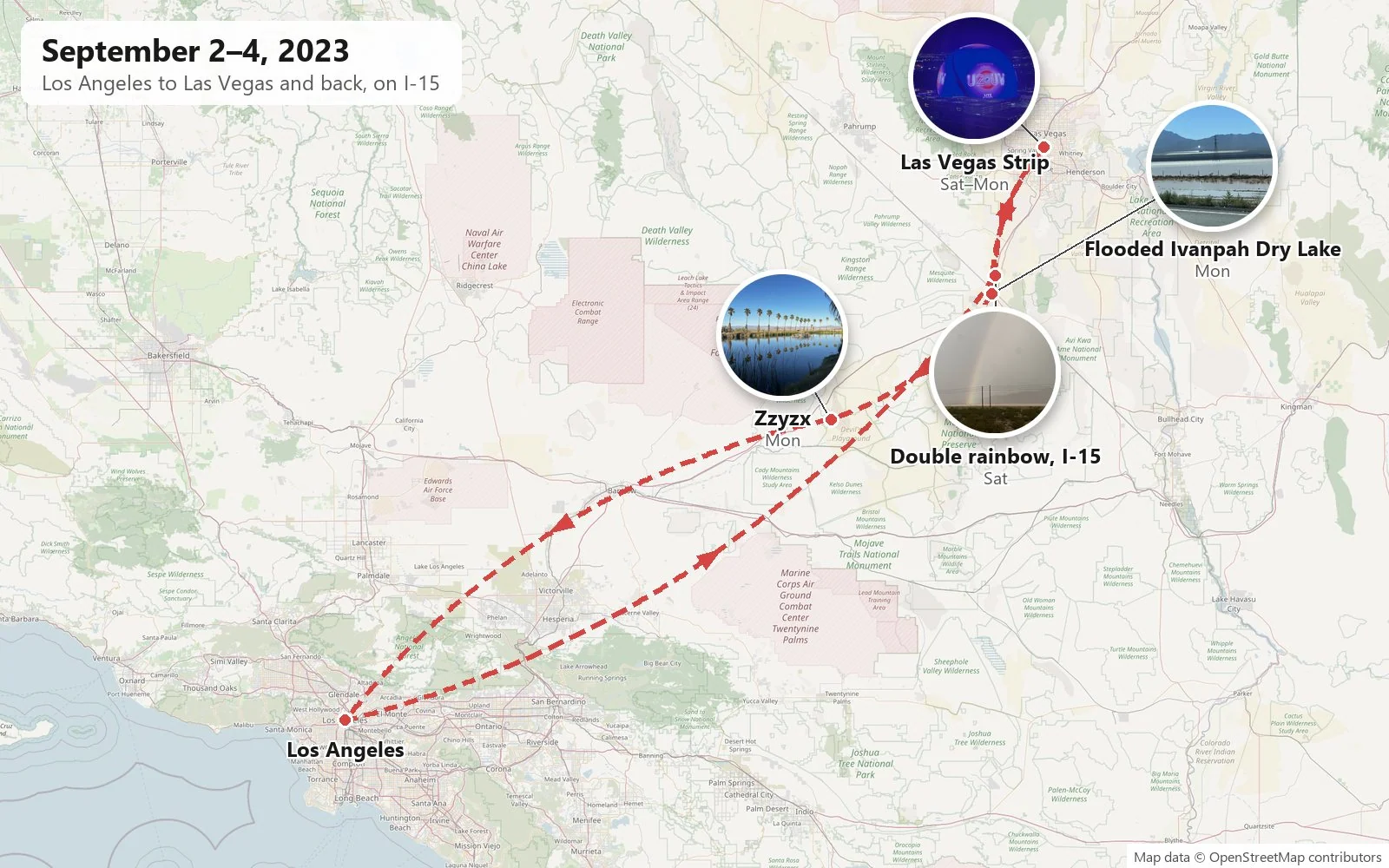
Some trips are built around a place. This one was built around a ticket. Adele's Las Vegas residency, Weekends with Adele, was in its second season, and we had seats for the Saturday night of Labor Day weekend. Everything else (the drive, the Strip, the wheel, the strange little oasis on the way home) grew around that one evening.
Las Vegas from Los Angeles is the most ordinary road trip in Southern California. It is about 270 miles of I-15, four hours if the traffic is kind, and on a holiday weekend it almost never is. Half of Los Angeles seems to make the drive on Friday or Saturday and the other half makes it back on Monday. Nobody expects much of the drive itself. This time it delivered a storm, two rainbows at once, a desert sunset, a lakebed that had turned back into a lake, and a place called Zzyzx. As usual, the story below is put back together from the camera roll, its timestamps and its locations. Where the phone was quiet, so am I.
Day 1: Up I-15, into the storm
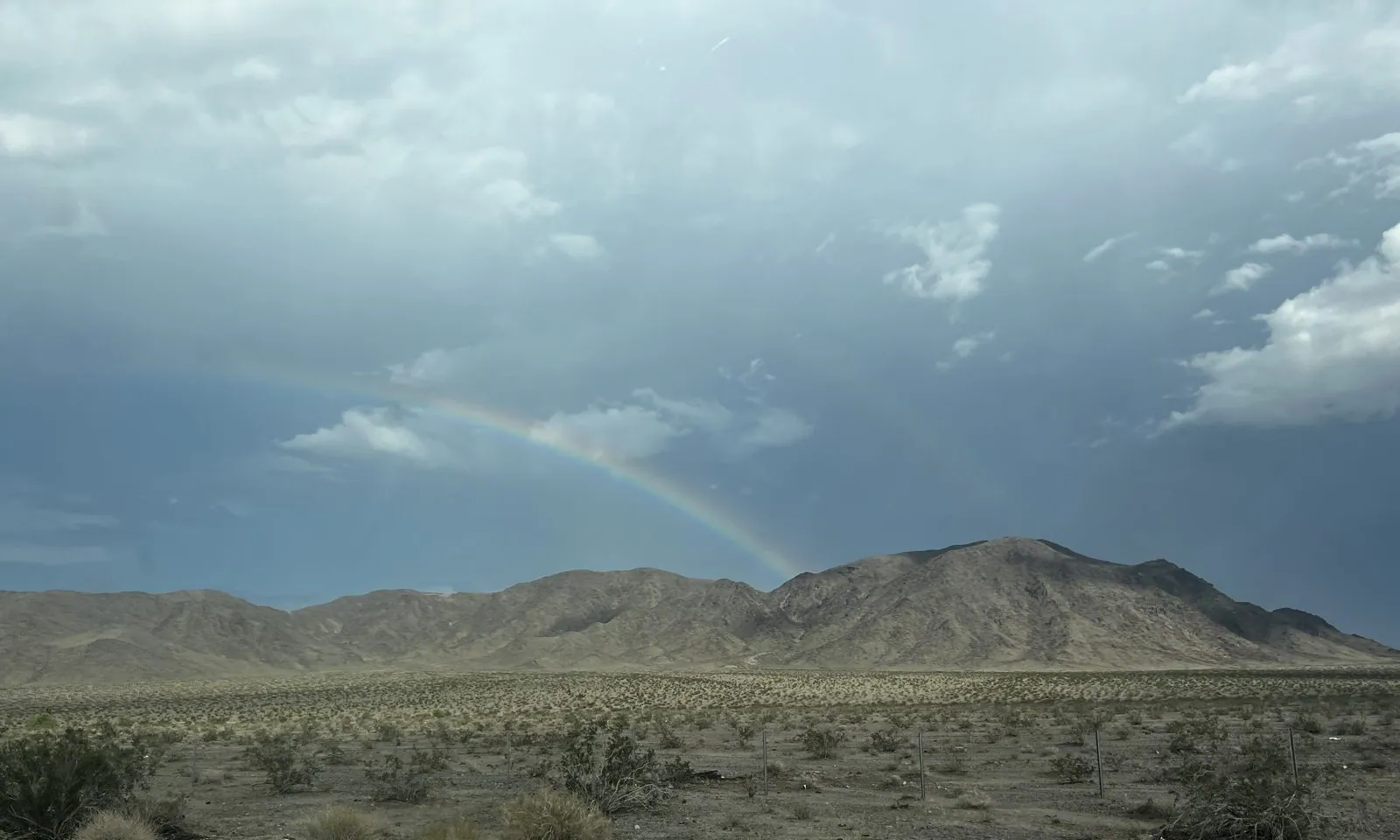
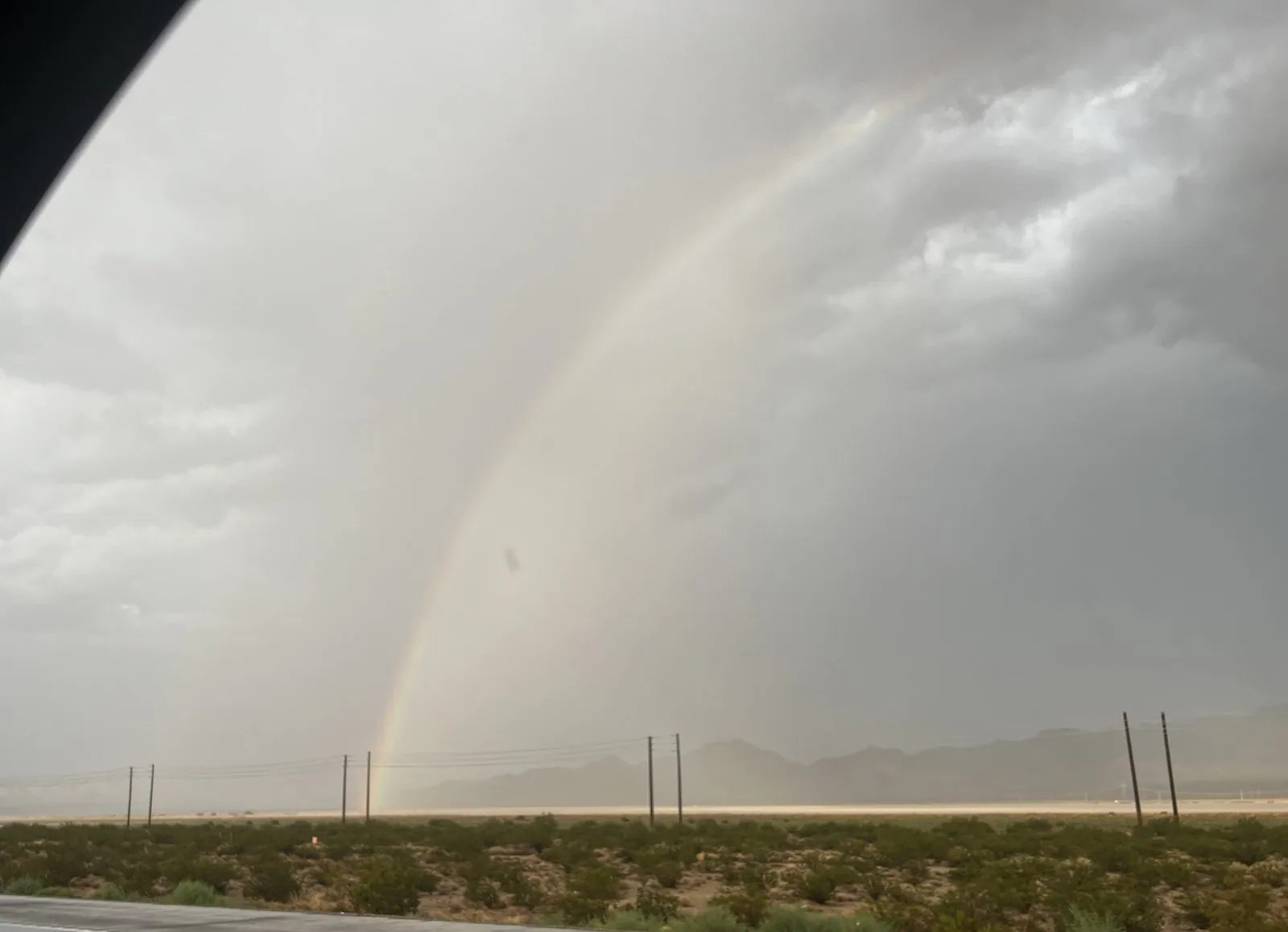
The first rainbow of the trip came well before the state line. At about five, west of Baker, an arc stood over the desert mountains beside I-15, and the phone came out. At 5:38 it buzzed with a National Weather Service flash-flood warning for the area we were driving through.
Half a mile in forty minutes
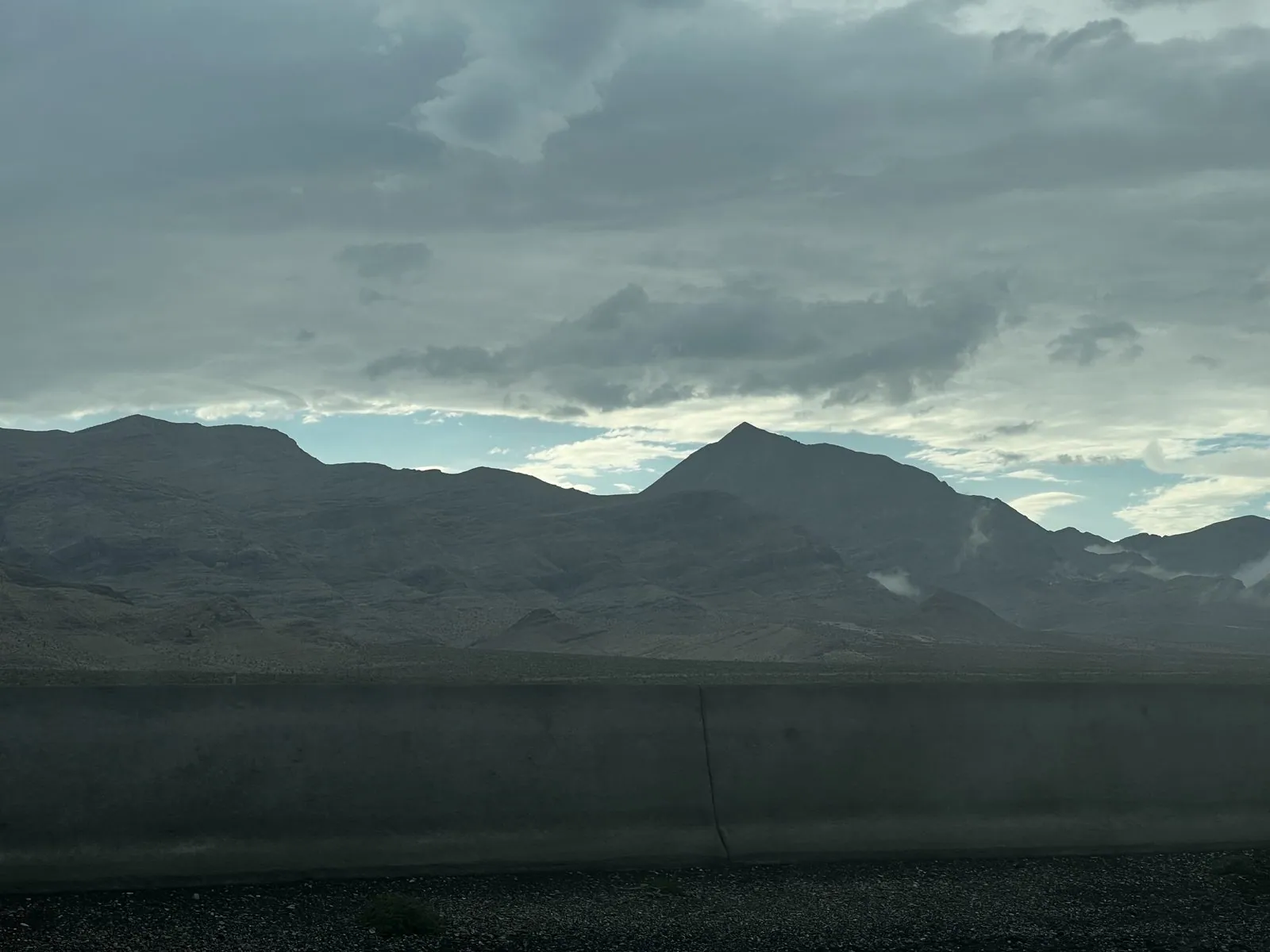
By 5:51 we had stopped moving, a few miles past Primm, the cluster of casinos that sits right on the Nevada state line, and the desert decided to put on a show. A ceiling of slate-colored cloud sat low over the mountains west of the freeway, with a strip of pale blue sky showing underneath. Wisps of rain cloud were snagged on the ridges like smoke.
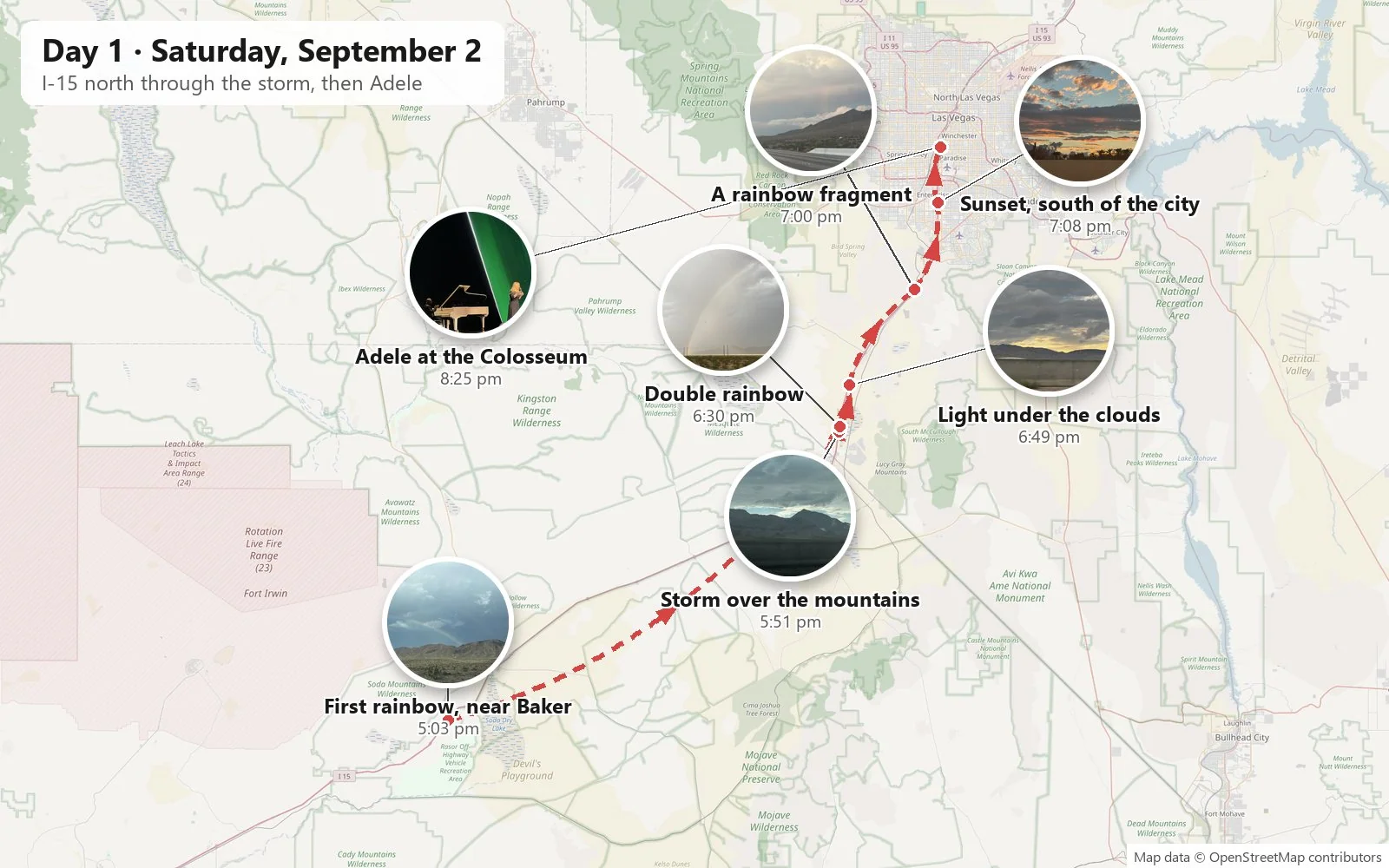
We had plenty of time to look at it, because we weren't going anywhere. According to the phone's GPS, between 5:51 and 6:30 we moved a little over half a mile. This was not the usual holiday crawl. The storm had already been through ahead of us, and in the desert rain does not soak in; it runs. Flash-flood water had come off the slopes and across the low spots in the road, deep enough that the cars caught in it looked half swallowed, and everything behind them (sedans, pickups, RVs and eighteen-wheelers, all pointed at Las Vegas) sat and waited for the water to let them through, brake lights glowing red under a dark sky. Late summer 2023 was an unusually wet one in the Mojave, and over that holiday weekend storms flooded stretches of I-15. In the desert, a traffic jam has a special quality. There is nothing to look at but the sky, so you look at the sky.
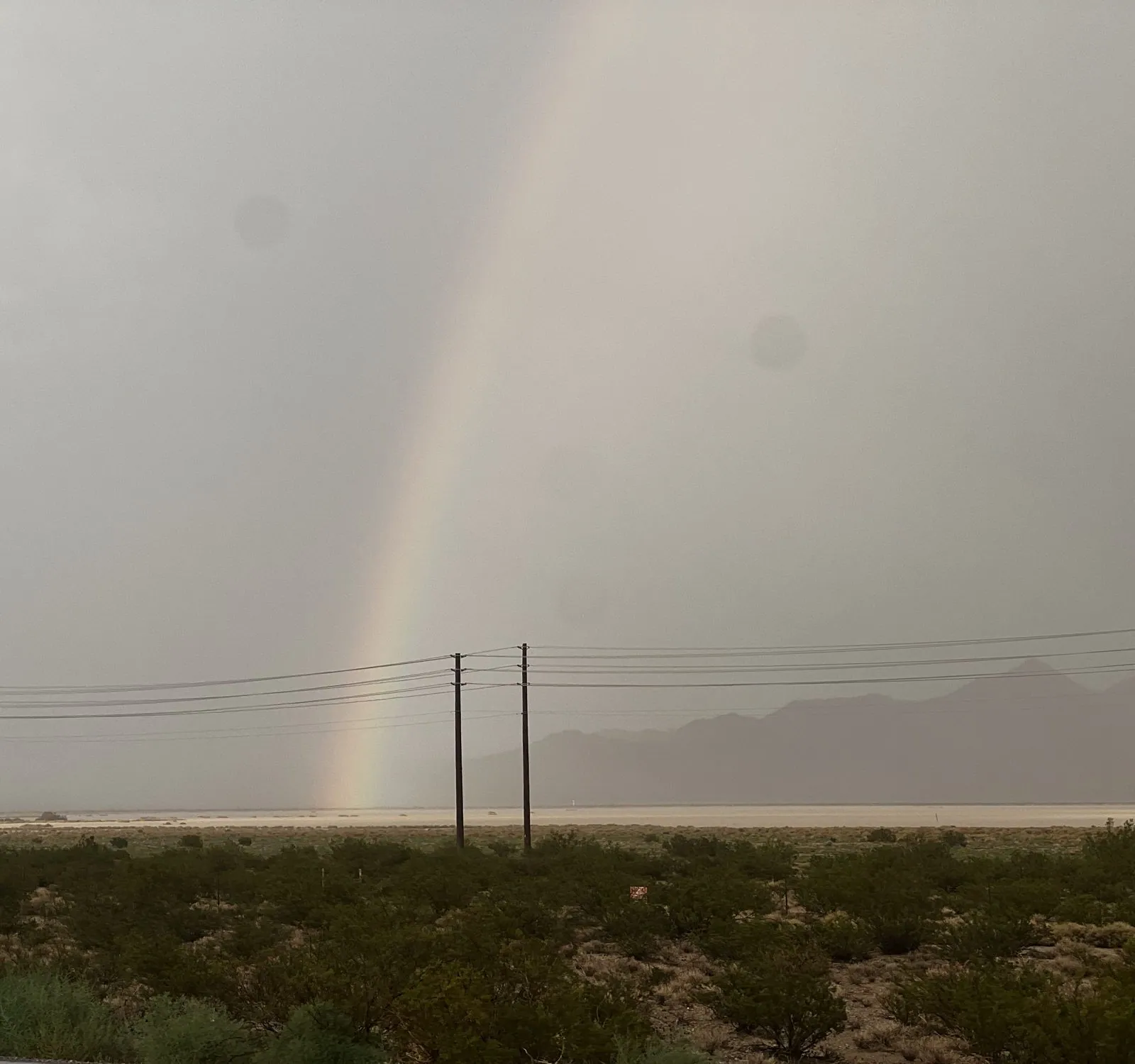
Then the rain came, and right after it the reward. At 6:30, with the sun breaking through somewhere behind us, a rainbow came down out of the gray and planted itself in the desert just east of the freeway. Then a second, fainter one appeared outside it. A double rainbow happens when sunlight is reflected twice inside each raindrop instead of once. The second bow is always wider and dimmer, and its colors run in the opposite order, red on the inside. The band of sky between the two is noticeably darker than the rest, an effect with a name: Alexander's dark band. The end of the bow seemed to stand on the pale floor of Roach Dry Lake, behind a row of power poles, close enough to see where it met the ground, which a rainbow is not supposed to let you do.
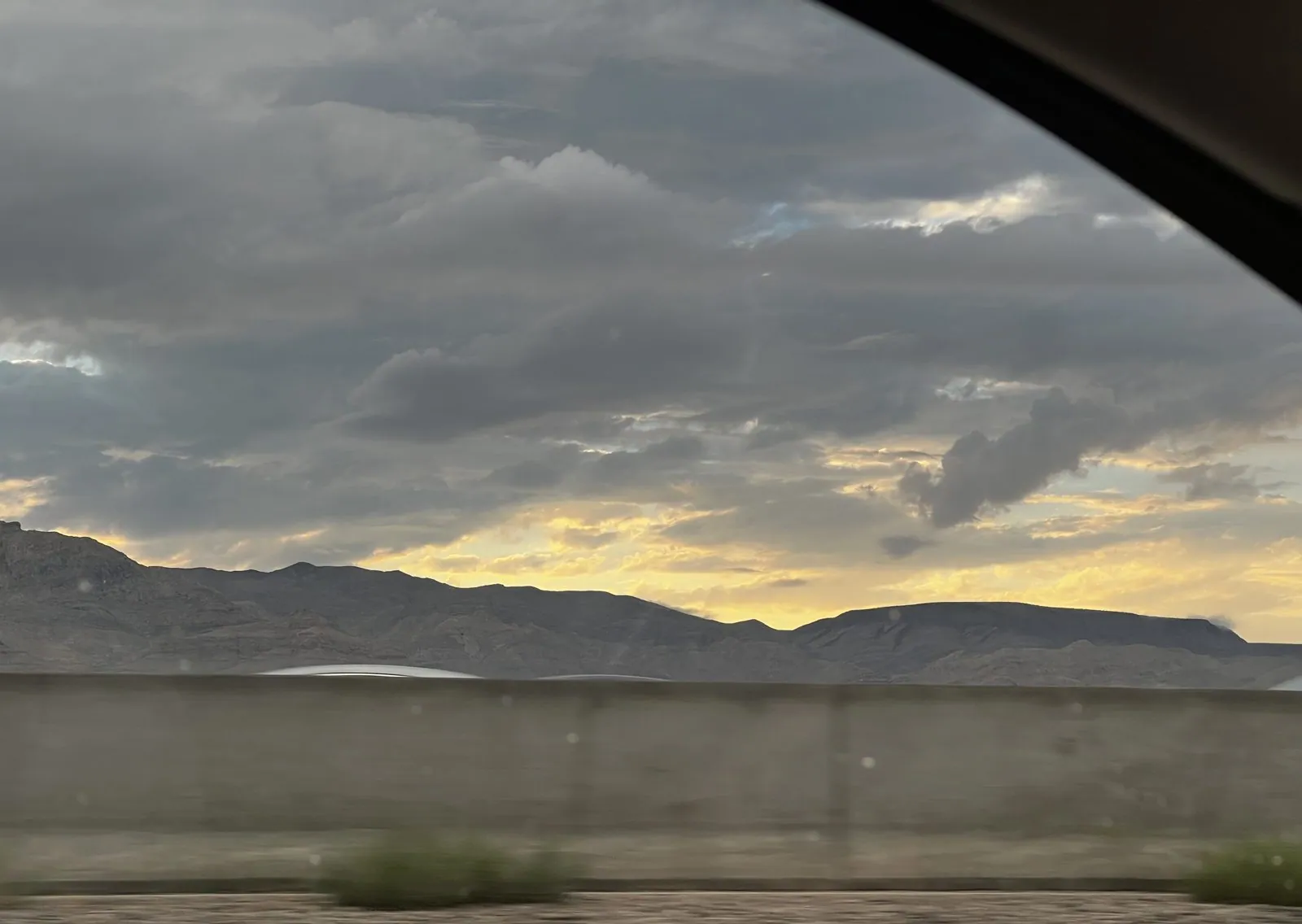
Somewhere around a quarter to seven, the jam let go, and the light did something else. The cloud deck lifted off the western mountains and the low sun slid underneath it, so the whole world turned gold from the bottom up: gold on the ridgelines, gold on the concrete median, gold on the sides of the trucks passing in the next lane. The wipers were still going. The phone, pressed to the window at highway speed, recorded it the way phones do, with a wiper blade swinging through the middle of the frame and raindrops on the glass. I've kept one of those, because that is exactly what it looked like.
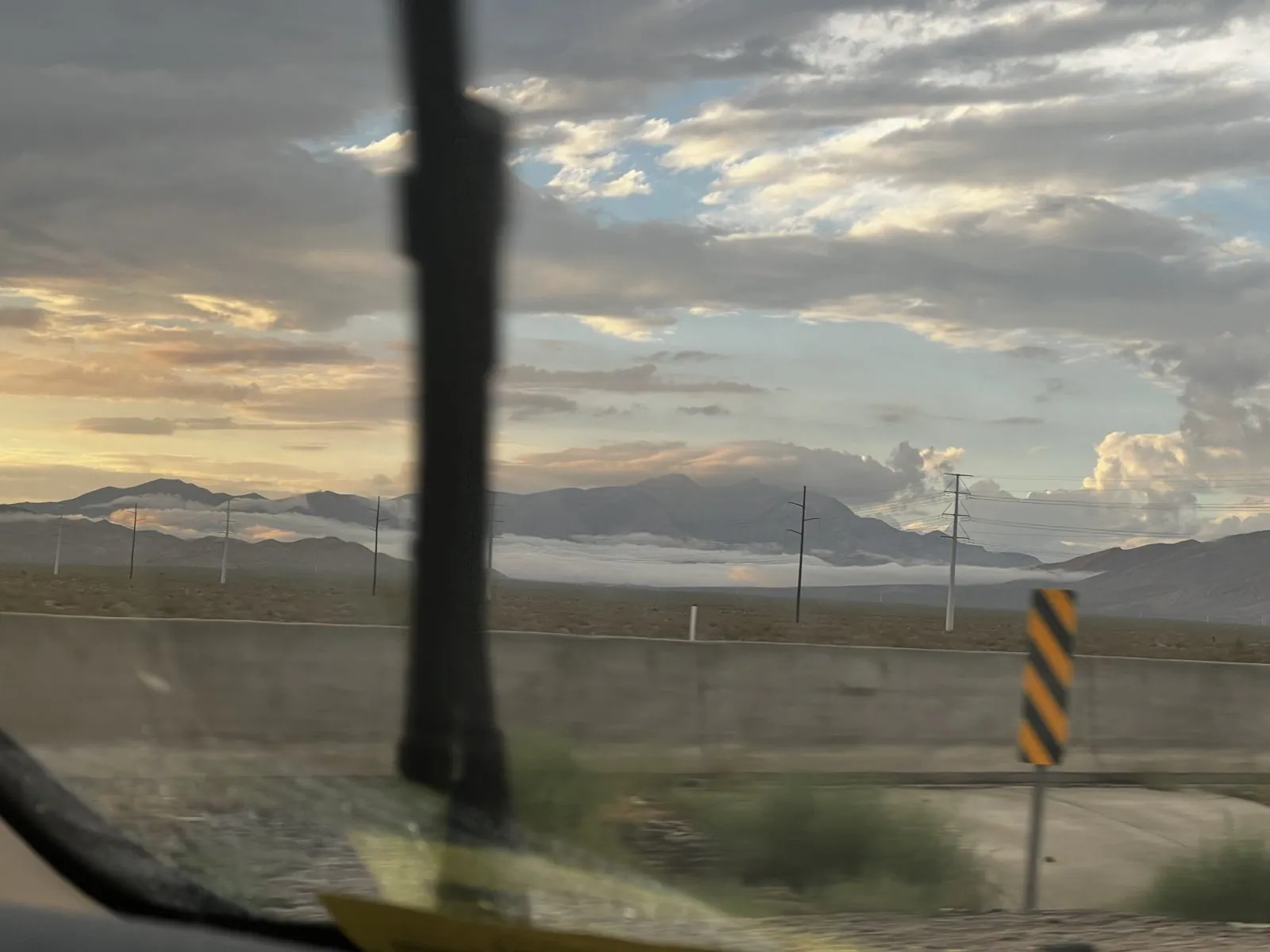
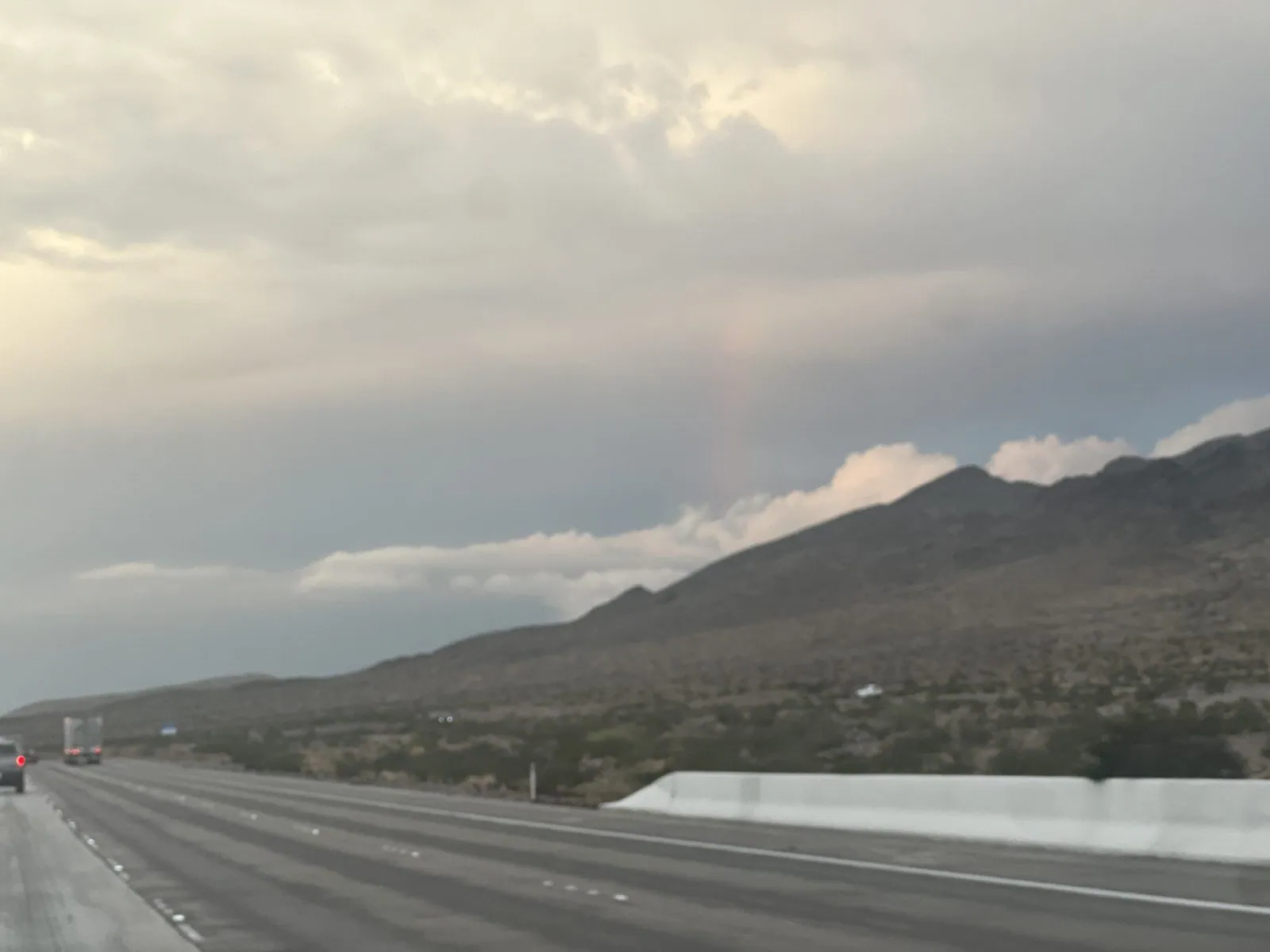
Past Jean and Sloan, the desert opens out and the freeway climbs gently toward the Las Vegas Valley. The storm was moving off to the east, and as it went it left one more piece of rainbow standing upright over the mountains: just a short stub of color, no arc, hanging above a pink-lit cloud bank on the ridge. The road ahead was wet and shining and, for the first time in hours, nearly empty.
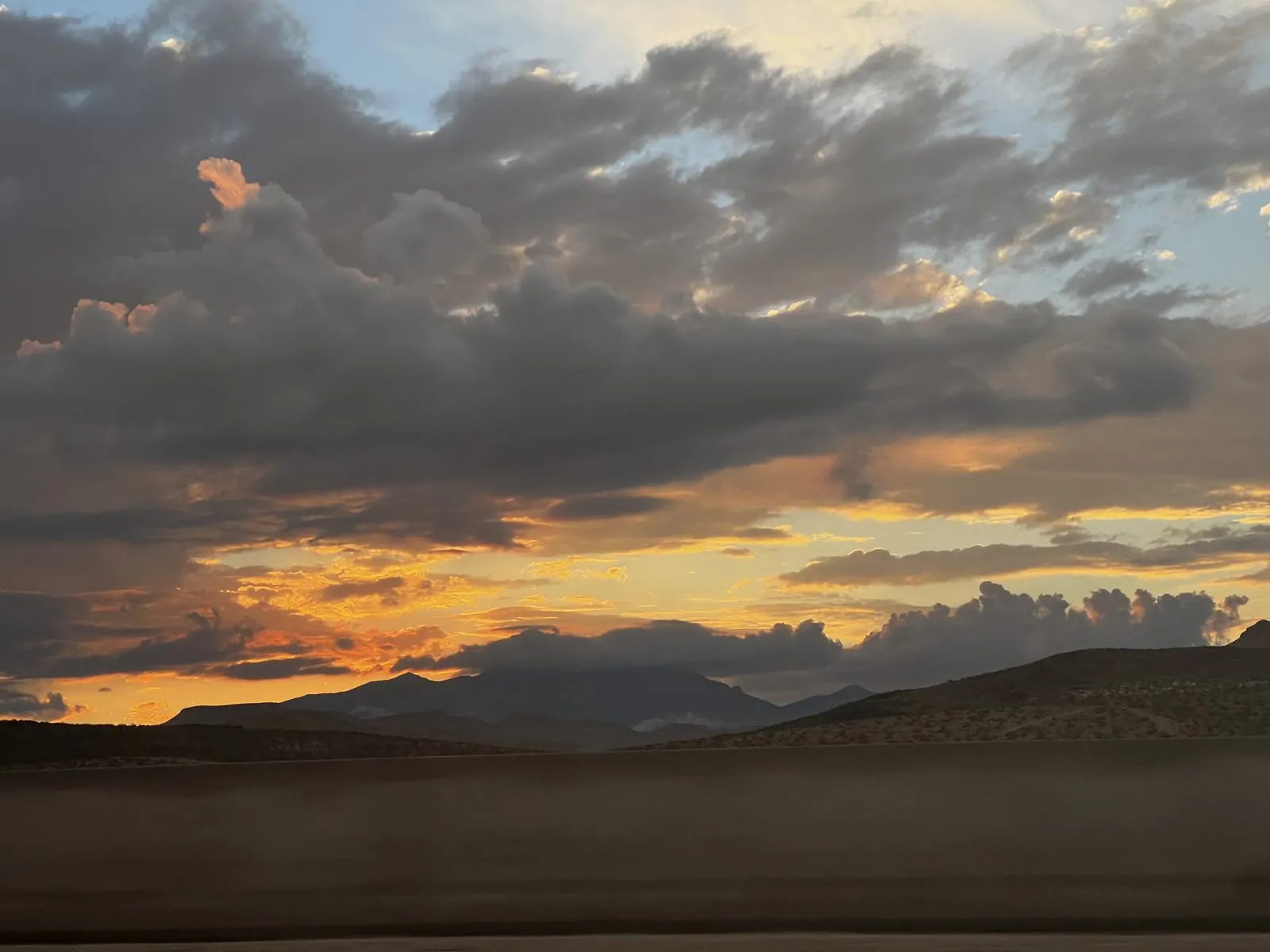
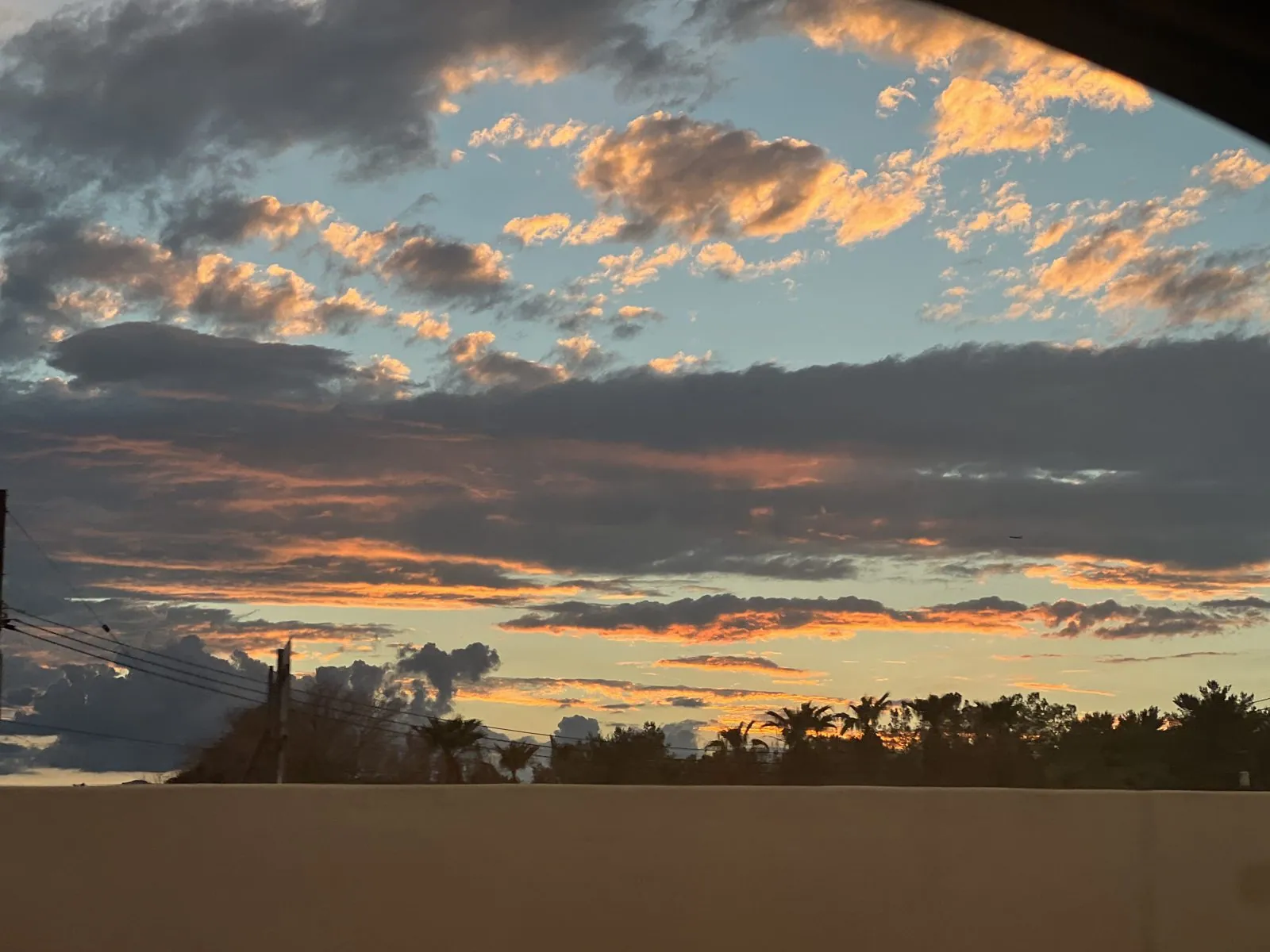
And then, as if the evening hadn't done enough, the sunset. In the last fifteen minutes before the city, the clouds broke into long ragged bands, and the sun lit their undersides orange and salmon against a sky that was still clear blue overhead. Distant peaks went black in silhouette. By the time we reached the southern edge of the valley, it was palm trees against the afterglow over the freeway wall, the clouds edged in fire. Then the first casino towers rose ahead, and Las Vegas began.
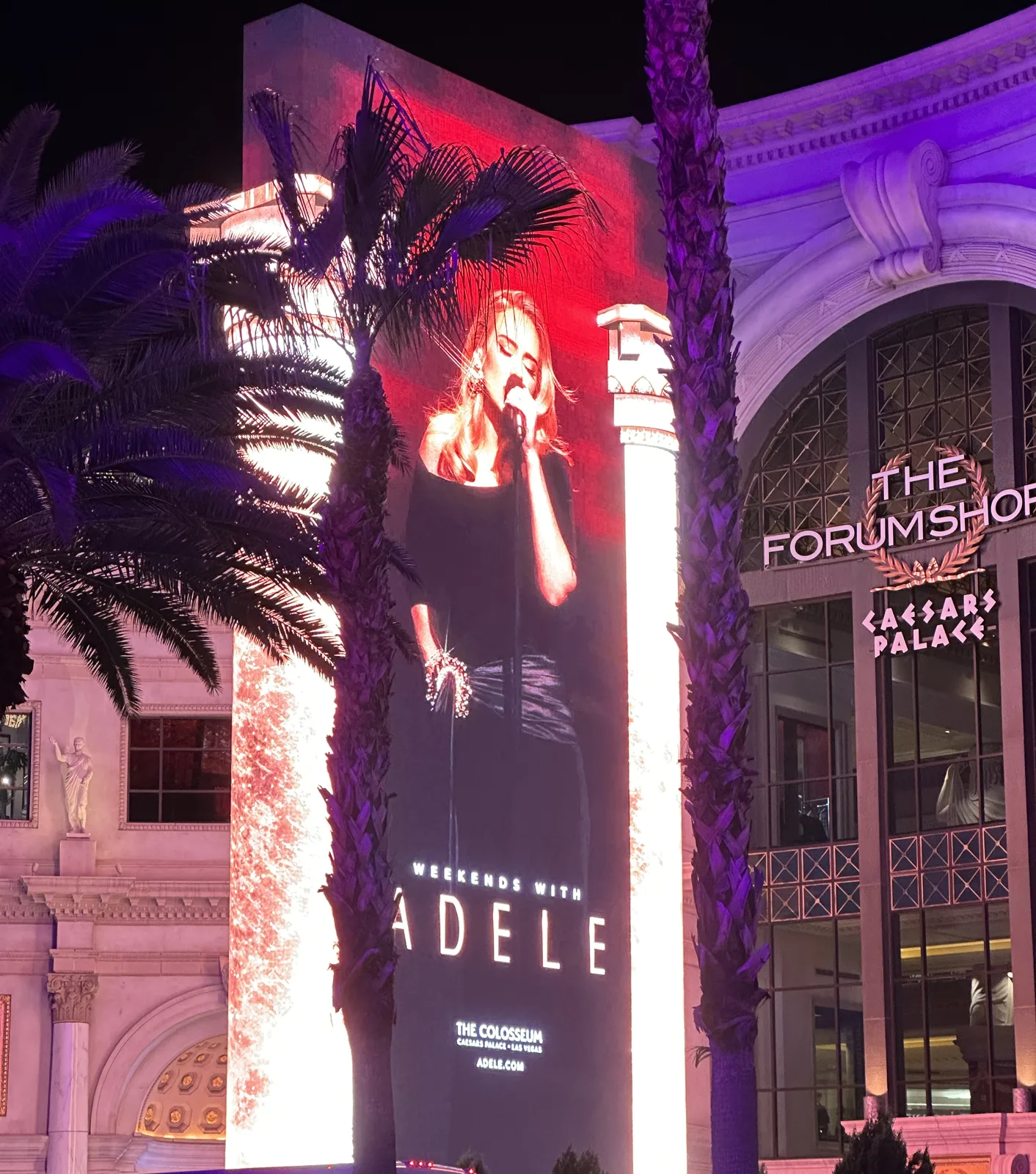
Weekends with Adele
An hour later we were in our seats in The Colosseum at Caesars Palace. The Colosseum was built in 2003 for Celine Dion, whose residency there more or less invented the modern Las Vegas residency. Instead of touring, a star stays put and the audience flies in. It seats a little over four thousand, which is huge for a theater and tiny for an Adele concert, and that is the point. Adele's residency had a rocky start. She called off the original opening in January 2022 the day before the first show, saying it wasn't ready. It finally opened in November 2022, and it would run, on and off, for two years.
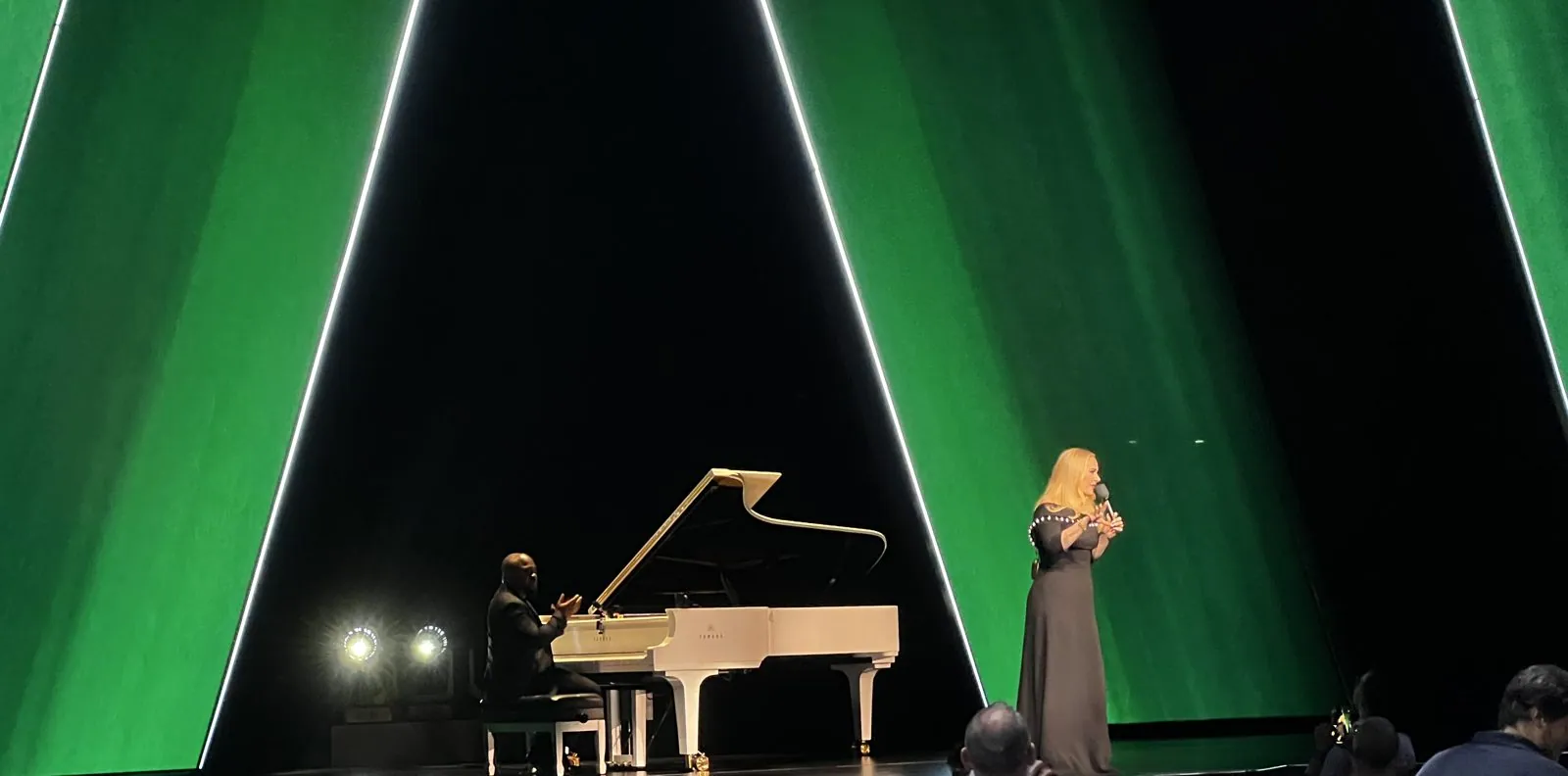
The stage at 8:25 was nearly bare: a white grand piano, a pianist, two great columns of green light leaning in toward each other like the sides of a cathedral window, and Adele, in a long black gown, microphone in hand, talking to the room. The residency was known for that as much as for the songs: long, chatty stretches between numbers, the stage kept simple so that the voice does the work.
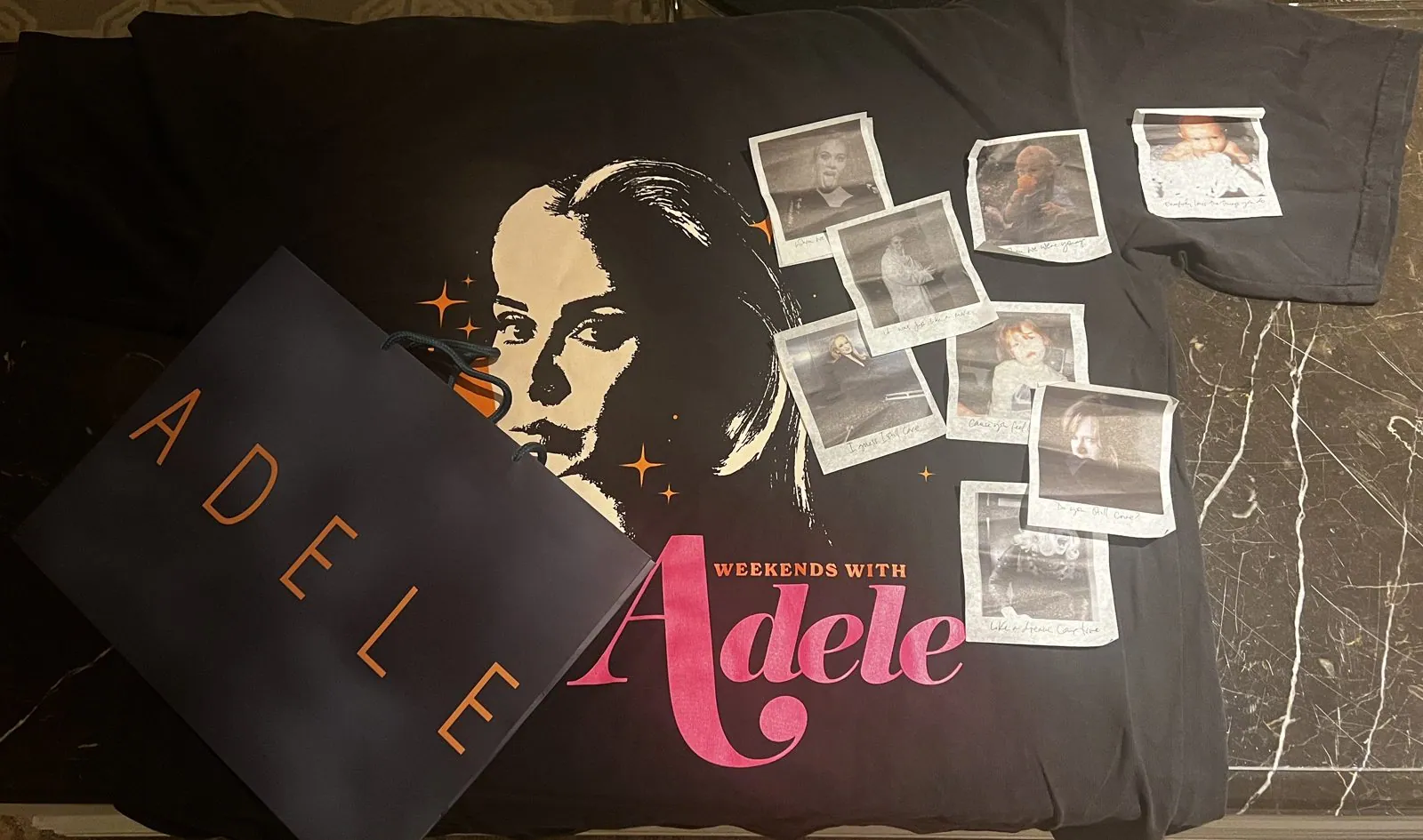
The show ran about an hour and a half. The phone recorded parts of it, and those clips are better left in the camera roll. What they show is a show built mostly on her voice, with a few big gestures: at one point columns of fire shot up along the front of the stage. The only physical souvenirs were the ones from the merchandise stand: a black Weekends with Adele T-shirt with her portrait printed in cream and orange, a navy bag with ADELE spelled out down its side, and a fan of Polaroid-style photo cards. Late that night, back in our room at the Palazzo, they were laid out in a row and photographed, as souvenirs are.
Day 2: The Strip by daylight
Las Vegas by day is a different city: hot and bright, and slightly embarrassed, like a party venue the morning after. Sunday was the day to look at it. The storm had left the sky full of big, clean cumulus clouds, and everything had the scrubbed look that desert air gets after rain.
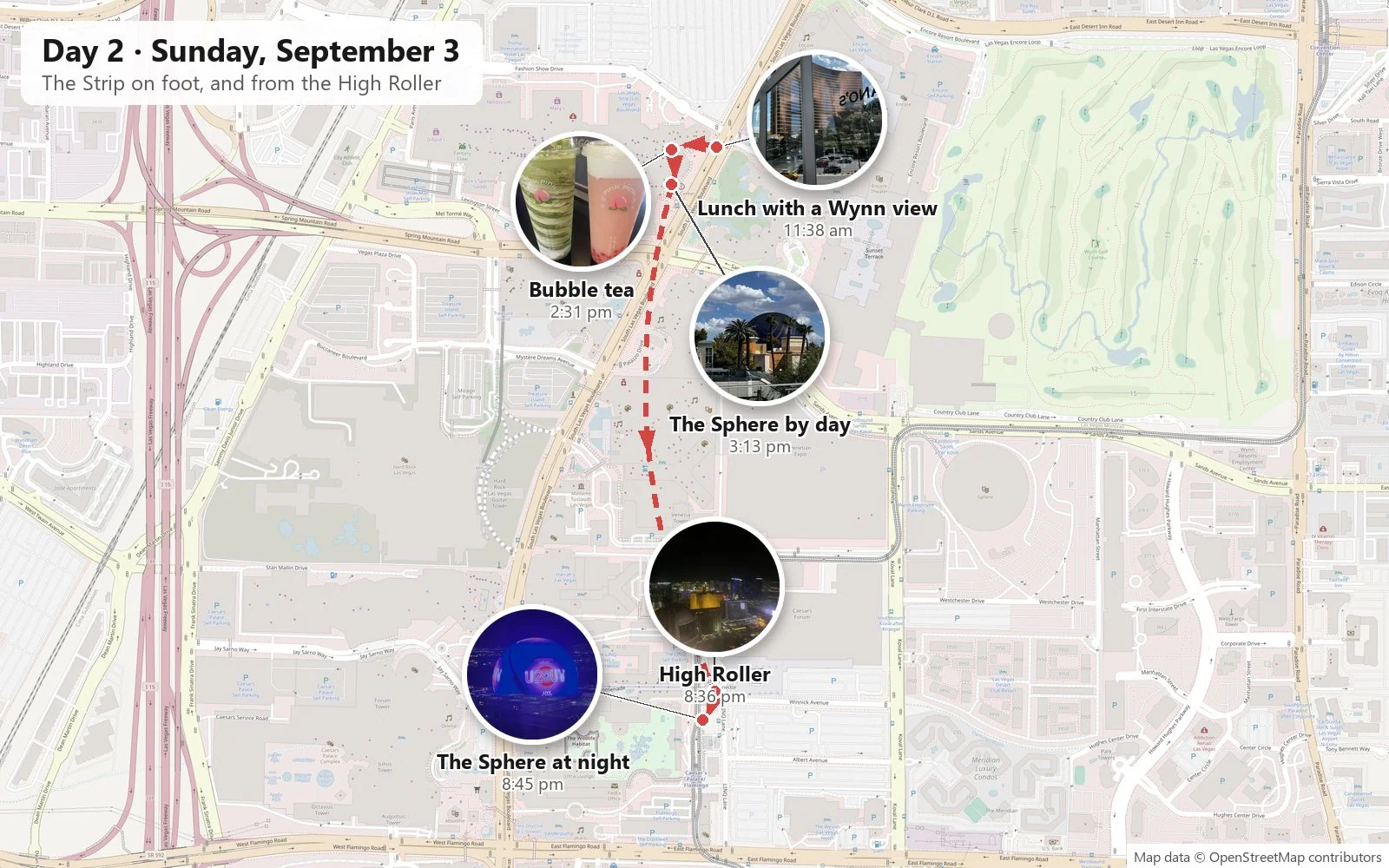
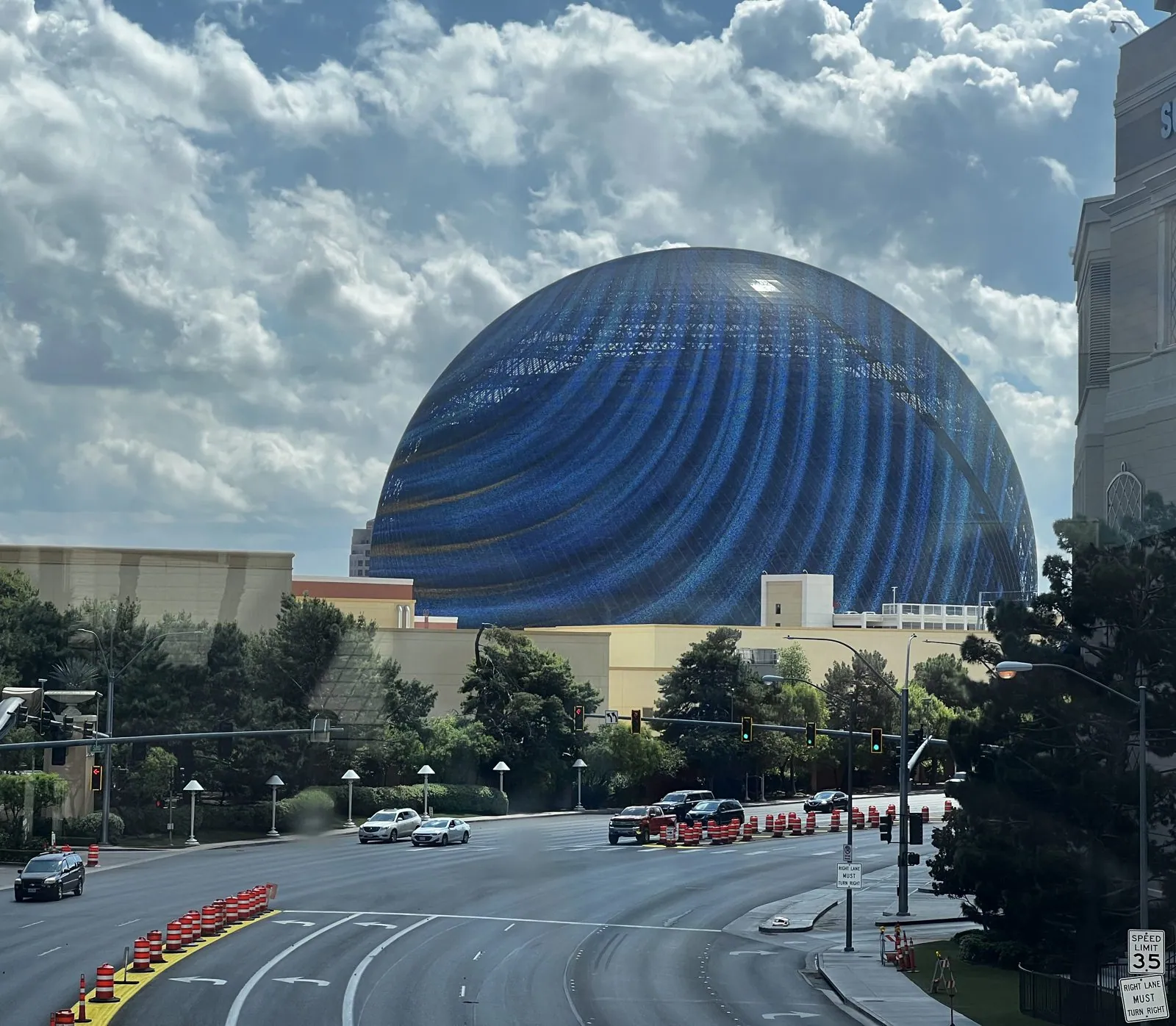
The first photo of the morning, at 11:29, is the one everybody in Las Vegas was taking that summer: the Sphere. It sits a block east of the Strip behind the Venetian, a ball 366 feet tall and 516 feet wide, and that September it was finished but not yet open. Its outer skin, which the builders call the Exosphere, is covered in about 1.2 million LED pucks, which makes it the largest video screen on Earth wrapped around the largest spherical building. It had been switched on that July 4th, and for two months it had been showing off: an eyeball, a basketball, the moon. That morning, seen over the cones and new paving on Sands Avenue, it was wearing deep blue stripes that curved around it like the seams of a beach ball.
Lunch with a view of the Wynn
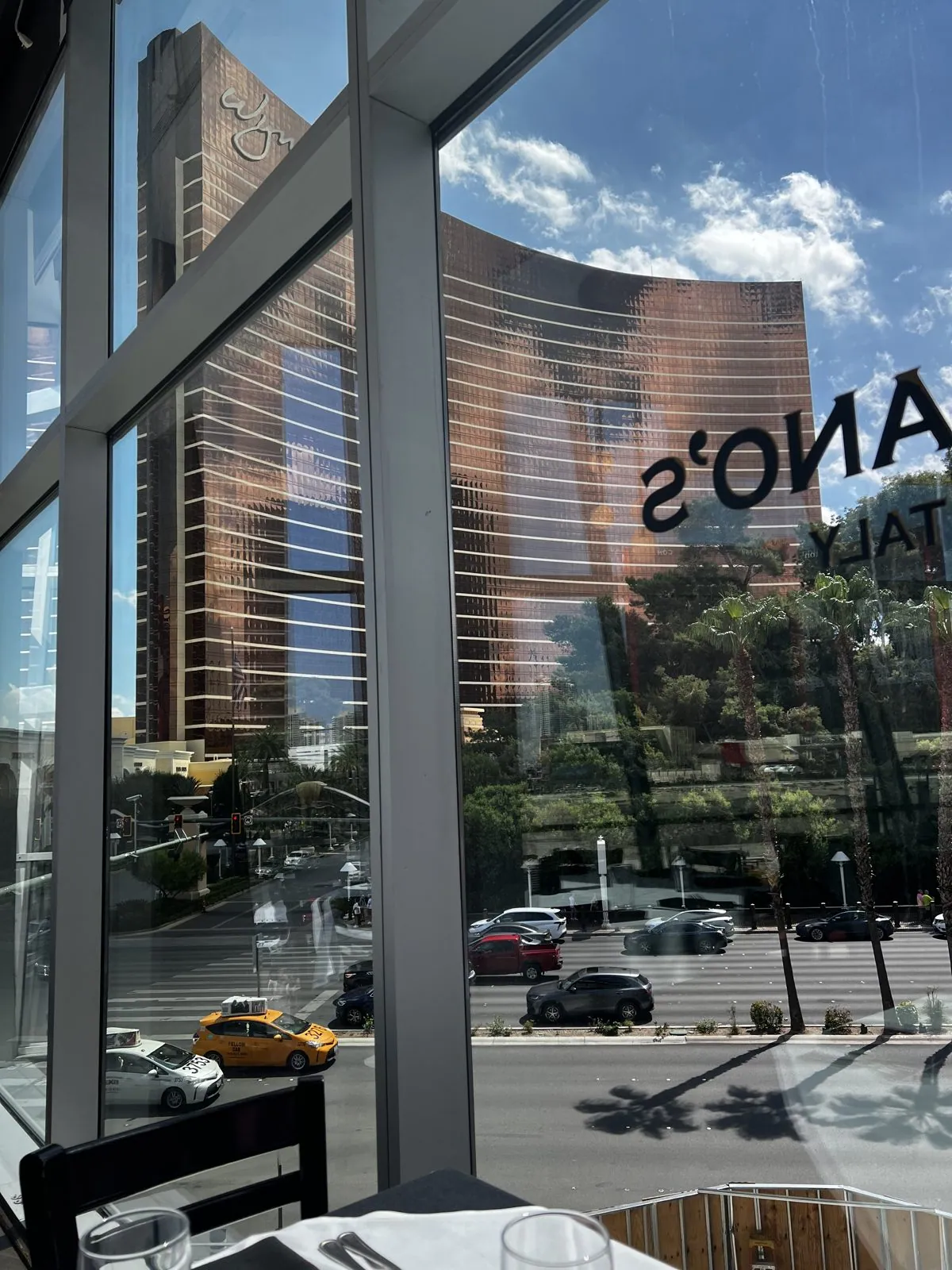
Lunch was at Maggiano's, one floor up in the Fashion Show mall, with a wall of glass looking straight across Las Vegas Boulevard at the Wynn. The Wynn tower, opened in 2005, is a single fifty-story curve clad in bronze glass, and at noon it glows a coppery brown that changes with every cloud. The restaurant's name was lettered on the window, so from inside it reads backwards across the view.
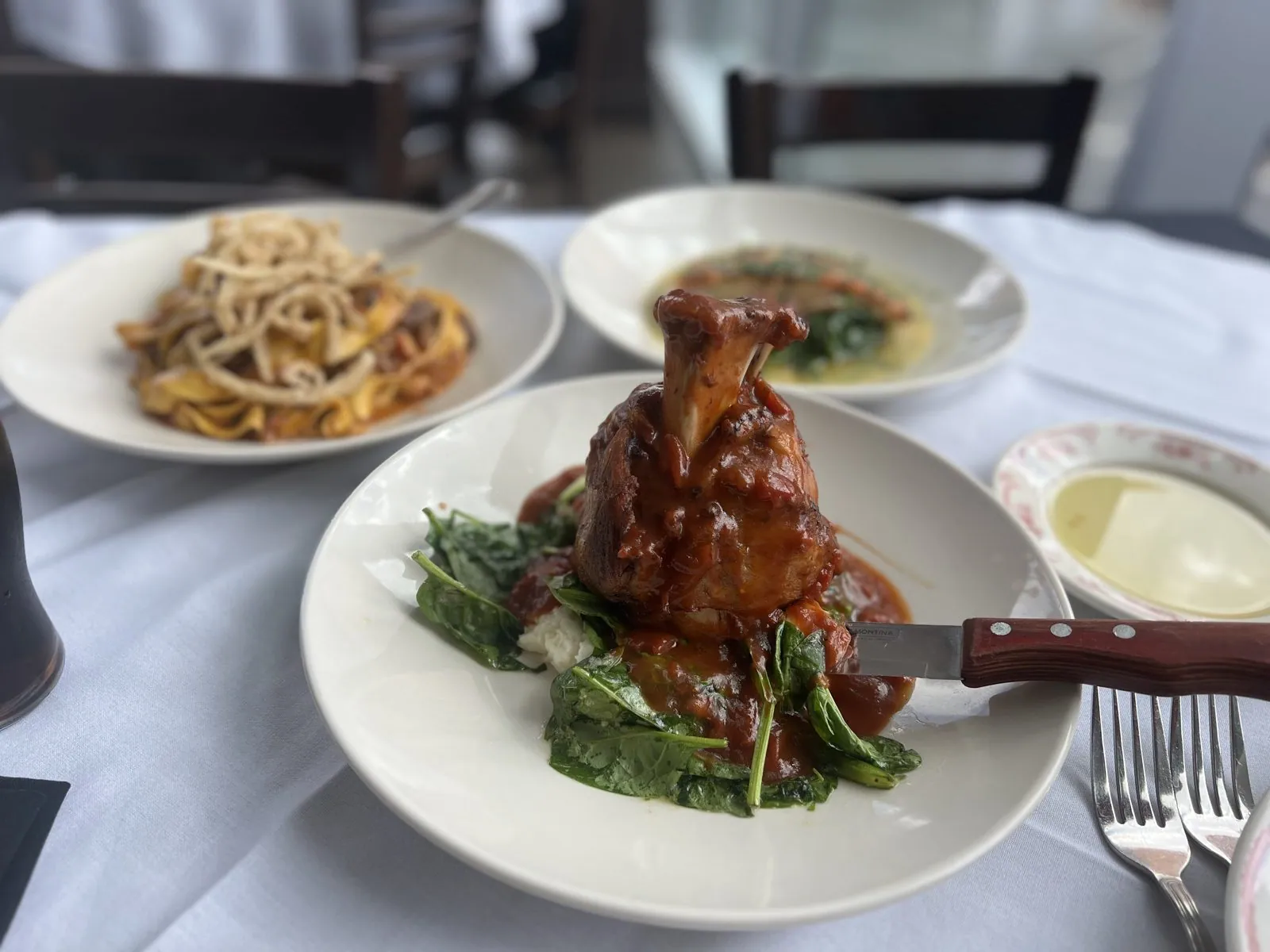
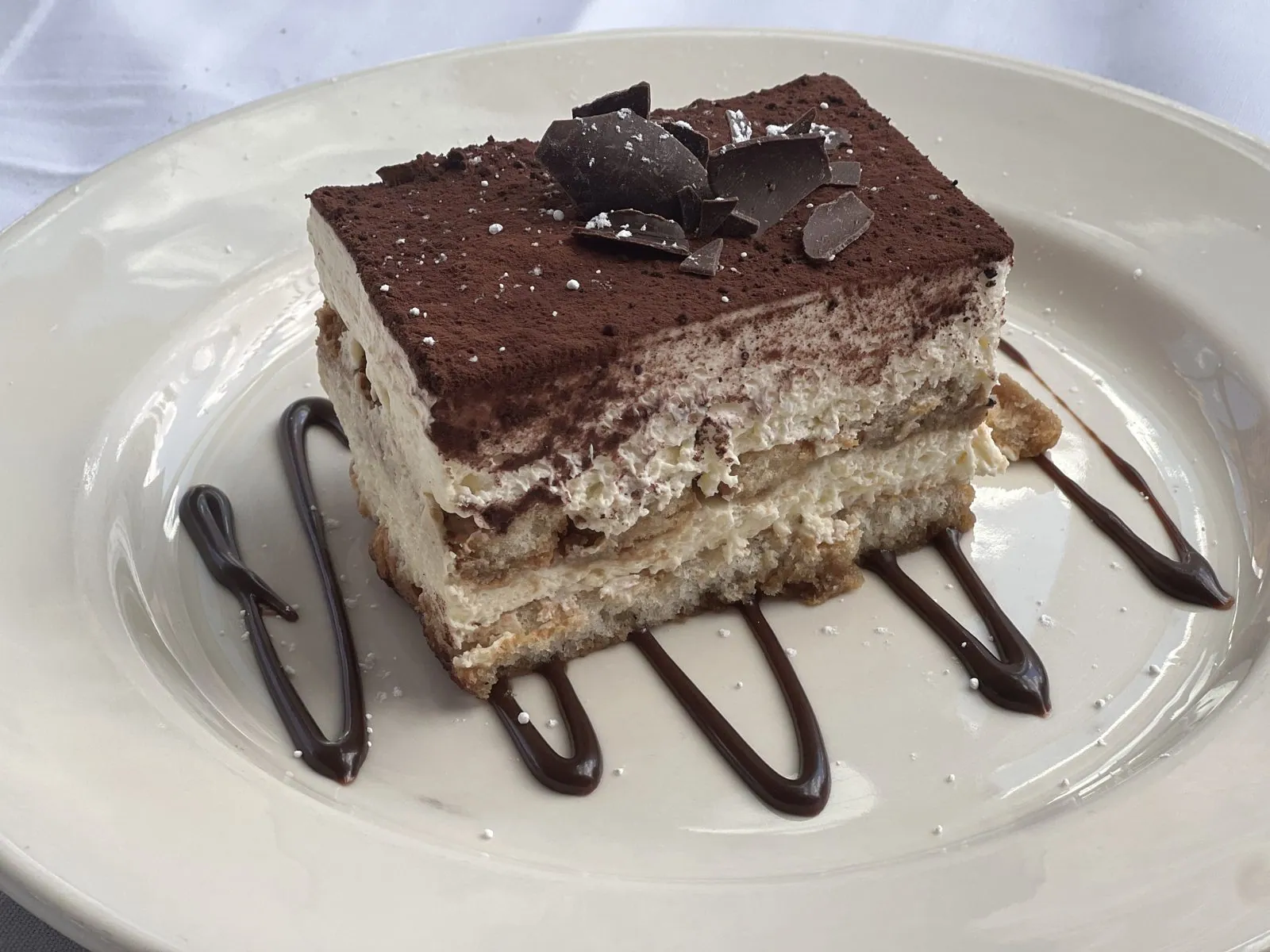
The food deserves its own paragraph. On the table: a braised shank standing upright on its bone in a dark, glossy sauce over a bed of spinach and mashed potatoes, a plate of pasta under a nest of crispy fried onions, and a third dish in a golden broth. The meal ended, as it should in an Italian restaurant, with tiramisu: a neat block of cocoa-dusted layers, shards of dark chocolate on top, and a zigzag of chocolate sauce across the plate.
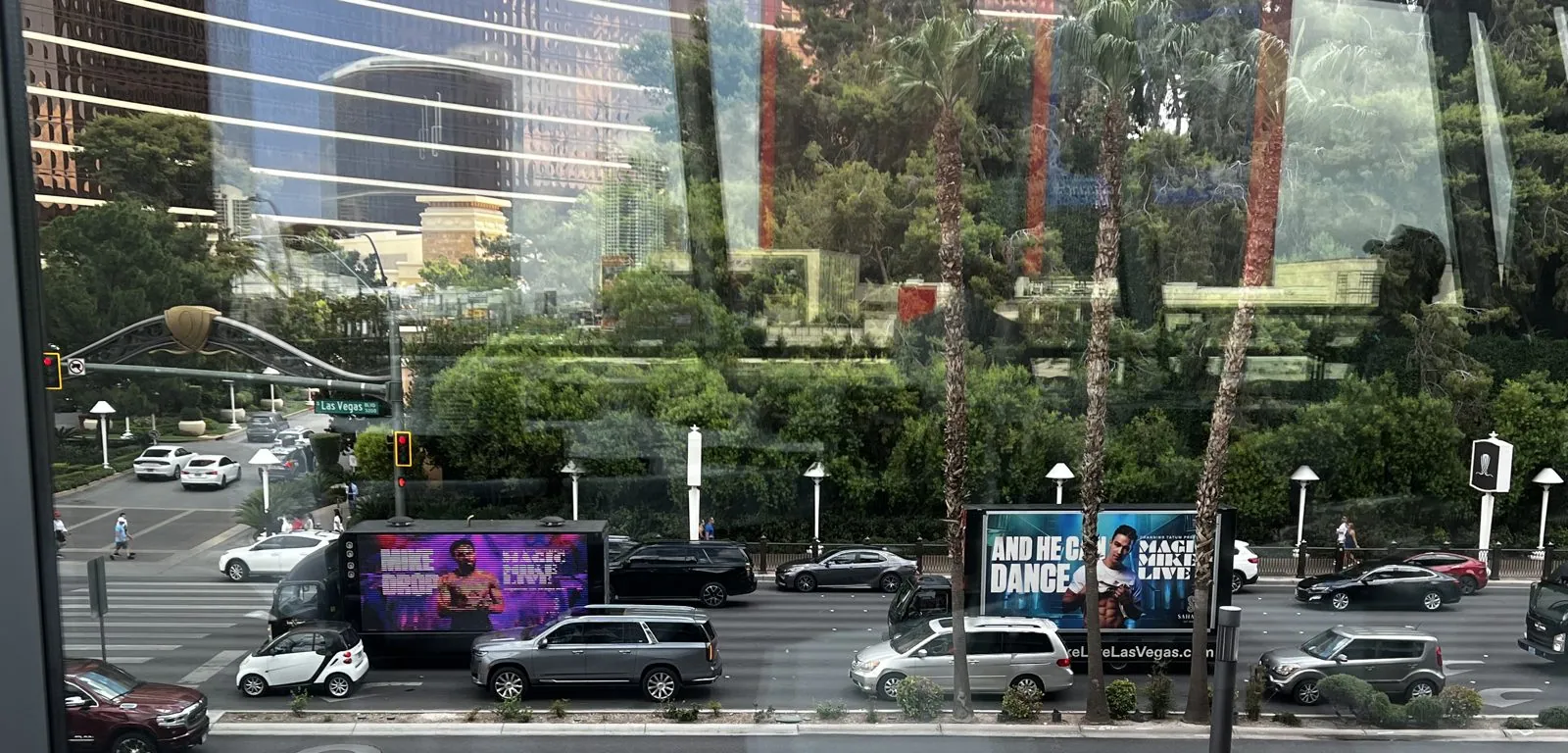
Below the window, the boulevard was its usual self. Las Vegas has a peculiar form of advertising: trucks whose whole side is a glowing billboard, which do nothing all day but drive slowly up and down the Strip. Two of them rolled past in the noon traffic, both selling the same show, both featuring a gentleman who had misplaced his shirt. Across the street, the Wynn's gardens and palms looked cool and green, which in a Las Vegas September is an illusion.
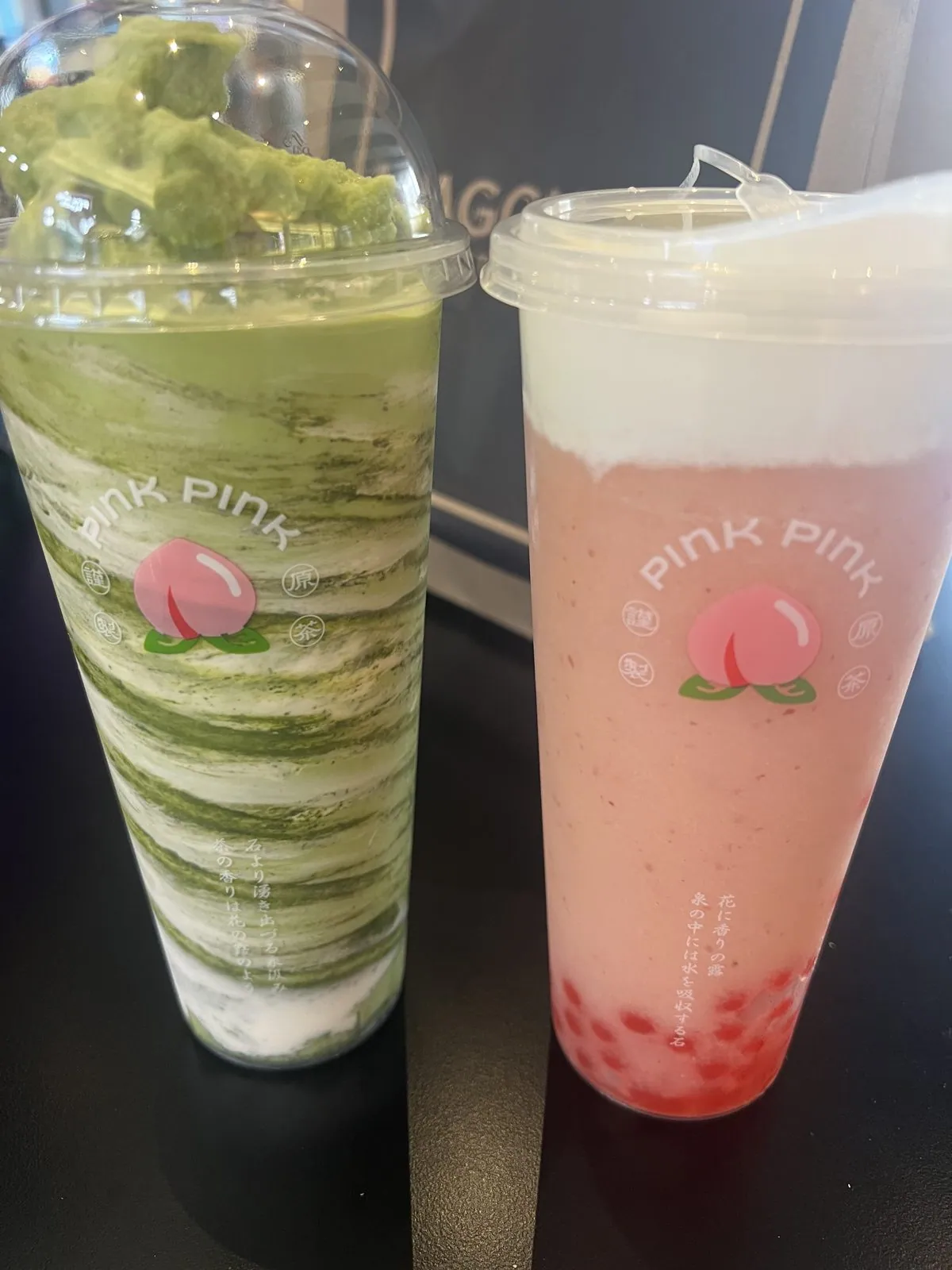
The afternoon was slow. In mid-afternoon came a bubble-tea break, in the tall clear cups of a shop called Pink Pink: a matcha drink swirled green and white in stripes, under a cap of matcha cream, and a strawberry drink with a white foam top and red popping pearls at the bottom.
The Sphere, again
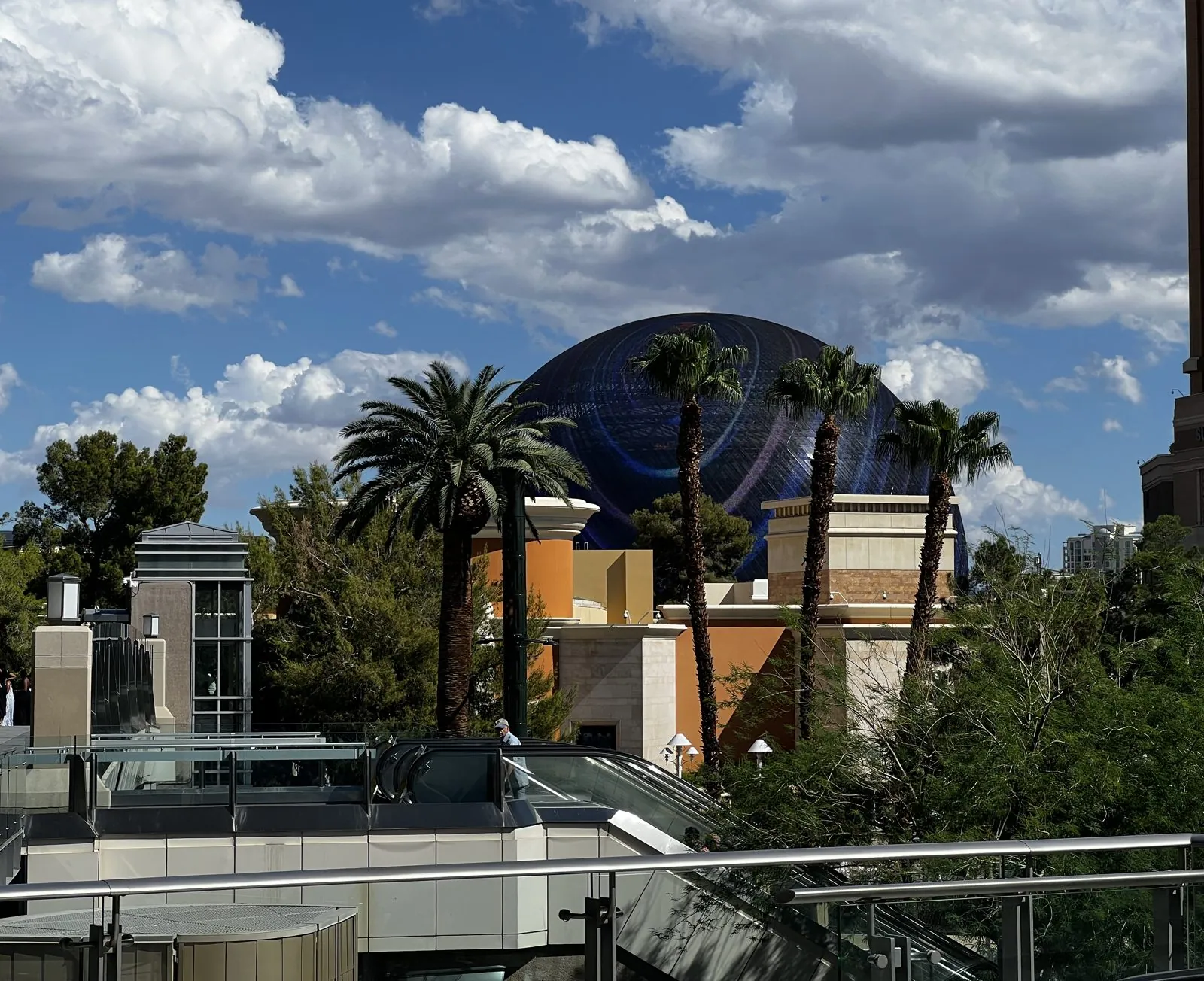
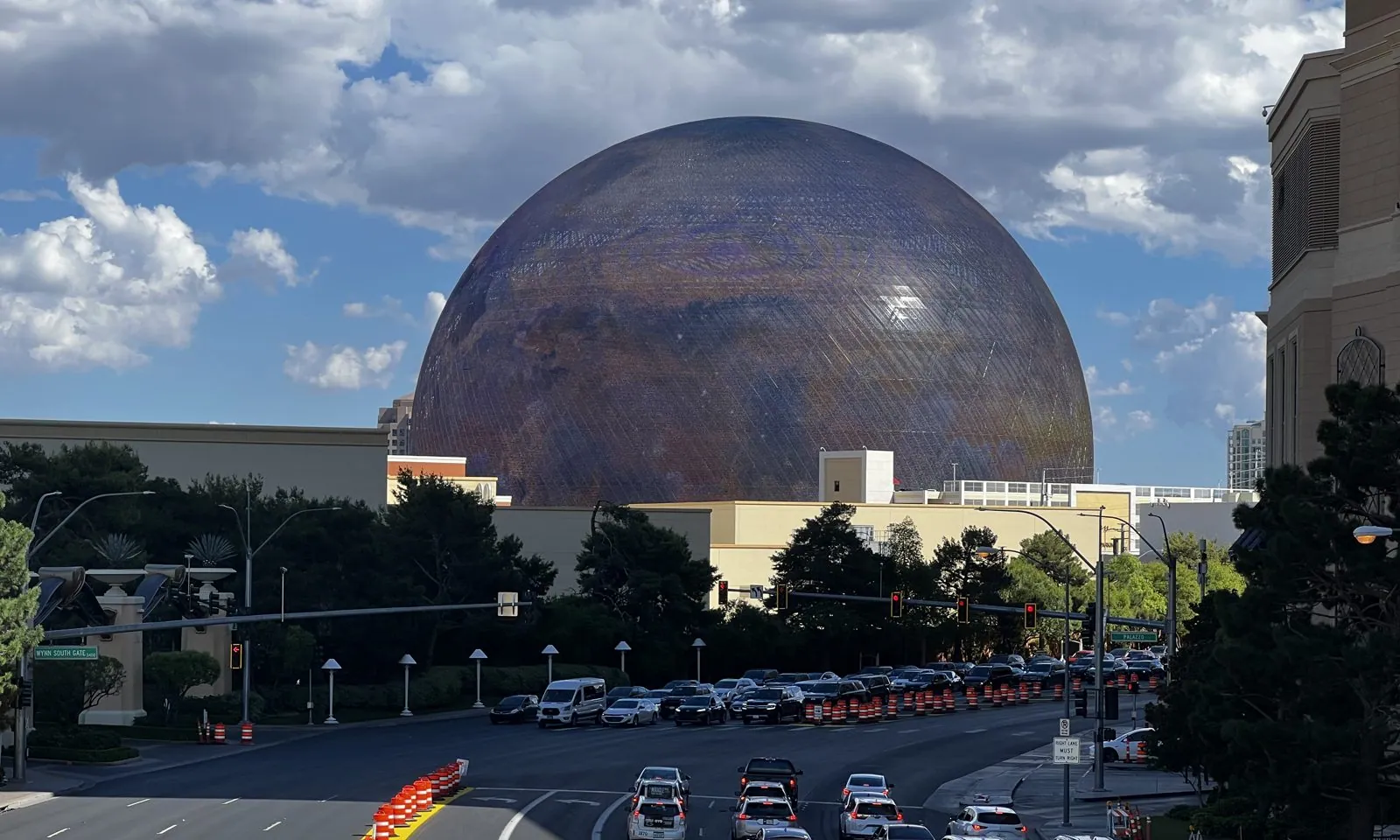
The Strip's north end is linked by pedestrian bridges, so walking it means climbing escalators, crossing above the traffic and coming back down. From the bridges at a quarter past three, the Sphere kept appearing between things: behind a row of palms and the sandstone walls of the Venetian's shops, and then, from a bridge over the road, whole. It had changed its skin since the morning. Now it was a planet, mottled purple, rust and brown like a gas giant, with the diamond grid of the LED panels showing faintly through. Below it, the traffic waited in a long line of orange construction barrels. It is hard to describe how odd the Sphere looks in person. It is far too big to be a ball and far too round to be a building, and your eyes keep trying to fix the scale and failing.
The photos go quiet for the next few hours, and I'll leave those hours alone. Sunday evening went up in the air and then down into a theater.
Thirty minutes on the High Roller
At 550 feet, the High Roller at the LINQ was the tallest observation wheel in the world from its opening in 2014 until Dubai built a taller one in 2021. It turns so slowly you can't see it move. A single revolution takes about half an hour, and the cabins never stop; you step aboard while it creeps past the platform. Each of its 28 cabins is a glass capsule big enough for a few dozen people, air-conditioned and fitted with screens. The first clip from our cabin is from 8:22, as it started climbing out of the LINQ's lights into the dark.
From the top, the Strip turns out to be a much smaller and much brighter thing than it seems from the ground. To the north, the Venetian's long gold façade was lit up like a stage set, with the red sign of Harrah's below and the dark grid of the city running out to the mountains, a sheet of tiny lights. The window glass, the cabin lights and the long exposures of a phone at night all argued with each other. Most of the photos show some reflection, a glow, a smear of light, but they are honest.
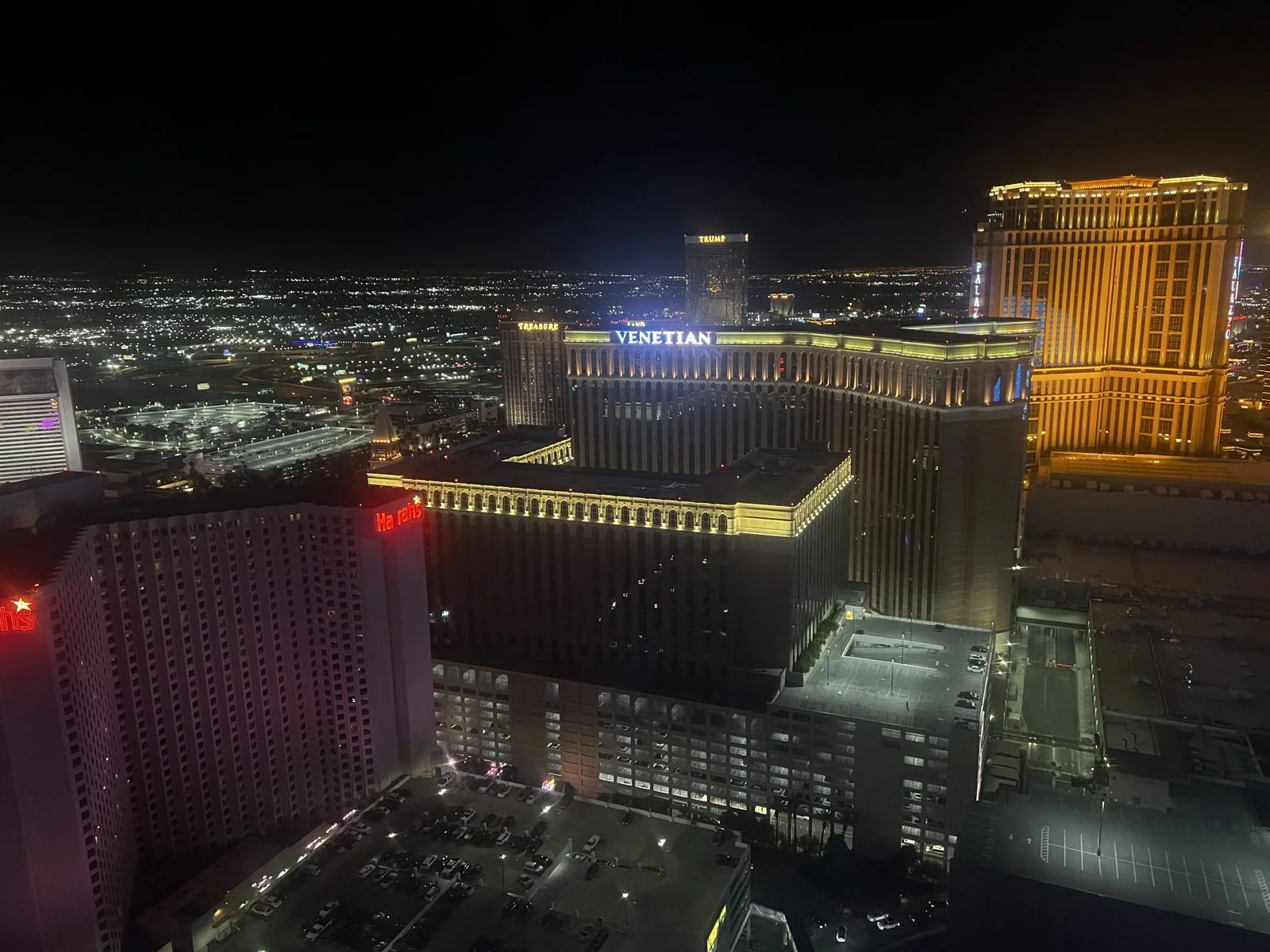
Looking south, the view was the Strip proper. In the foreground, the next cabin hung in the air like a glass Christmas ornament. Below it were the pink neon flamingo of the Flamingo and a gold-lit block of hotel towers along the boulevard, with the blue-lit glass of the Cosmopolitan beyond. From this height the whole glittering thing looked like a model of itself.
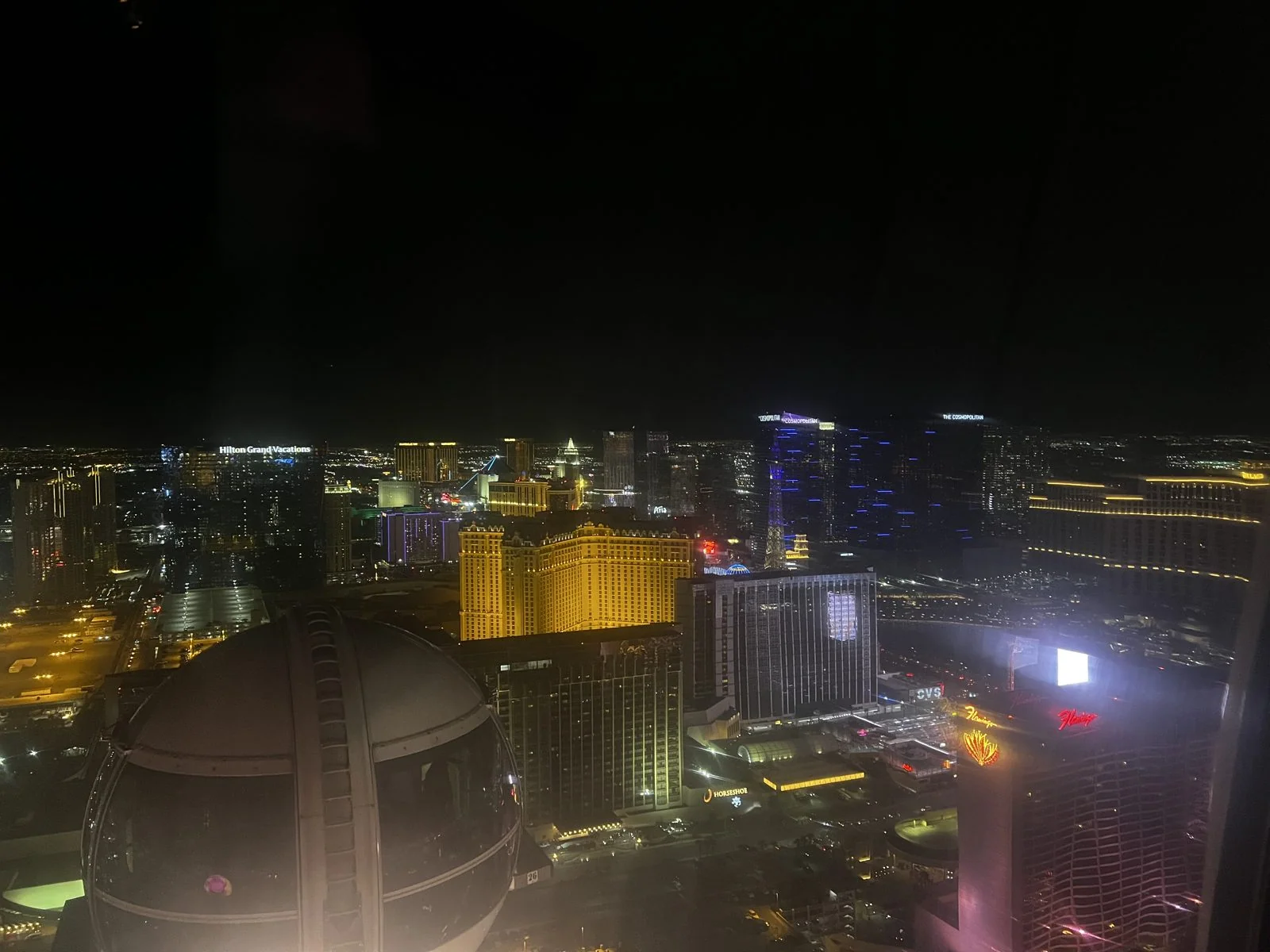
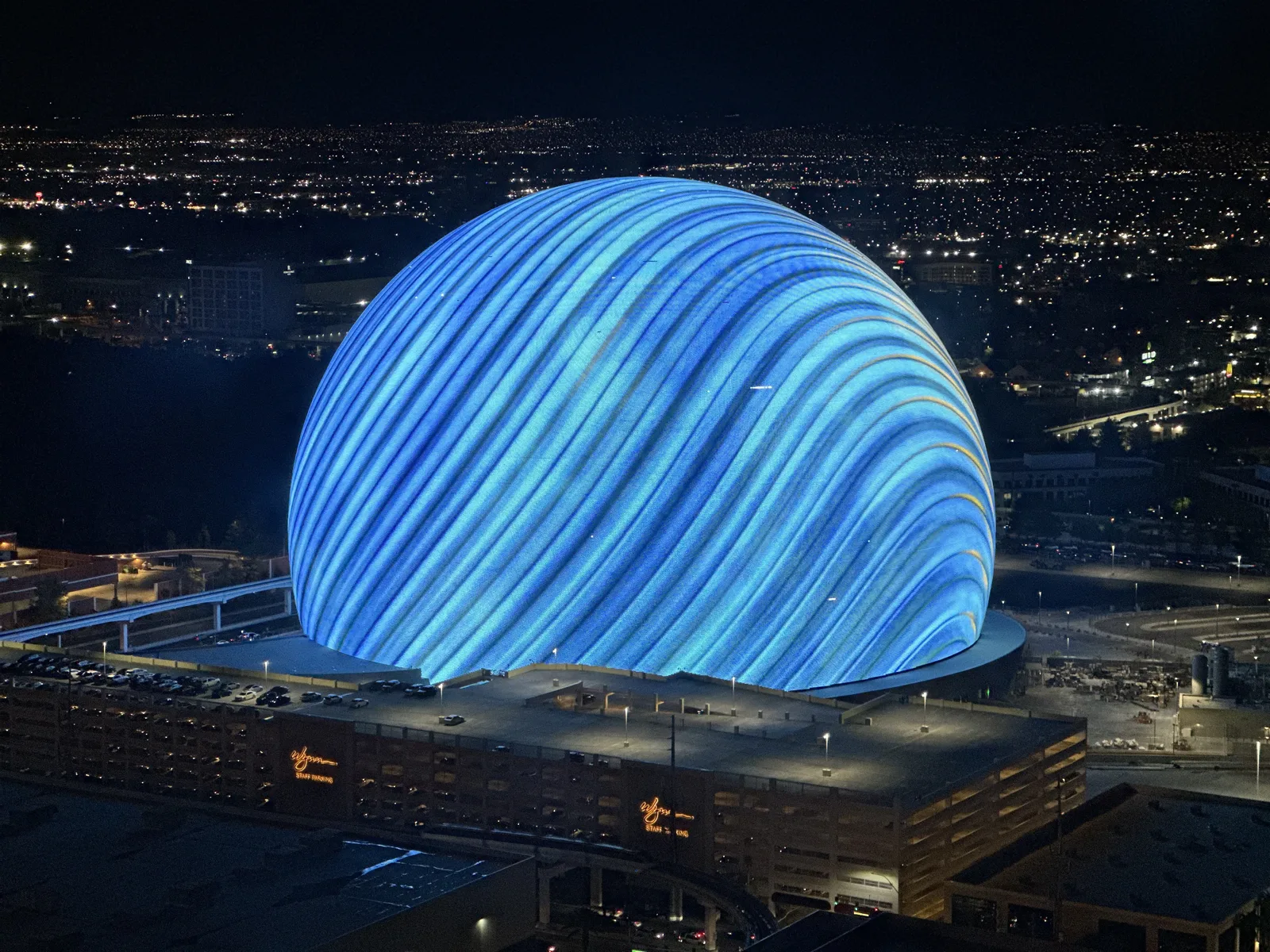
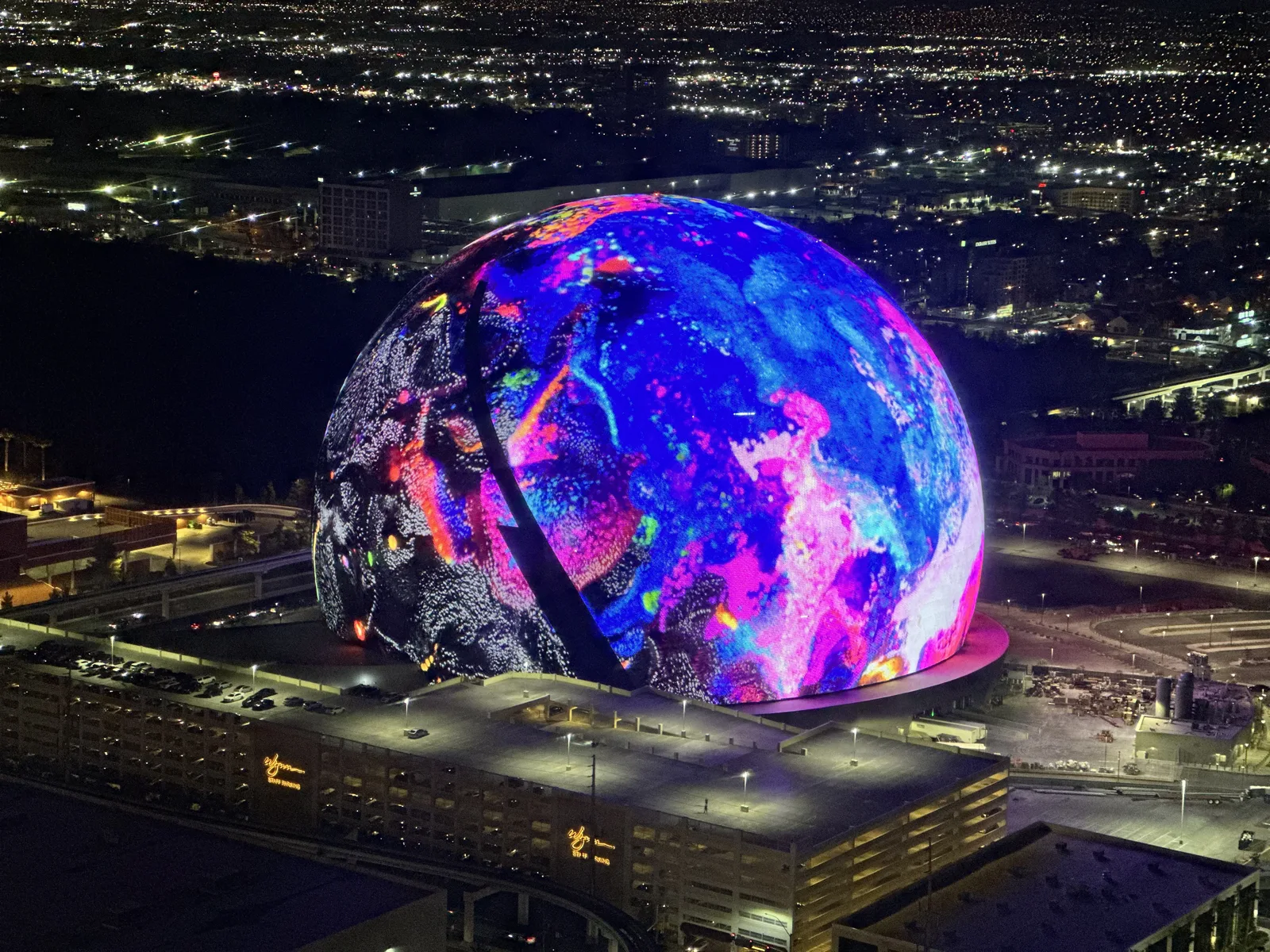
The best surprise of the ride was to the east, where the Sphere kept changing its skin. At 8:29 it was blue, wrapped in curving white stripes; five minutes later it was a swirl of pink, blue and violet.
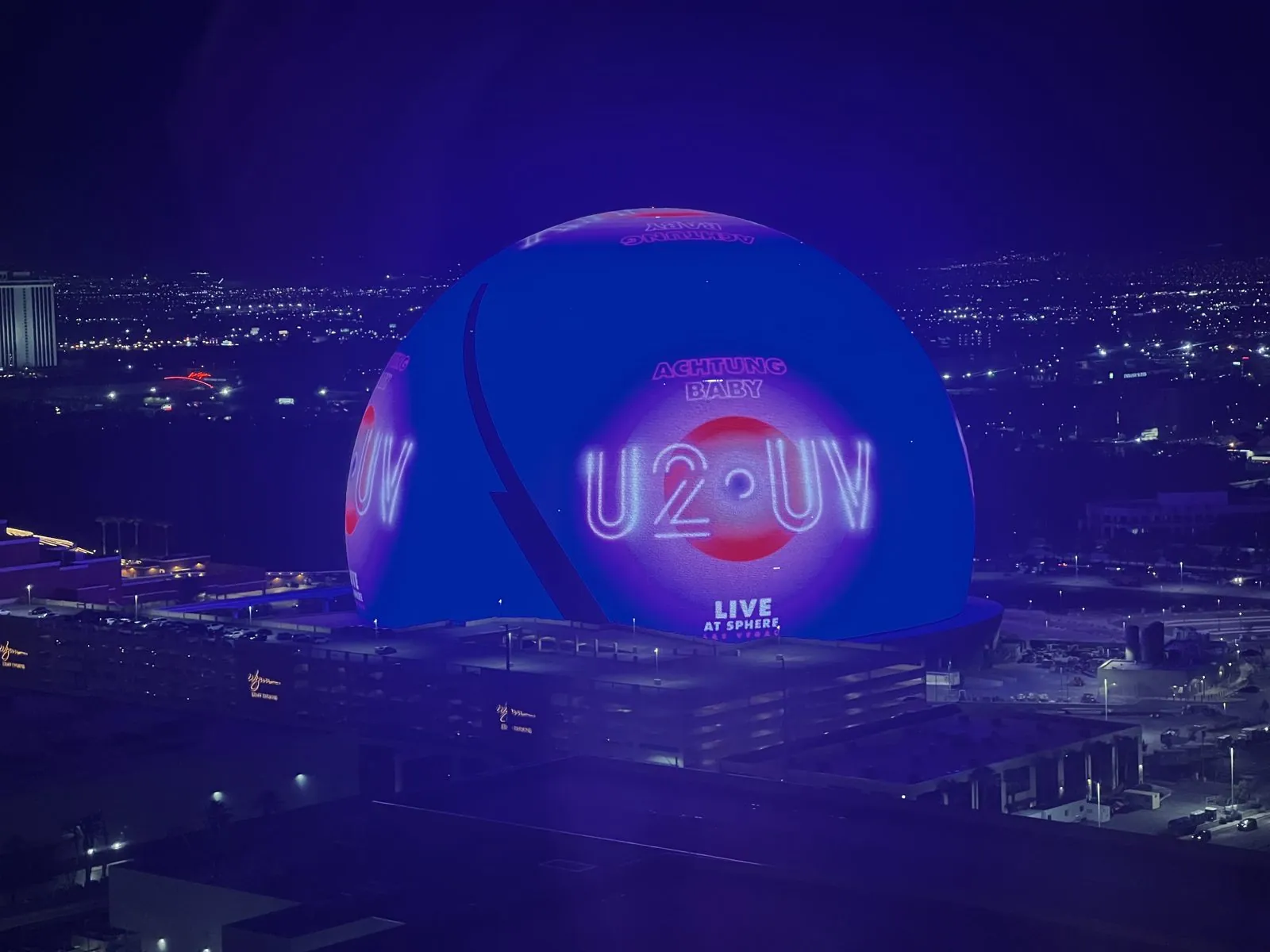
At 8:45, near the top, the Sphere had stopped pretending to be a planet and was advertising its opening act: U2:UV, Achtung Baby live at Sphere. In a field of deep blue, a red-and-white target, the band's name in glowing neon letters and the word LIVE, the whole thing lighting up the dark blocks around it like a second moon. Four weeks later, on September 29th, U2 would open the building. That night, though, it was just a giant ball of light talking to the sky.
KÀ
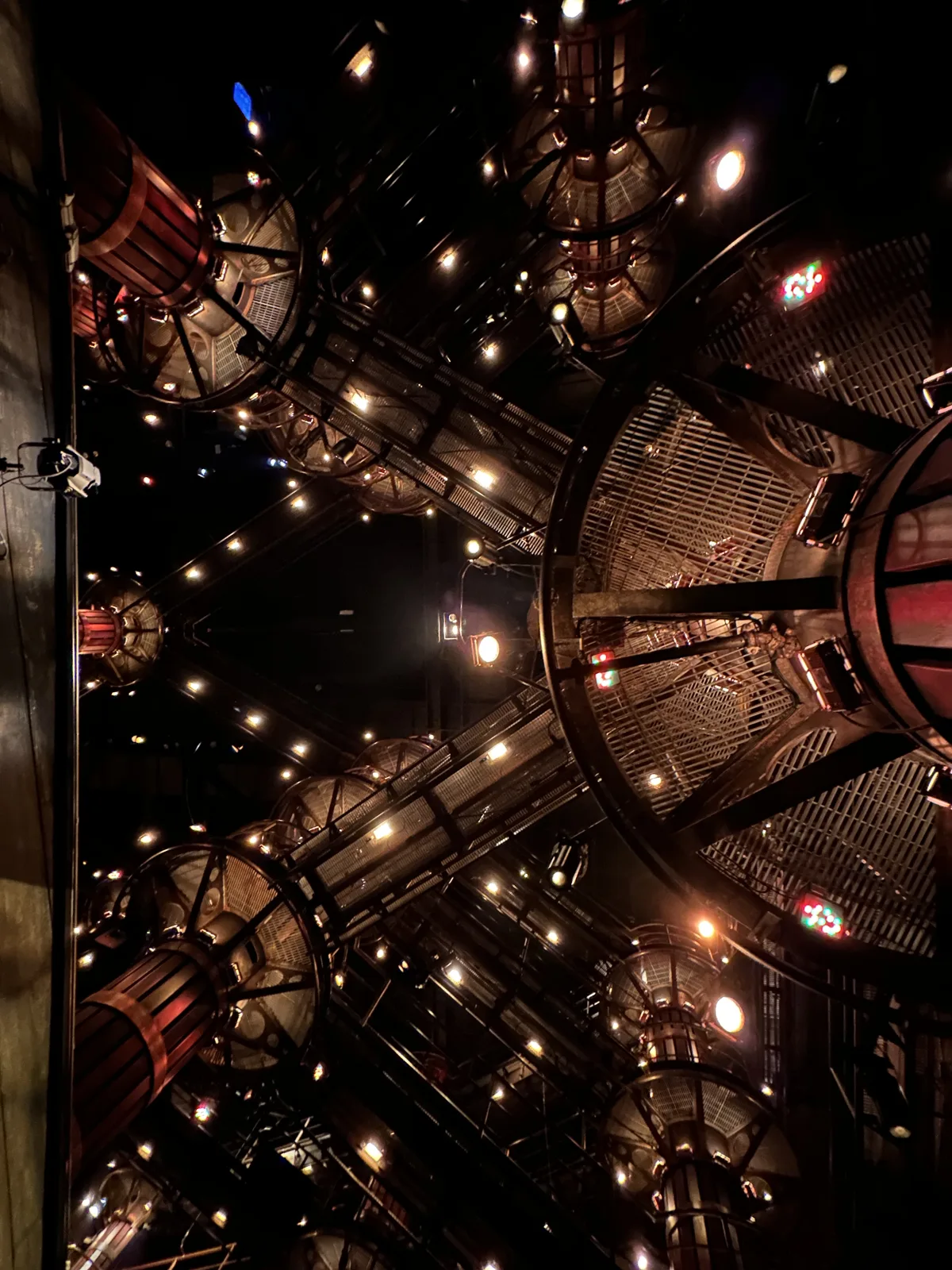
From the wheel it was a short hop down the Strip to the MGM Grand, for the second show of the weekend: KÀ, Cirque du Soleil's resident show there since 2005. Most Cirque shows are acrobatics strung on a loose dream. KÀ tells an actual story, of twins separated and fighting their way back to each other, and it is famous less for any one act than for its stage. There isn't a floor in the usual sense. There is a pit, and above it a huge deck on a robotic arm that rises, spins and tilts until it is nearly vertical, while the performers keep fighting, climbing and falling across it as if gravity had been turned sideways. After Adele's piano and two beams of light the night before, it was the opposite idea of a show: all machine, no microphone.
We were in the theater by half past nine, under a ceiling of dark steel rings and gantries, and the show ended a little before eleven with the whole cast lined up along the edge of the pit.
Day 3: Floodwater, and the end of the alphabet
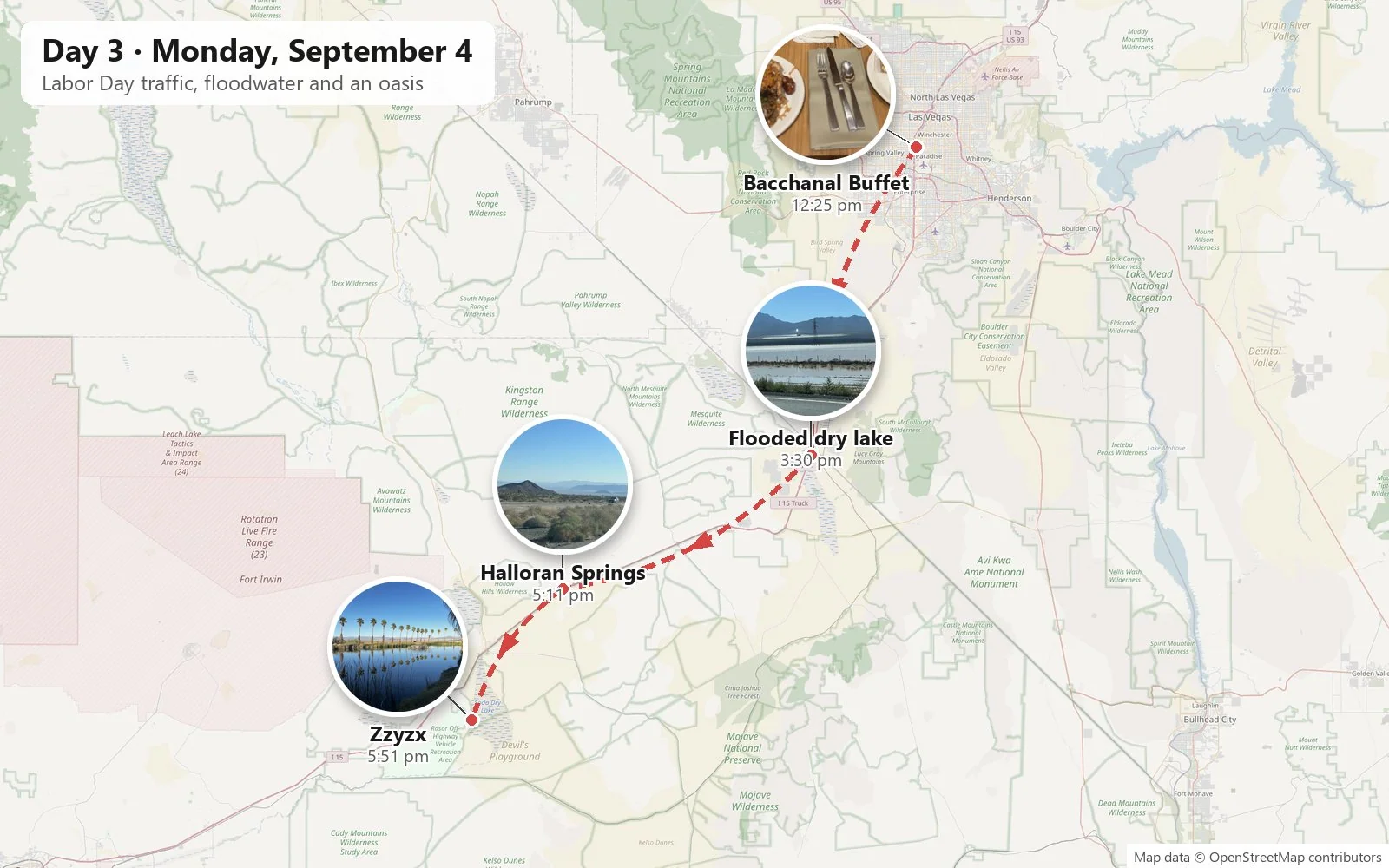
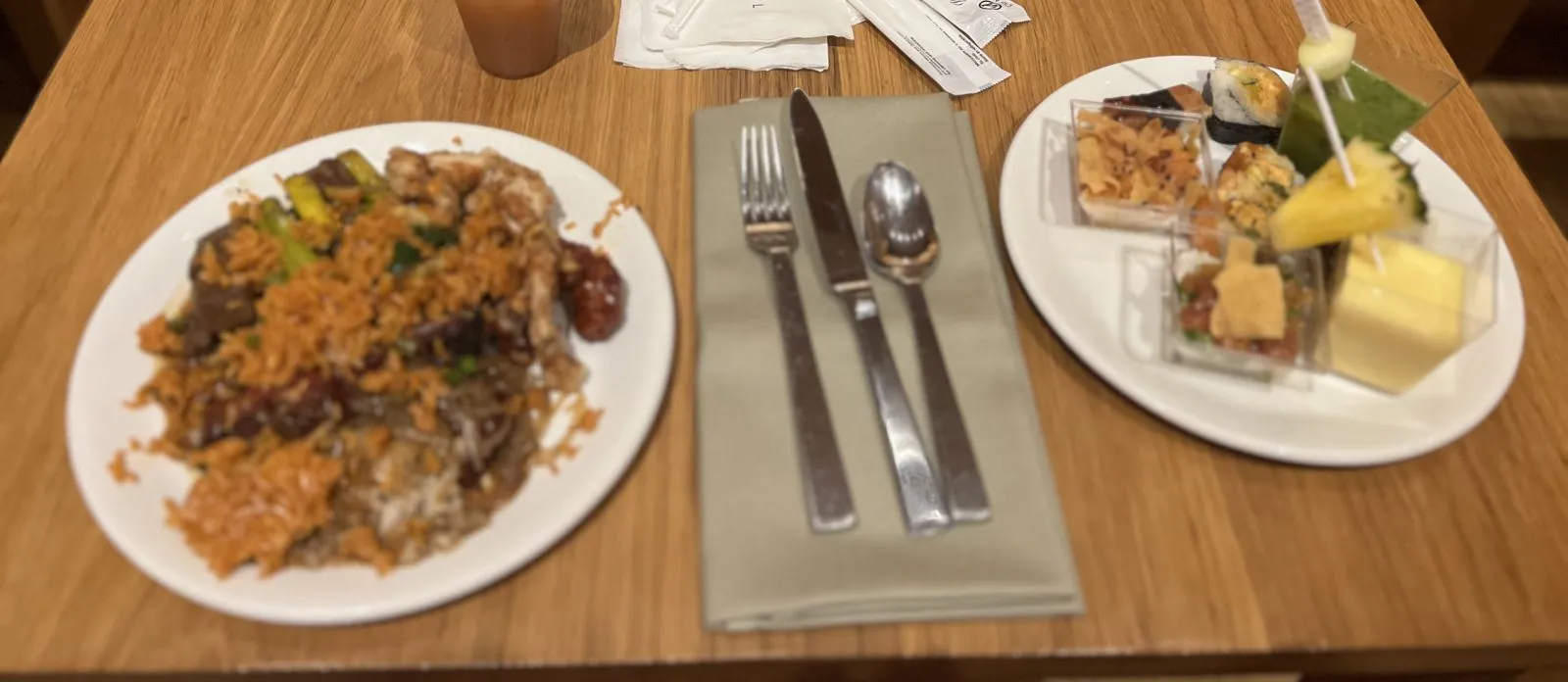
Monday was Labor Day, and on Labor Day everybody leaves Las Vegas at once. We started with the most Las Vegas meal there is: lunch at the Bacchanal Buffet at Caesars Palace, where plates go back to the stations as often as you like. The camera roll records one round: on one plate, carved meats and fried rice, and on the other, a small sampler of tiny dishes in glass cubes, sushi, wedges of pineapple and melon.
A lake in the desert
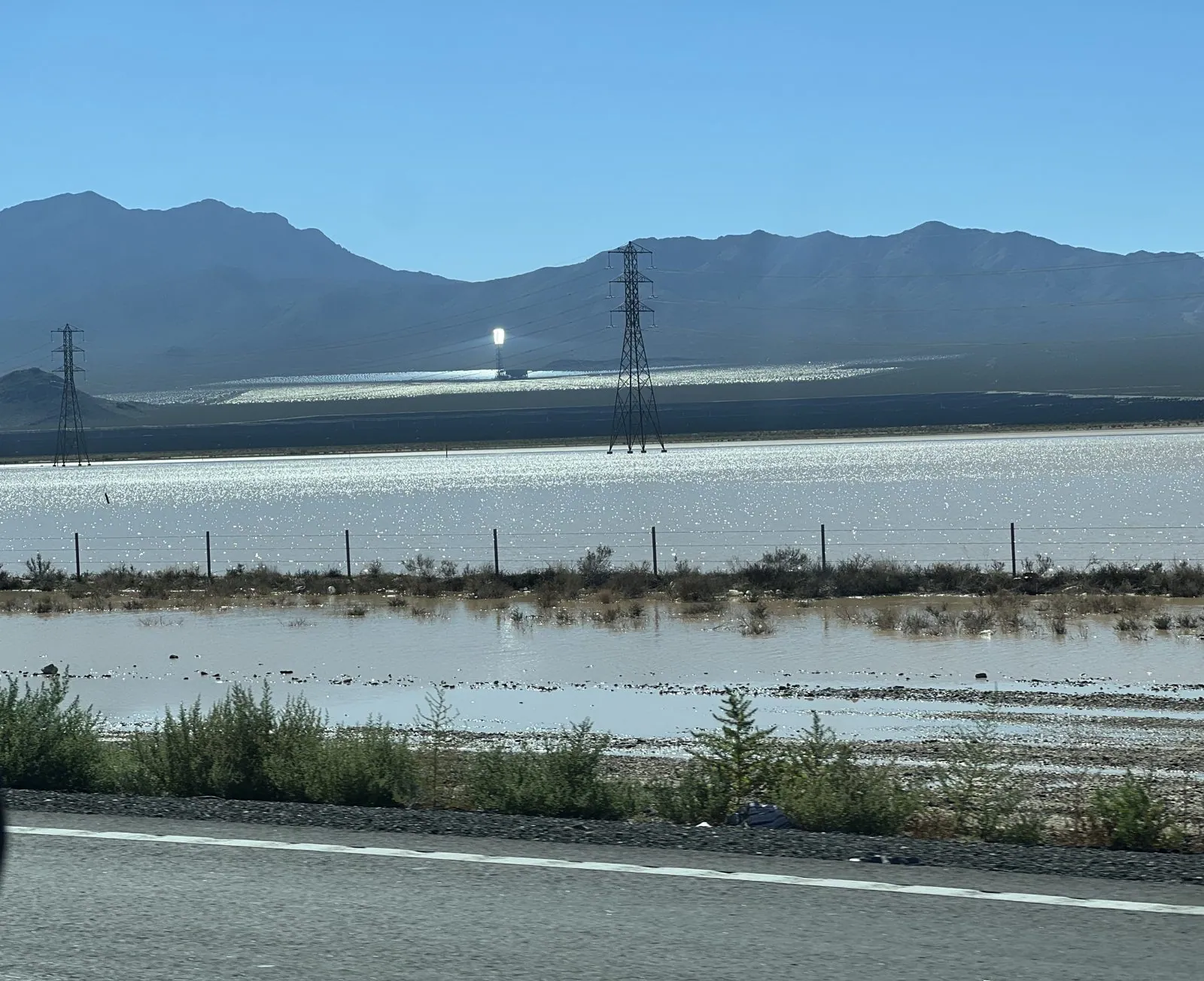
By 3:30 we were back at the state line, just into California, and the desert had changed since Saturday. Beside the freeway lies Ivanpah Dry Lake, a flat bed of baked clay that is dry nearly every day of the year. It wasn't dry now. Late summer 2023 had been wild out here: Tropical Storm Hilary had soaked the Mojave two weeks earlier, and the storms we had driven through on Saturday added more. The lakebed was a sheet of shining water from the shoulder to the mountains, with a fence line and the tops of the bushes poking through, and an orange traffic cone standing in the shallows like it had been posted there on purpose.
Beyond the water, past the high-voltage towers, a point of white light burned on the slope as if a star had landed there. That is the Ivanpah Solar Electric Generating System, opened in 2014: three towers about 450 feet tall, each surrounded by a field of tens of thousands of flat mirrors that track the sun and aim its light at a boiler at the top. The boiler gets so hot it glows. From I-15 the towers look like lighthouses that someone forgot to turn off in daytime, and with a lake in front of them they were twice as strange.
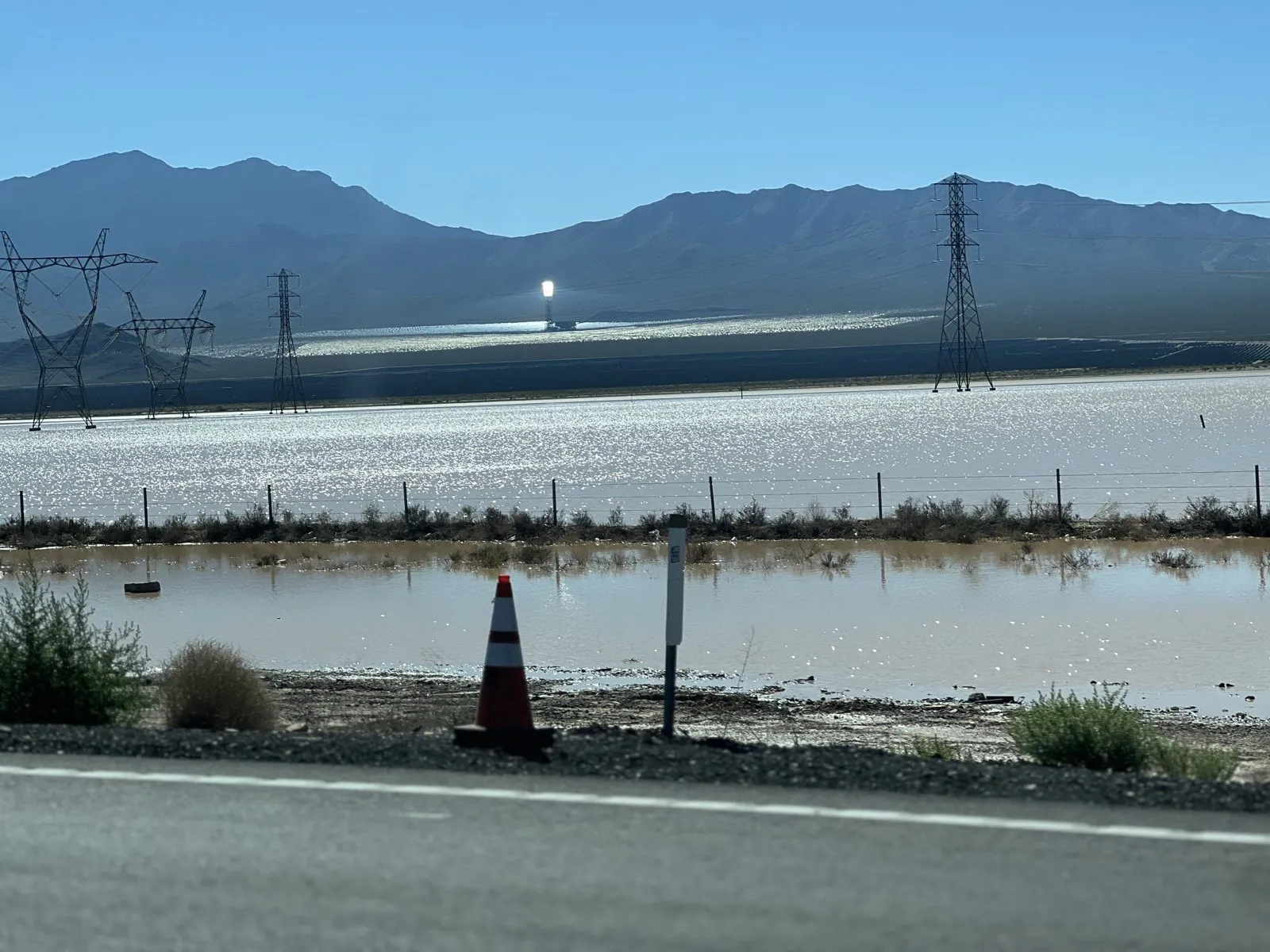
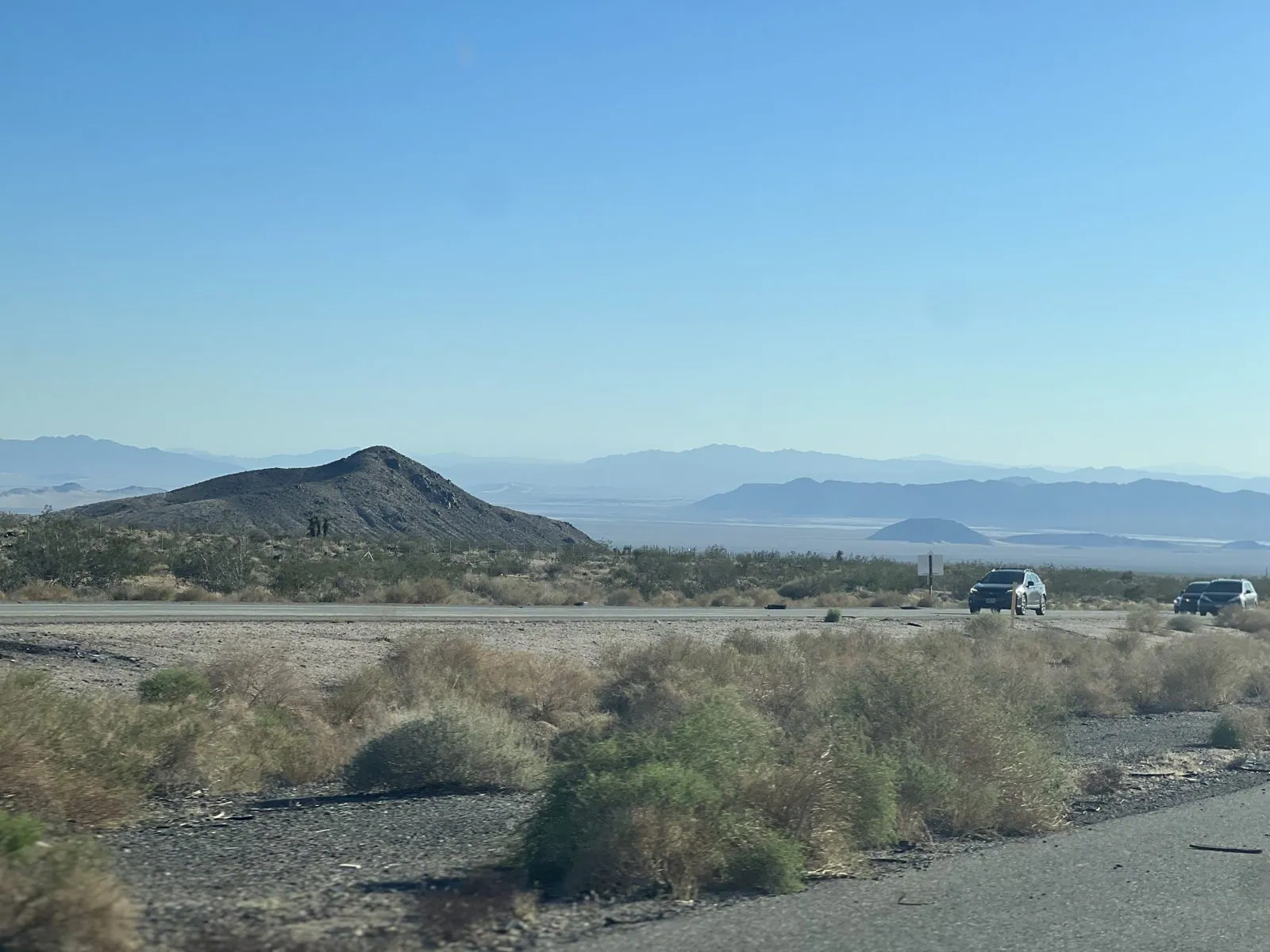
Then came the traffic. Southbound I-15 on Labor Day afternoon is a famous ordeal, and it was true to form: according to the timestamps, it took an hour and forty minutes to cover the thirty-odd miles from the state line to Halloran Springs, past the long downhill toward Baker. The desert at least was handsome in the late light: a dark volcanic cone beside the road, and range after range fading into haze toward the south.
Zzyzx
A few miles past Baker there is an exit that every Las Vegas driver has seen and almost nobody takes: Zzyzx Road. We took it. The name, pronounced roughly "ZYE-zix", was invented in 1944 by Curtis Howe Springer, a radio evangelist from Los Angeles. He claimed the land around a set of springs on the edge of Soda Dry Lake and built a health resort there, the Zzyzx Mineral Springs and Health Spa, with a pond, rows of palms and guest buildings, and promoted it and his health tonics on his radio show. He chose the name so that it would be the last word in the English language. In 1974 the federal government, which had never agreed that the land was his, evicted him. Since 1976 the place has been the Desert Studies Center, a field station run by the California State University and set inside the Mojave National Preserve.
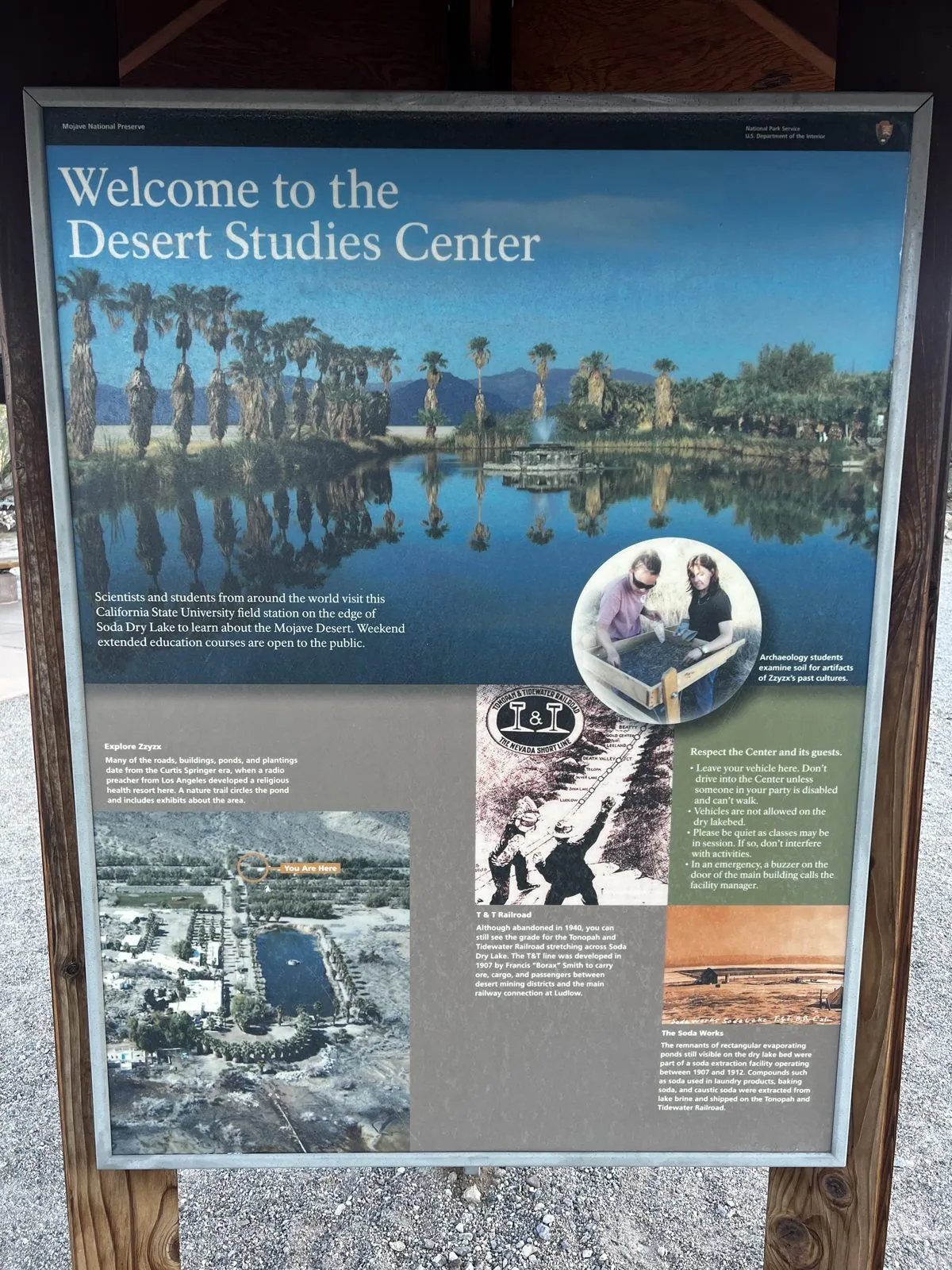
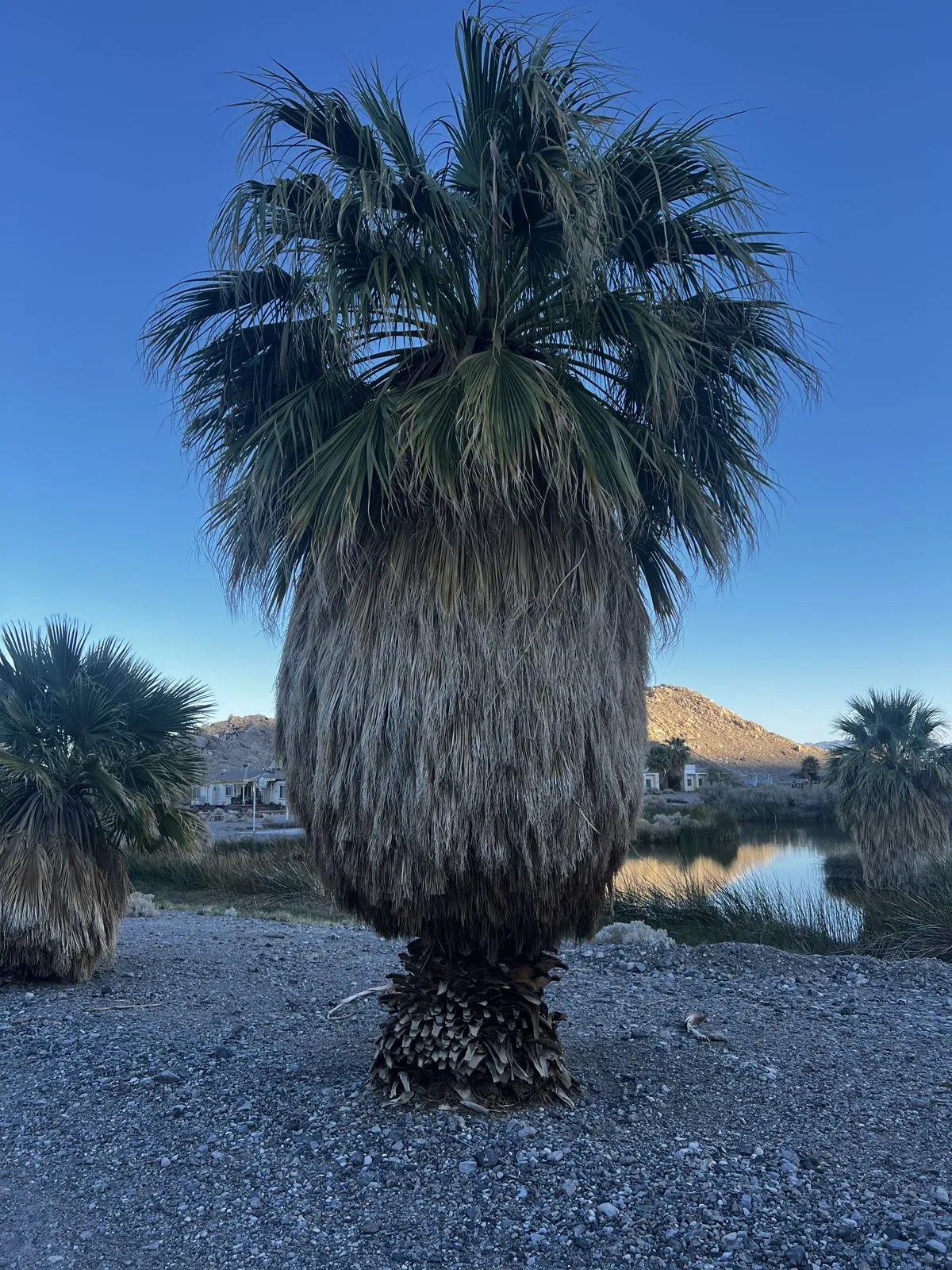
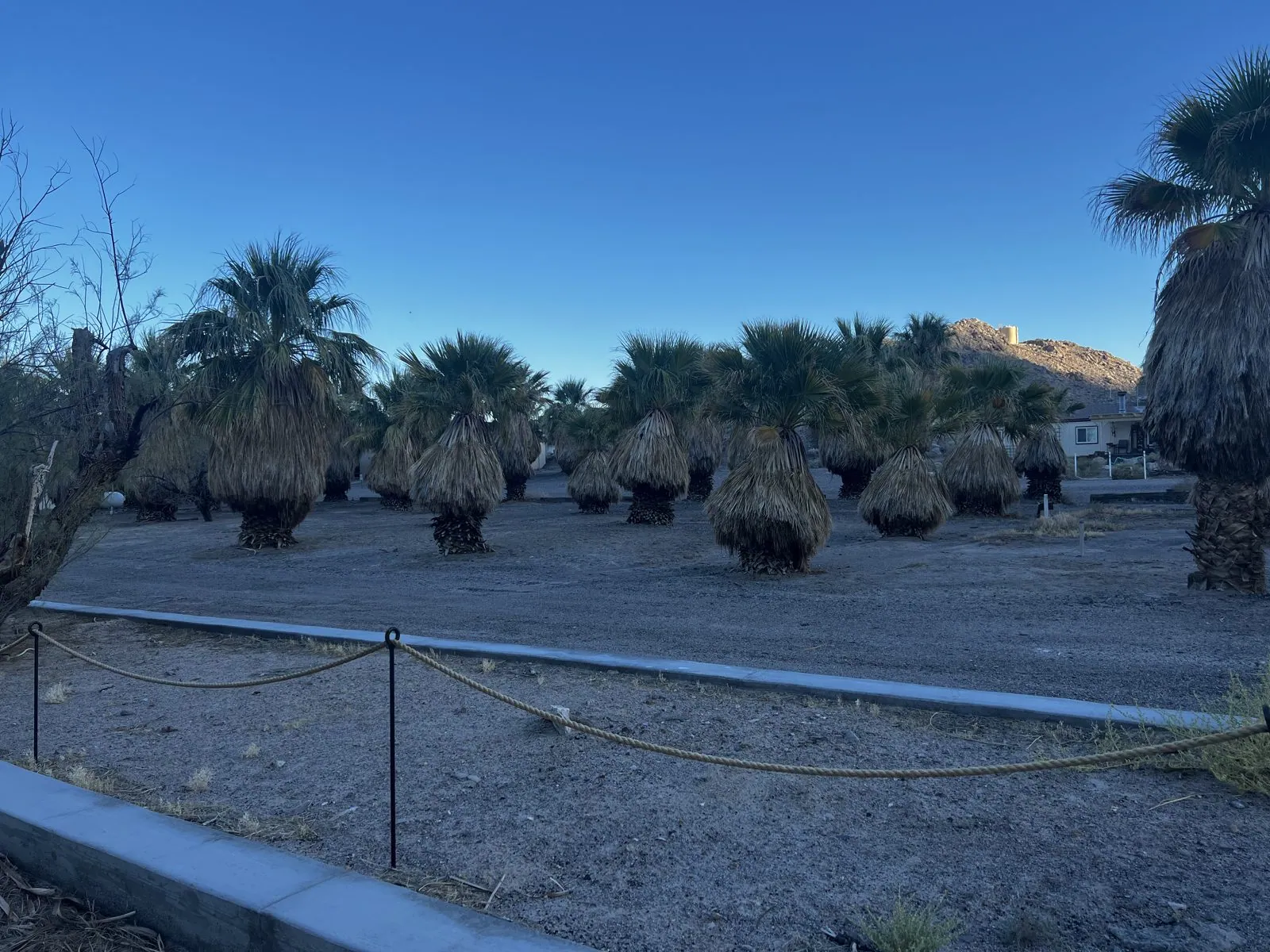
We arrived at a quarter to six, after a few miles of road out across the desert, and the place was empty and very still. Springer's buildings are still there, low and plain, along the foot of a rocky hill. The light was already going gold on the hilltop while the ground lay in blue shadow. The shaggy palms look like California fan palms, the only palm native to the state, left to grow the way they do in the wild. Their dead fronds hang down in a thick shaggy skirt to the ground, so each one looks less like a tree than like a large, patient animal in a hairy coat.
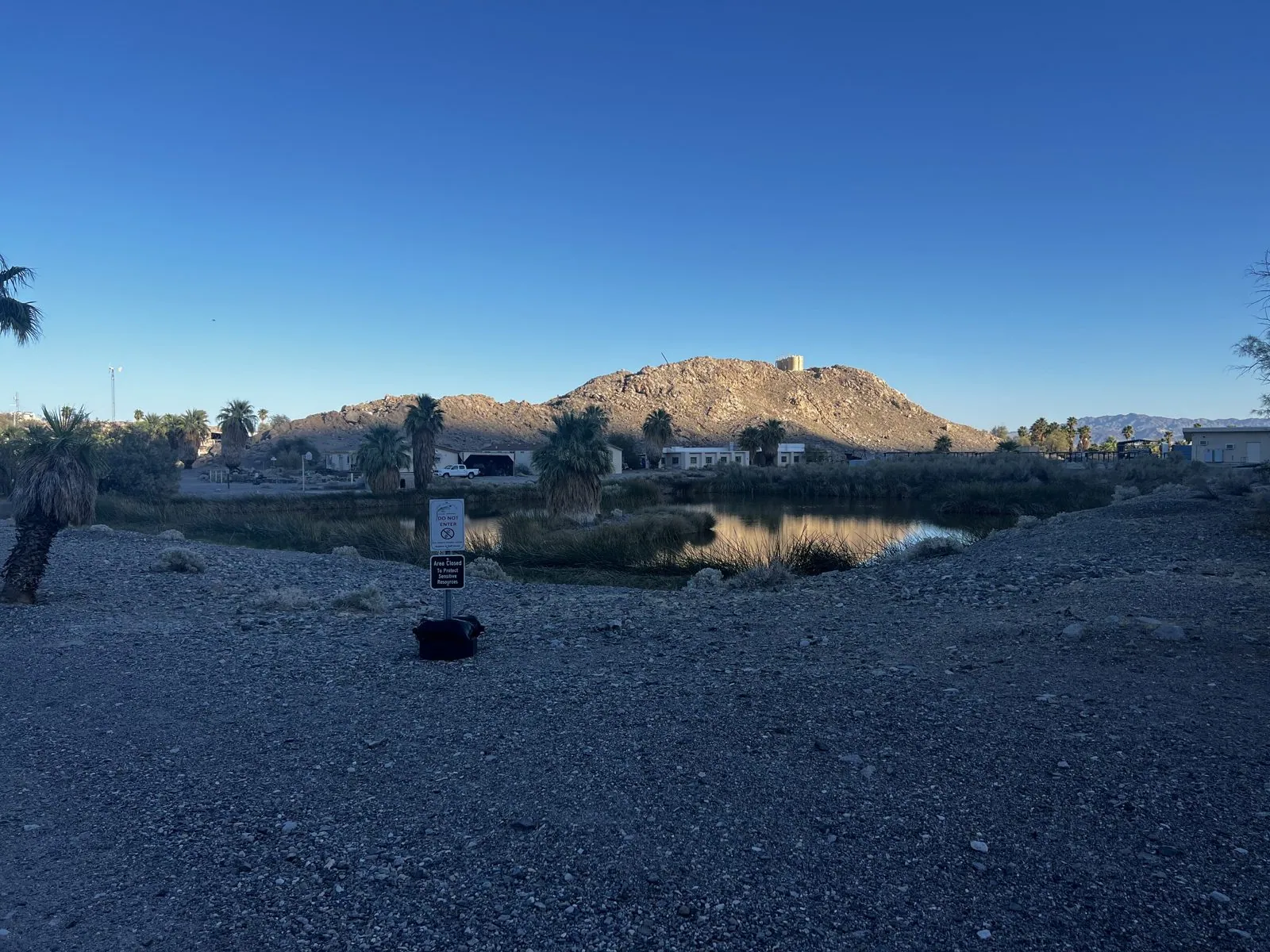
A whole grove of them stands on the gravel beside the road, behind a low rope fence: a dozen shaggy shapes in a loose crowd, like a herd that has stopped to graze.
The pond is Lake Tuendae, and it is the reason to come. Springer dug it as part of his resort. Today it is a refuge for the Mohave tui chub, a small, endangered fish that once lived throughout the ancient Mojave River system and now survives in only a handful of places like this one. At ten to six on Labor Day, there was no wind at all. The water was a perfect mirror, and a line of tall, skinny palms along the far bank stood on top of its own reflection, upside down in the blue, with the bare mountains and the white floor of Soda Lake beyond. After three days of neon, it was the quietest place of the whole trip, and maybe the most beautiful.
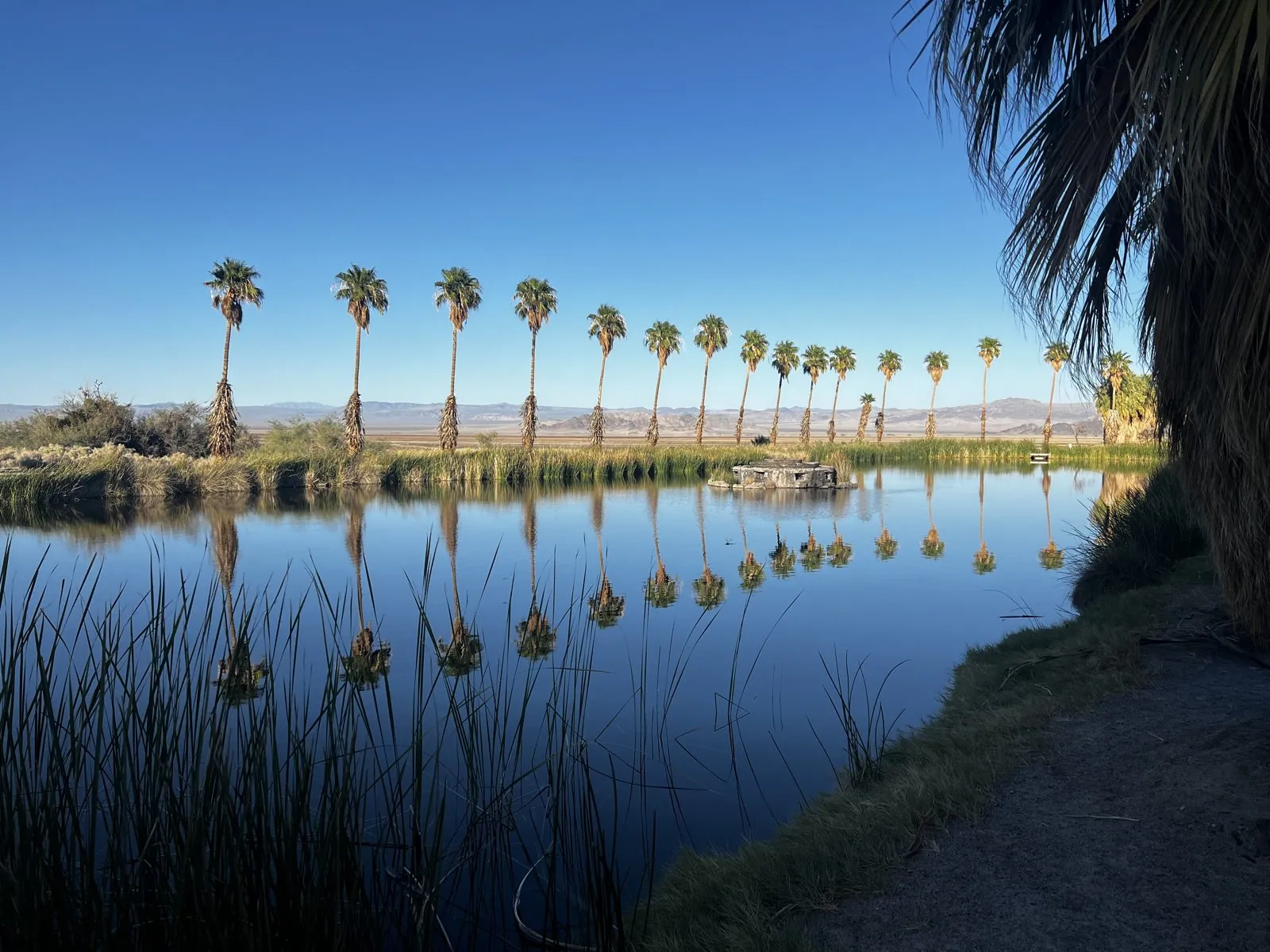
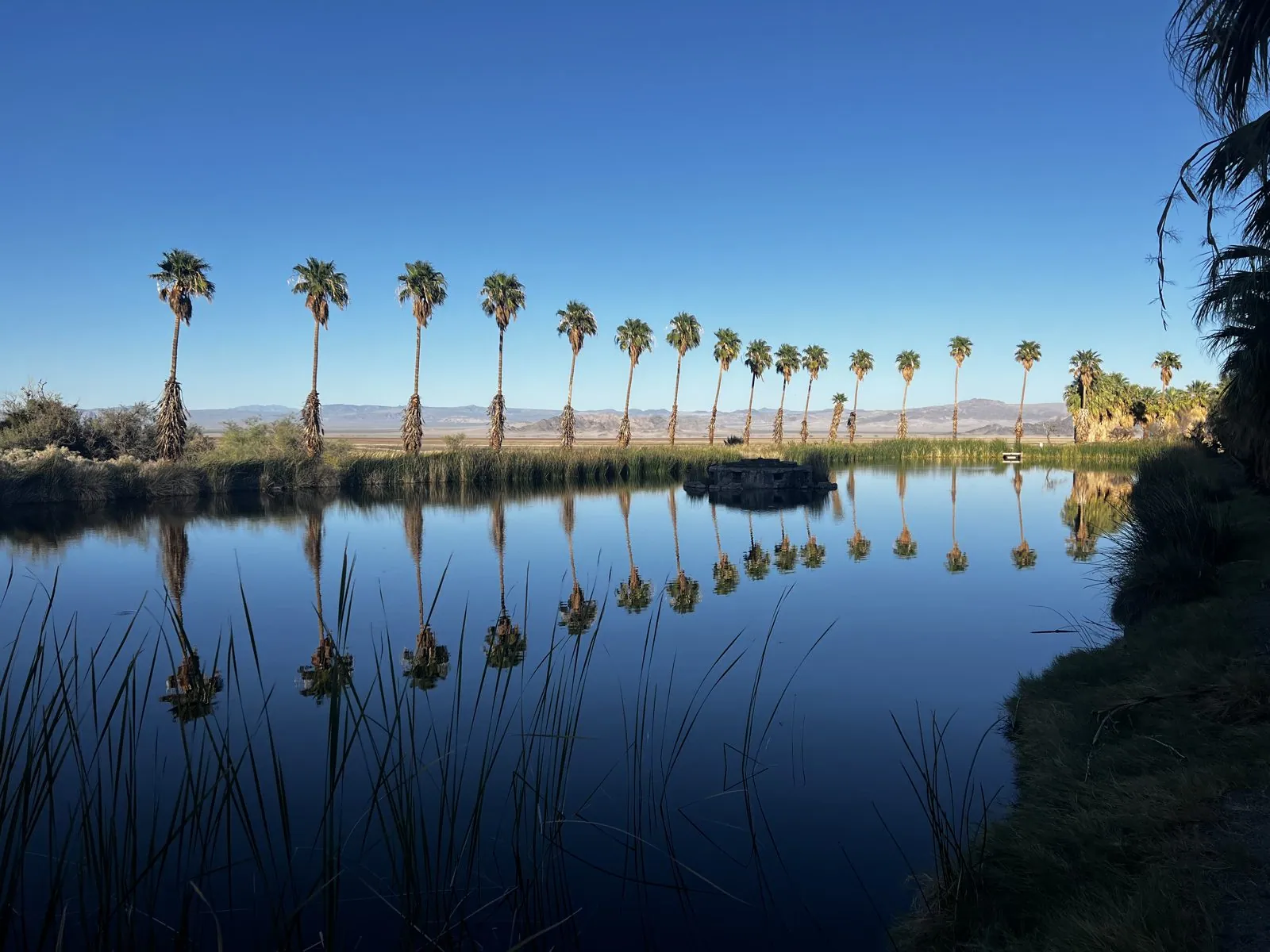
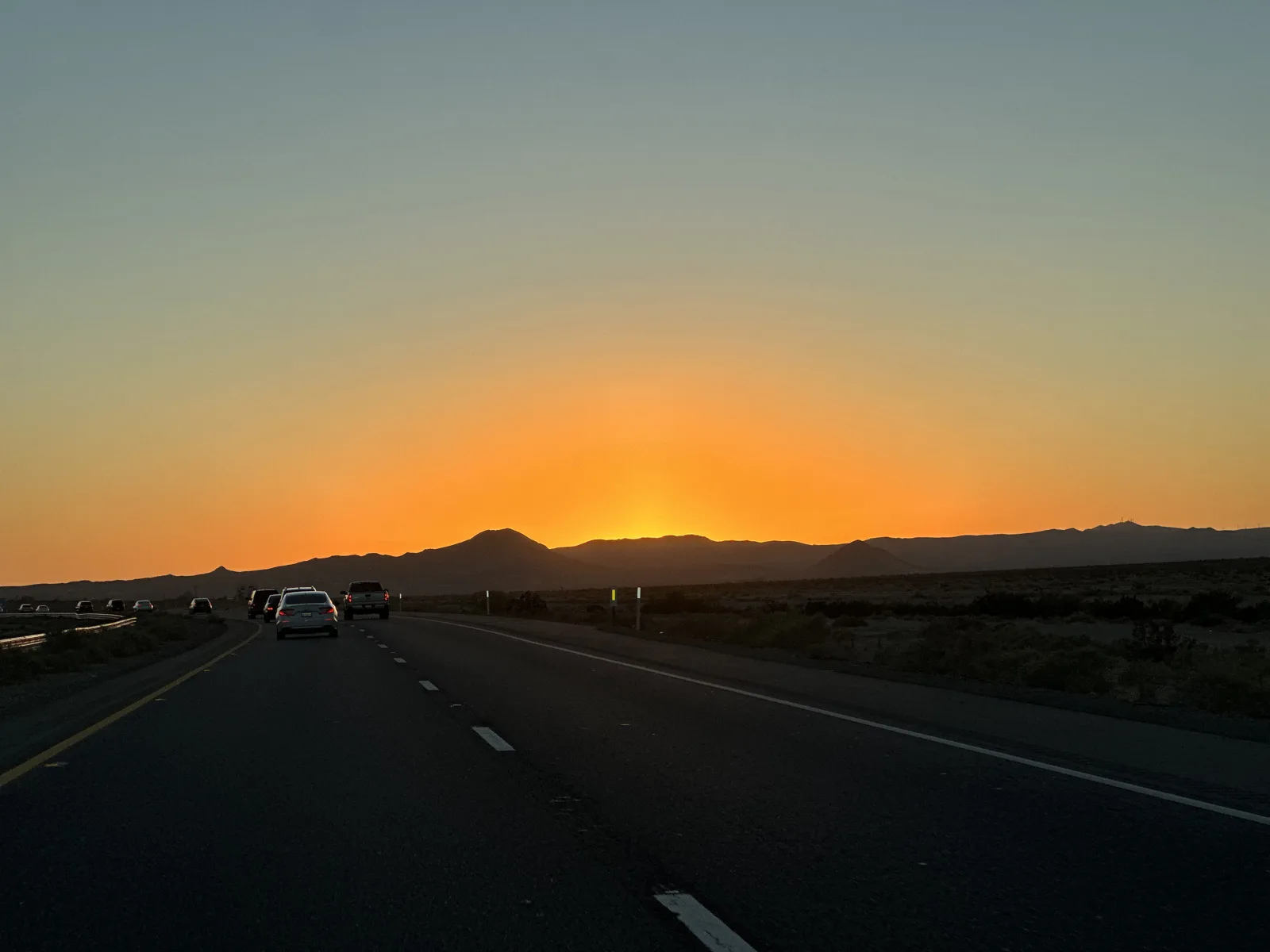
My last photo was taken at 5:53. After that it was back up Zzyzx Road to the interstate and the rest of the long Labor Day crawl home to Los Angeles. My wife's camera caught one more moment of it: the sun going down over I-15 near Barstow at 7:06.
The shortest road trip
Las Vegas is the road trip everyone in Los Angeles has done, and that is why it is easy to stop seeing the road. I-15 is the thing between you and the show. This weekend it refused to be ignored. It gave us a storm and a double rainbow on the way up, a sky on fire at the edge of the city, and on the way back a dry lake full of water and a solar plant glowing behind it.
The city did its part, too. We heard one of the great voices of the age in a room built for residencies, watched a stage turn on its side, and saw a city of lights from 550 feet up. We caught the Sphere in its last month as a mystery, before anyone had been inside. But if I had to pick one picture from the weekend, it would not be any of those. It would be a row of palms standing on its own reflection in a pond at Zzyzx, at the end of a road named for the end of the alphabet, five miles from the traffic. The best stop of the trip was the one we almost drove past.
Maps built from the trip's photo timestamps and locations; mileage is approximate road distance. Photo locations have been removed from the published images. Day maps: map data © OpenStreetMap contributors; each stop is placed where its photo was taken, hotels and home are never marked, and the dashed lines show the order of stops, not the exact roads.
Some photos in this post are my wife's.
Likes and comments
React with an emoji or leave a comment. Signing in with GitHub is required.