Research
AI is learning to predict and act in the physical world, and robots are increasingly trained in simulation.
Physics-based simulators are interpretable but hand-built; learned models are general but opaque. I build
interpretable physical AI: models whose parts are written in the language of physics, so physics
becomes the interpretation of what a model learns rather than a limit on it.
A common thread is connections between descriptions: how a 3D body becomes a rod or a shell, how a
material law summarizes a microstructure, and how measurements become a model. Each one can keep all the physics if
it is built right, and each one is a place where learning can enter in a form we can still read and check.
Thin shells that capture 3D elasticity
Classical Kirchhoff–Love shells fix the thickness, so a thin silicone sheet pressed over a bolt hides the bolt,
while the real sheet thins and reveals it. Treating the thickness as the third principal stretch gives a shell
model that supports any isotropic material and matches volumetric FEM at a fraction of the cost.
SIGGRAPH Asia 2026
Elastic rods with any nonlinear material
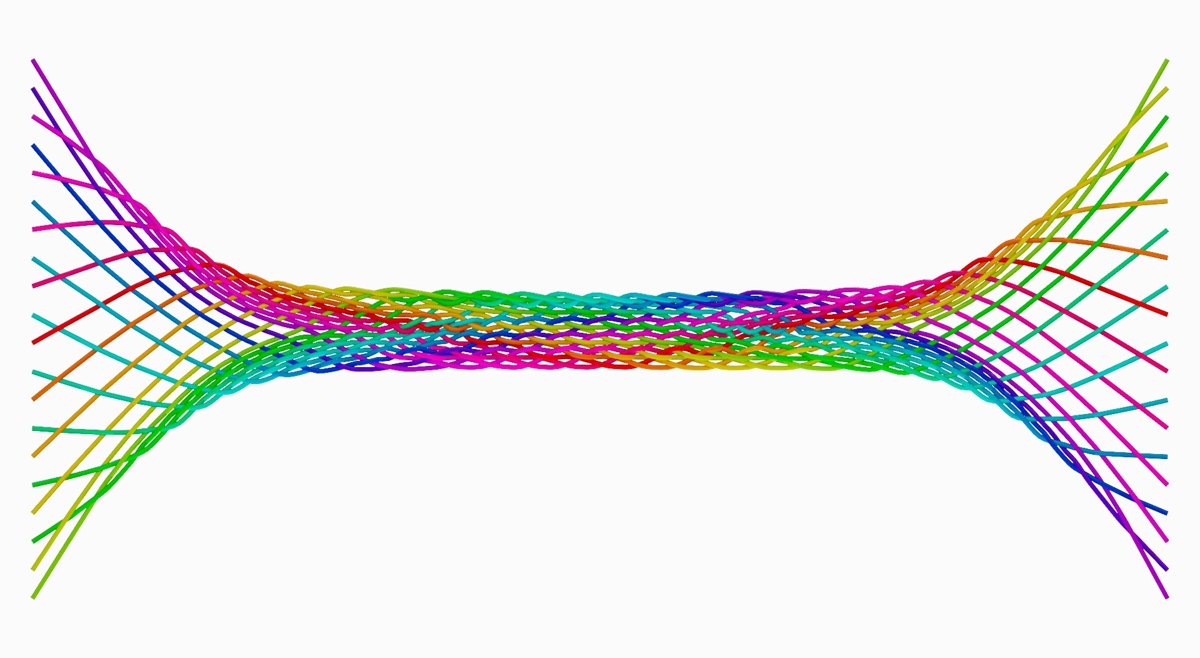
Classical rod models know only three stiffnesses (stretching, bending, twisting). At the centerline of a rod
the deformation gradient is already in singular-value form, so any nonlinear isotropic material survives the
reduction from 3D to 1D: different materials give visibly different coiling, buckling and plectonemes.
SIGGRAPH 2025
Reading and equalizing nonlinear materials
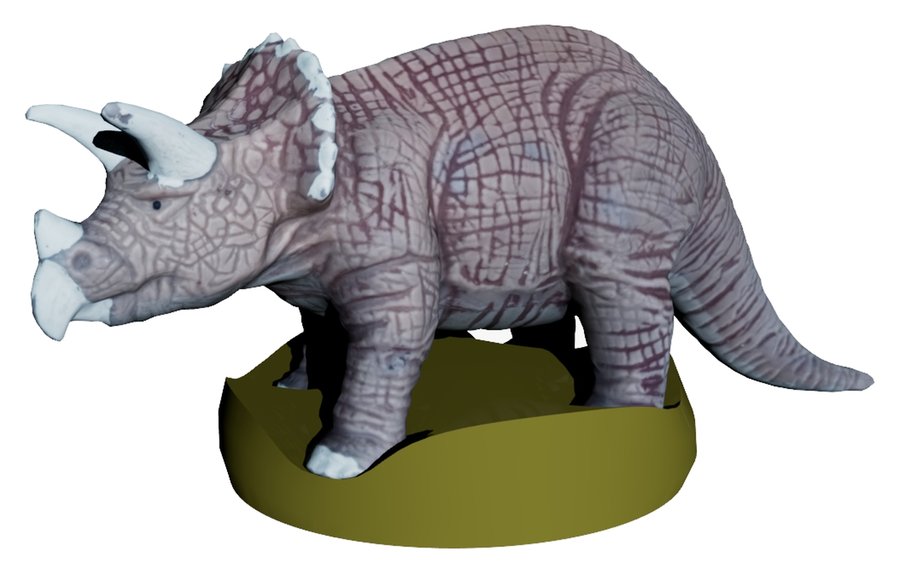
Two materials with the same Young's modulus and Poisson's ratio can behave very differently under large
deformation. Any isotropic material can be read as its linear part plus one weak-nonlinearity knob, and that knob
can be equalized, so artists and engineers can tune a material's nonlinear behavior independently.
SCA 2026 · Best Presentation Award (presented by Jernej Barbič)
Measuring materials from real objects
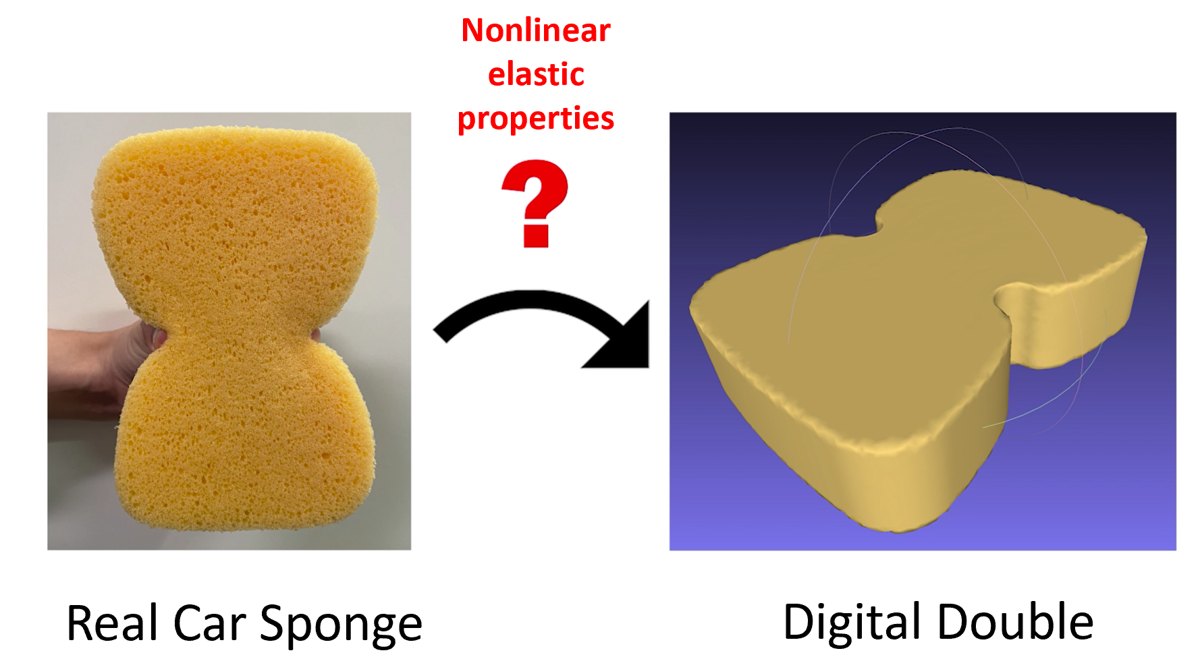
A low-cost robotic poking rig and an inverse solver recover a full nonlinear, stable-by-construction
material law from force measurements on real objects. Ongoing work under NSF Award 2622123 uses computed
tomography (CT) to observe the interior of deforming specimens, making the whole material law identifiable.
SIGGRAPH Asia 2023 · ongoing (NSF)
Earlier work
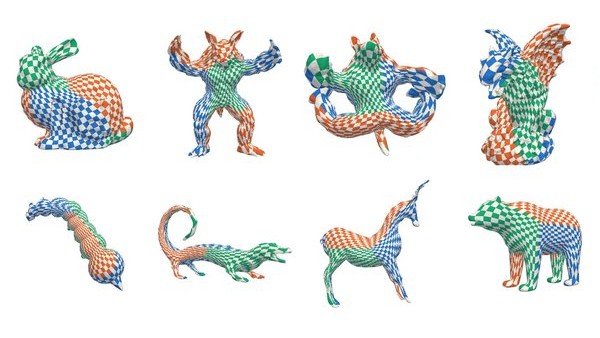
My bachelor thesis (USTC 2021, advised by Ligang Liu): flip-free, low-distortion maps from closed surfaces to
the sphere, by turning each triangle into a tetrahedron with the sphere's center. English translation, the
original results and new results on a 100-mesh benchmark.
B.Sc. thesis, 2021 · re-implemented 2026
Open source
Isotropic Distortion Energies: one Python
solver core (batched SVD, closed-form Hessian eigensystems, projected Newton, implicit Euler with IPC contact) for
parameterization, deformation and elastodynamics in 2D and 3D, with the slides of my UCLA lecture.