← Misc · May 2024
Welcome to Springfield (the Real One)
We drove all night to chase the northern lights, missed them, and spent the next day hunting Simpsons murals instead.
Los Angeles → Sacramento → the Oregon border, at night → Springfield, Oregon → Eugene airport → Burbank
zero auroras · most of the length of California driven overnight · about forty murals photographed in a little over two hours · one fence with half the town painted on it · no donuts on record
Every fan of The Simpsons knows the running joke: nobody can say which state Springfield is in. The show has spent more than thirty years dodging the question, putting the town next to mountains, deserts, oceans and nuclear plants as each episode requires. But the man who created it has given a straight answer. Matt Groening grew up in Portland, Oregon, and he has said that the show's Springfield was named after Springfield, Oregon, a small city a hundred miles south of Portland. He picked it, he explained, partly because Springfield is one of the most common town names in America, so every viewer could assume it was theirs.
Groening's Portland is all over the show: Flanders, Lovejoy, Quimby, Kearney and Terwilliger are all names of streets in Portland. Homer, Marge, Lisa and Maggie are the names of his own father, mother and sisters. So the real Springfield has a fair claim, and in recent years it has leaned into it with enthusiasm. Walk around its small downtown today and the yellow faces start appearing on the walls: next to the city jail, under a sign for a meat business, around a disabled-parking sign, in an alley full of dumpsters.
How we ended up in Springfield
We never meant to go to Oregon. The plan for that weekend was Santa Barbara: an easy drive up the coast, a reasonable bedtime. Then, on Friday, May 10th, 2024, the sun did something it had not done in twenty years. A run of huge eruptions hit the Earth's magnetic field and set off the strongest geomagnetic storm since 2003, and the northern lights were seen far south of anywhere they normally reach. By Saturday the news was full of photographs of pink and green skies over Oregon, and there were forecasts of more to come that night.
On Saturday morning, friends from Irvine called with a question: did we want to go and chase the aurora? We said yes. They drove up to Los Angeles, arriving around noon, and we set off north straight away, all of us in one car, up I-5 through the Central Valley, reaching Sacramento by dinnertime. That is where the plans split. Our friends had to get their car back to Irvine before Monday, so they could only go as far as the southern border of Oregon that night and no further. We wanted to keep going. So at Sacramento we went to the airport, rented a car of our own, and both cars drove north into the night toward the Oregon line.
The aurora did not come. Whatever the sky did over Oregon that night, we saw none of it. By then, though, we were most of the way there, so we kept driving north and reached a hotel near Springfield at about three in the morning on Sunday. It was only then that the name sank in. We had long heard that Springfield, Oregon was the Springfield, the one the Simpsons are named after, and it seemed impossible that a town like that would not have something Simpsons-themed in it. A quick search before sleep turned up the murals. That settled Sunday.
What follows is reconstructed from the camera roll, which turns out to be an unusually tidy record of a mural hunt: one wall, one photo, one timestamp, and then on to the next wall.
Eugene, briefly
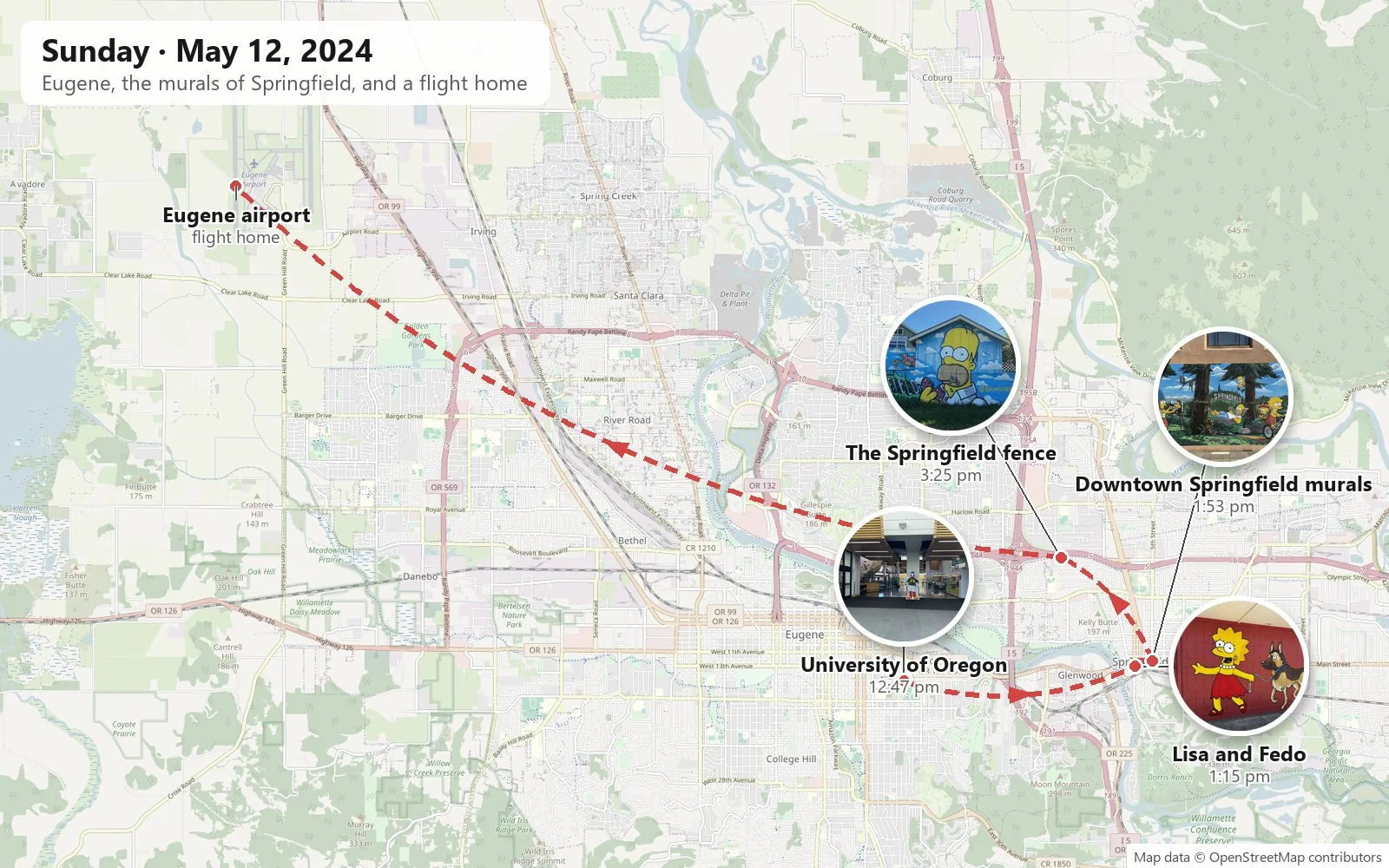
Springfield and Eugene are twin cities, separated by the Willamette River and not much else; you can drive from one downtown to the other in ten minutes. Eugene is the bigger of the two and home to the University of Oregon, so the day started there, late in the morning, with a long brunch downtown and a beer at Max's Tavern on 13th Avenue by campus. Max's is an old, dark college bar, and local lore says it was the model for Moe's Tavern, which nobody involved with the show has ever quite confirmed. Then came a short walk on the east side of campus. We looked into the lobby of the student recreation center, a tall, bright atrium of glass and pale wood with a climbing wall studded with colored holds visible through the windows. In the middle of the floor, guarding the entrance, stood a life-size cardboard cutout of the Oregon Duck, the university's famously strange mascot, in green and yellow with his orange feet planted wide.
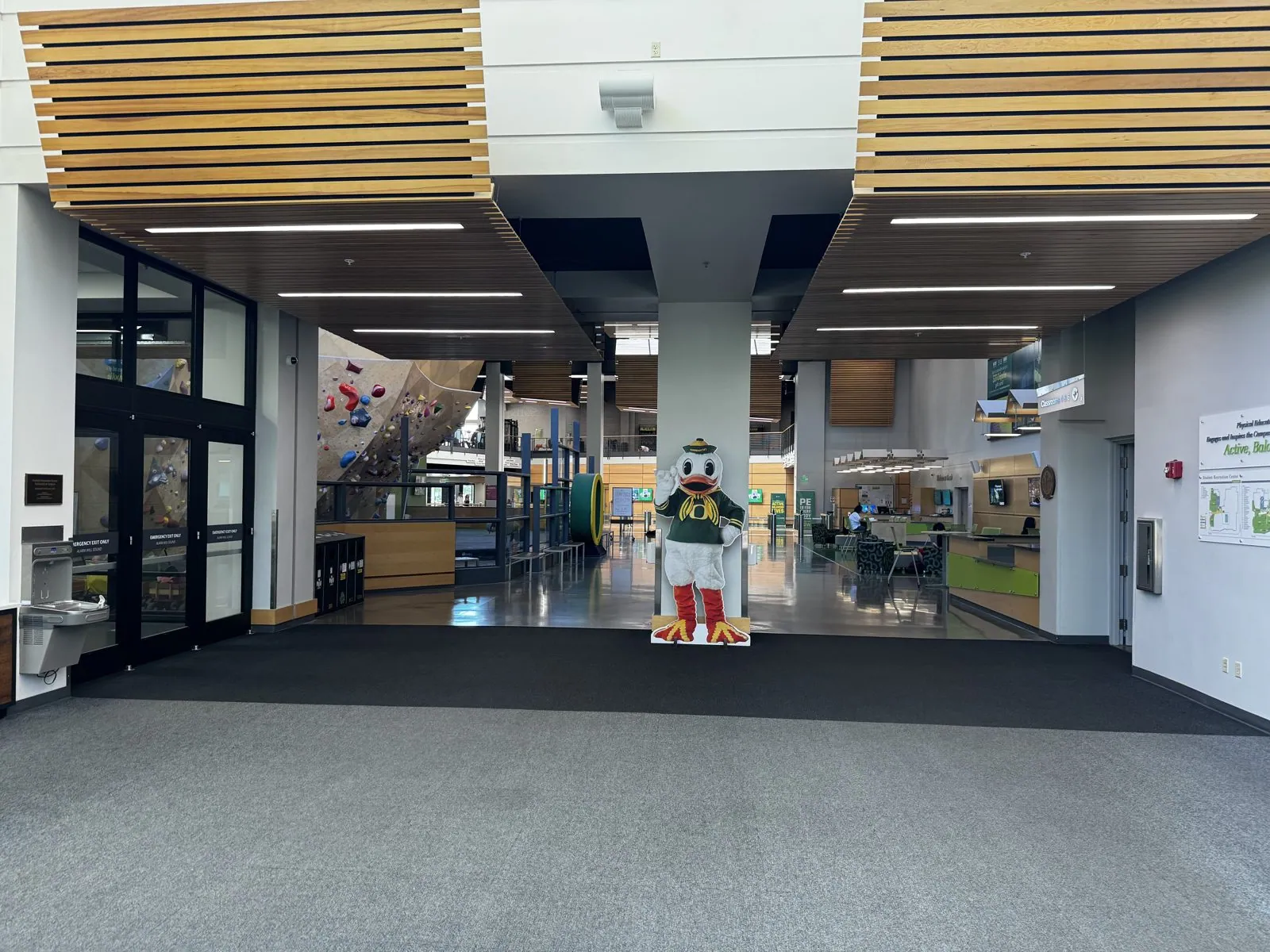
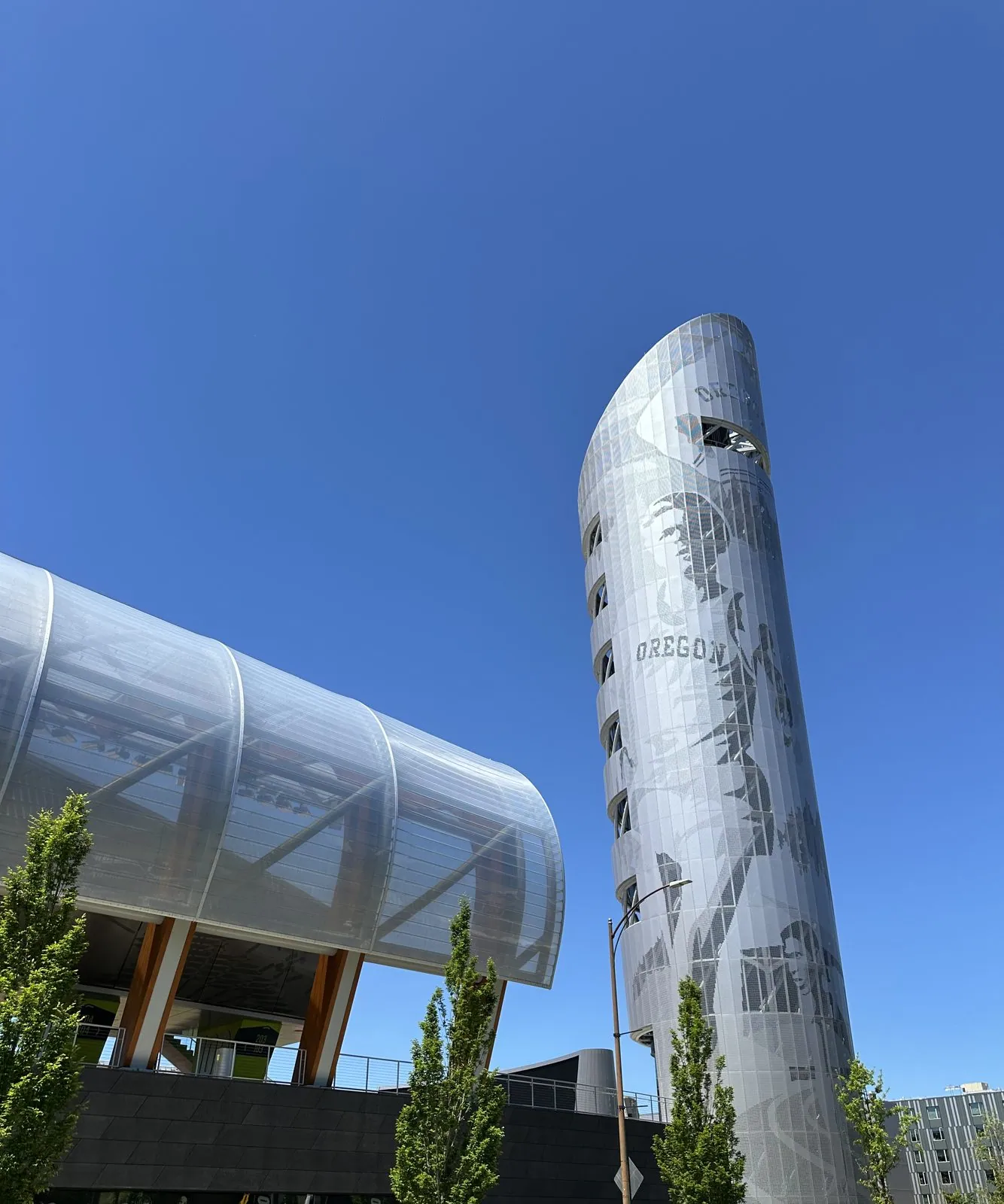
It was a Sunday in the middle of the spring term, and the building was almost empty: a few people at the far desk, and the Duck. The weather outside was the kind Oregon is not famous for: hot sun, a hard blue sky without a single cloud, and new leaves on every tree. It stayed like that all day, which is why every photo below has the same sky. We also walked past Hayward Field, the university's track stadium, with a tall tower clad in perforated metal. Then we crossed the river.
The mural walk
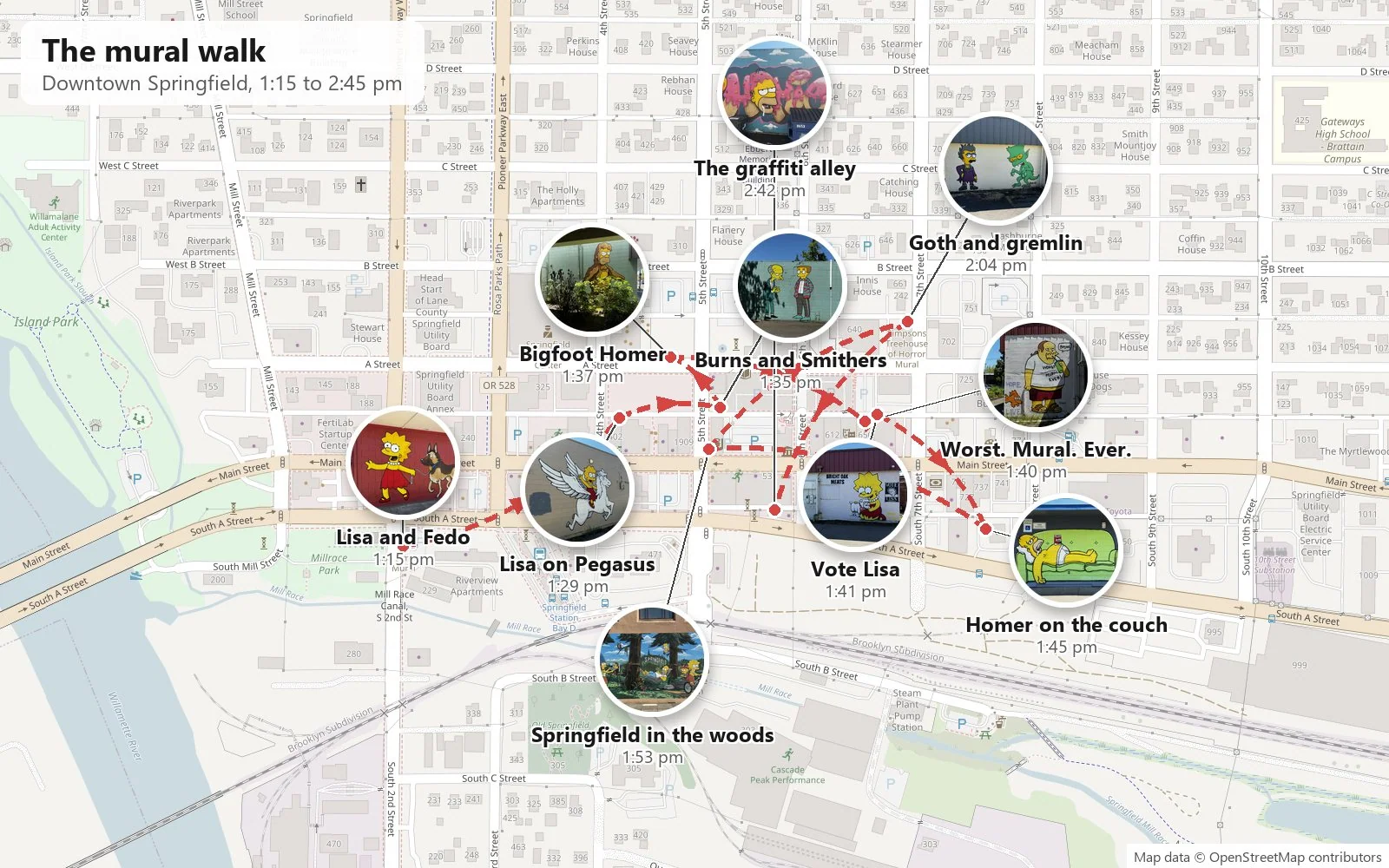
Downtown Springfield is a grid of a dozen or so blocks along Main Street, with low brick and concrete-block buildings, wide streets and a lot of parking lots. It is not a place that looks like it is expecting tourists, and that is part of the charm. The murals are not on the front of the buildings. They are on the backs and the sides, facing alleys and parking lots, next to the electricity meters, the drainpipes and the trash bins. You find them by wandering. From the first one, just after one o'clock, to the last in the downtown alleys, we spent a little over an hour and a half, mostly on foot.
A word on the artist. Almost every mural on the walk carries the same signature in a corner, sometimes with a date: Bayne Gardner, or just "Bayne". The dates run from 2019 to 2023, which means this is not an old tradition but a recent, steady campaign by one painter, one wall at a time. The style is consistent and instantly recognizable: thick black outlines, flat bright colors, characters drawn big and close, usually doing something slightly off-script.
Lisa, a dog and a flying horse
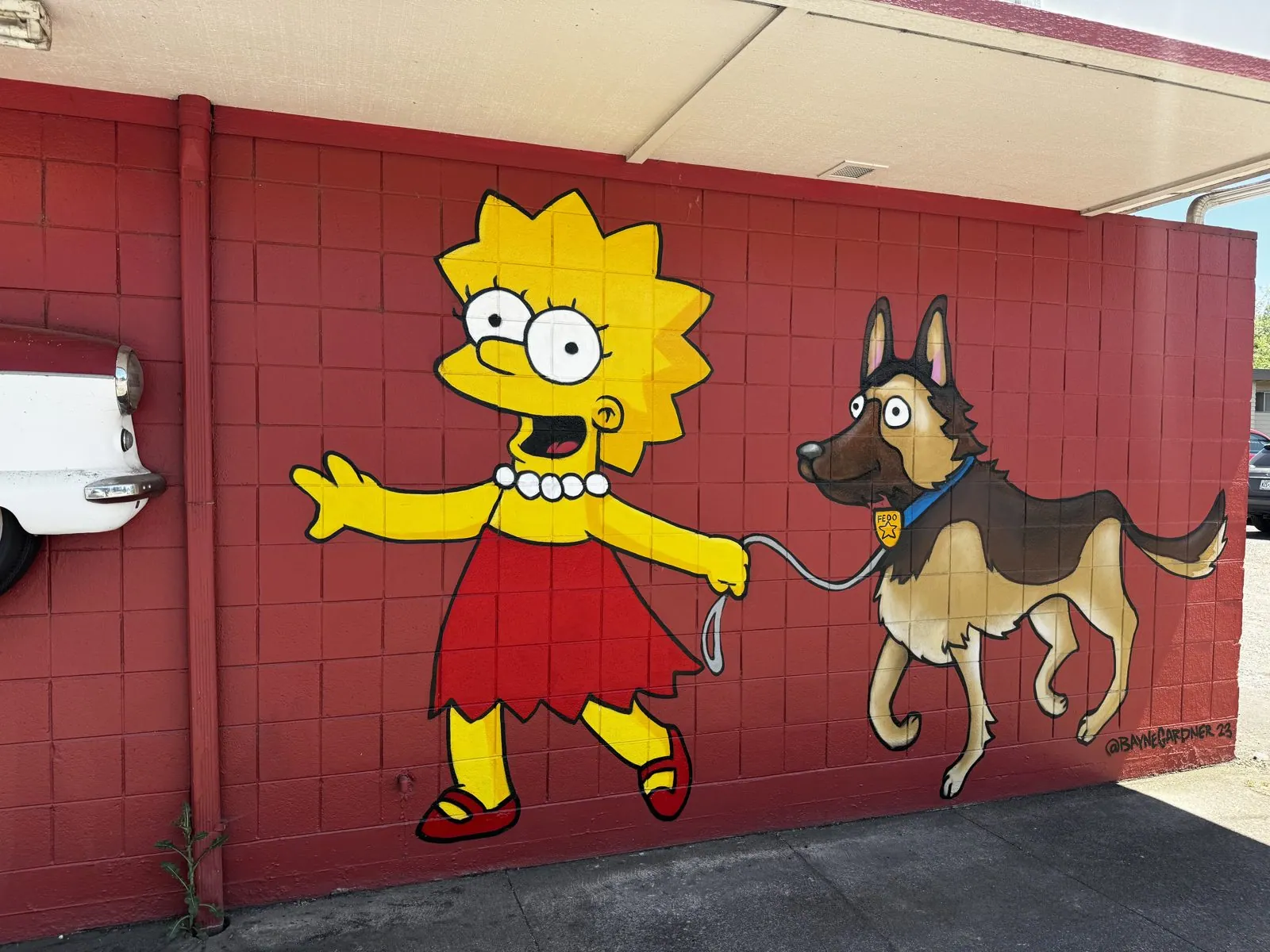
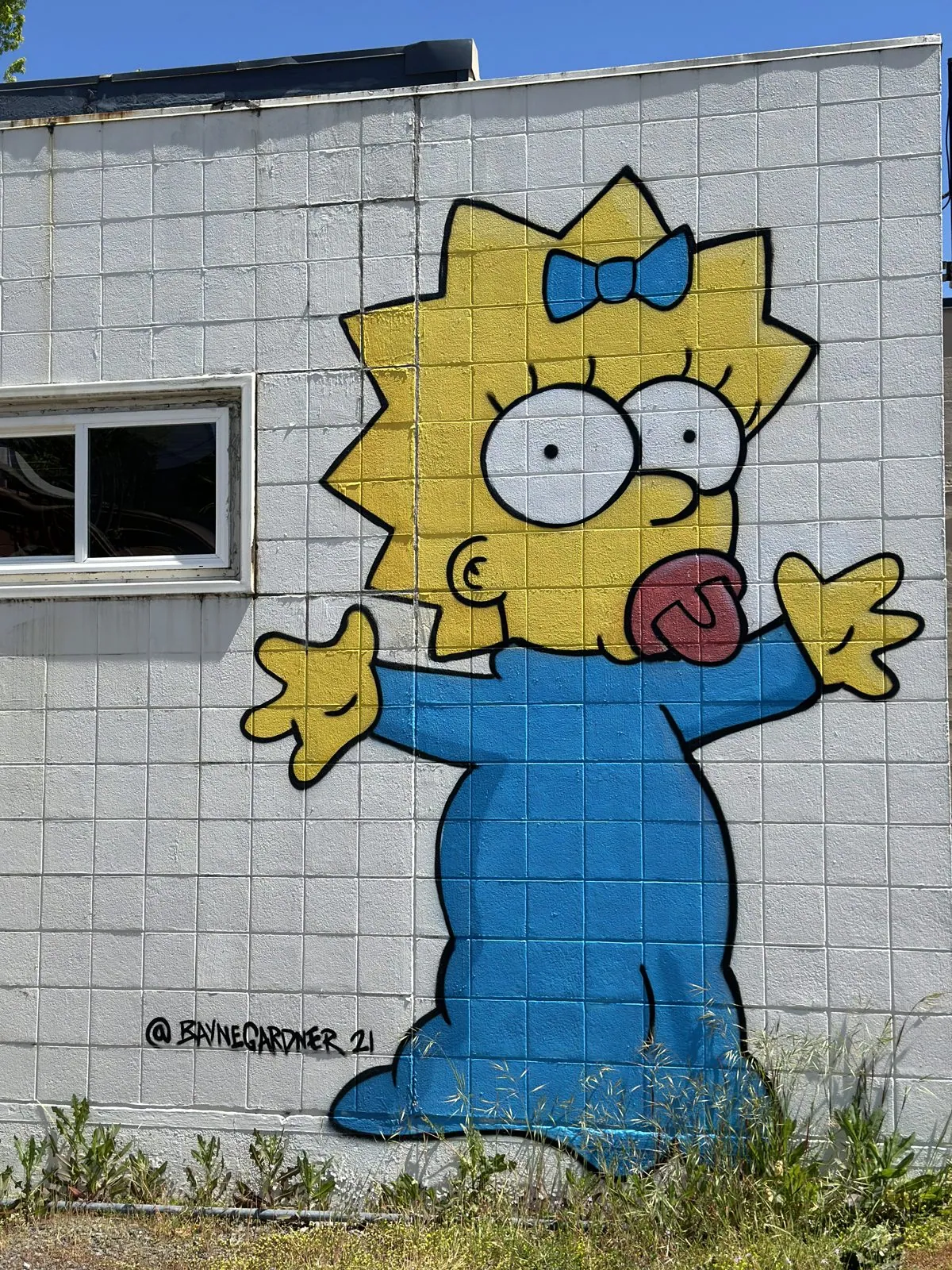
The first one we found was on a red block wall west of downtown, near the river. Lisa, in her red dress and pearls, strides along with her arms out, walking a German shepherd on a leash. The dog is not Santa's Little Helper, who is a greyhound. He wears a blue collar with a gold star-shaped tag that reads "Fedo". Beside them, what looks like the tail end of a white vintage car sticks out of the wall, fins and all. A little further on, a plain Maggie in her blue sleeper holds out her arms on a white block wall.
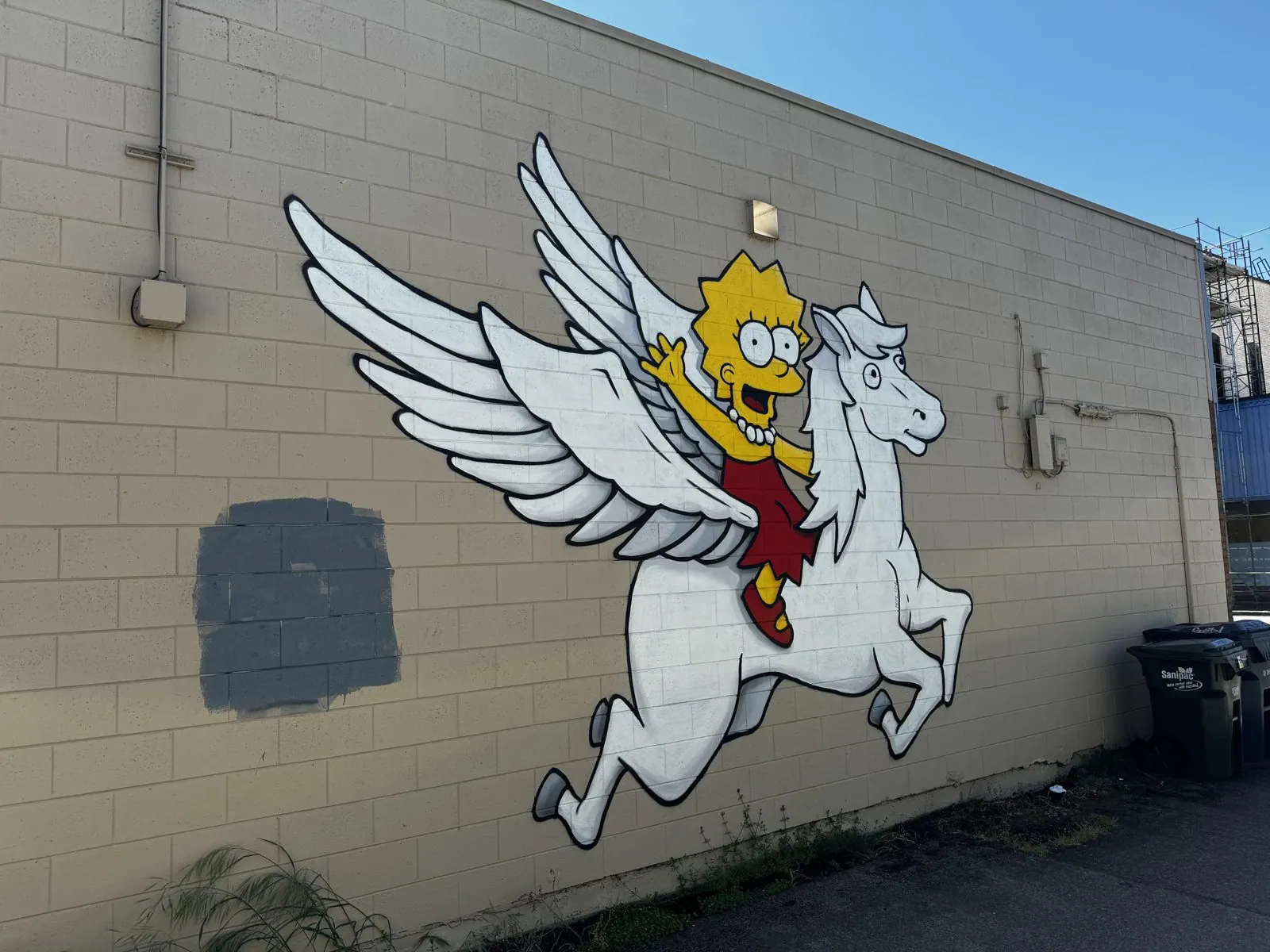
A few blocks east, by the back of the city's municipal buildings, the murals come thick and fast. On a long beige wall, Lisa rides a white winged horse across the bricks, waving, her pony obsession finally rewarded with wings. Around the corner, by a fire exit and a dumpster, is a ski scene. On the left, Ned Flanders poses in a skin-tight red and blue ski suit, a direct quote of the episode in which Homer, watching him, mutters "stupid sexy Flanders". On the right, Homer is bundled up in a puffy jacket and bobble hat, looking cold and doubtful. Between them stands a wooden signpost pointing to the runs: The Widowmaker, Spinebuster and Colostomizer.
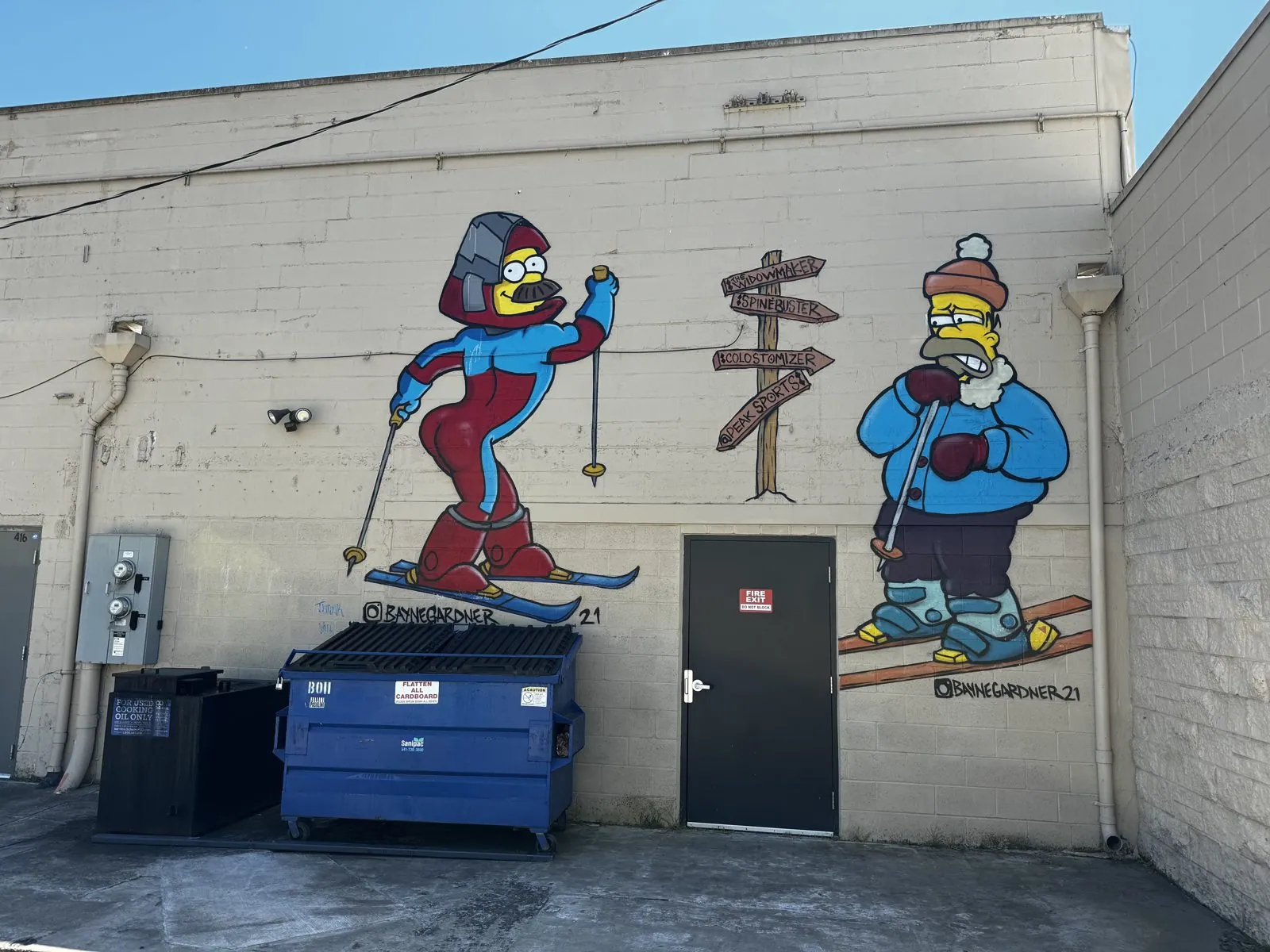
The ski scene sets the tone for the rest of the walk. These are not the family posing for a group portrait. They are deep cuts, moments a fan will recognize from one particular episode, painted on a wall where you have to stand next to a dumpster to see them.
Behind City Hall
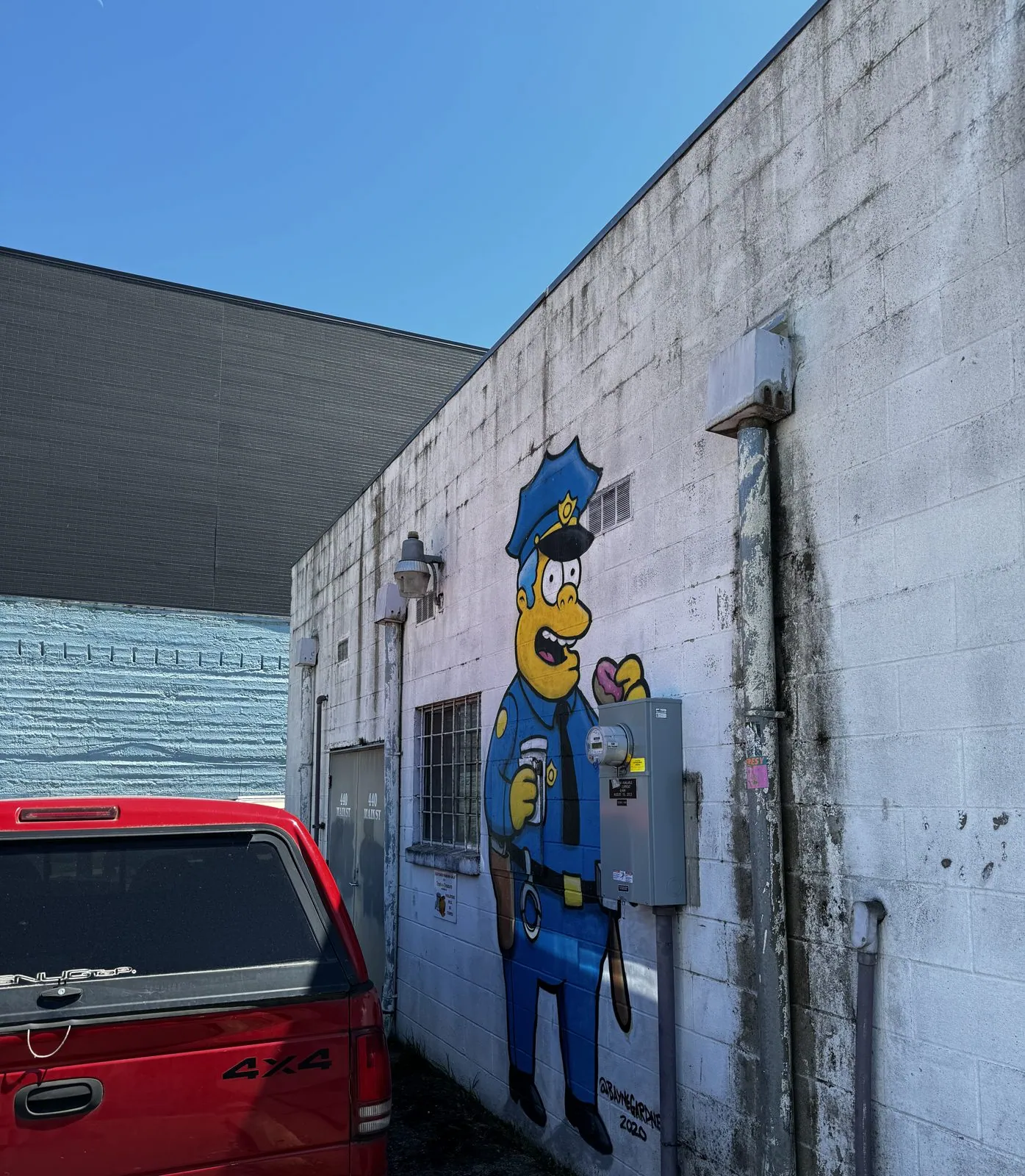
A few steps from the city jail, on a grimy white wall by a parked pickup, stands Chief Wiggum, in full blue uniform with a pink donut in his hand. The placement is either a coincidence or the best joke in town: Springfield's most useless police chief, painted a stone's throw from Springfield's real jail, on a donut break.
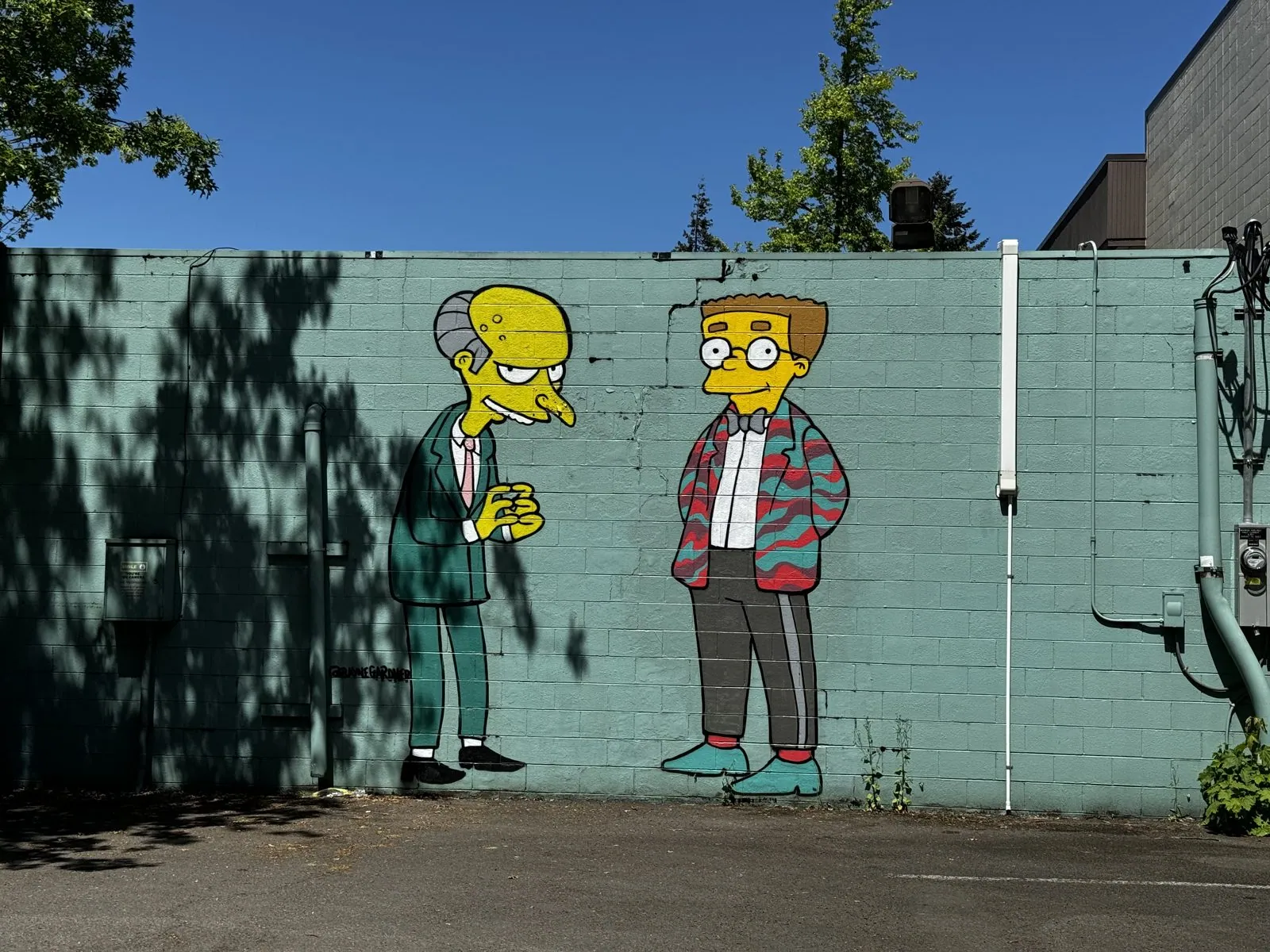
Across a parking lot, on a long wall painted a soft sea green, are Mr. Burns and Smithers. Burns is hunched in a green suit, tenting his fingers in the famous "Excellent" pose. Smithers stands beside him in a red-and-teal patterned jacket, hands behind his back, a little more relaxed than he usually gets to be. The shadow of a tree fell across Burns when we were there, which suited him.
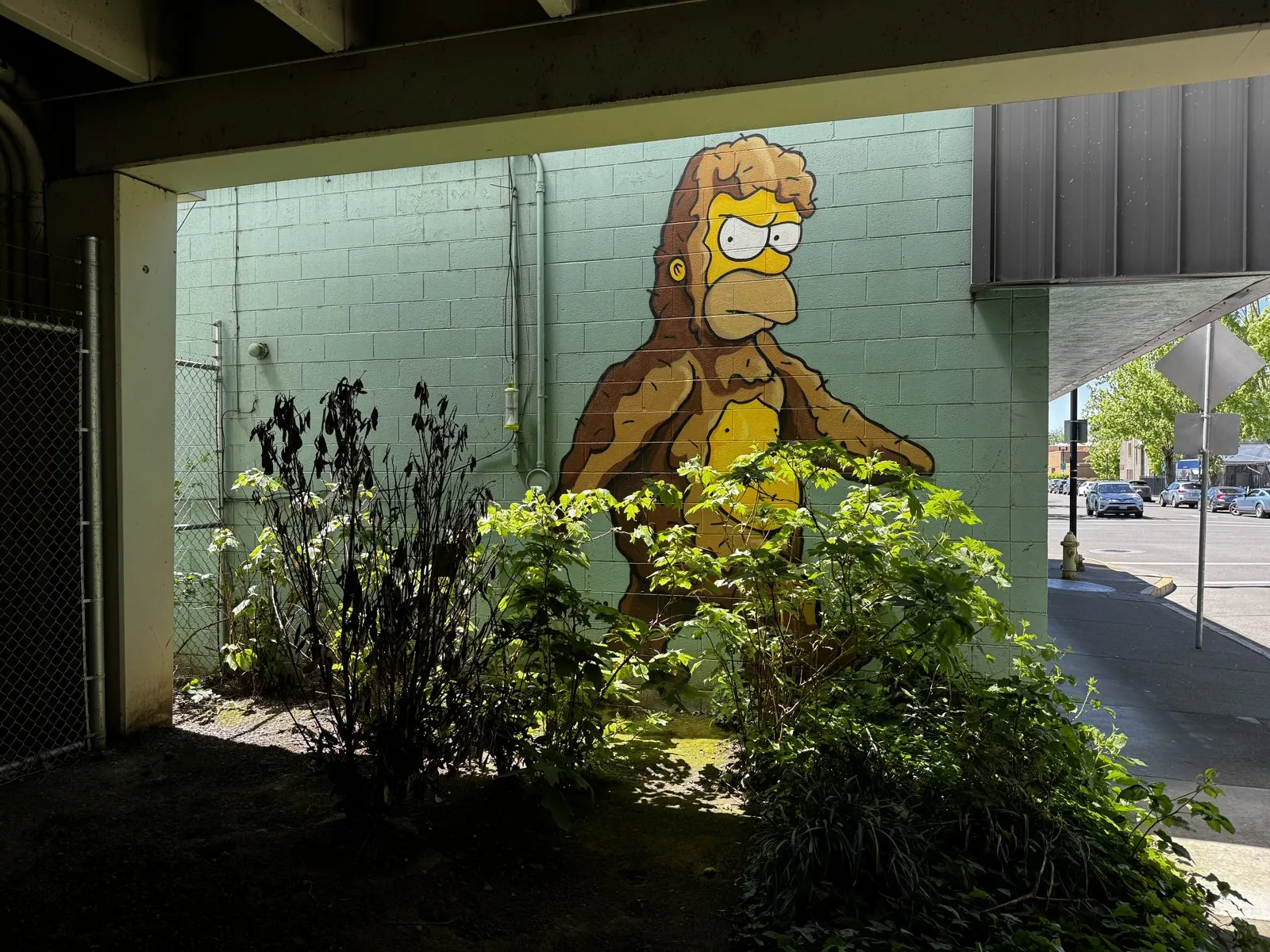
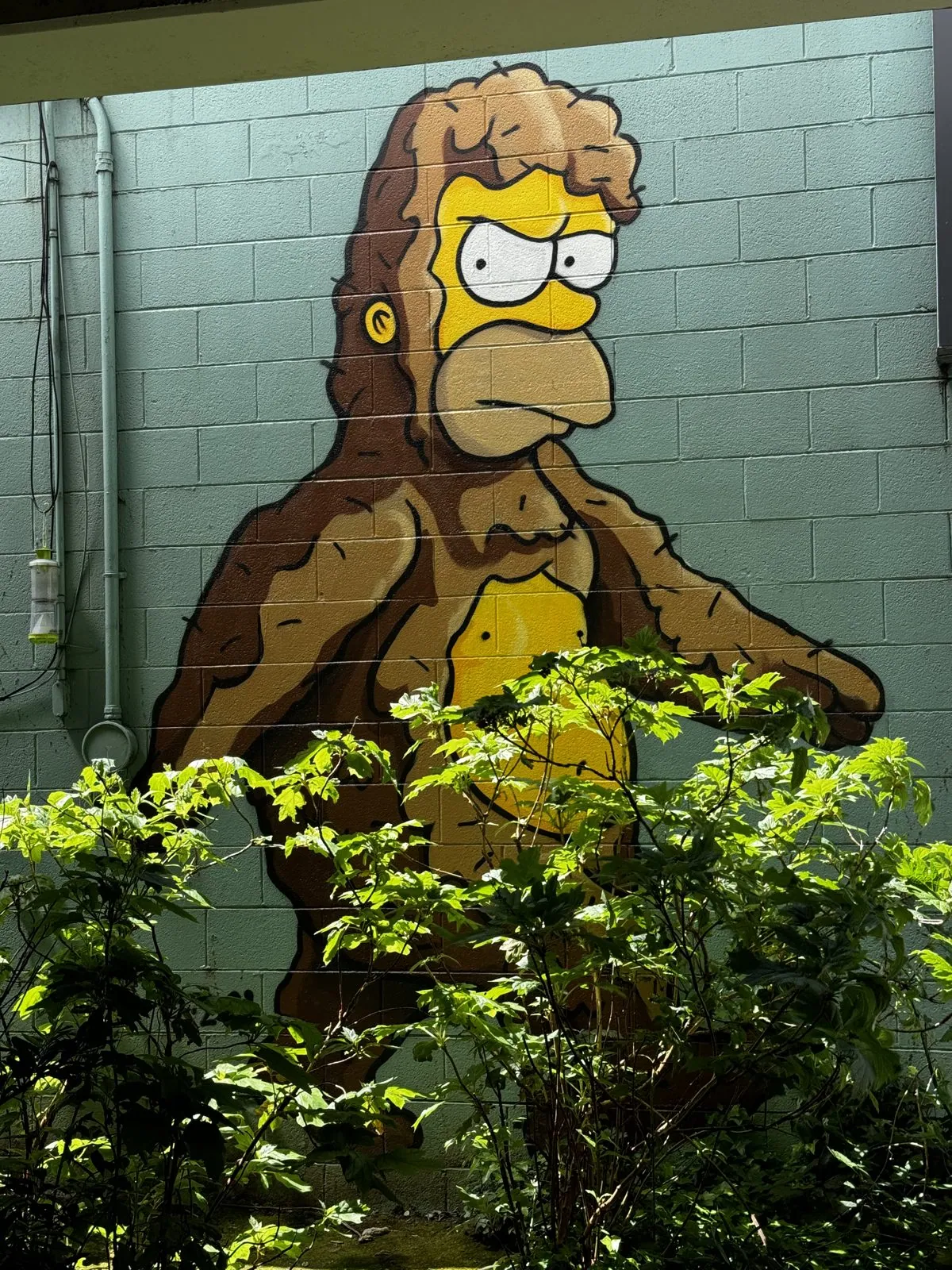
Under an overhang just beyond is the cleverest placement of the day. Homer stands in a shaggy brown Bigfoot suit, scowling, half hidden behind a real bush that has been allowed to grow up in front of him. It is a reference to one of the very first episodes, from 1990, in which Homer gets lost in the woods on a camping trip, ends up caked in mud and is mistaken for Bigfoot. Here the bush does the job of the forest. From the sidewalk you see a glimpse of fur through the leaves; only when you step under the overhang do you get the full glare.
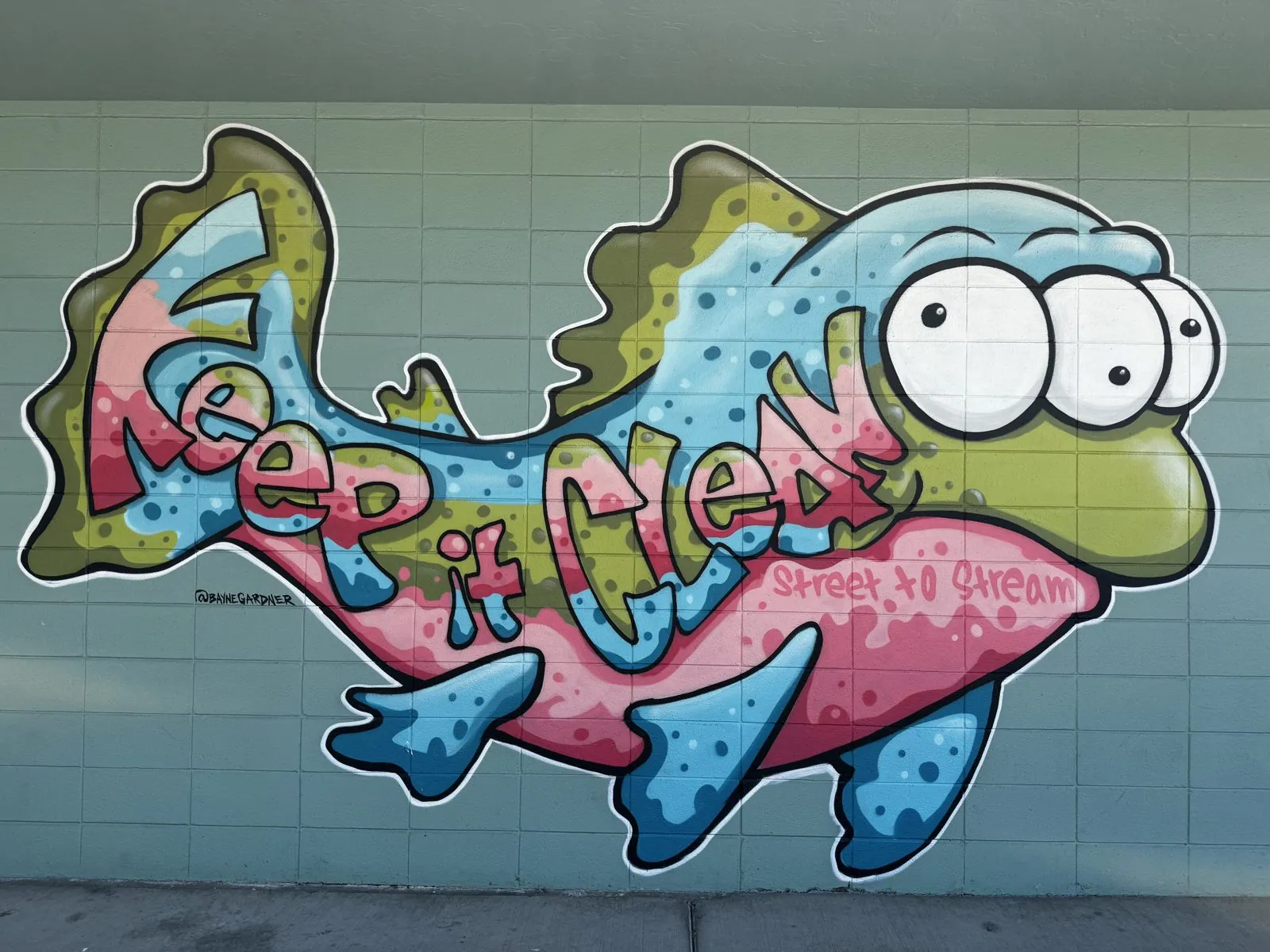
The wall next to it has a mural with a job to do. A huge fish in pink, blue and green spells out "Keep it Clean" in graffiti letters along its body, with "street to stream" underneath. It is a reminder that whatever goes down the storm drains here ends up in the river. The fish, naturally, has three eyes. That is a nod to Blinky, the three-eyed fish caught downstream of Mr. Burns's nuclear plant, which makes it probably the only public-service message in America that doubles as a joke about radioactive waste.
Bright Oak Meats
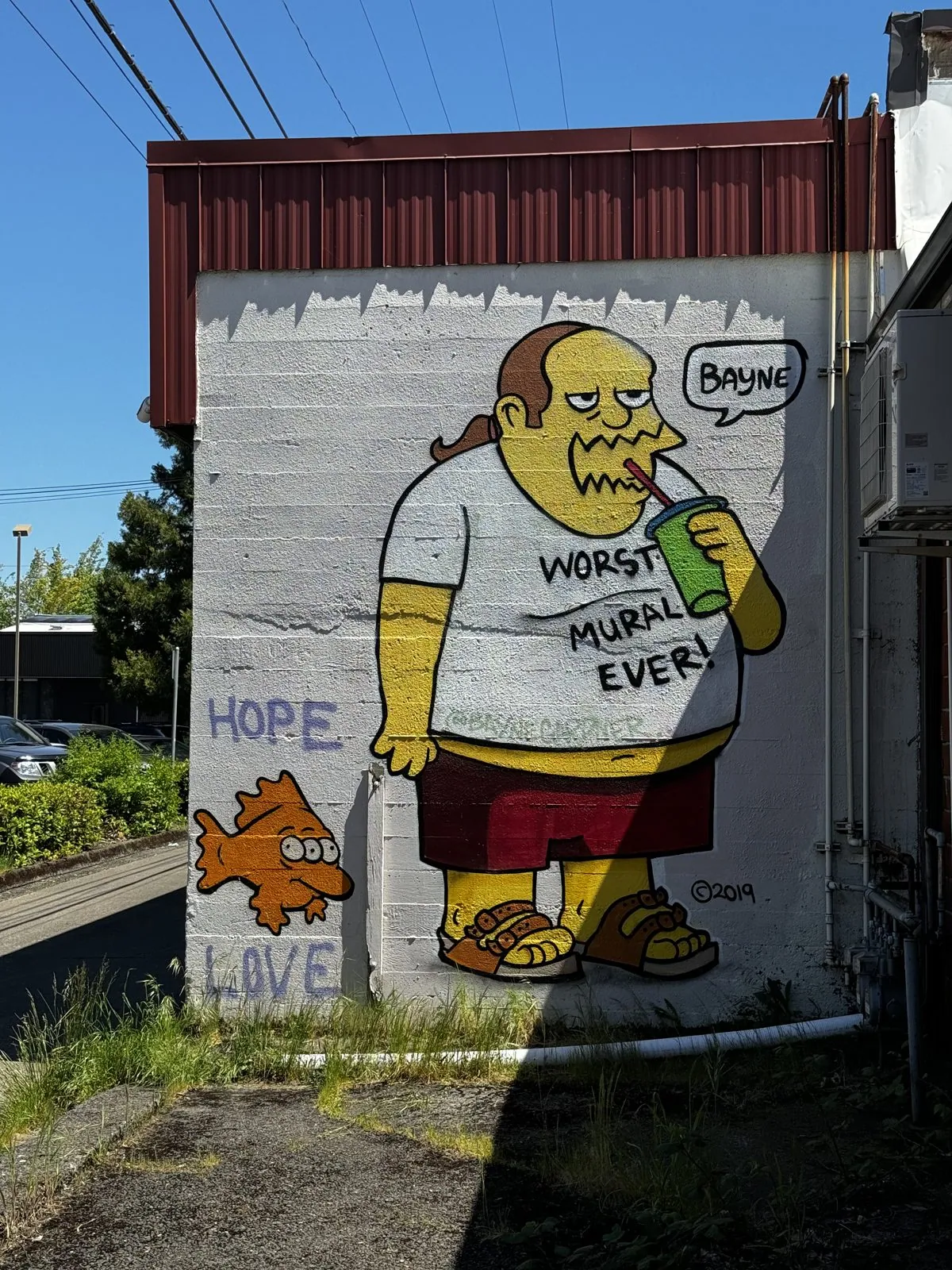
On 5th Street, on the side of a small white building under a dark red metal roof, stands Comic Book Guy. He is sipping a drink through a straw and wearing a T-shirt that reads "Worst. Mural. Ever!", a perfect rewrite of his catchphrase about the worst episode ever. A speech bubble beside him says simply "Bayne"; it's dated 2019, among the earliest on the walk. Someone has added "Hope" and "Love" in purple to the wall beside him, along with a small three-eyed orange fish.
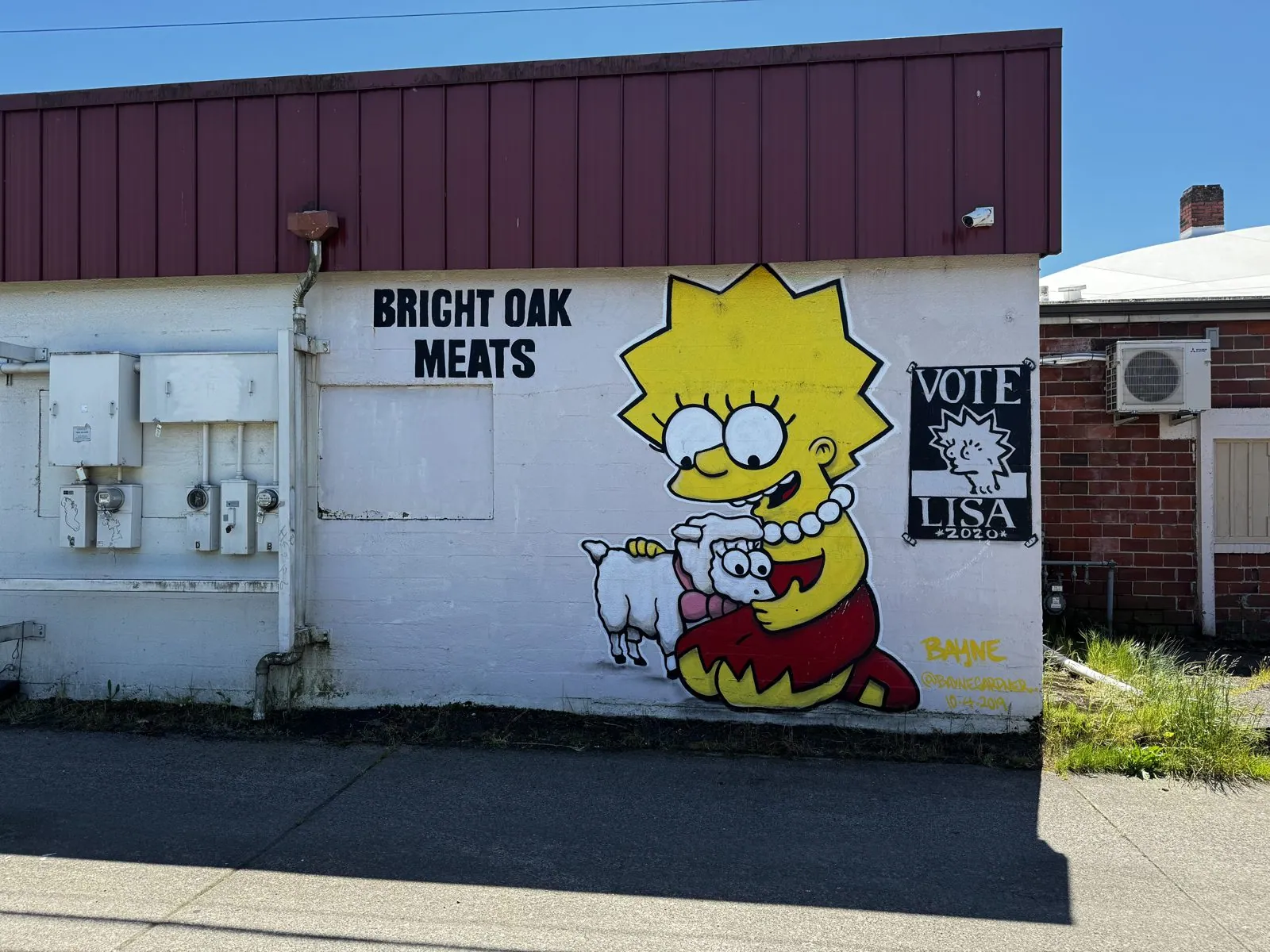
Around the corner the joke gets darker and funnier. "Bright Oak Meats" is painted in big black letters on the side of the next building. Right next to the name sits Lisa, hugging a little white lamb. Lisa famously went vegetarian after meeting a lamb at a petting zoo, so putting her under a sign about meat is a choice. Behind her is a campaign poster: "Vote Lisa 2020", a nod to the episode in which she becomes president. The mural is dated October 2019, just in time for the campaign. We visited in 2024, by which point the poster had become a period piece.
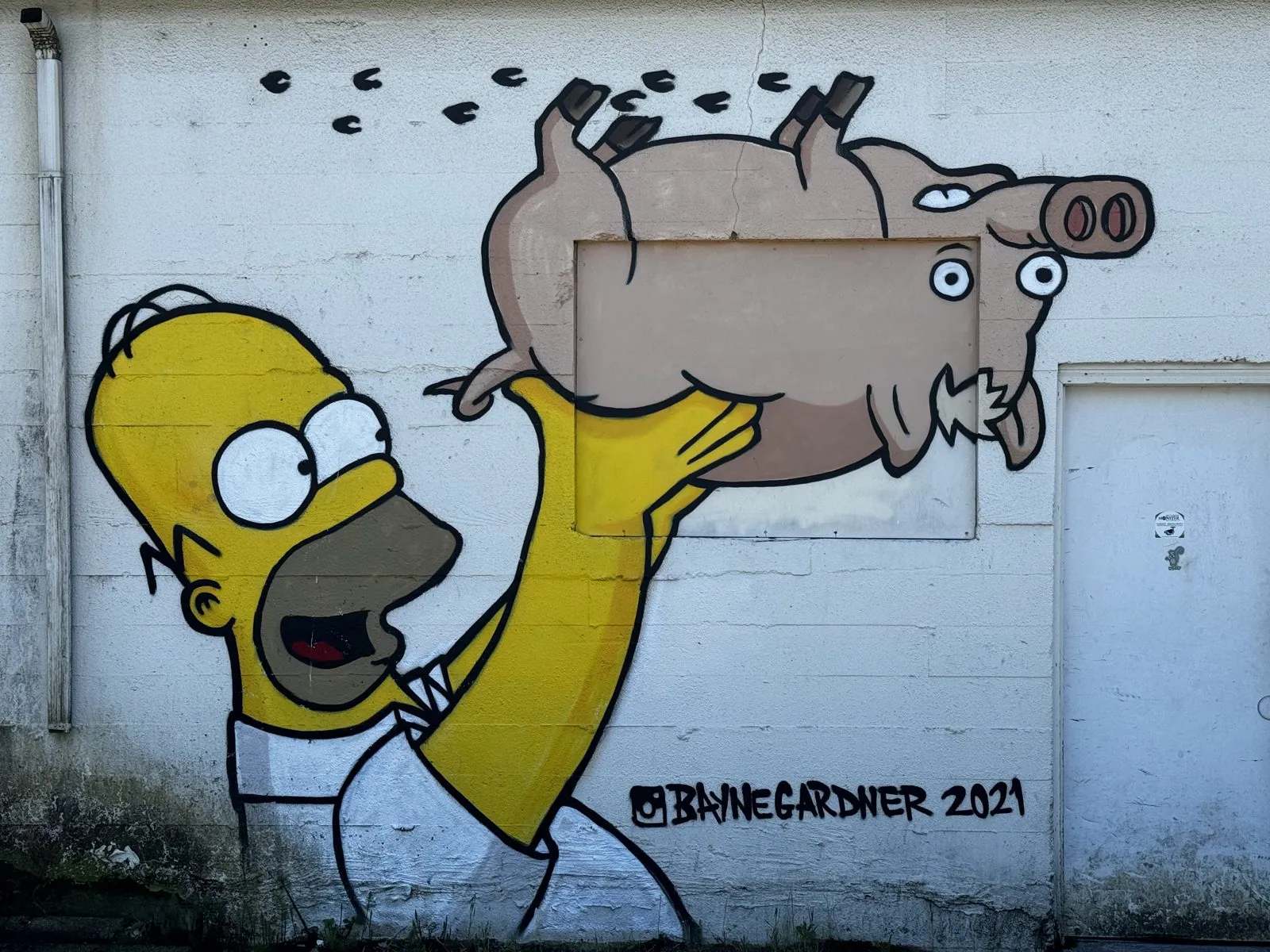
The murals keep going along the same block. Homer holds a pig high over his head in triumph, with a trail of little hoofprints running across the wall above them, as if the pig had just walked across the ceiling. It is Spider-Pig, from The Simpsons Movie of 2007. The pig's body is cleverly painted over a boarded-up opening in the wall. A little further on, Marge's sisters Patty and Selma stand side by side under their purple hair, arms folded, wearing exactly the expression they wear whenever Homer walks into the room. The edge of Homer's head pokes into the right of the frame, as if he had wandered over to see what they were disapproving of. He shouldn't have.
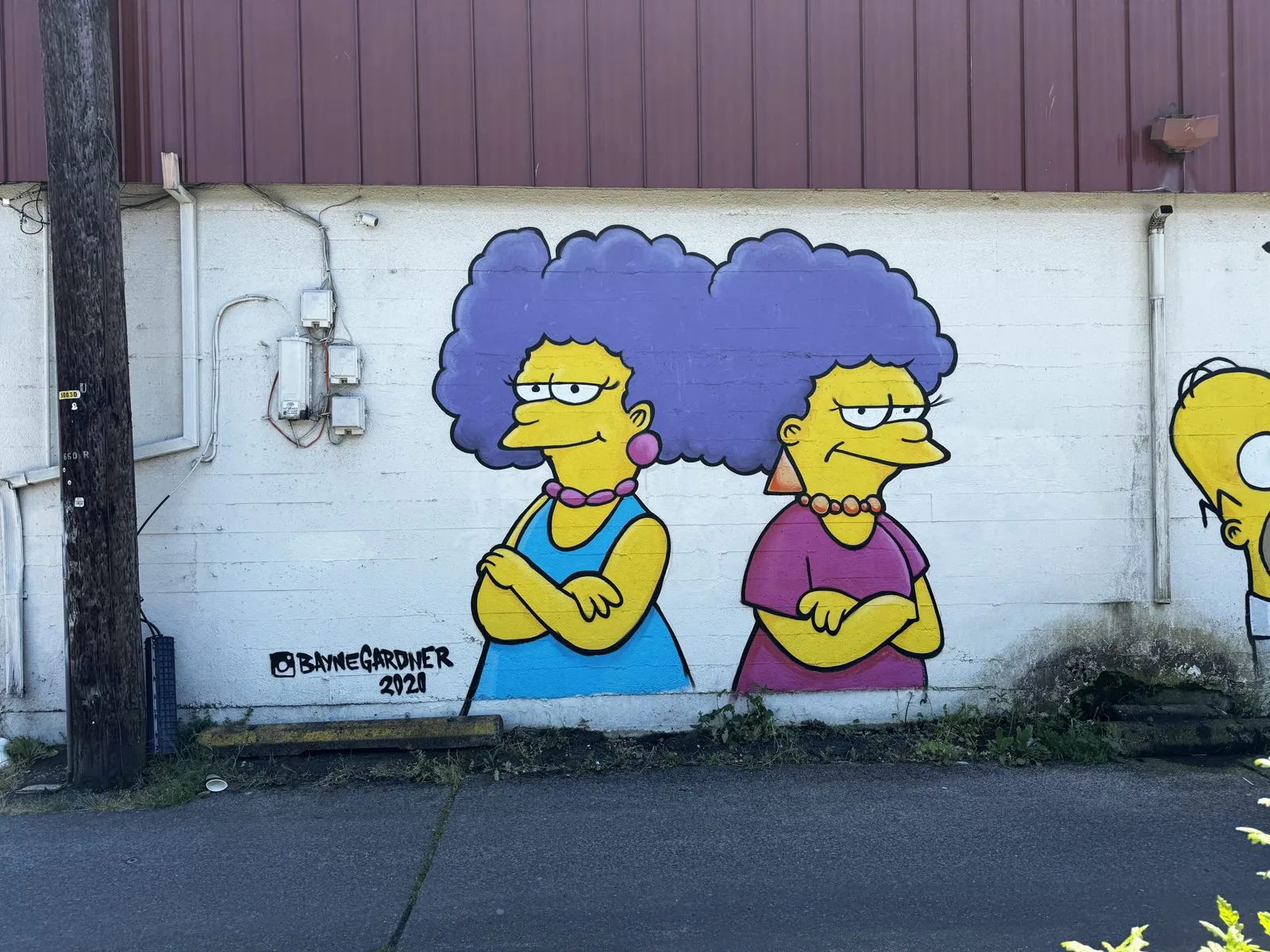
By this point we had worked out the rhythm of the hunt. You round a corner, scan the walls, spot a flash of yellow behind a parked truck or a power pole, and go over to stand in front of it. You try to remember the episode, take the photo, and look for the next one. The streets were nearly empty on a Sunday afternoon; we had most of the walls to ourselves.
Aliens and three-eyed fish
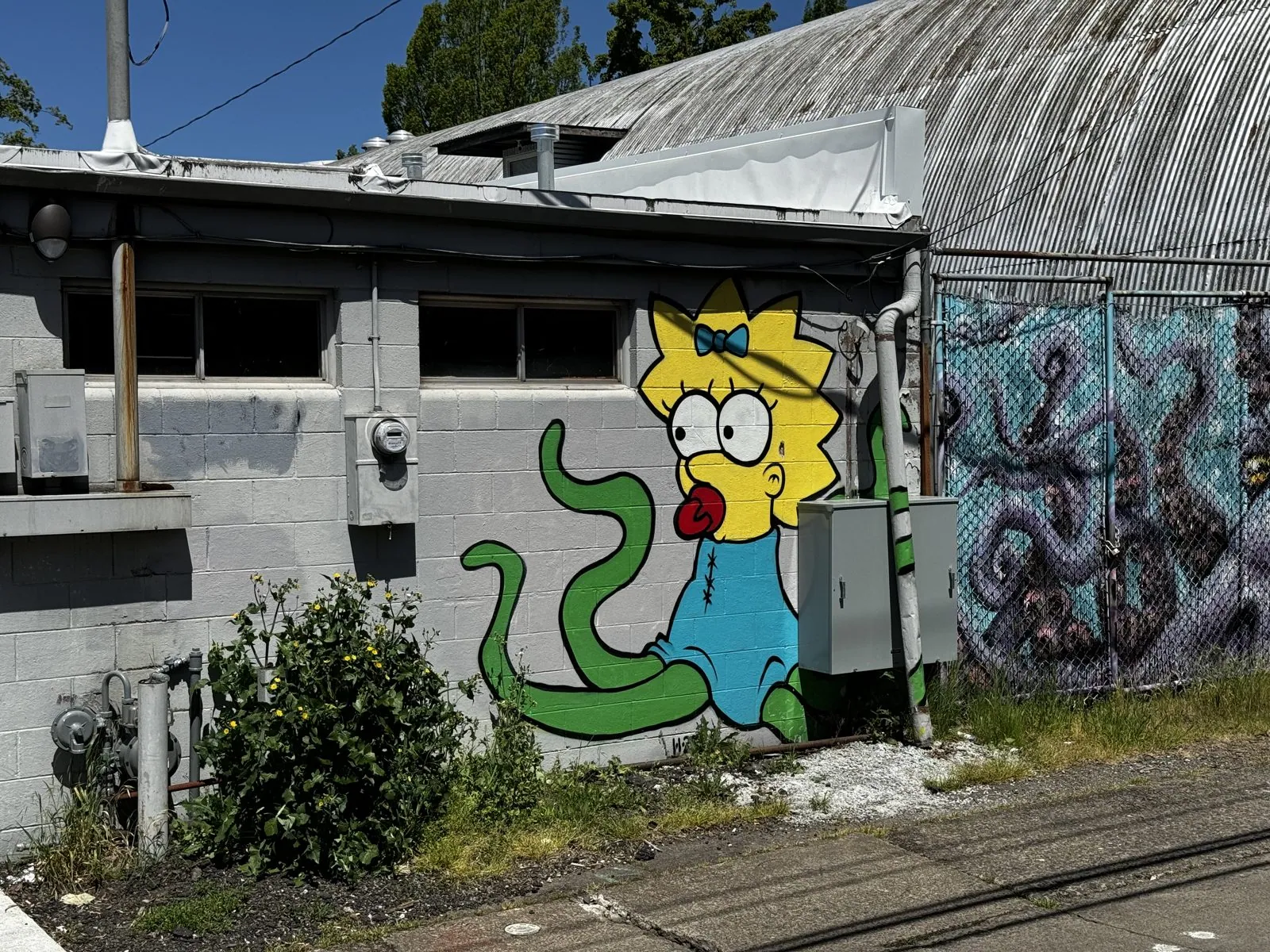
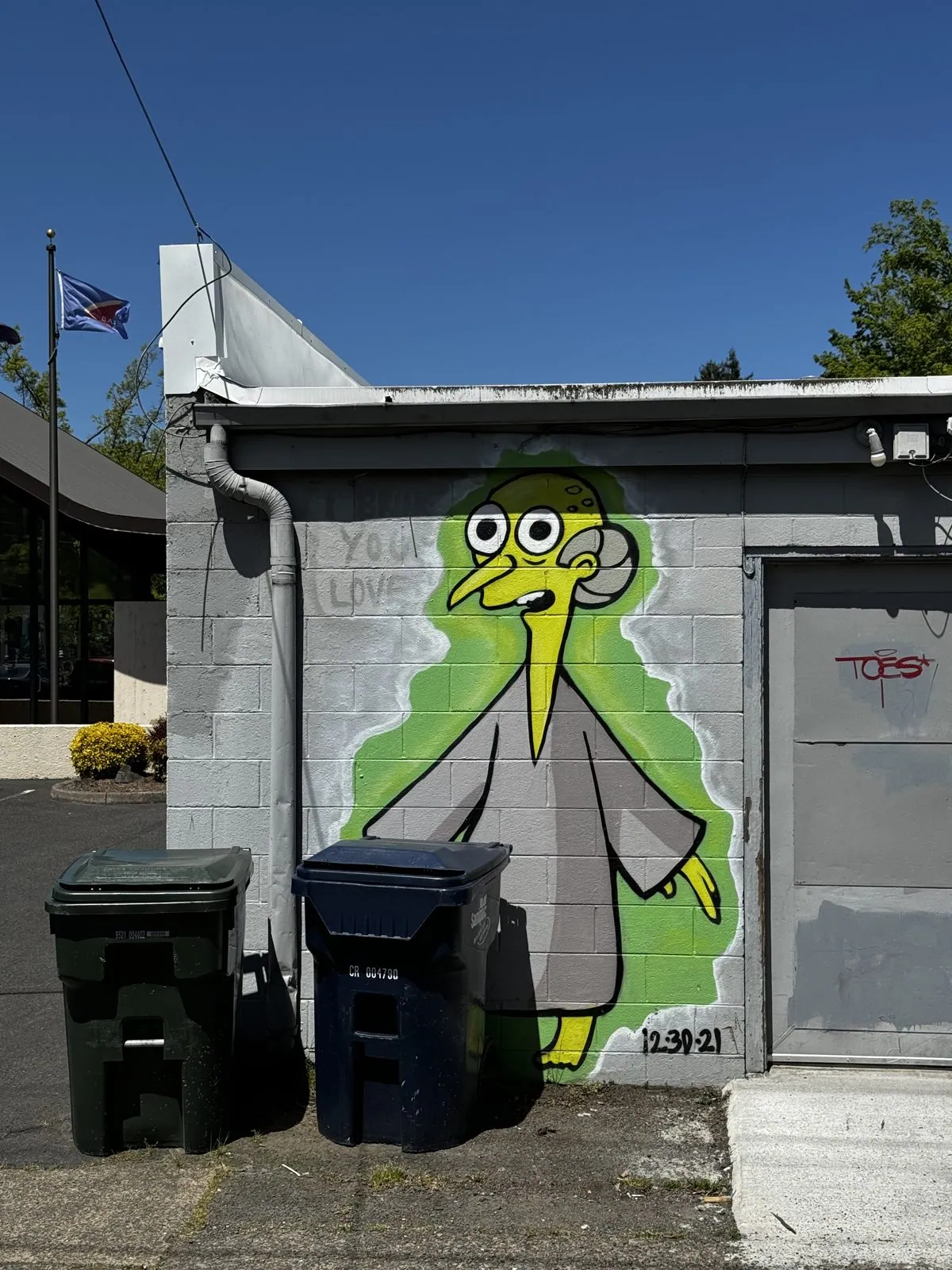
The next stretch, off Main Street, was a run of the show's stranger side. Baby Maggie sits on a gray block wall with a green tentacle curling out from under her: a reference to the Halloween episode in which Marge reveals that Maggie's real father is Kang, the drooling one-eyed alien. Around the back of a small building, Mr. Burns glows a radioactive green in a long gray robe, with sunken eyes and a vague smile. That is from the episode in which a "space alien" terrorizes Springfield on Friday nights and turns out to be Burns after his weekly treatment to stay alive. The mural is dated 12-30-21.
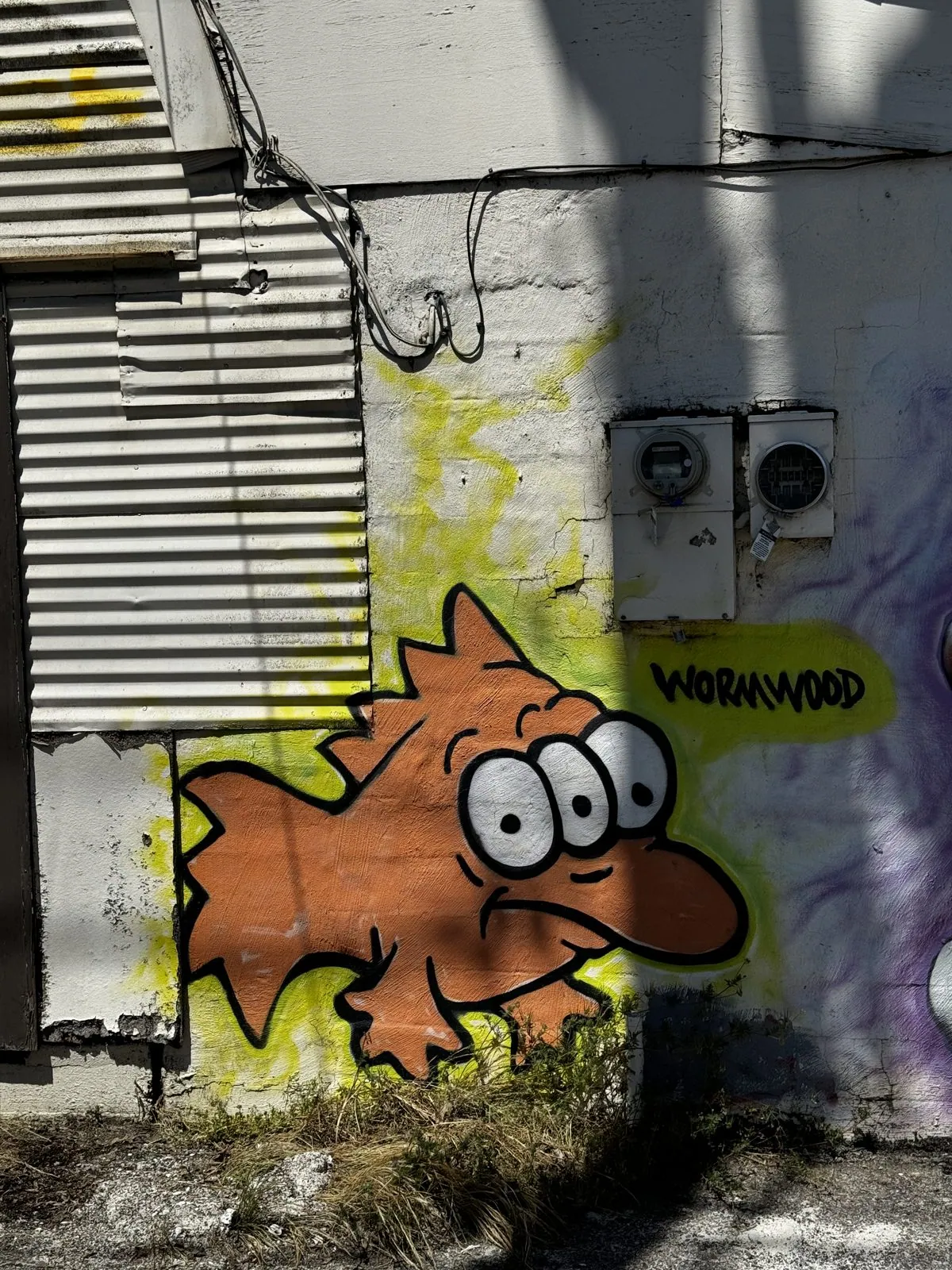
Next to it, on a wall streaked with yellow paint and shadow, another three-eyed fish glowers under the word "Wormwood". That is the name of the star in the Book of Revelation that falls from the sky and poisons the waters, which is a very literate way to make a joke about Blinky.
The glowing Burns stands between two trash bins, in front of a door, under a flagpole. It is a perfectly ordinary corner of a small American downtown, which is what makes him so unsettling. The show's Springfield has always been an ordinary town where extraordinary nonsense happens on a weekly basis, and this corner gets the balance just right.
The couch
Then came our favorite. On the dark gray side of a building, under a reserved-parking sign and a "Van Accessible" sign, is a lime-green couch, and on it lies Homer, in his underpants, asleep, mouth open and drooling, a can balanced on his belly. The couch is the most famous piece of furniture on television; the show has opened with the family rushing to it for more than thirty years. Here it is painted exactly where the van-accessible parking space is, so that the sign reads like a placard for Homer himself. Reserved parking, indeed.
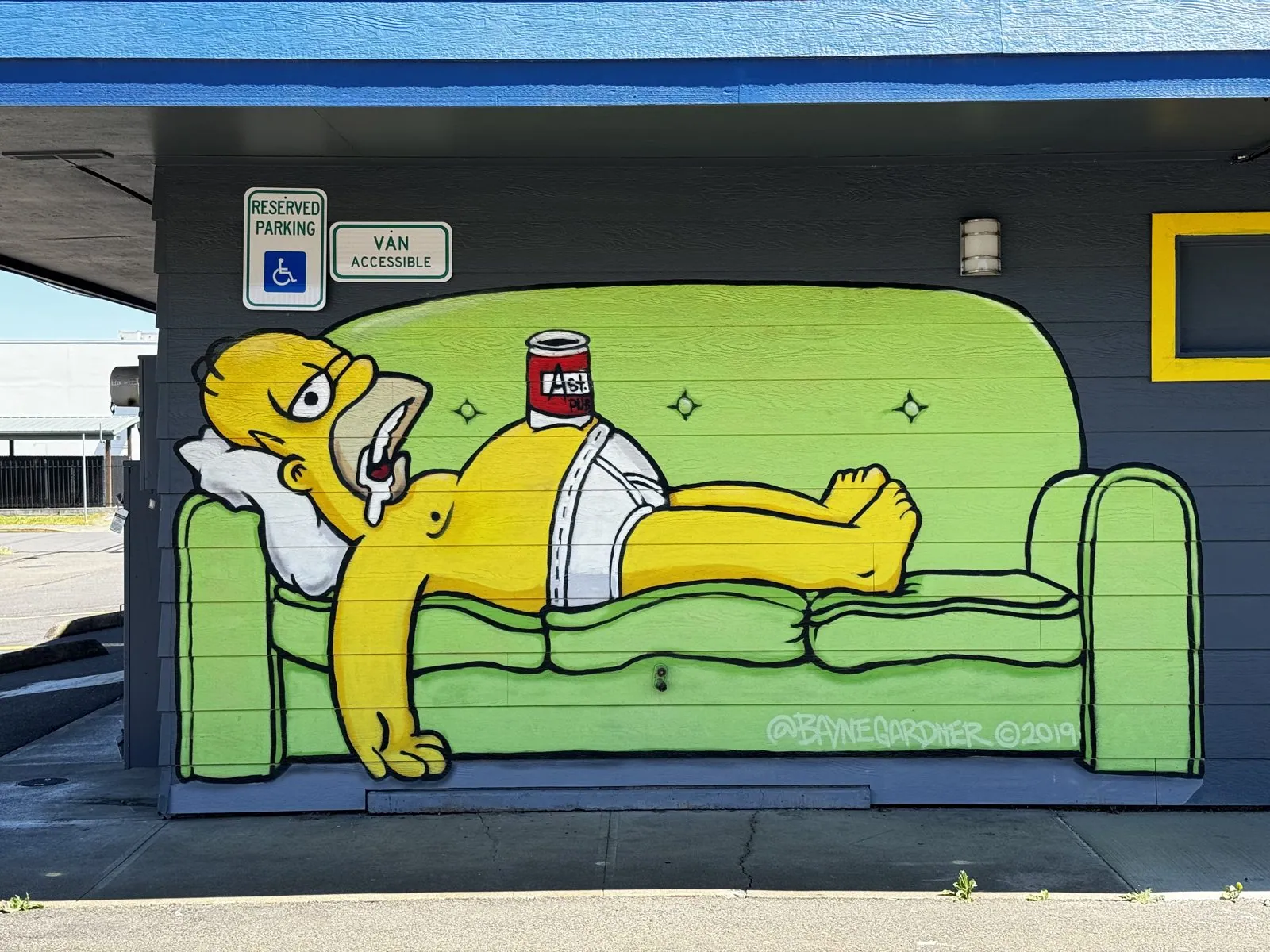
It is signed and dated 2019, one of the oldest on the walk. The paint was still bright, and the sidewalk in front of it was empty and sunlit. If there is a single image from the day that sums up both the show and the town, it is this one: a man asleep on a couch, painted on a wall facing a parking lot, completely at peace.
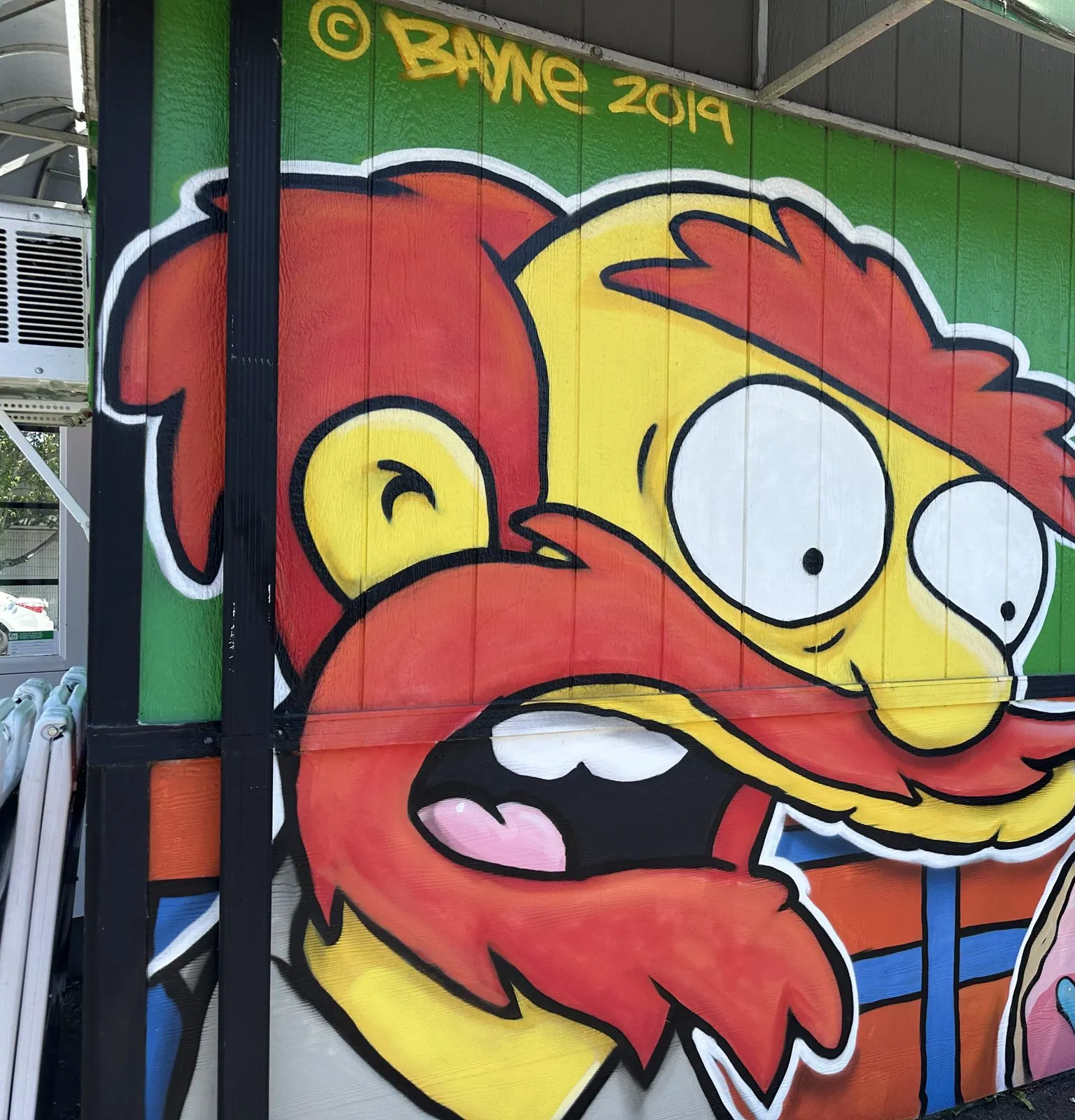
A few minutes later, Groundskeeper Willie, enormous and open-mouthed, stared out of a green wall signed "© Bayne 2019".
Springfield in the woods
On Main Street itself, across the whole side of a tan two-story building, is the biggest and most elaborate mural of the day, and it is different from the rest. Instead of one or two characters on a blank wall, it is a full scene, painted in the show's own polished style. The family is in an Oregon forest. Tall conifers rise into a blue sky, snowy peaks line the horizon, and on a green hill in the middle stands a "Springfield" sign in white letters, exactly like the Hollywood sign. Marge paints at an easel on the left. Homer lies in a hammock strung between two huge trunks, a can in his hand and a beaver gnawing at the base of one of the trees, which seems unwise. Bart crouches on a branch above him with a water balloon, Lisa rides by on a bicycle, Maggie in a helmet rides in a seat behind her, and an owl watches the whole thing from a branch.
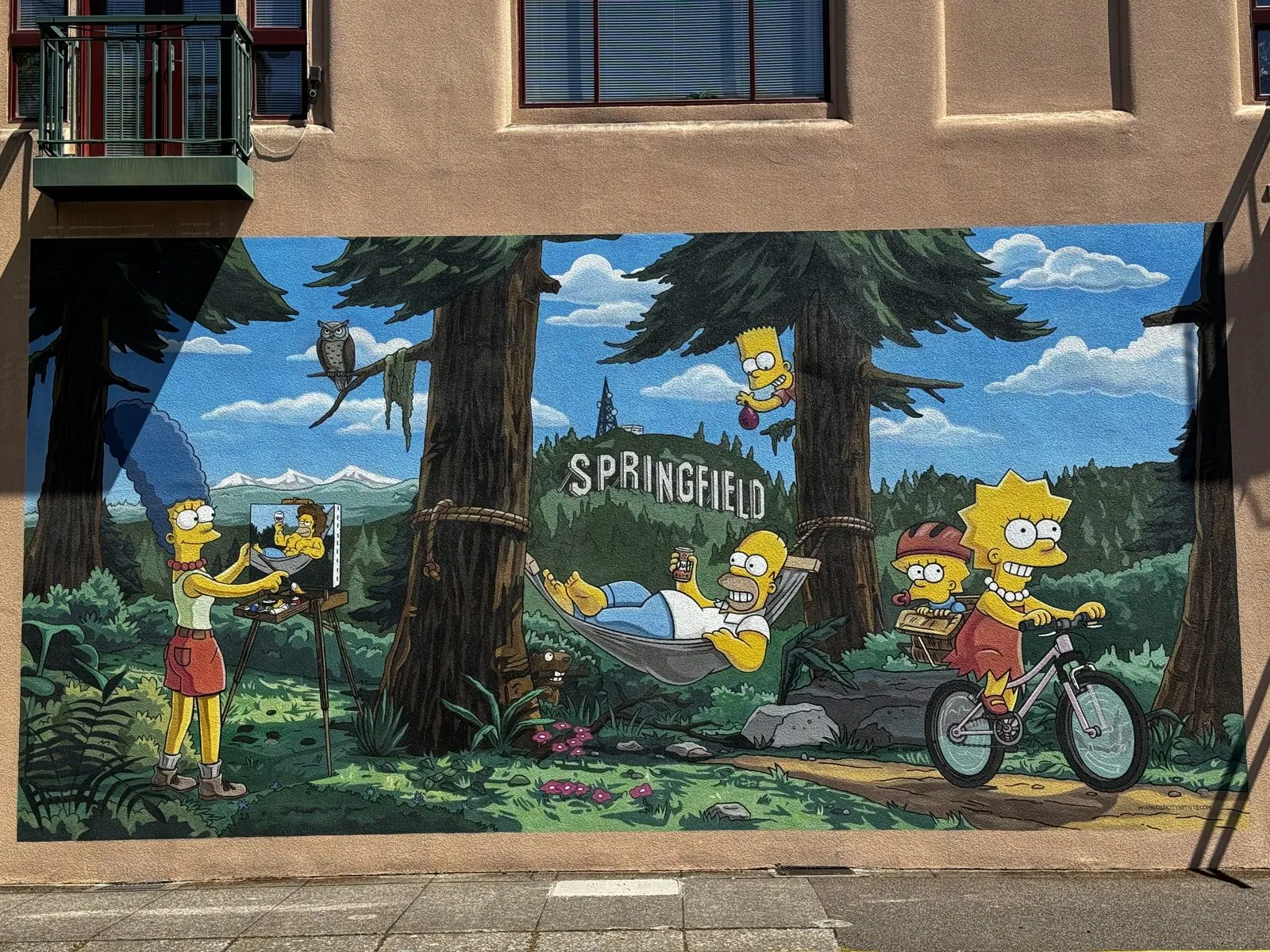
It is the one mural on the walk that feels like an official statement: the show's family placed, at last, in its namesake's landscape of firs, rivers and mountains. The shadow of a building cut diagonally across the left side of it while we stood there. We took two photos, a few seconds apart, as if the second might somehow capture more of it.
A Treehouse of Horror
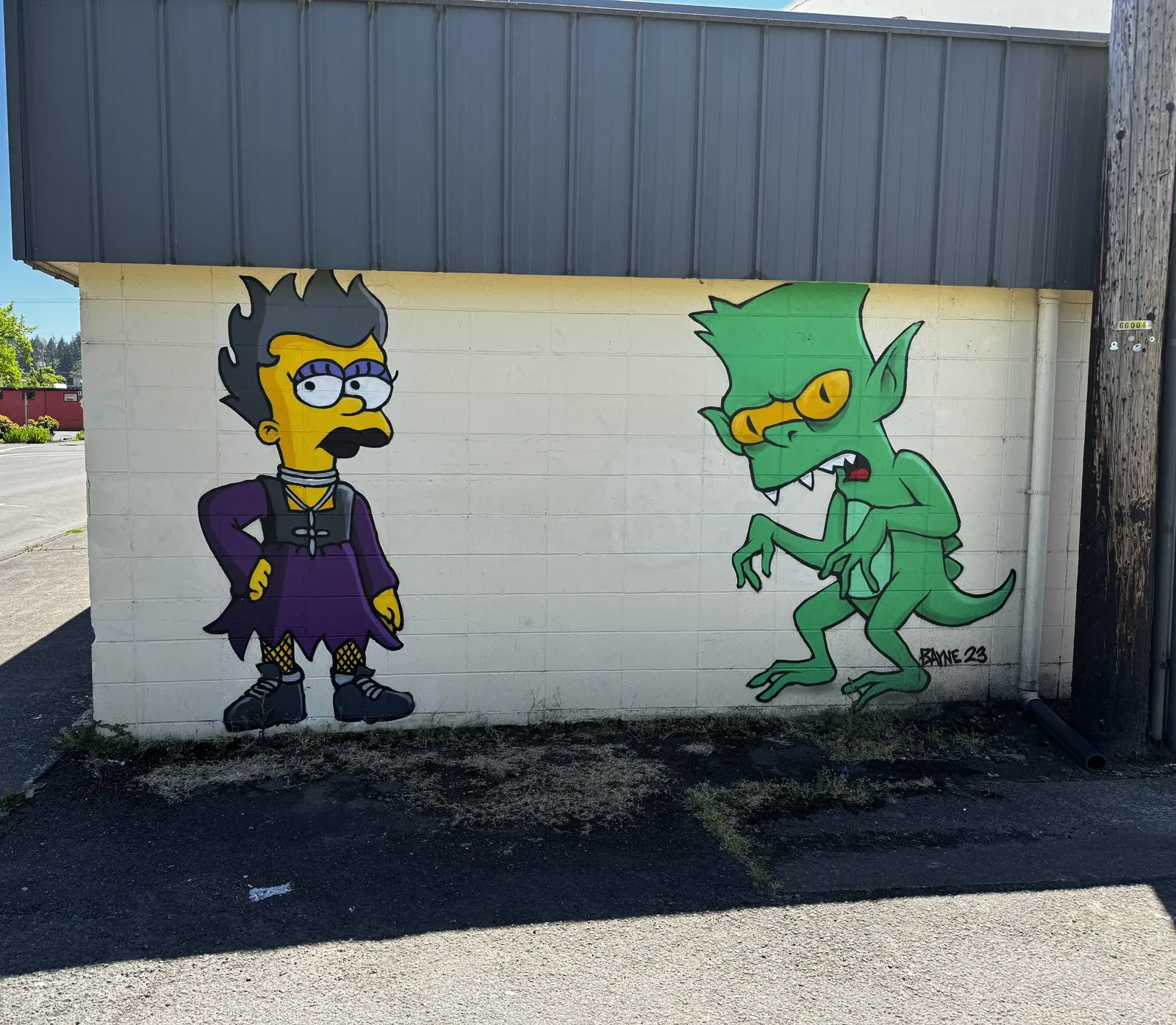
A few blocks north, ten minutes later, on the side of a low cream building on a quiet corner, is a pairing straight out of the show's Halloween specials. On the left is a goth in a ragged purple dress, black corset, choker, fishnets and heavy boots, with a crest of gray hair. On the right, a green gremlin with yellow eyes and fangs crouches, mid-snarl, its claws out. He looks like the gremlin from the "Treehouse of Horror" segment in which Bart spots a monster tearing at the school bus. The mural is signed "Bayne 23", among the newest on the walk.
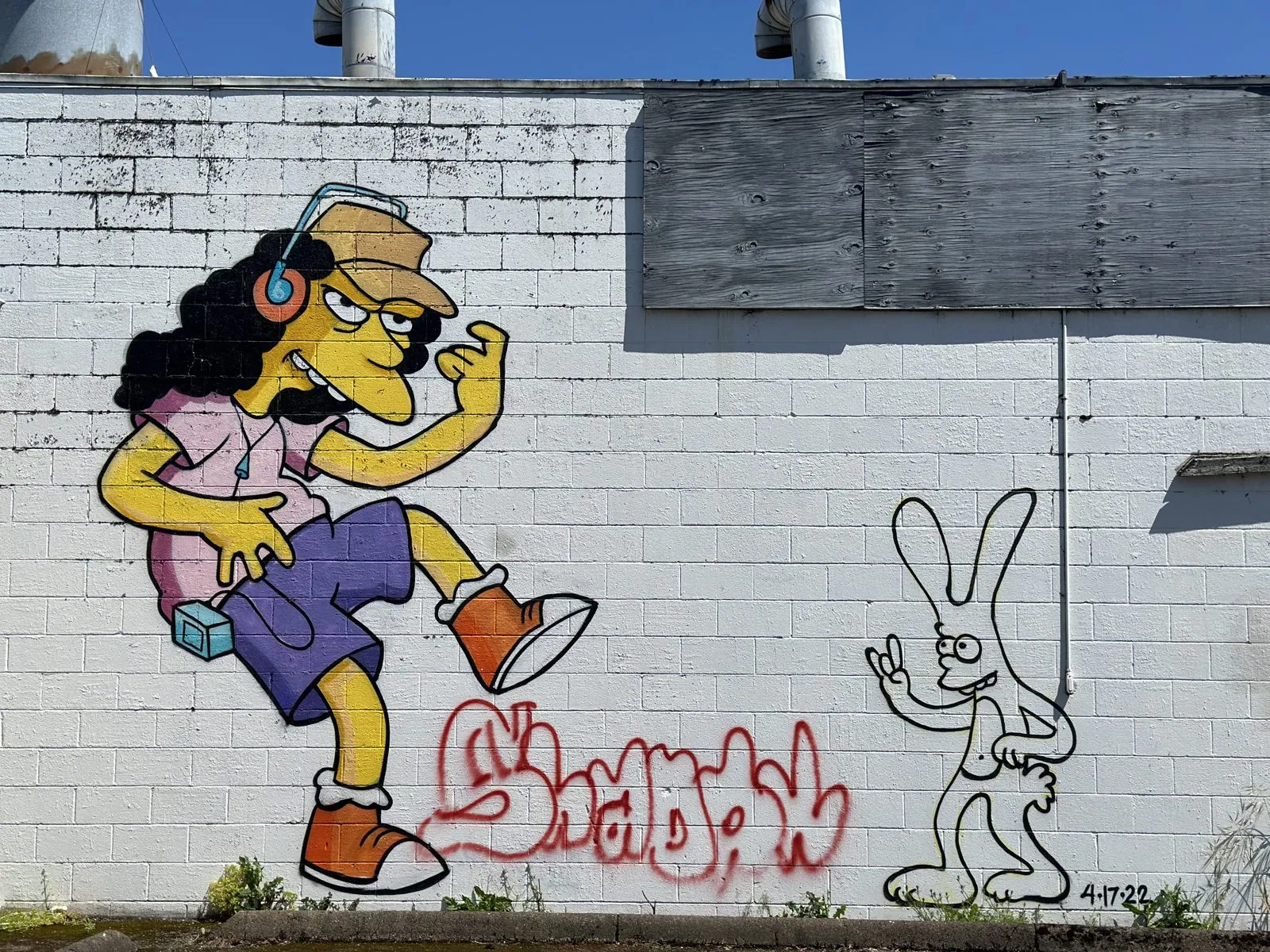
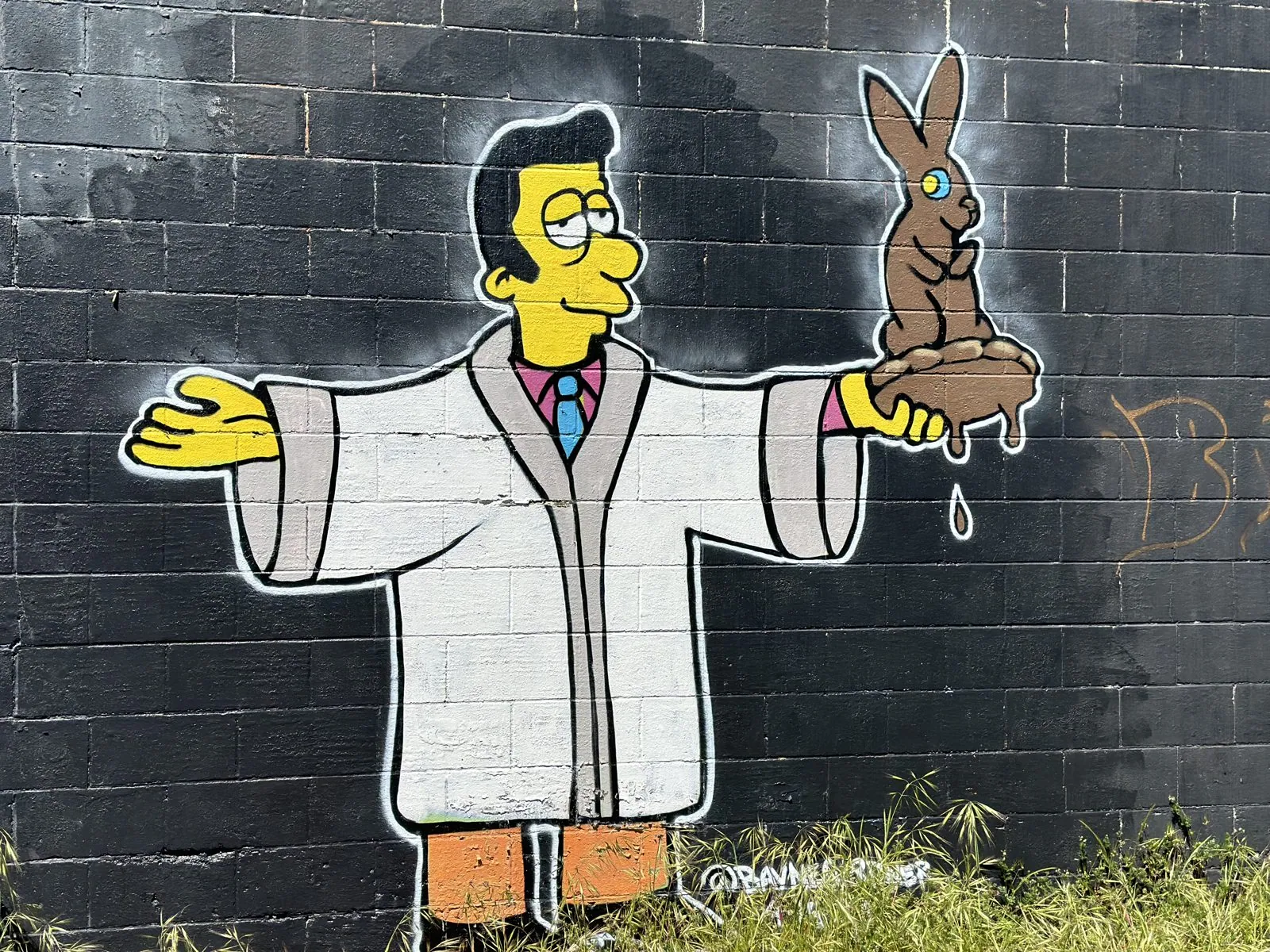
Before the alleys we made a loop east, where the murals are farther apart. Otto, headphones on, kicked his way across one wall beside a white rabbit, and on a black wall nearby a man in a white robe held up a dripping chocolate bunny.
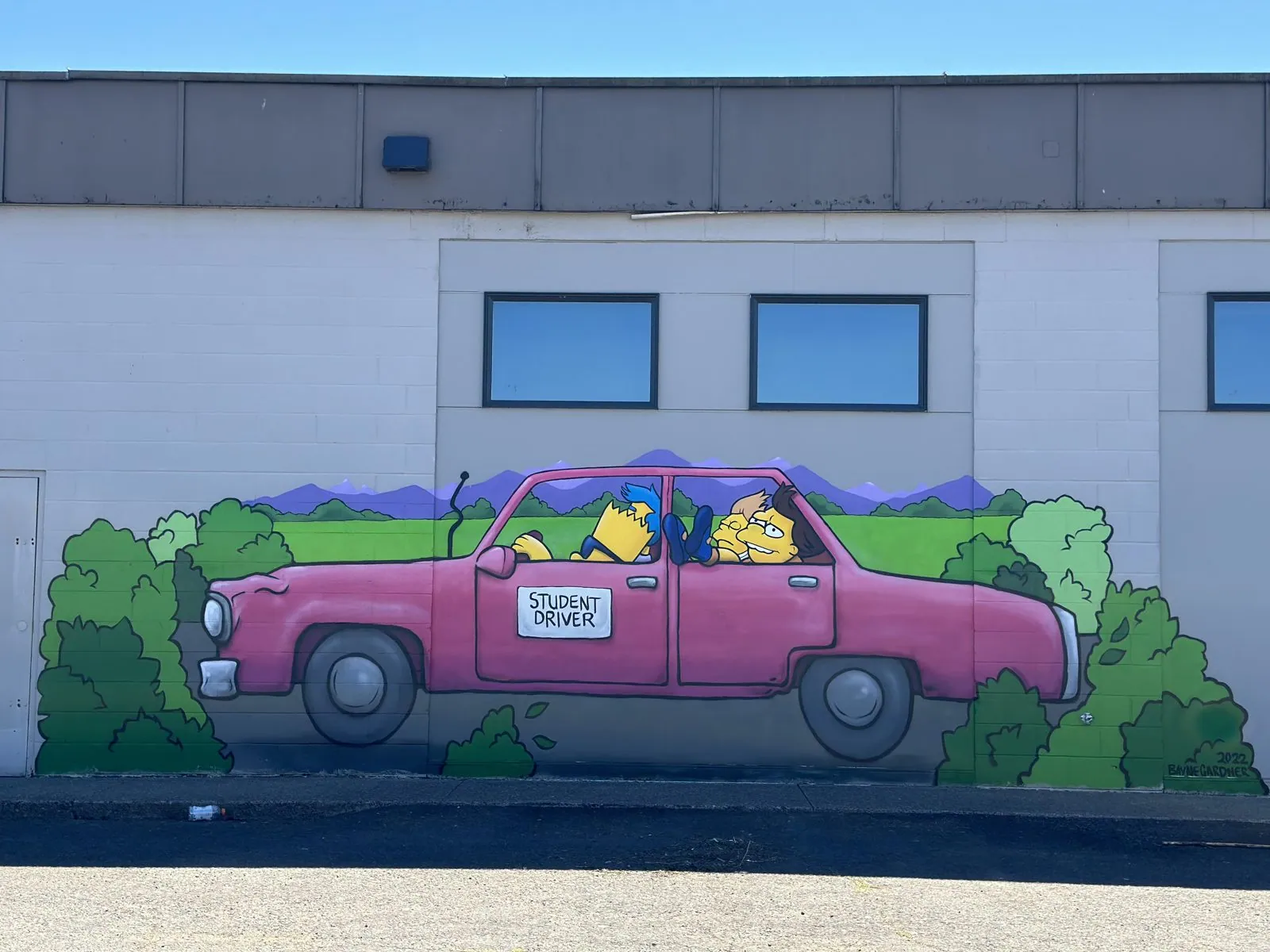
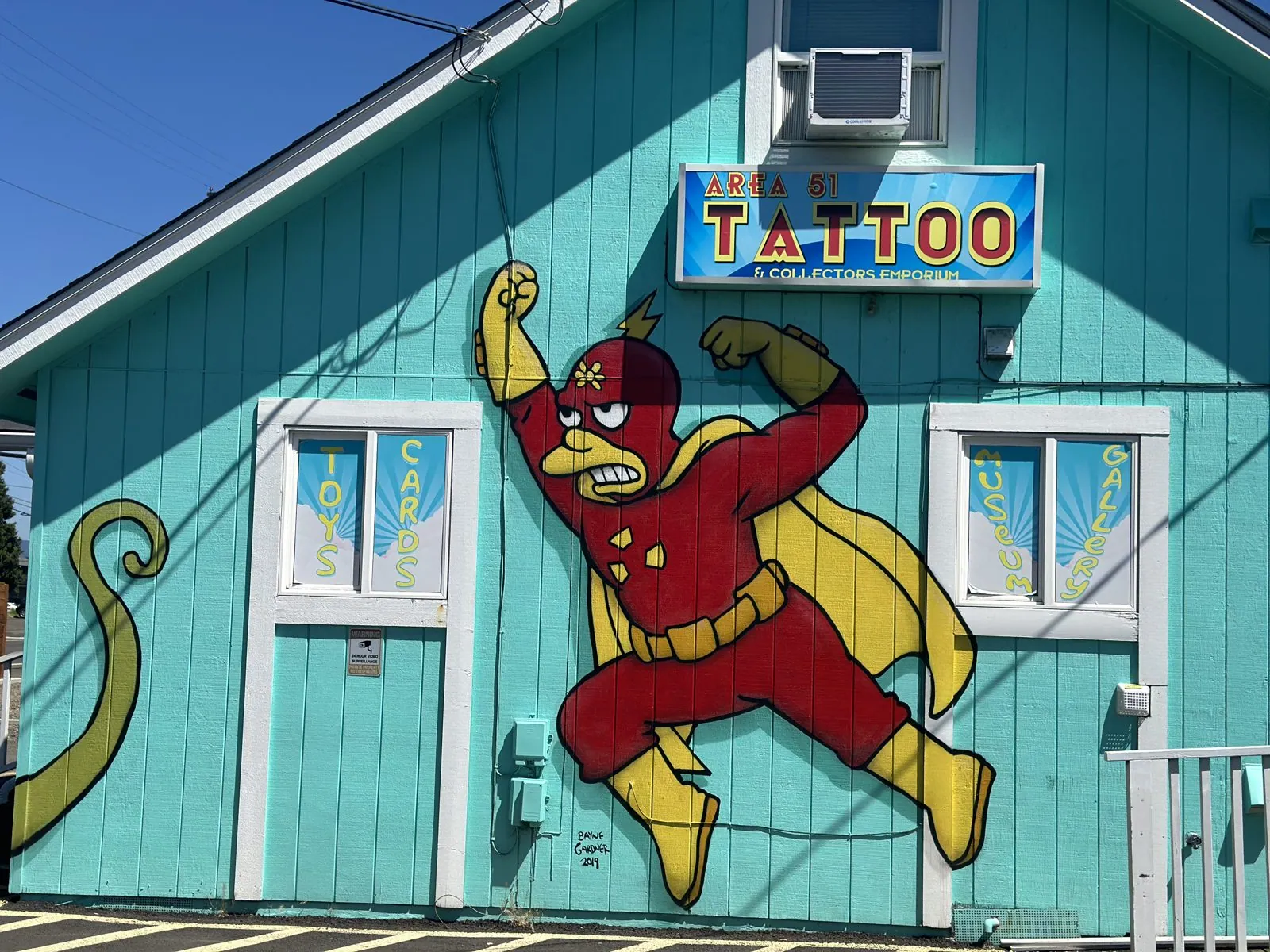
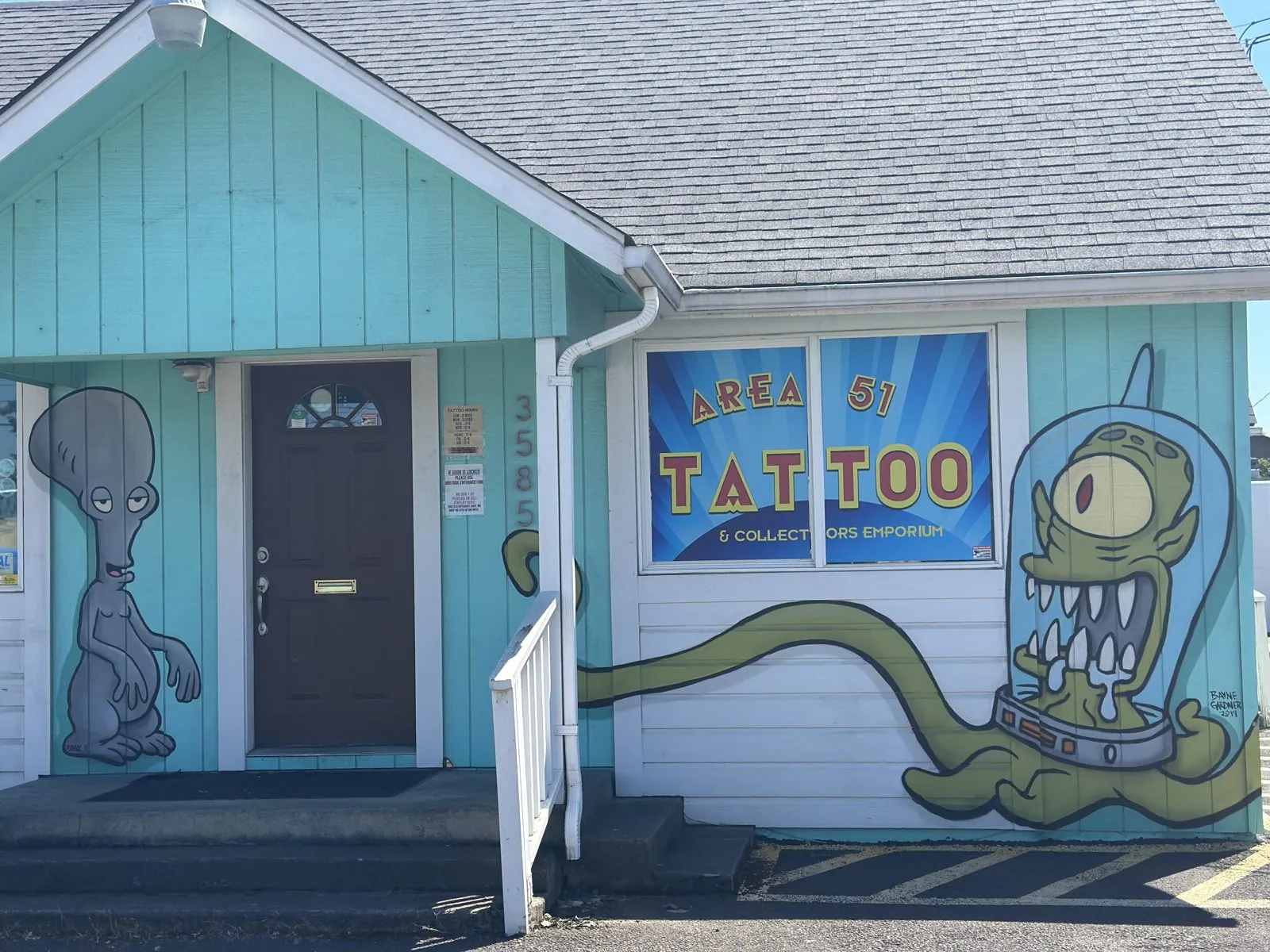
The family's pink sedan, with a "Student Driver" sign on the door, drove past painted hedges on another wall. Radioactive Man flexed on the side of a tattoo parlor called Area 51.
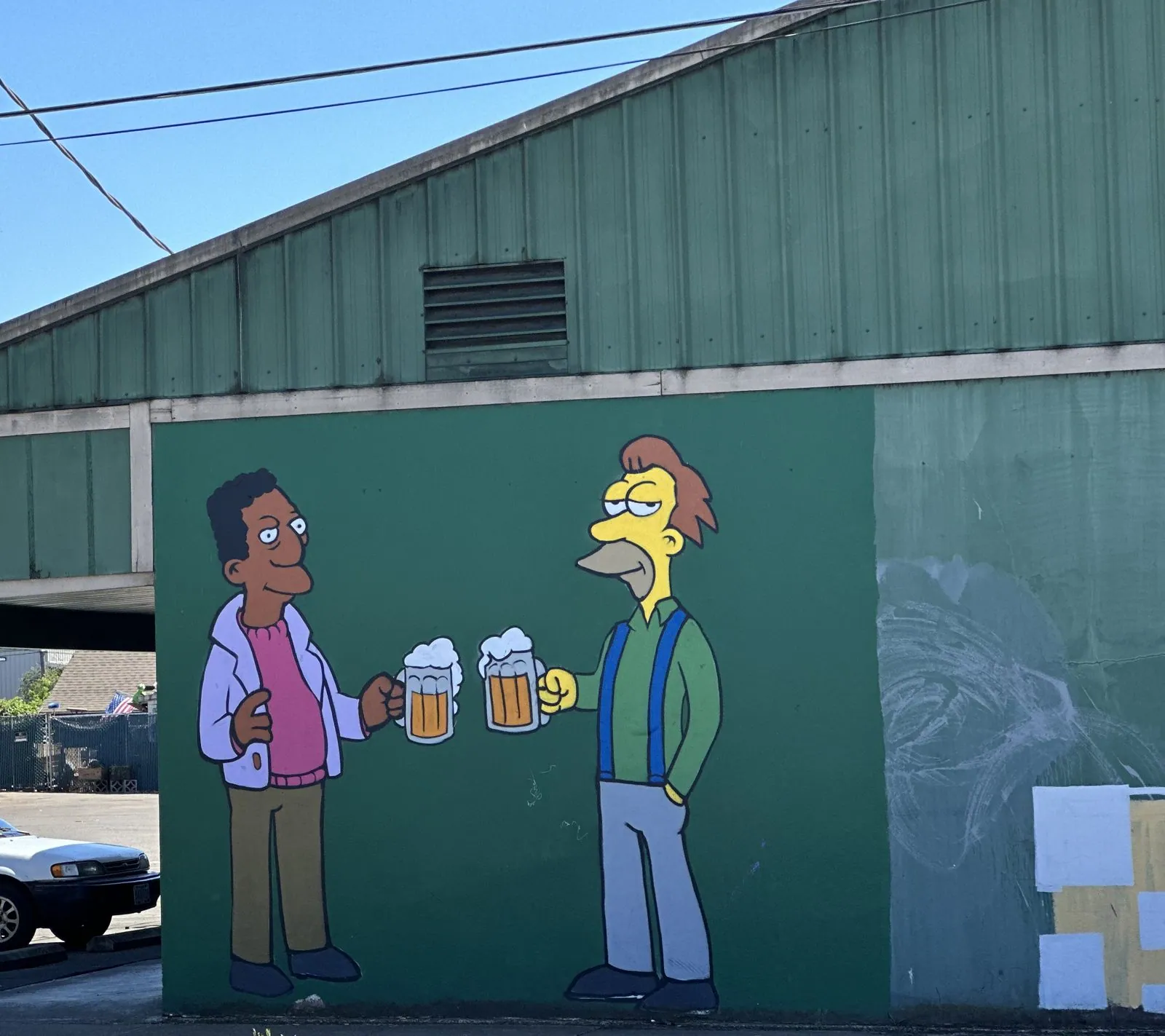
The parlor's front wall, naturally, belongs to aliens: a gray one by the door and a tentacled one in a glass dome. Nearby, Lenny and Carl raised their beers on a green wall.
The graffiti alley
The walk ended where it seemed to have been heading all along: in the alleys just south of Main Street, where the murals stop being polite. The first thing you see from the street is Krusty the Clown, grinning across a long wall of red-and-white stripes, with stars for eyes, rainbow hair dripping like melted ice cream and a red, white and blue lightning bolt across his face. Two small square windows on either side each frame a grinning green elf. It is dated 2019, and it is loud.
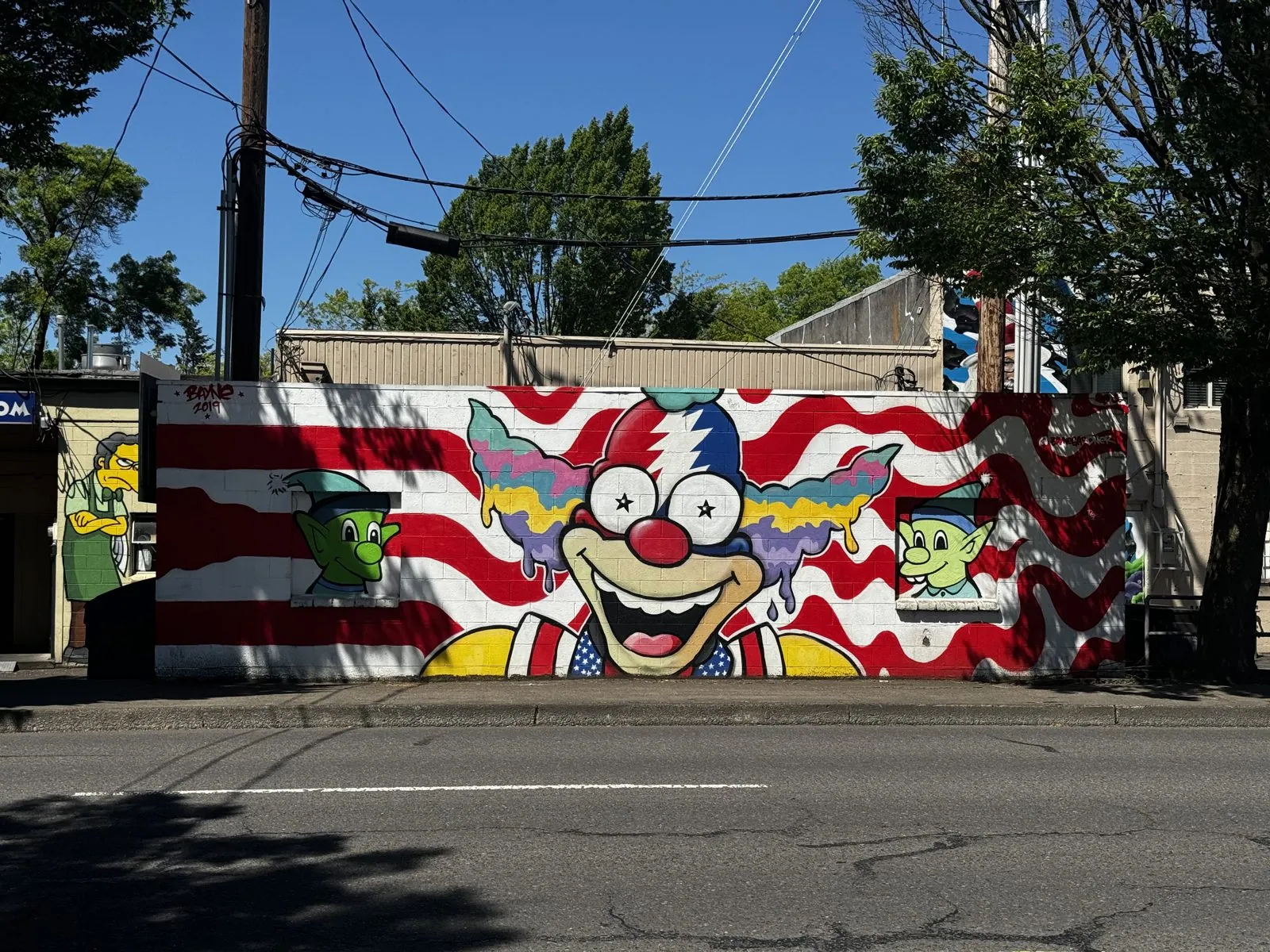
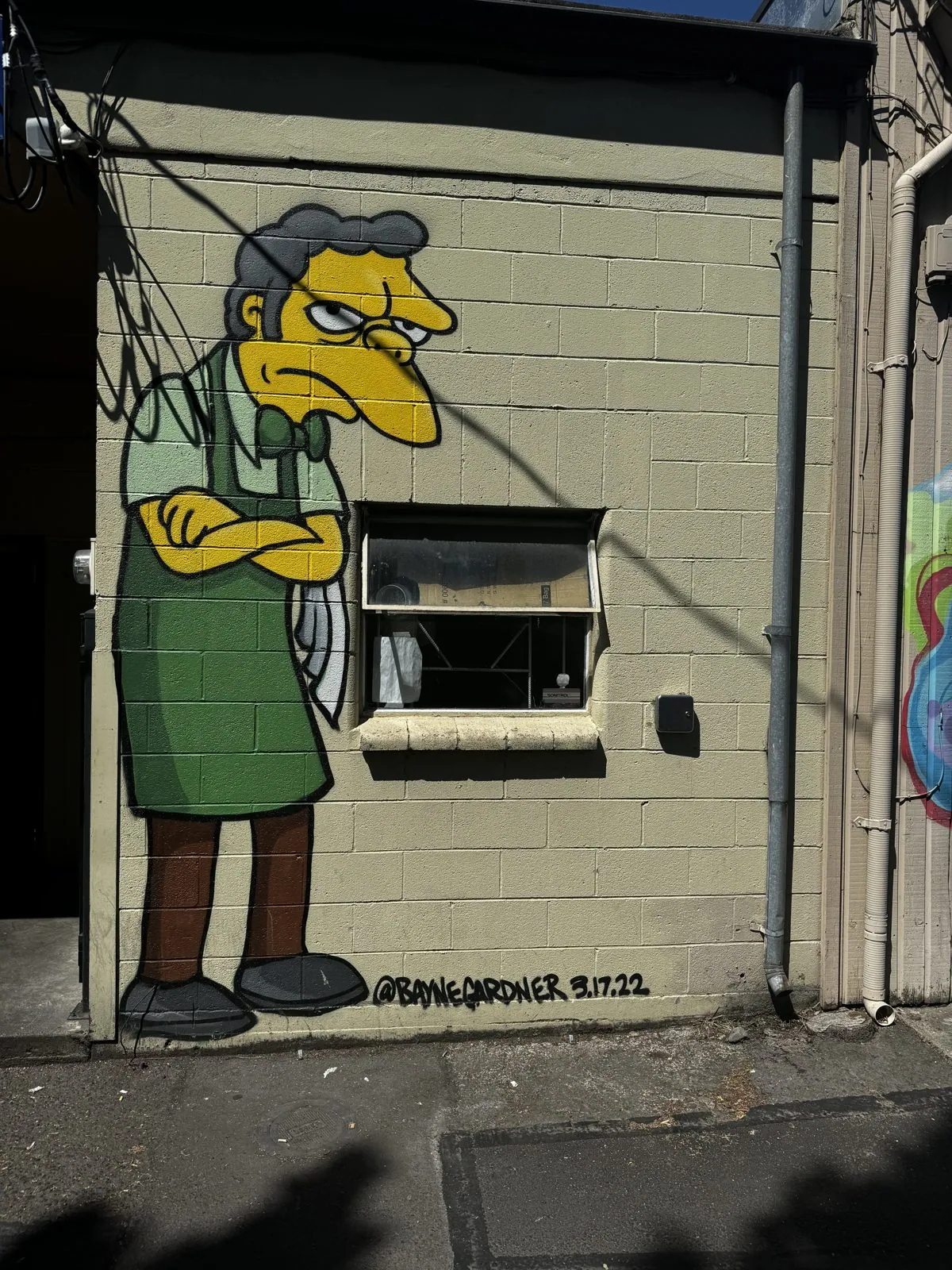
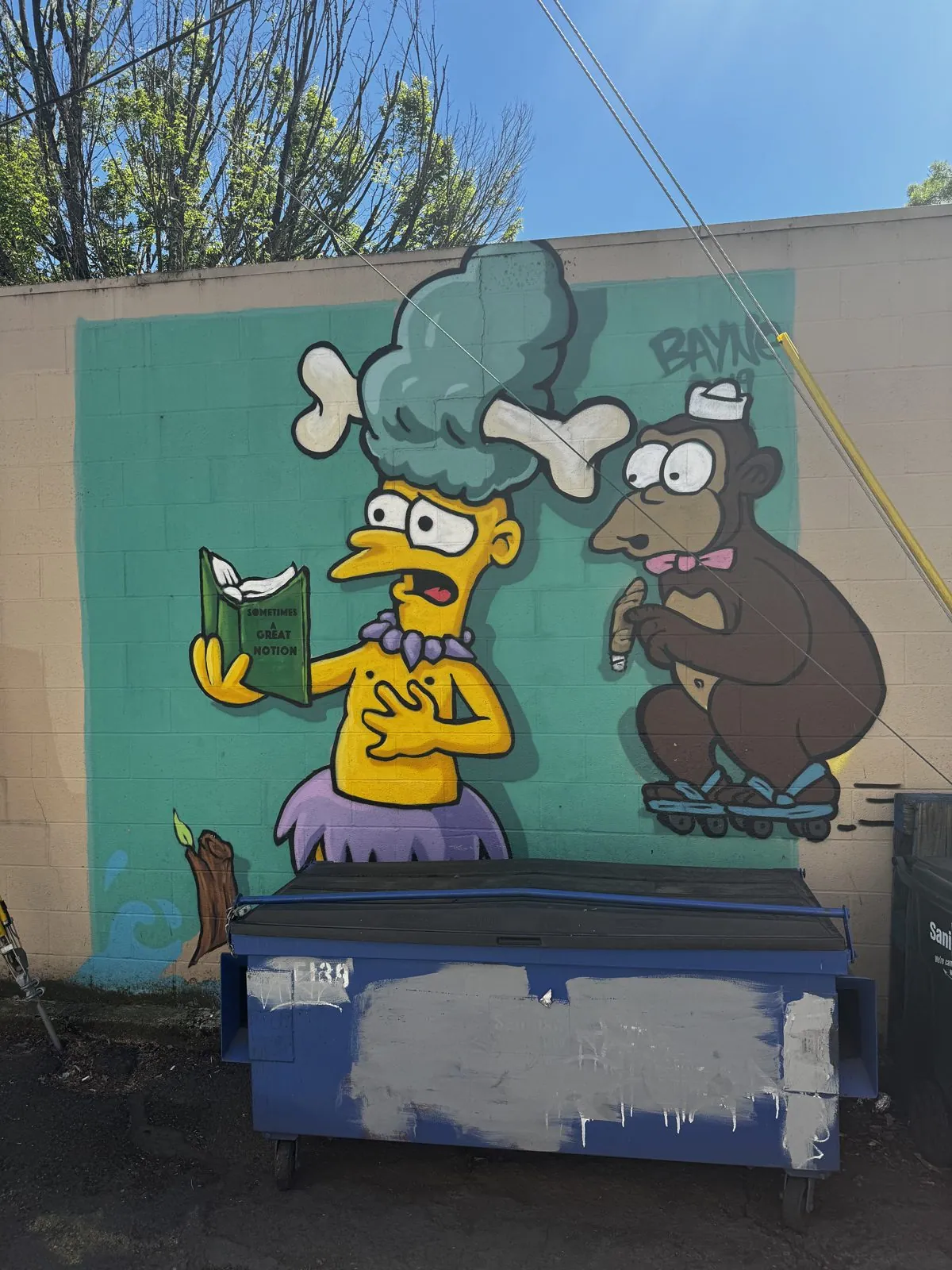
Next to Krusty, on a drab beige wall, stands Moe in his green apron, arms crossed and scowling. He is painted right beside a real window with a small sill, so it looks as if he has stepped out of his bar to complain about you. If the lore is right, we had been drinking in the original earlier that day. Around the back of the next building, a startling figure with a bone through her towering blue hair, a grass skirt and a necklace of shells is reading a green book called Sometimes a Great Notion, while a monkey in a sailor cap rolls past on roller skates. The book is the Springfield detail. Ken Kesey, the author of One Flew Over the Cuckoo's Nest, grew up in Springfield and went to high school here. Sometimes a Great Notion is his big novel about a stubborn Oregon logging family. It is a local reference hidden inside a cartoon reference, painted above a dumpster.
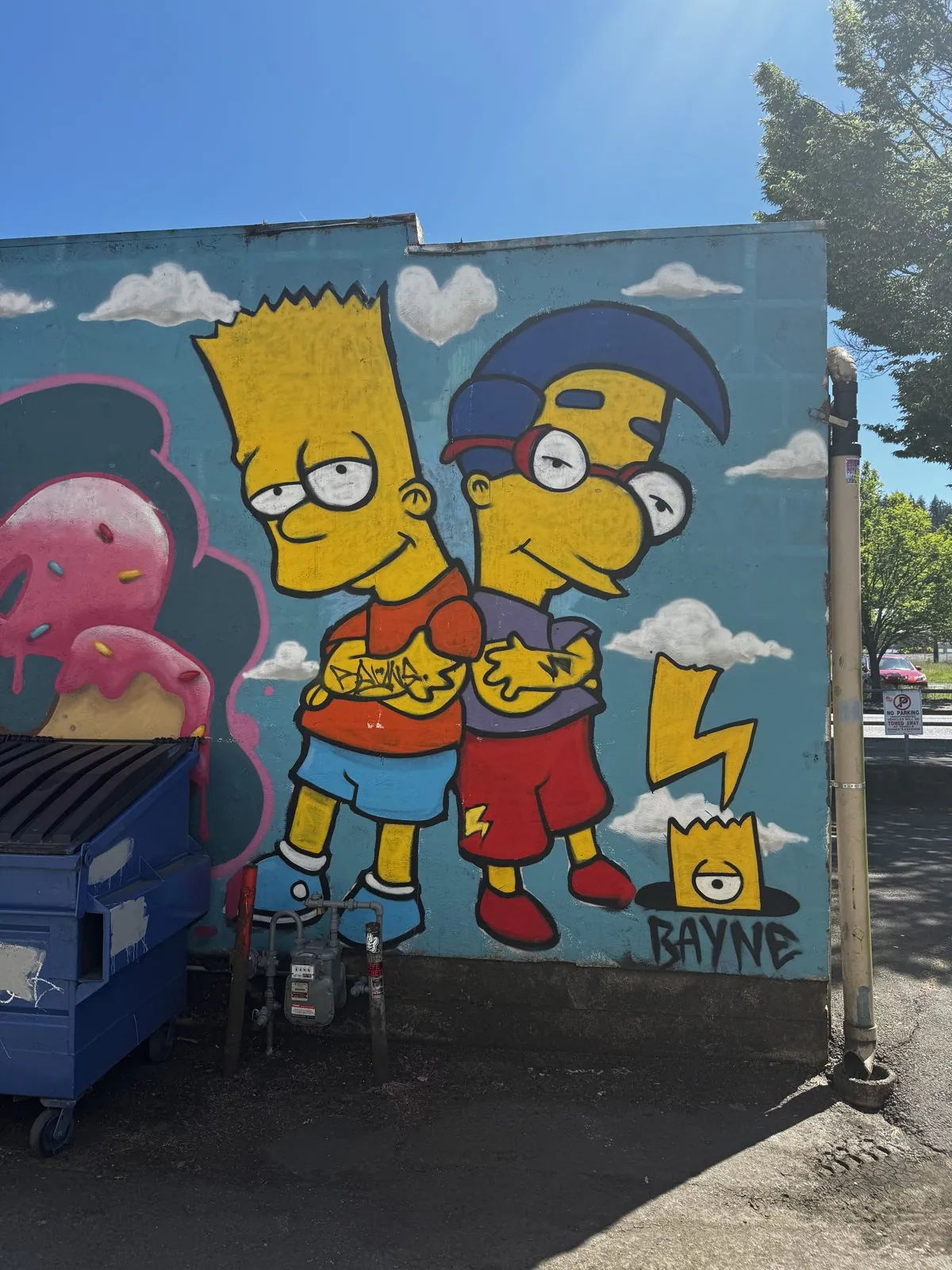
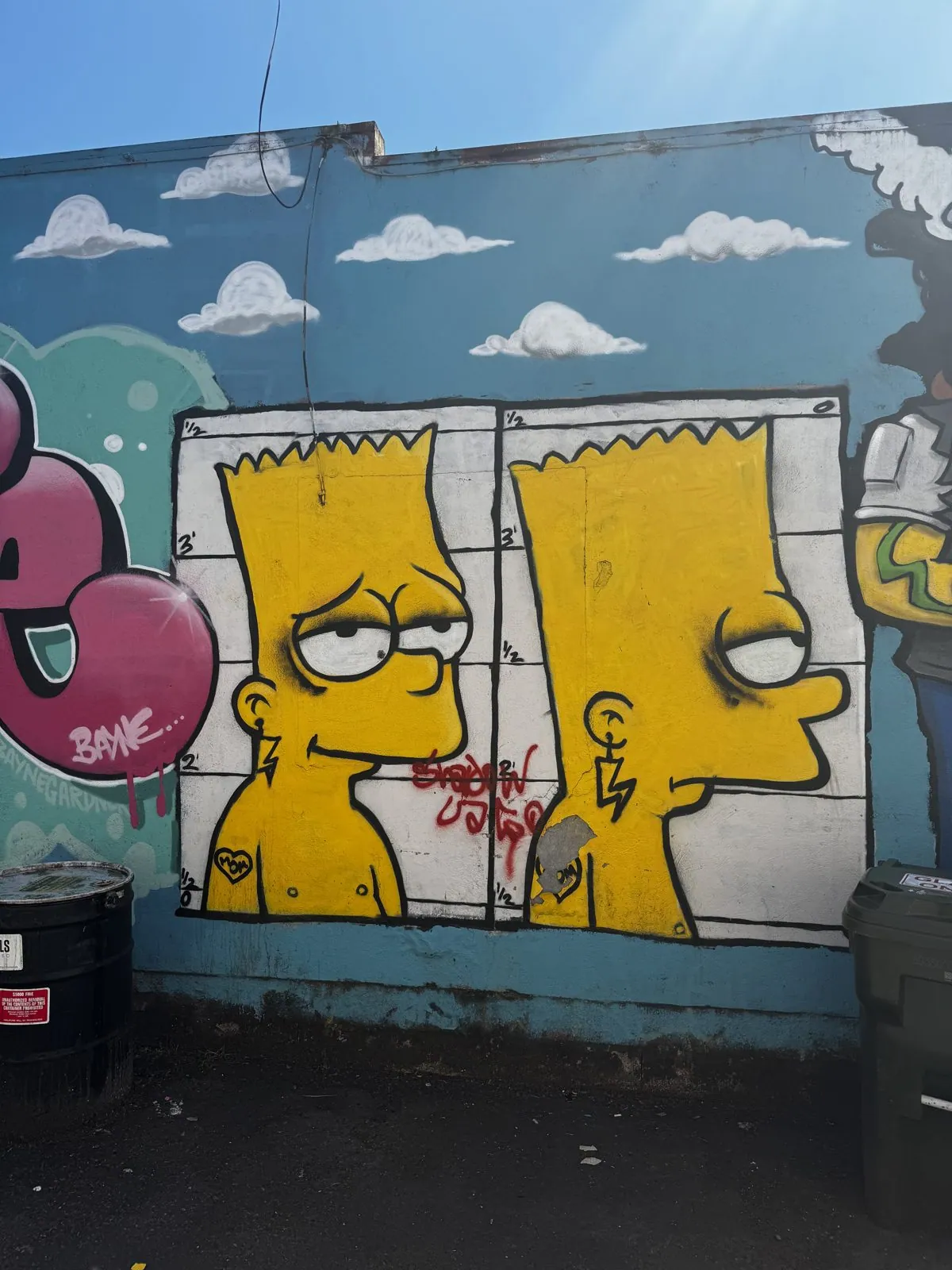
The alley behind is a continuous wall of graffiti-style murals on a sky-blue background dotted with cartoon clouds, the same clouds as the show's opening titles. Bart and Milhouse stand back to back, arms folded, looking unbothered. A little further along, two Barts are painted against a height chart, one facing forward and one in profile: a police mugshot, which, given his record, was only a matter of time. Someone has scribbled red graffiti across his chest, which only adds to the effect.
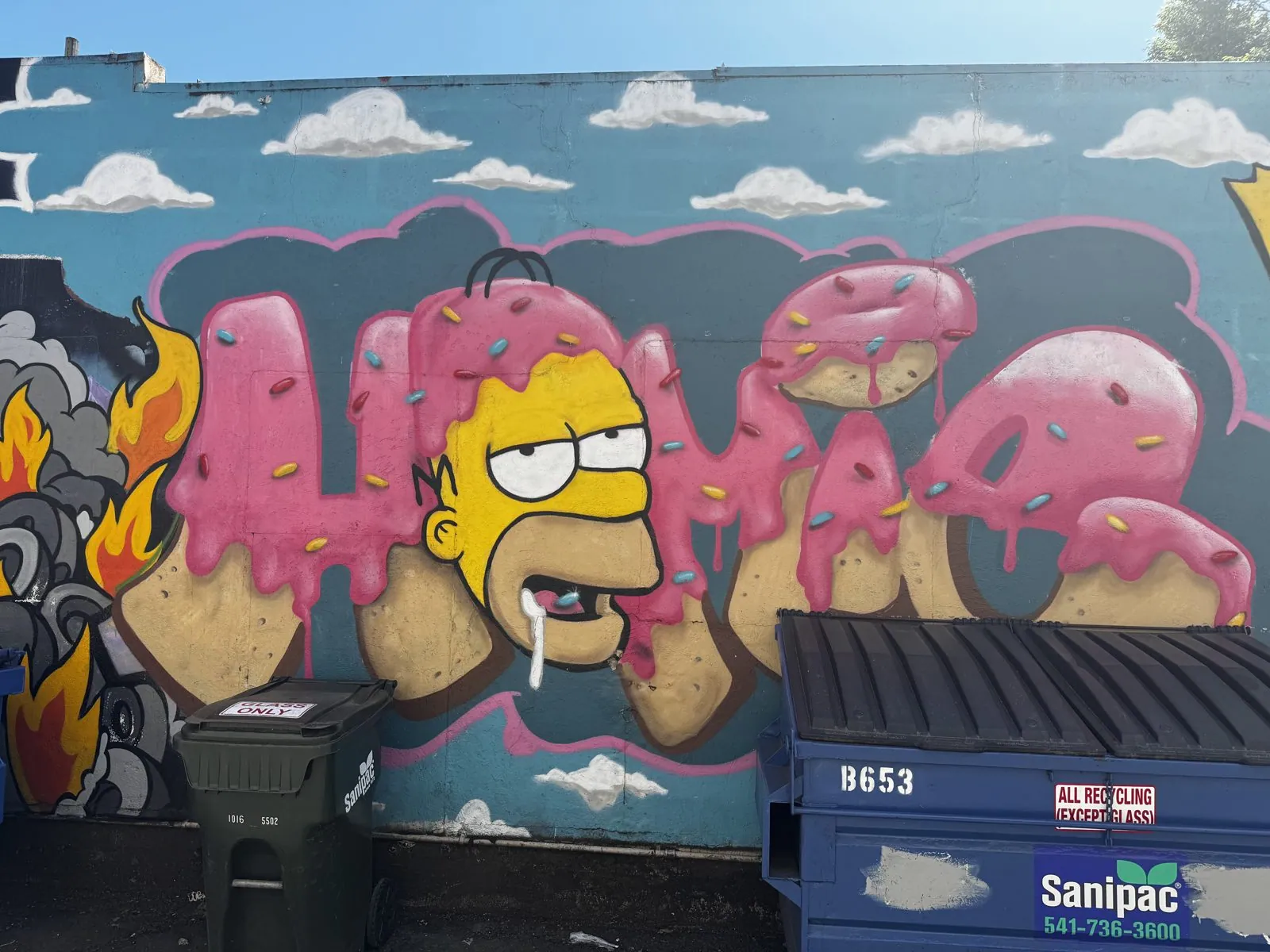
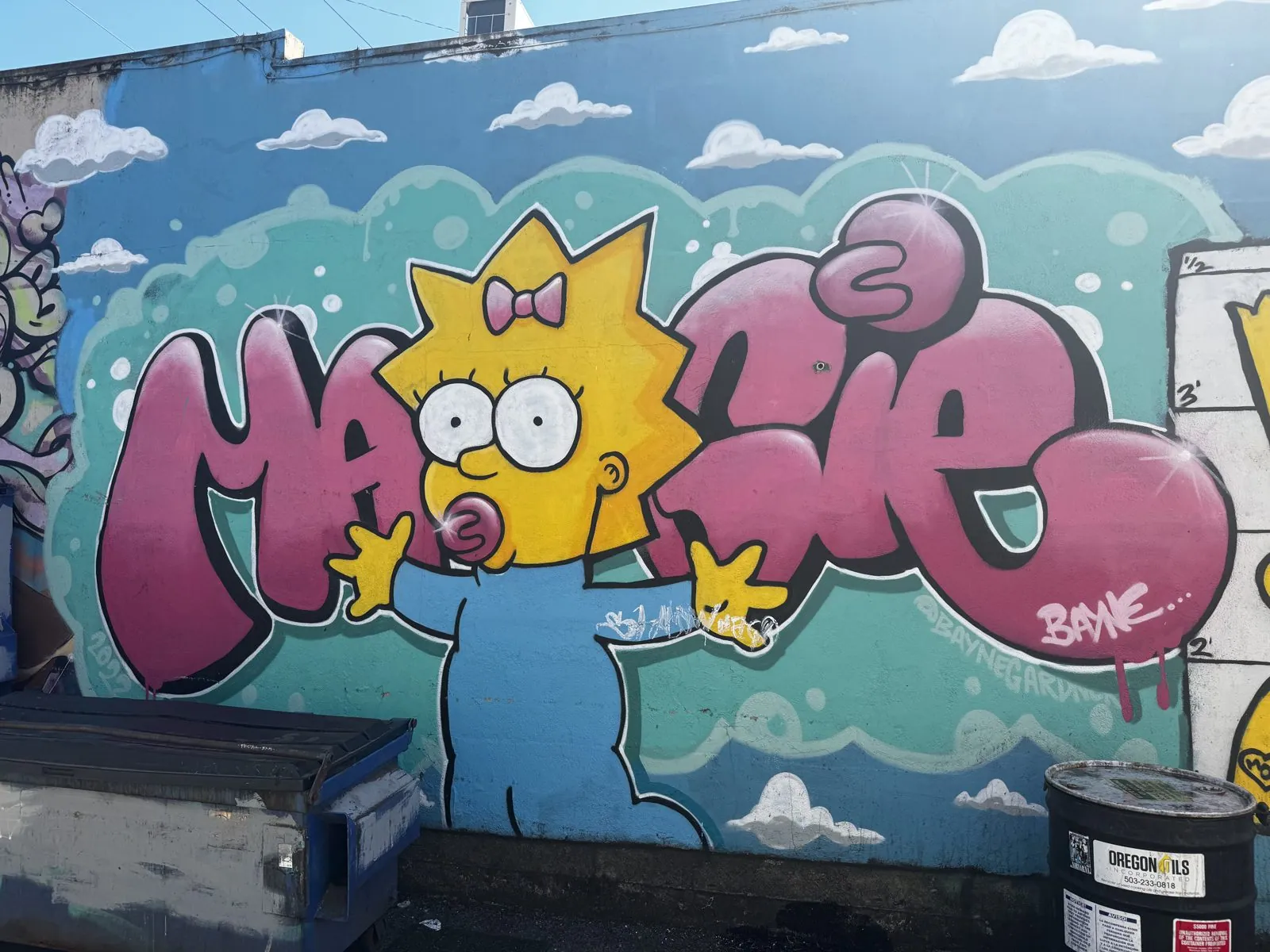
The biggest pieces are pure graffiti lettering. "HOMER" is spelled out in fat letters coated with pink frosting and sprinkles, with his head bursting through the middle, half-asleep and drooling, and flames and smoke at one end. A few yards along, "MAGGIE" is written the same way in bubblegum pink, with Maggie herself popping out of the middle, arms wide, pacifier in, as the letters sparkle around her. Both sit right behind the alley's dumpsters and recycling bins, which turn out to be part of the composition.
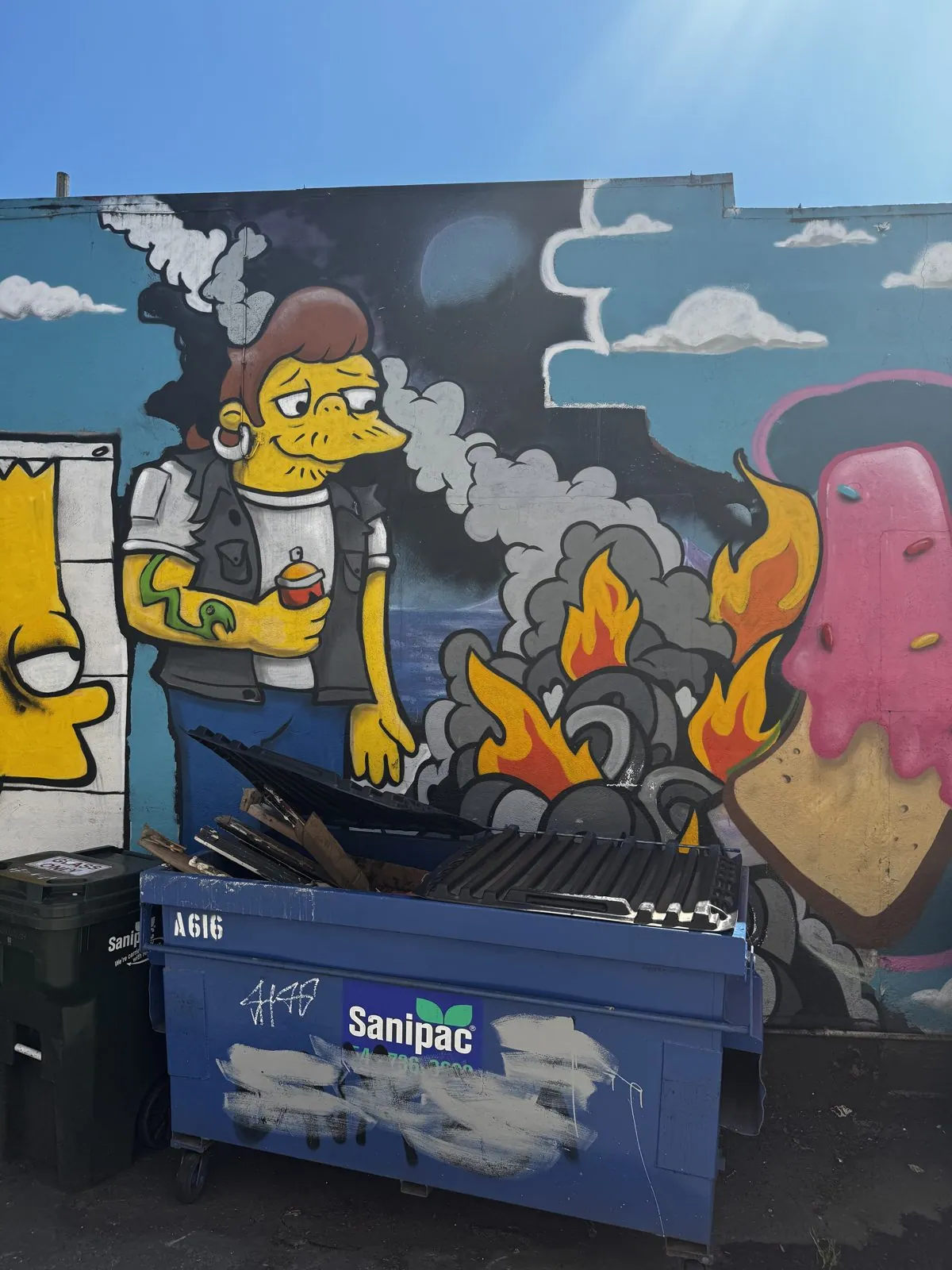
The best use of a dumpster belongs to Snake, the town's resident jailbird. He leans in his leather vest at the edge of a painted bonfire, and the flames and black smoke rise directly out of the real blue dumpster parked in front of the wall. It is a dumpster fire, in the most literal sense. Across the alley, by an iron gate, a gray spiky three-eyed fish grins out of a turquoise square, signed "Bayne 19", the last of the day's many Blinkys.
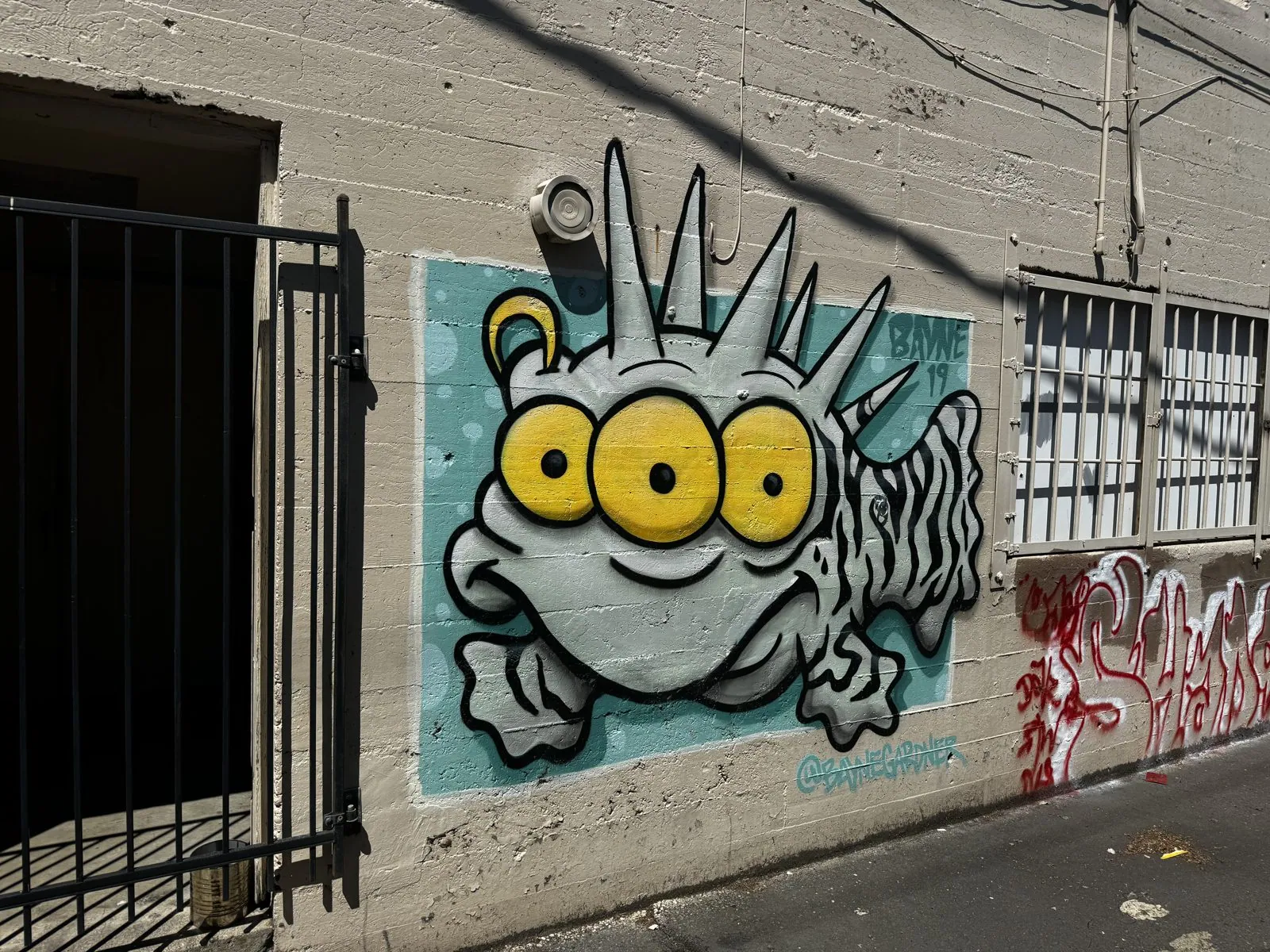
The alley photos are all from a two-minute burst, at 2:41 and 2:42 in the afternoon. You can almost feel the pace: nine murals in under two minutes, phone up, trying to get each one before the next caught the eye.
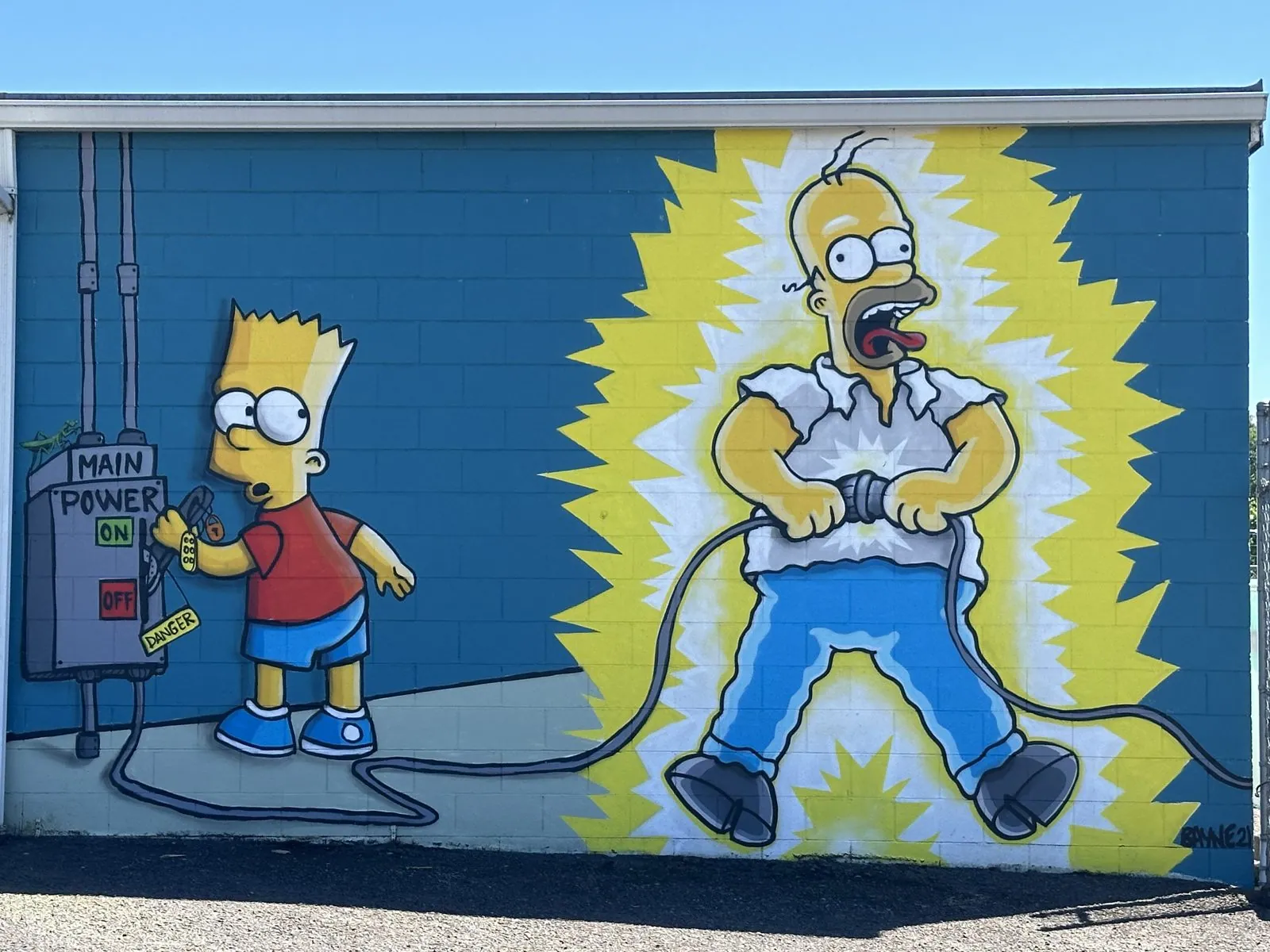
On the way out to the fence we passed one more: Bart, flipping the main power switch while Homer lights up in a yellow burst.
The fence
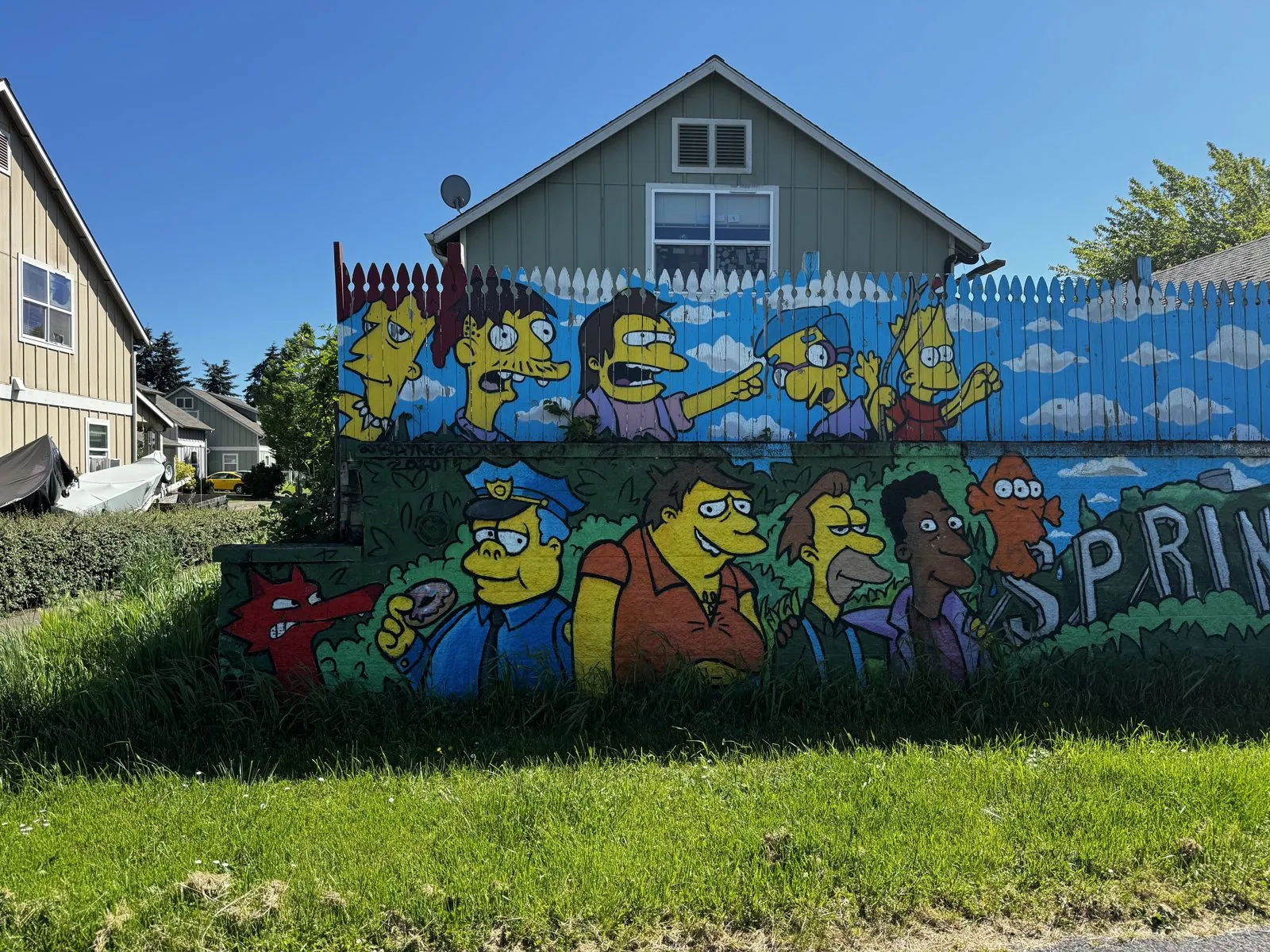
There was still one more, and it was the best finale the town could have offered. A mile and a half northwest of downtown, near the highway, a long wooden fence and the side of a garage have been painted into a single mural of the whole town. It runs along a strip of grass, with ordinary houses rising behind it, and the sky painted on the fence matches the real sky above almost exactly.
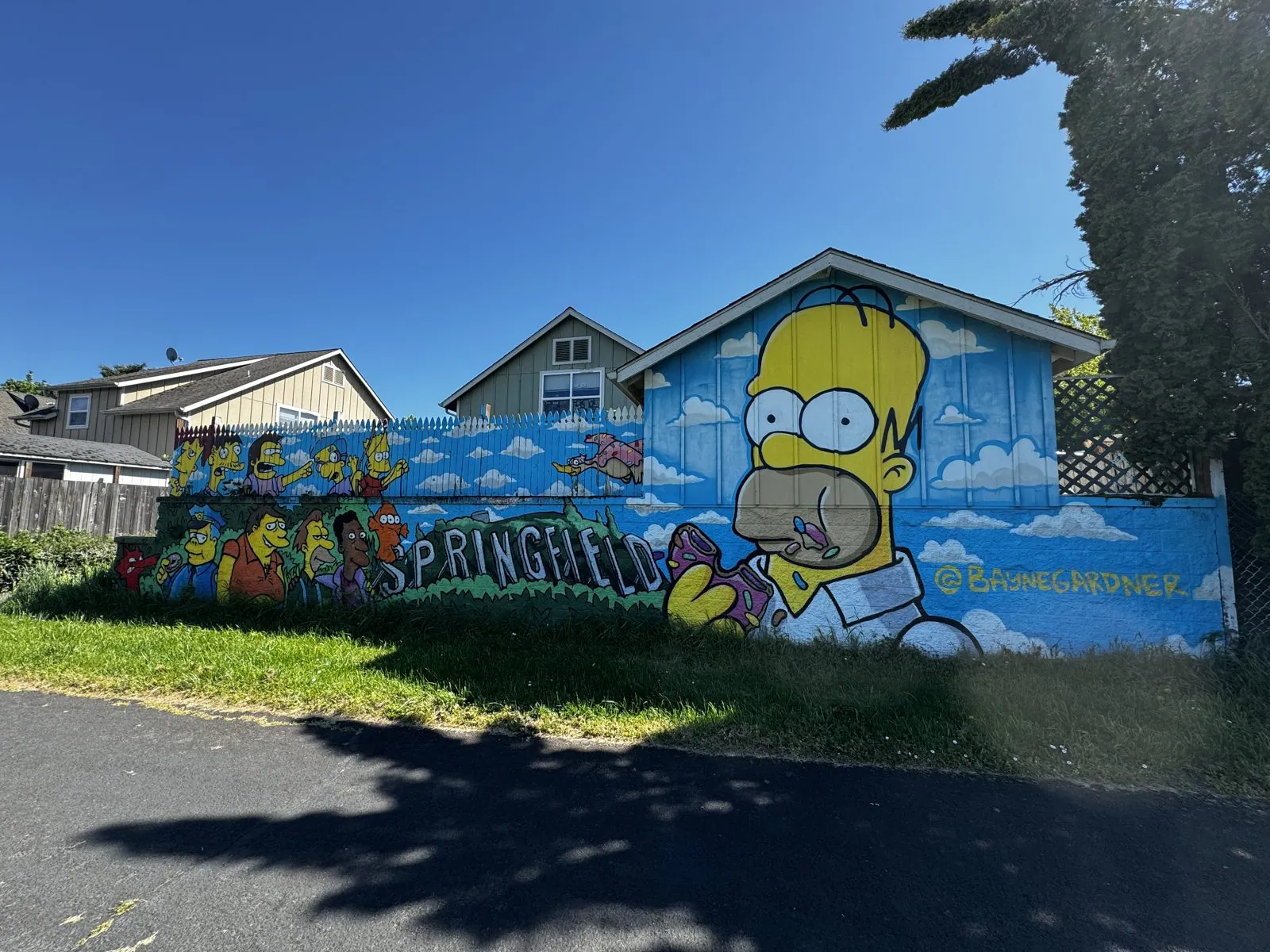
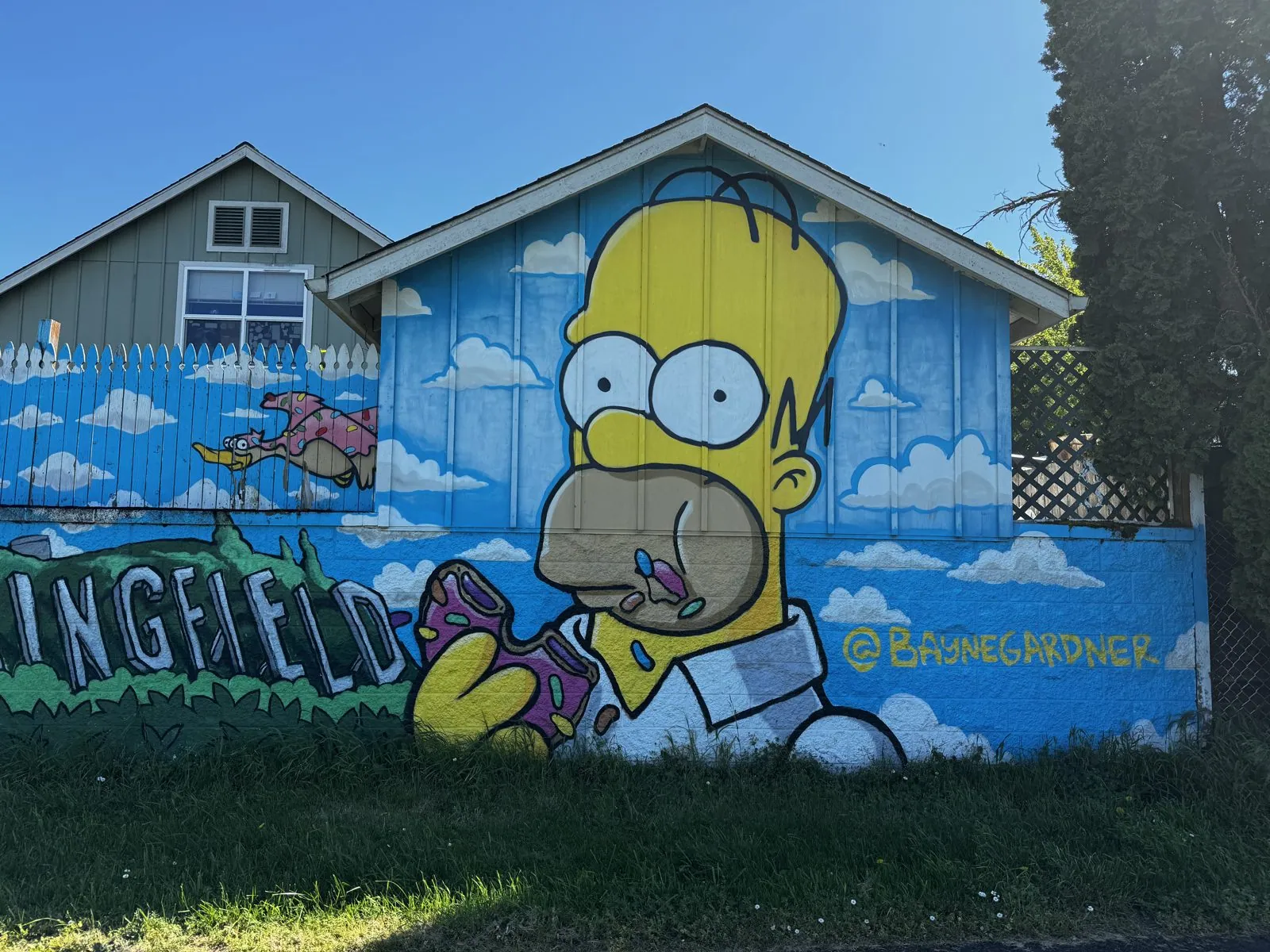
The left half is a crowd: a double row of Springfield's residents peering over the green hedge as if over a garden wall. You can pick out Chief Wiggum with yet another donut, Bart with his slingshot, Carl, someone pointing and laughing in true Nelson style, and Blinky again, bright orange this time. "SPRINGFIELD" is written across the hedge in big white letters. On the right, the garage wall belongs to a giant Homer, taking a bite out of a pink-frosted donut with sprinkles, signed "@BayneGardner" in yellow beside him. Across the painted sky behind him flies a creature with a duck's bill and wings of pink frosting and sprinkles: part duck, part donut, which in this part of Oregon seems about right.
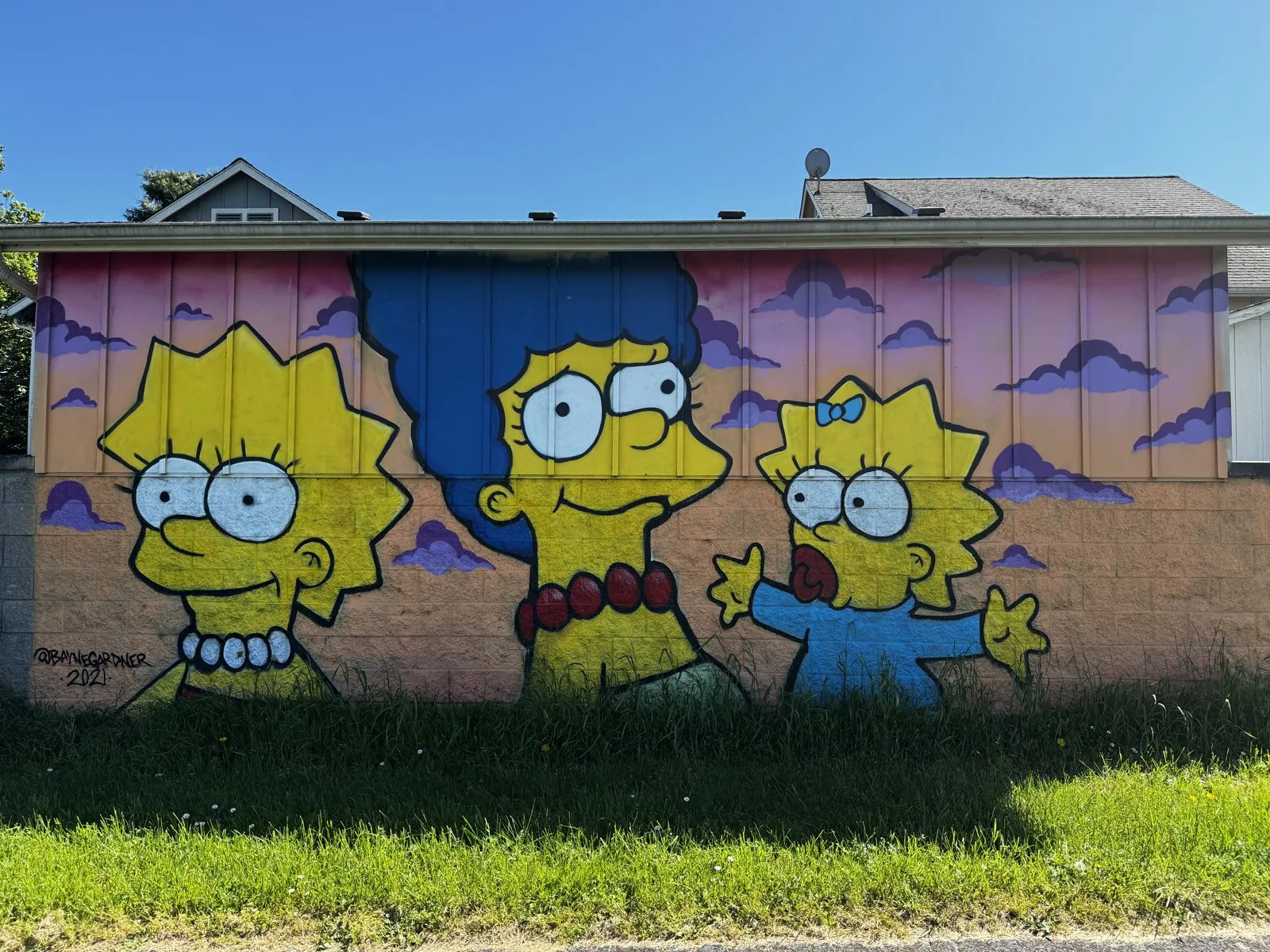
Around the corner, on another wall of the same building, Lisa, Marge and Maggie stand in a row against a pink and orange sunset sky full of purple clouds, Marge's blue beehive towering over the other two. It is signed and dated 2021. After two hours of deep cuts, jokes and dumpster fires, it was nice to end with a simple portrait of the family's sensible half, standing in the long grass in the afternoon sun.
Leaving Springfield
By a quarter past four we were at the Eugene airport, a short drive west across the valley. We returned the car and that evening flew home to Burbank, leaving all those walls behind: Homer on his couch, Burns glowing green, Bigfoot in his bush.
It was a short trip, and an accidental one. We had set out to see the sky do something it does once in twenty years, and we never saw it. What we found instead was a very particular kind of pilgrimage: to a place that is famous for being named after a place that doesn't exist. The real Springfield could have ignored the connection, or turned it into one statue and a gift shop. Instead it handed its blank back walls to a painter, and he filled them with the show's best jokes, one alley at a time. As Comic Book Guy would say: best. Mural walk. Ever.
Maps built from the trip's photo timestamps and locations. Photo locations have been removed from the published images. Maps: map data © OpenStreetMap contributors; each stop is placed where its photo was taken, hotels and home are never marked, and the dashed lines show the order of stops, not the exact roads.
Some photos in this post are my wife's.
Likes and comments
React with an emoji or leave a comment. Signing in with GitHub is required.