Bachelor thesis · University of Science and Technology of China · 2021
Efficient Bijective Spherical Parameterizations
高效无翻转球面参数化
Huanyu Chen · advisor: Prof. Ligang Liu
Thesis (English translation, PDF) · 原文 (Chinese original, PDF) · 2026 lecture slides & code
The problem
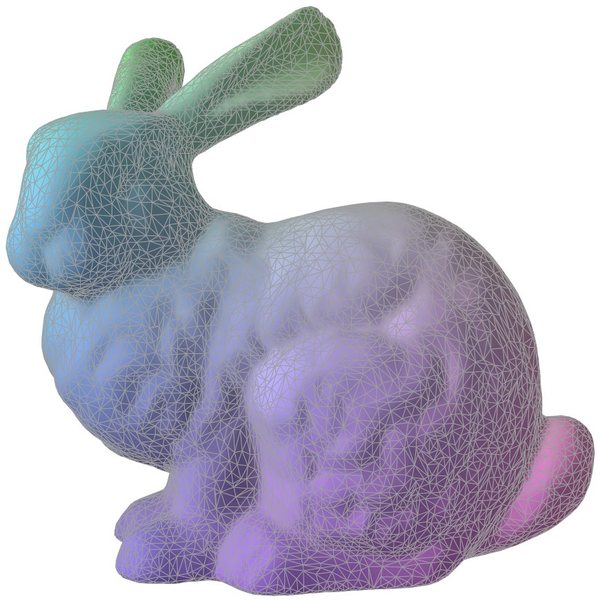
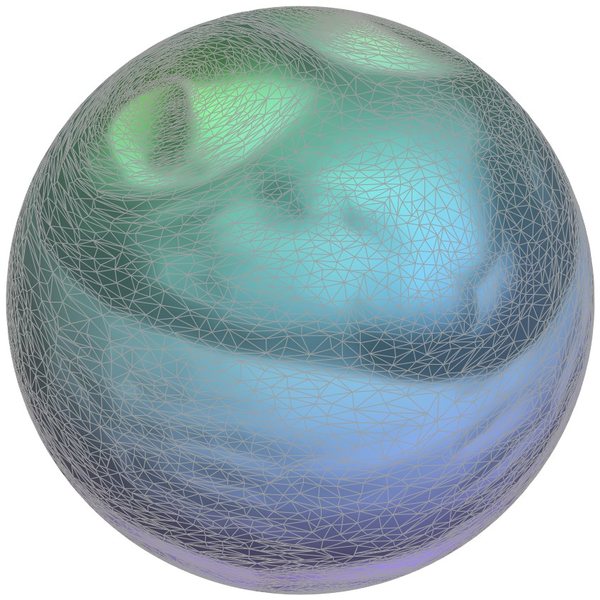
A closed surface of genus 0 (a bunny, a skull, a hand) can be mapped onto the unit sphere without cutting. Such a spherical parameterization gives a seamless texture domain and a common domain for comparing, morphing and remeshing shapes. Flat parameterizations must cut a closed surface into patches, and every cut becomes a seam.
The map must be bijective (no triangle flips over) and have low distortion. For planar maps there is a standard, robust pipeline for this: start from a flip-free initial map, then minimize a distortion energy that blows up as a triangle degenerates, so the map can never flip. Applied naively to the sphere, that pipeline breaks: the sphere is curved, the vertices must stay on it, and planar triangles do not measure spherical flips.
The method
- Triangles become tetrahedra. Each triangle together with the sphere's center forms a tetrahedron, so every face gets a 3×3 Jacobian whose determinant is proportional to the tetrahedron's signed volume. A spherical triangle flips exactly when its tetrahedron inverts.
- A flip-free barrier. The symmetric Dirichlet energy of these 3×3 Jacobians goes to infinity as a tetrahedron collapses, so a locally flip-free map stays flip-free during optimization. On a closed sphere, locally flip-free means globally one-to-one.
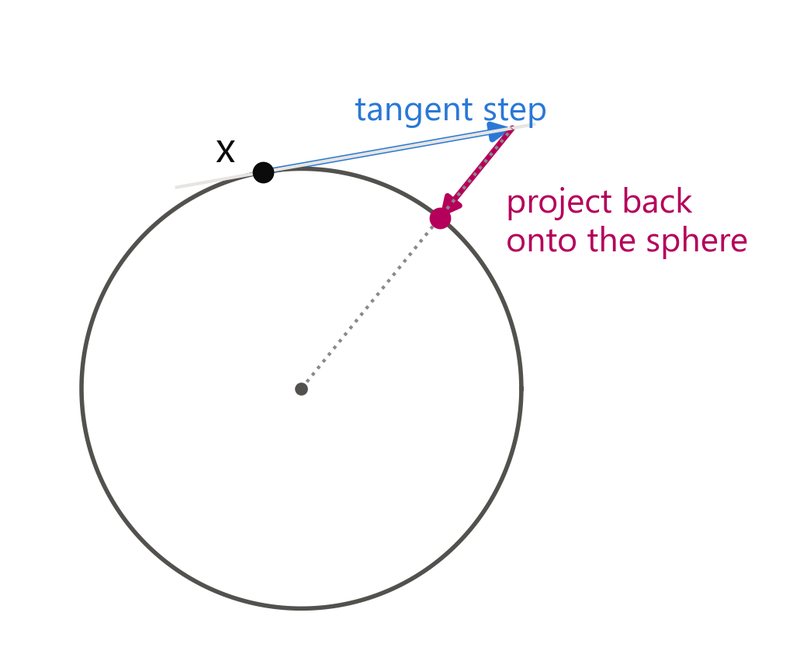
- Staying on the sphere by geometry. The gradient is projected onto each vertex's tangent plane, and every step is retracted radially back onto the sphere.
- A safe step size in closed form. The largest step before any tetrahedron would collapse is the first positive root of a cubic, so a line search never leaves the flip-free region.
- Fast solvers. Initialization from a gnomonic (central) projection of a Tutte embedding, then preconditioned first-order or second-order solvers; analytic projected Newton was the fastest.
Thesis results (2021)
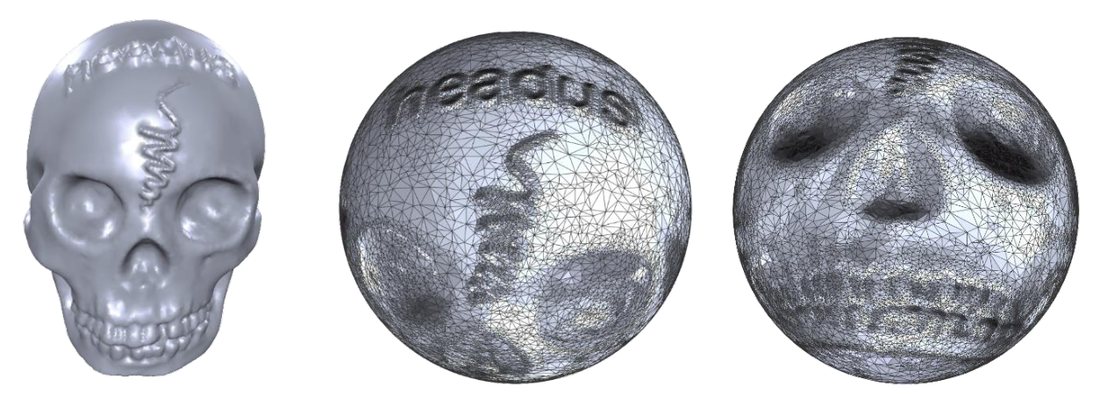
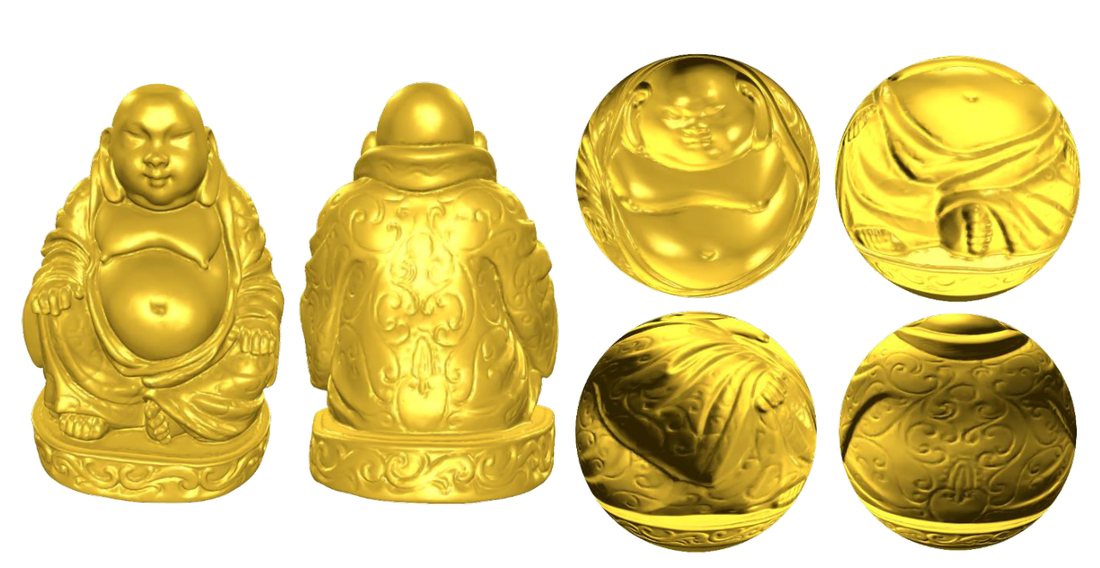
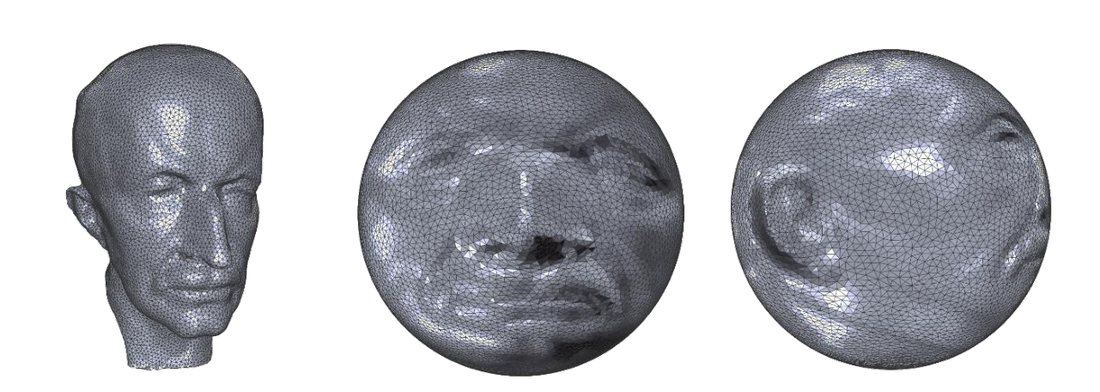
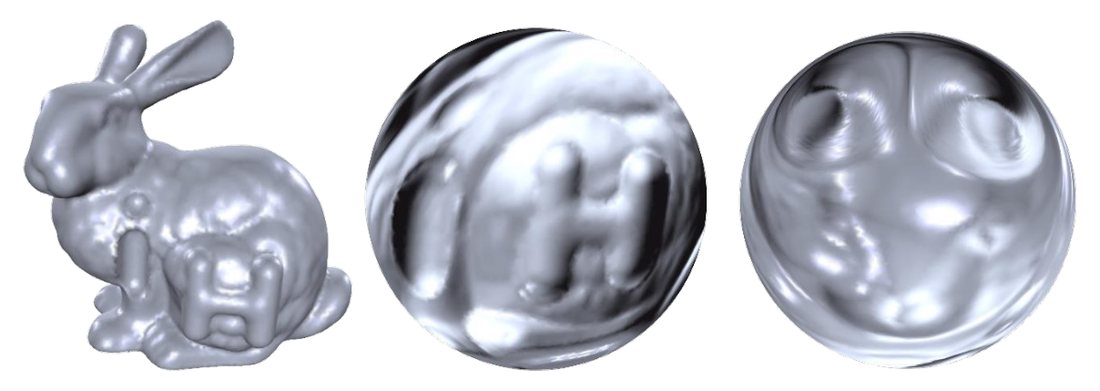
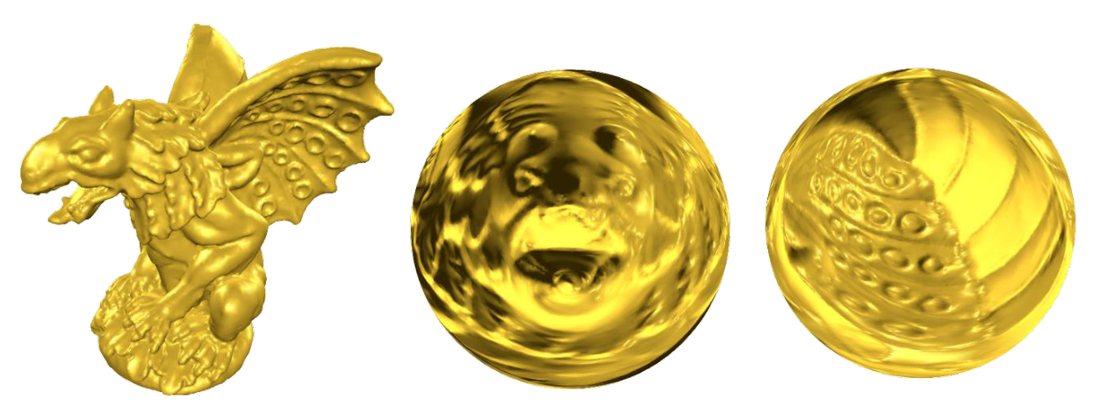
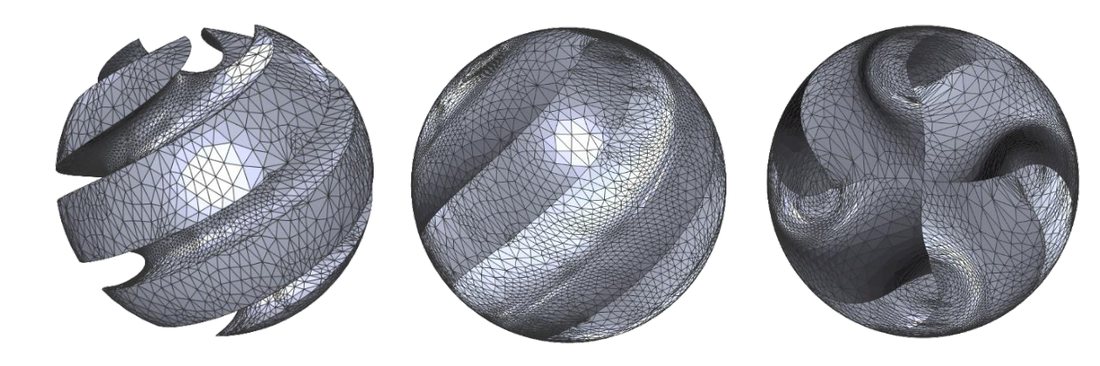
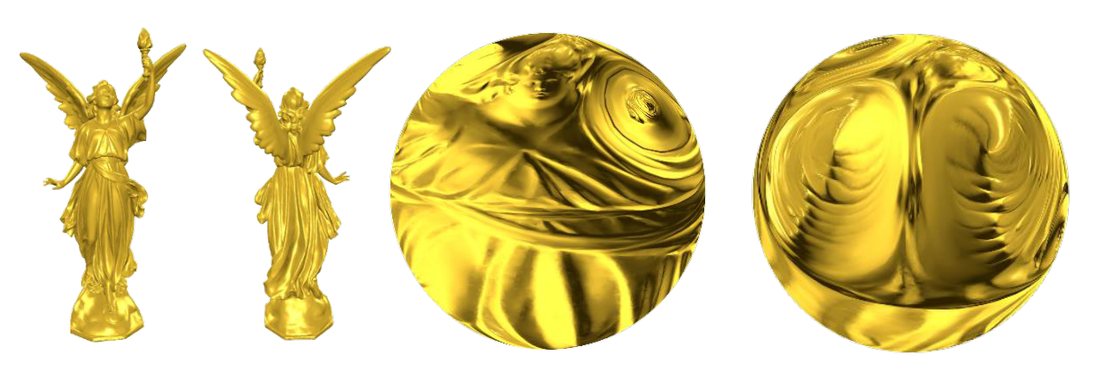
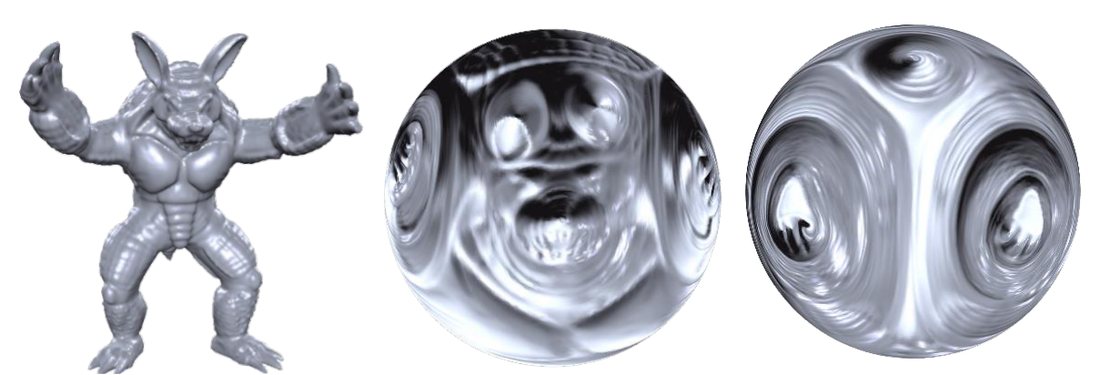
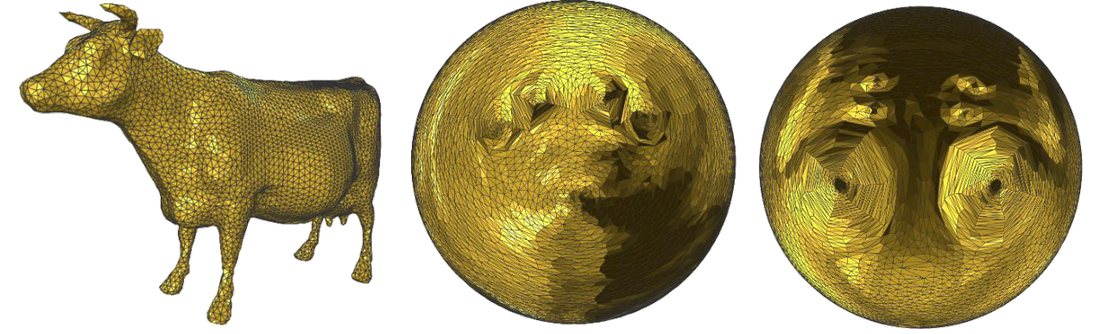
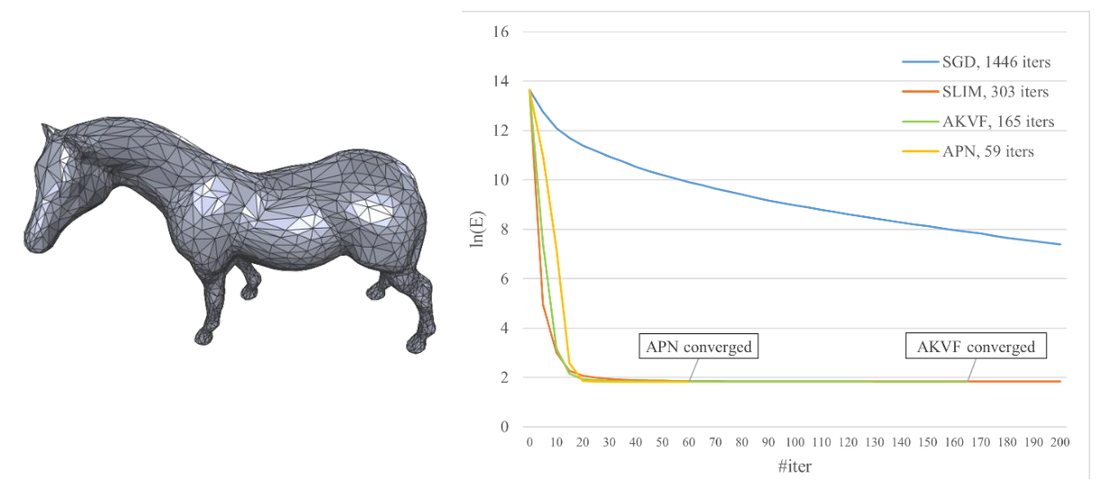
The original C++ implementation (now lost) produced flip-free maps on a wide range of models. Analytic projected Newton converged in tens of iterations, where SLIM and AKVF needed hundreds and gradient descent over a thousand. Each figure shows the model and views of its spherical map.
New results (2026)
For my 2026 UCLA lecture on isotropic distortion energies I re-implemented the method in Python on top of a shared solver core (batched SVD, closed-form Hessian eigensystems, projected Newton with safe steps).
Robust on a 100-mesh benchmark
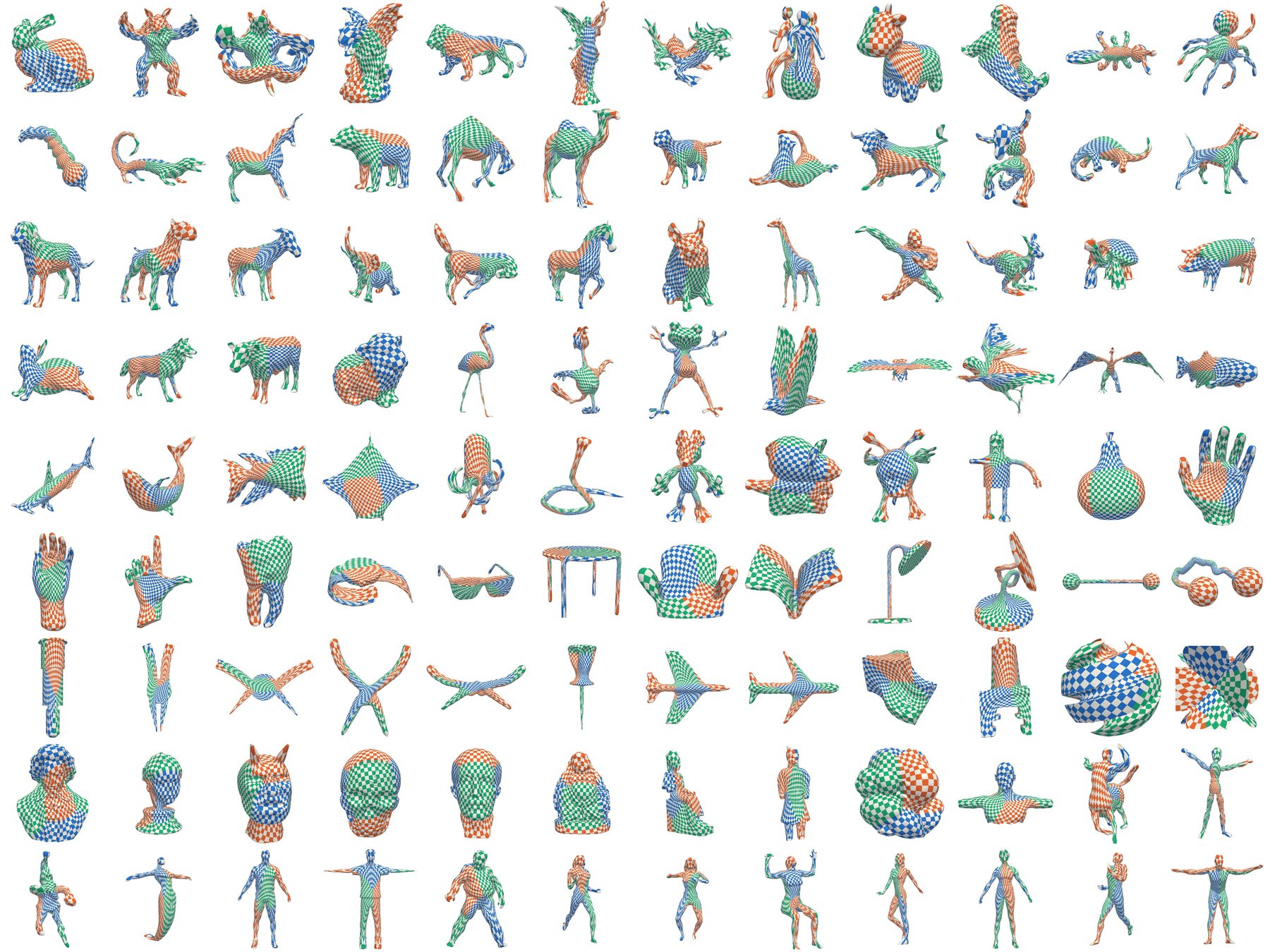
On the 100-mesh spherical-parameterization benchmark of Hu, Fu and Liu (2018), every map is flip-free. Starting from the spherical maps distributed with the benchmark, our symmetric Dirichlet maps lower the area-weighted isometric distortion, max(σ1, 1/σ2), on all 100 meshes: the median falls from 3.28 to 2.44. The gallery at the top adds the thesis models and Keenan Crane's Spot.
The Earth on a skull
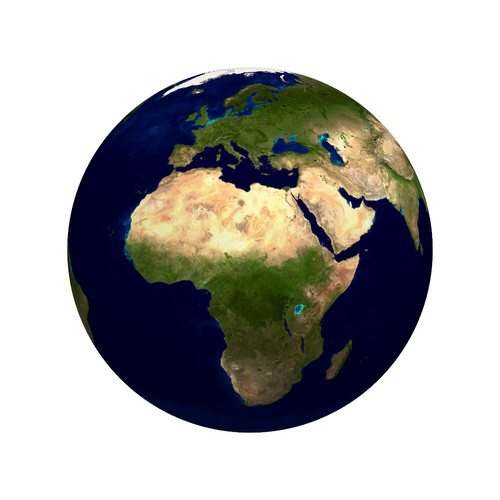
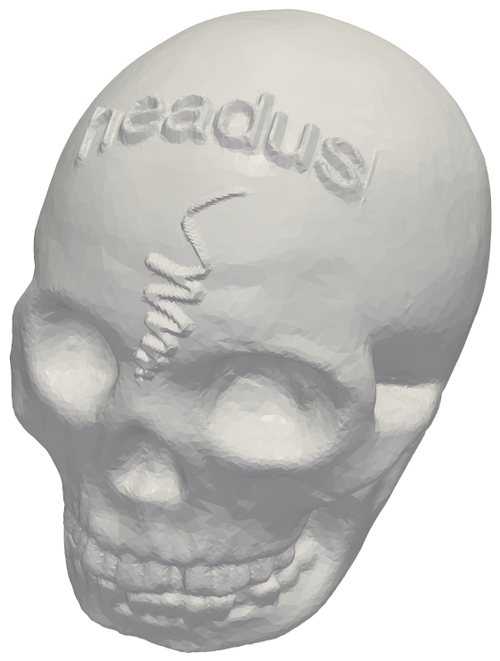
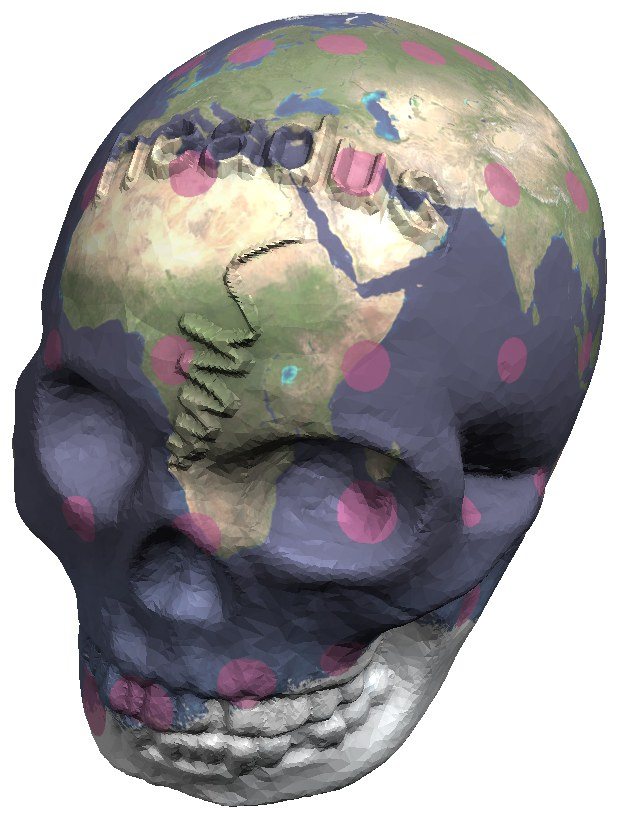
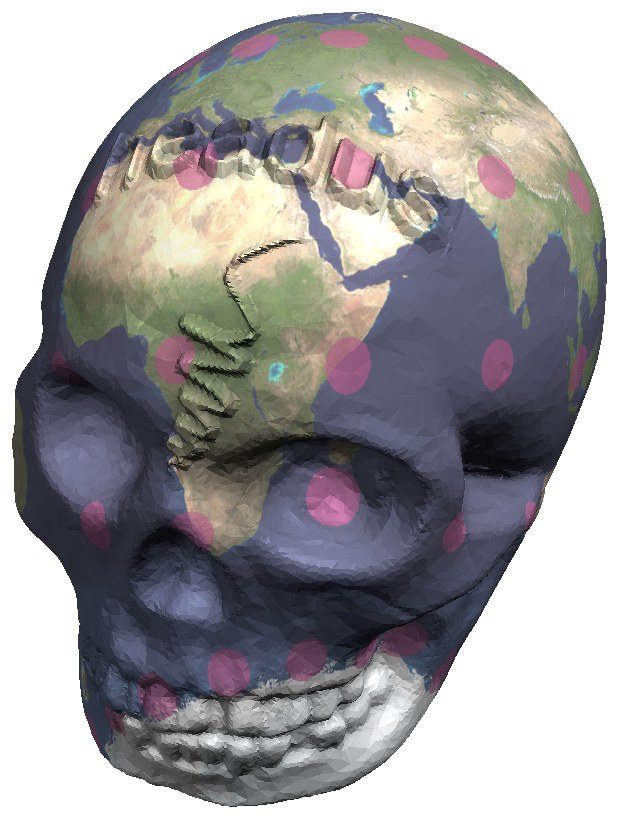
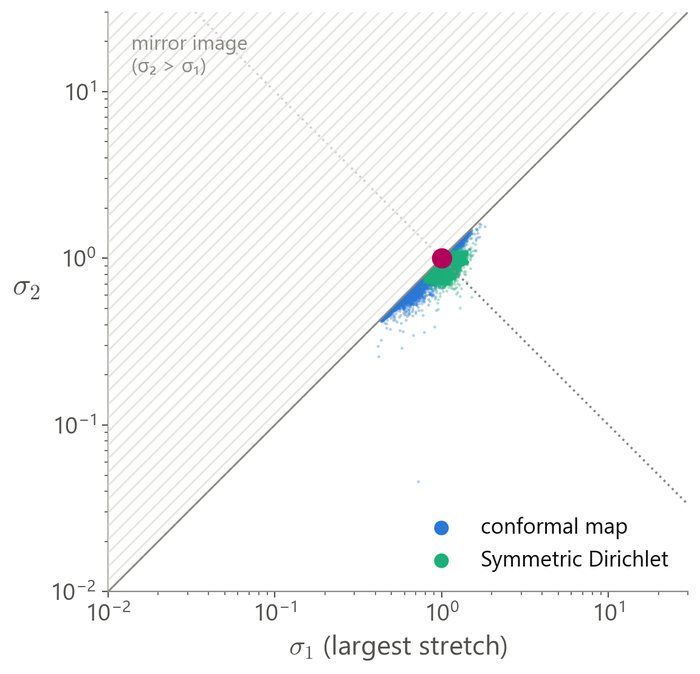
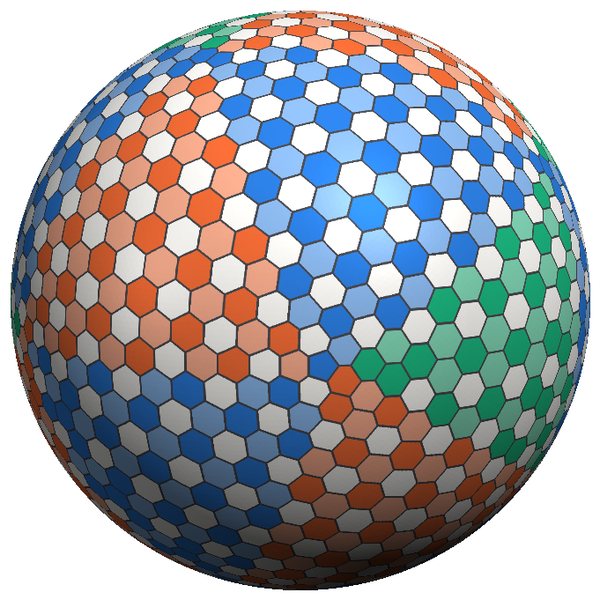
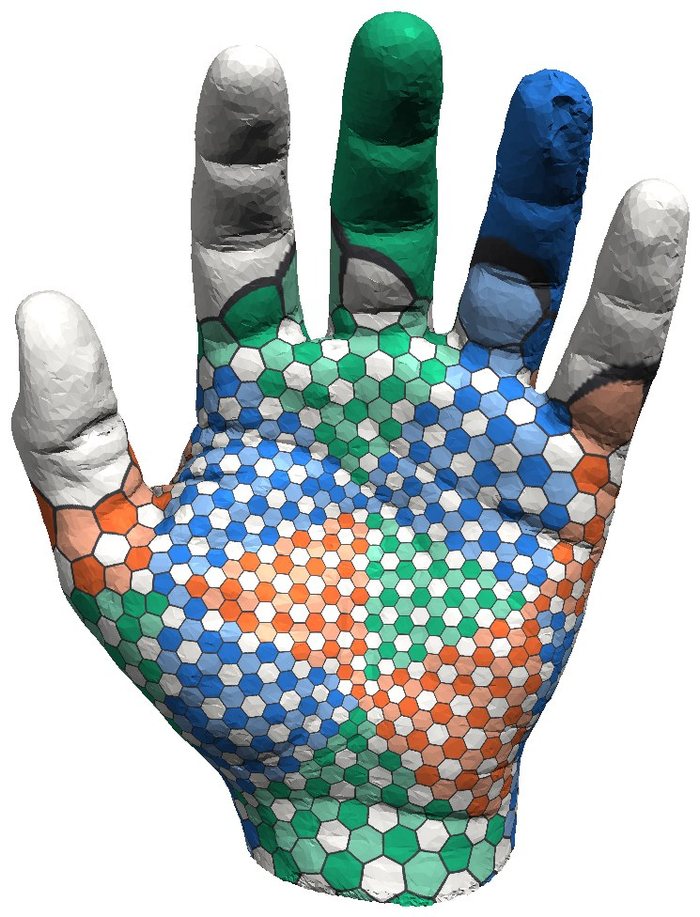
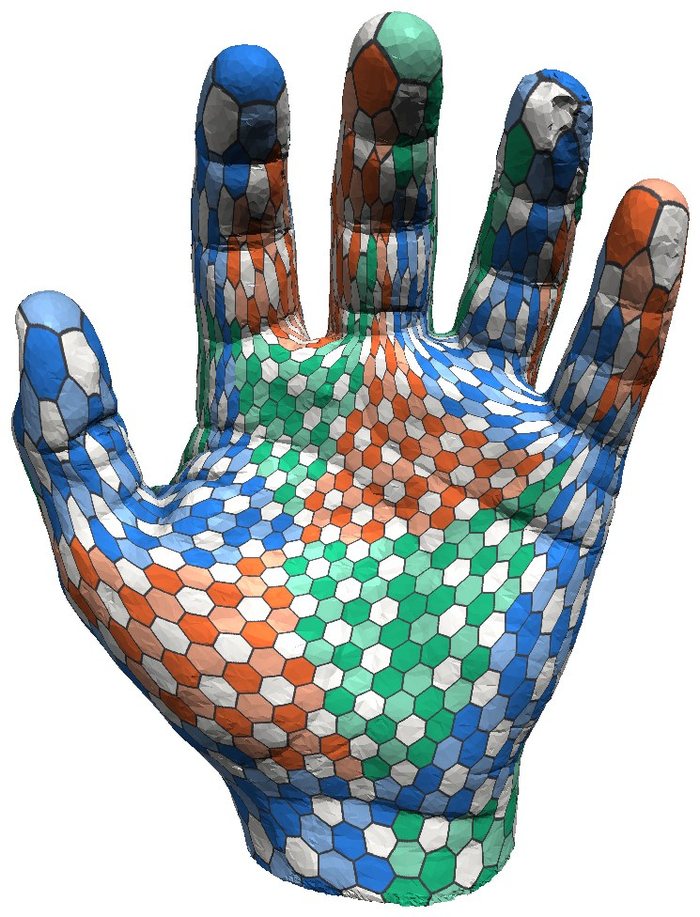
Tissot ellipses show where each map distorts. On a round shape both maps look similar, but in stretch space the conformal map spreads along the diagonal (round but resized), while symmetric Dirichlet stays near (1, 1).
Conformal vs. symmetric Dirichlet on a hand
Cite
@thesis{chen2021spherical,
  author = {Huanyu Chen},
  title  = {Efficient Bijective Spherical Parameterizations},
  type   = {B.Sc. thesis},
  school = {University of Science and Technology of China},
  year   = {2021},
  note   = {In Chinese; English translation at https://huanyuchen618.github.io/spherical/}
}