← Misc · 2022–2025
Connecting the Dots
Nine night skies from four years of trips, with the constellations drawn back in.
Dante's View · Keys View (twice) · the Angeles Crest Highway · Joshua Tree · the San Bernardino Mountains · Mauna Kea (twice) · the Klamath Basin
24 constellations drawn · 2 planets, each landing on a bright dot · between 54 and 322 stars matched per photo · 1 sky globe of three places · 1 lunar eclipse
A lot of our trips end with the camera pointed straight up. Going back through the trip posts on this page, I kept finding the same kind of photo at the end of the night: a dark rectangle full of small white dots, taken from a lookout or a garden or a roadside, with a caption saying something like "the phone's best effort." The photos are honest, but they don't tell you what you are looking at. A sky full of dots only becomes a sky full of stars you know once someone draws the lines.
So I went back and drew them. Every photo below is a real phone photo, and every line connects real stars in that photo. The overlays are not pasted on by eye. Each photo was matched star by star against a star catalogue for the exact time and place it was taken (how that works is at the end). That also means the planets come out on their own: where the ephemeris says Mars or Jupiter should have been, the photo had better show a bright dot. It did, every time. The photos are in date order, and each one links back to the trip it came from.
March 2022: Orion over Death Valley
The first is from the night of March 12, 2022, at Dante's View, the overlook more than five thousand feet above Death Valley (the trip is in Death Valley, Vegas & Page). At 7:37 p.m. the phone was pointed south-southwest, about halfway up the sky. The Moon was three-quarters full and nearly overhead, which is why the sky is a washed-out blue rather than black. It is also why only the brightest stars made it into the frame. Fortunately, the brightest stars are exactly the ones that make the shapes.
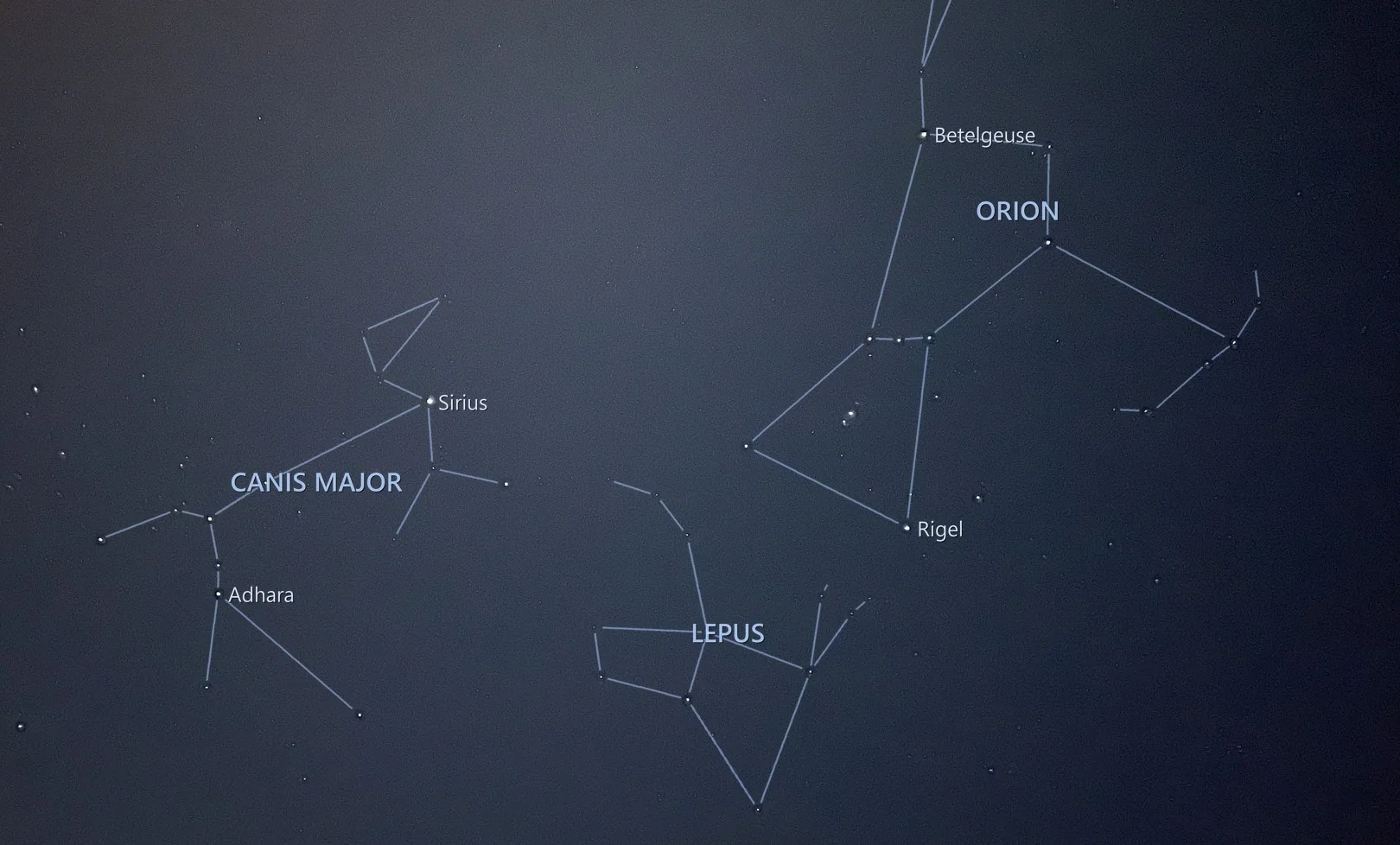
Orion is the winter sky's centerpiece, and on a March evening it is already past its highest point, leaning west after dark. Its two brightest stars sit at opposite corners: Betelgeuse, the red supergiant at the hunter's shoulder (the one that famously dimmed in 2019–2020), and Rigel, a blue supergiant at his foot. Follow the three stars of the belt down and to the left and you reach Sirius in Canis Major, the hunter's big dog. Sirius is the brightest star in the night sky, partly because it is genuinely luminous and partly because it is close, only about 8.6 light-years away. Under Orion's feet crouches Lepus, the hare he is hunting.
September 2022: the winter sky at 3 a.m.
Six months later we were at Keys View in Joshua Tree at three in the morning on September 28, for no better reason than a sudden urge to drive to the desert (the story is in Four Visits to the Same Desert). The Moon was a thin crescent far below the horizon, so the sky was properly dark. These frames came out nearly black and are brightened here.
The odd thing about this night is that the sky looks like winter. That is just how the stars move through the year: every night they rise about four minutes earlier, which adds up to two hours a month. The constellations that fill a December evening are already up before dawn in late September. At 3:03 a.m., looking east-southeast and about halfway up, Orion was climbing, with Taurus the bull above it.
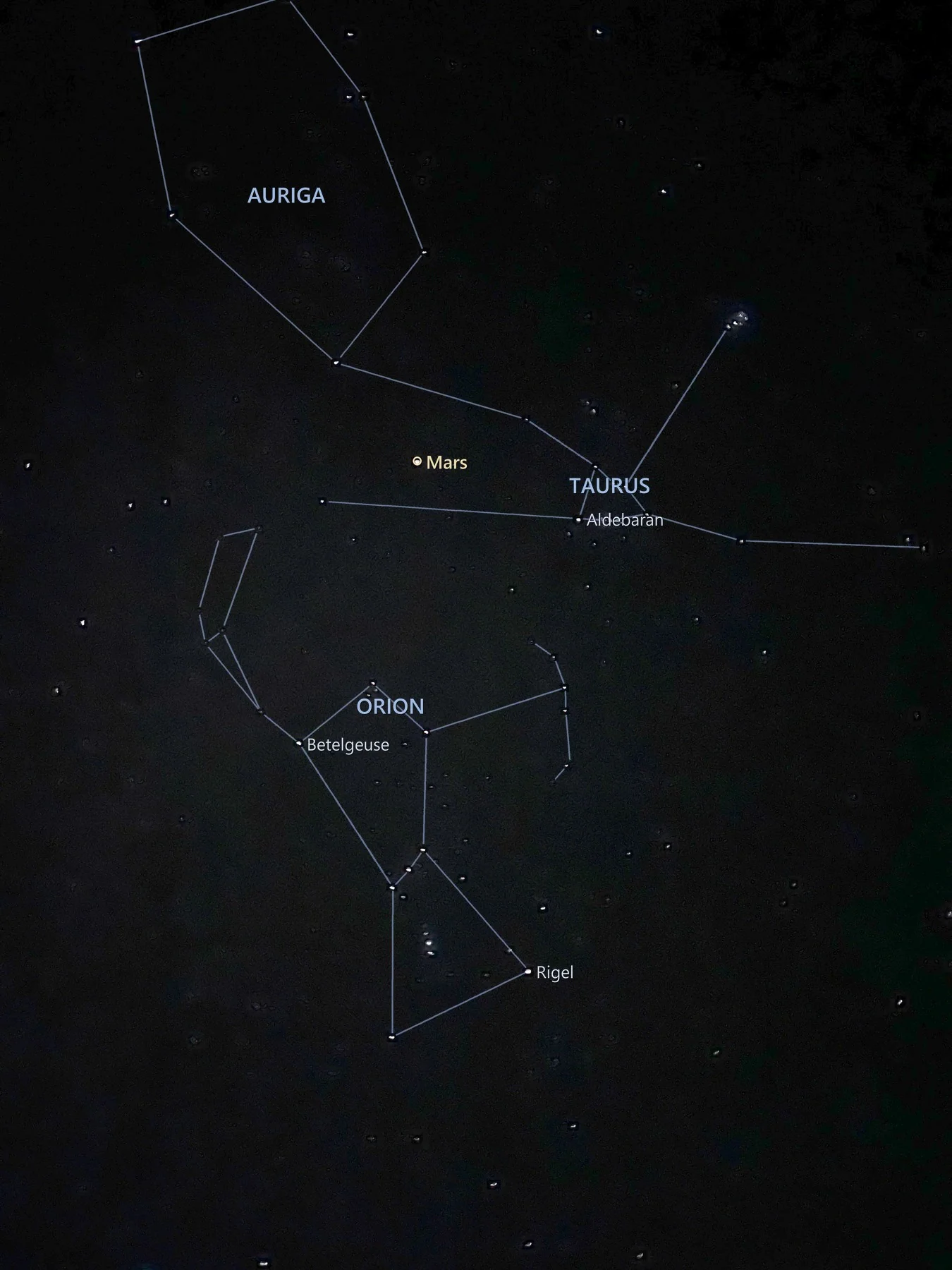
The orange star at the bull's eye is Aldebaran. Its name comes from the Arabic for "the follower," because it rises after the Pleiades, the tight little cluster at the upper end of the line (the same cluster that is drawn on the Subaru logo). The ringed dot to the left of Taurus is not a star. It is Mars, which the overlay placed from the planetary ephemeris, not from the photo. It lands right on a bright dot that no star catalogue explains. In the autumn of 2022 Mars was in Taurus and getting brighter every week, on its way to opposition on December 8, when it would be opposite the Sun in our sky and at its brightest.
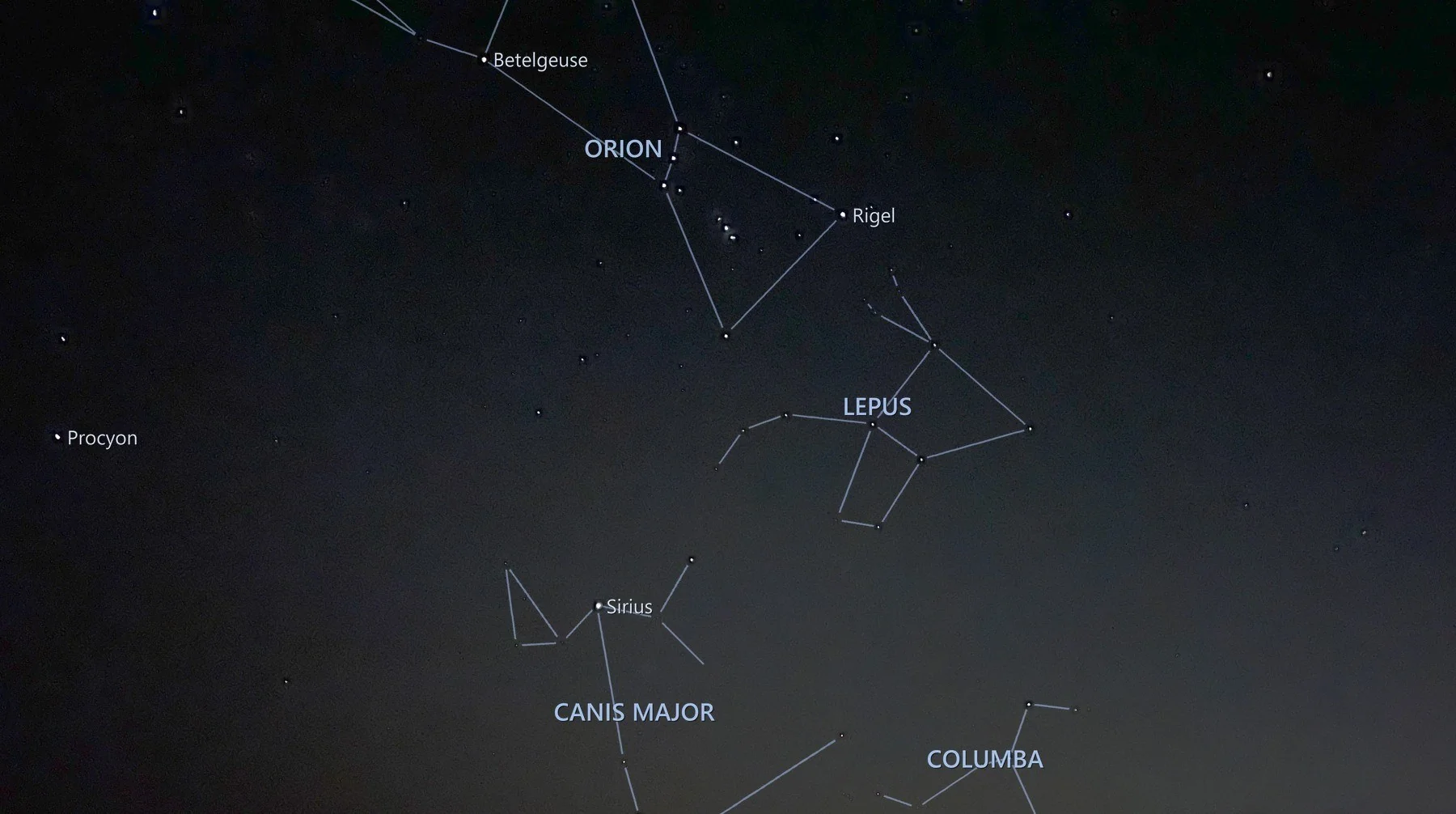
Twenty-six minutes later the phone turned southeast and lower, and Sirius had cleared the ridge. In ancient Egypt, the first appearance of Sirius in the dawn sky after months of absence marked the season of the Nile flood. Here it sits low in the southeast, with the dog's body stretching down toward the horizon, and beside it Columba, the dove, a small, faint constellation that stays low in the south from California.
November 2022: Mars at its brightest
Seven weeks after that, at 1:55 on the morning of November 19, we were at a turnout on the Angeles Crest Highway, high in the San Gabriel Mountains above Los Angeles. It was the week of the Leonid meteor shower, which is most likely why we drove up. This is as close as dark sky gets to the city, and it isn't very dark: the glow of the basin lights up the whole frame. But the phone was pointed almost straight up, and up there the bright stars and one planet came through clearly.
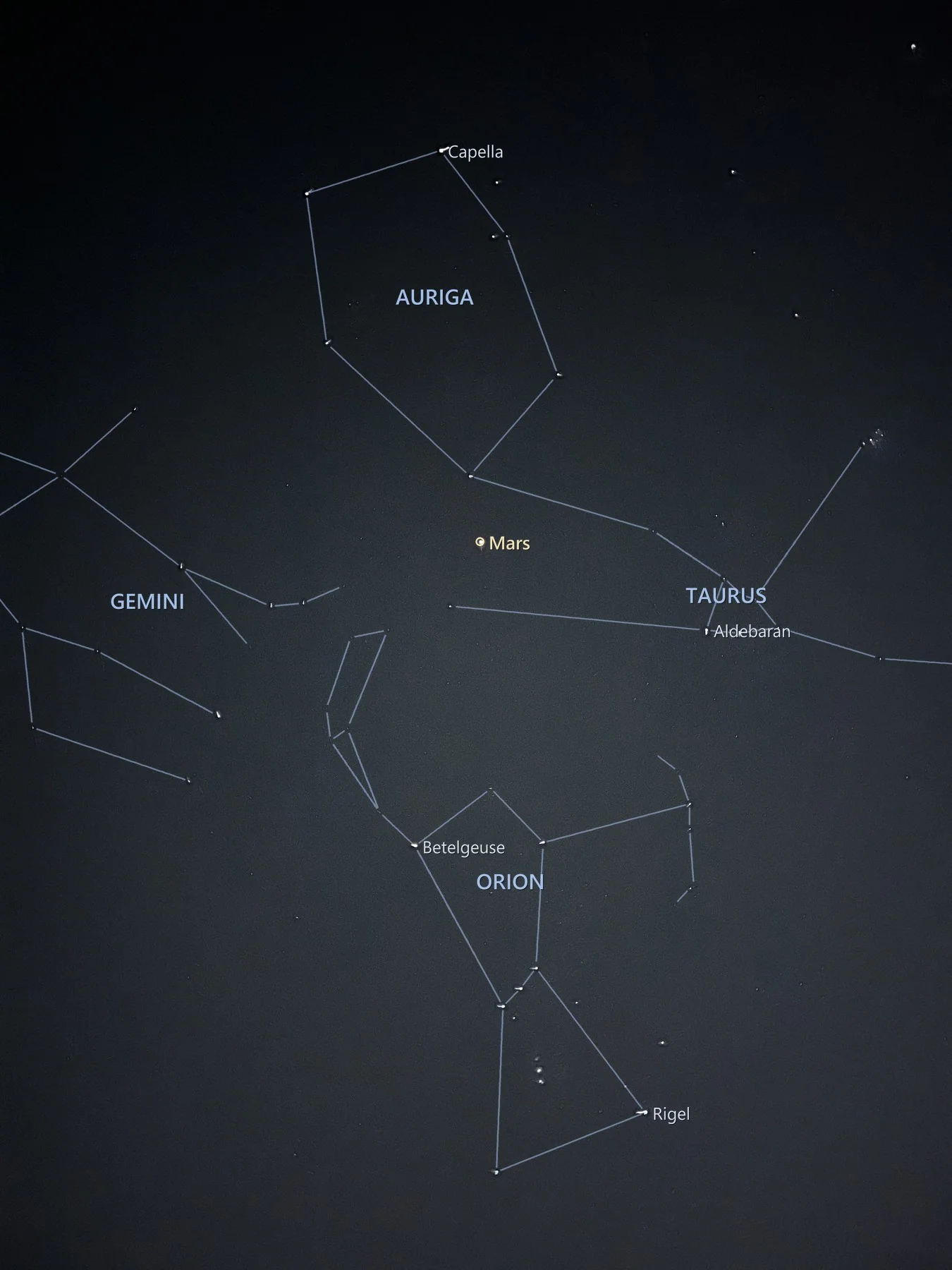
Mars was still in Taurus, now nearly overhead, less than three weeks before opposition. According to the ephemeris it was at magnitude −1.6, about as bright as Sirius. Once again the computed position falls on the brightest dot in the frame. Gemini, the twins, was rising on the left, and at the top is Auriga, the charioteer, a lopsided pentagon anchored by Capella.
December 2024: Orion and Jupiter over a Joshua tree
The best photo of the set came two years later, at 1:22 a.m. on December 9, 2024, in a garden in the town of Joshua Tree (also in Four Visits to the Same Desert). A Joshua tree in the garden was lit gold from below, and Orion stood almost directly above it, high in the south-southwest. In December Orion is at its best after midnight. This photo was taken with the ultrawide lens, so it covers more than a hundred degrees of sky, from the mountains on the horizon up past Gemini.
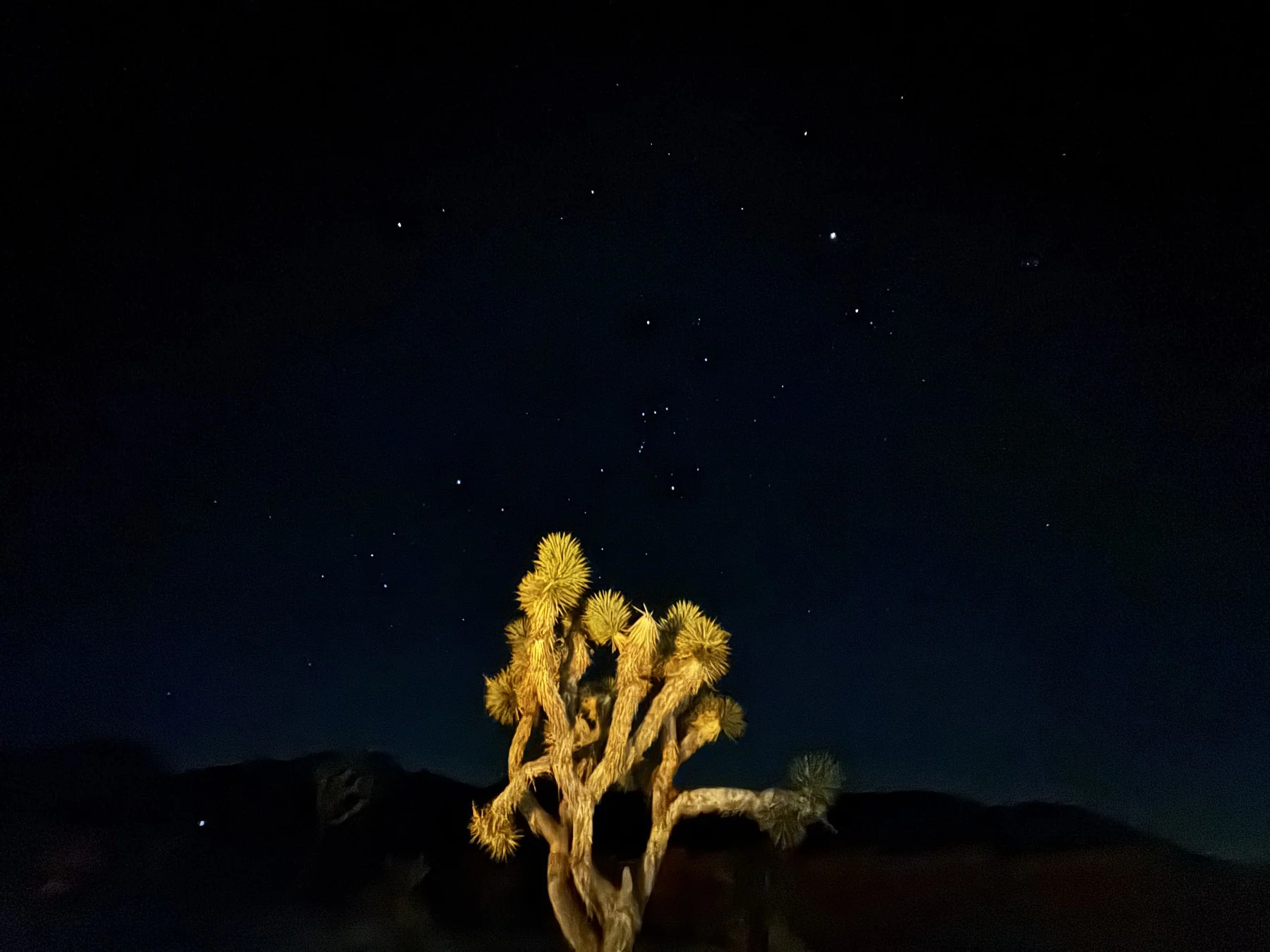
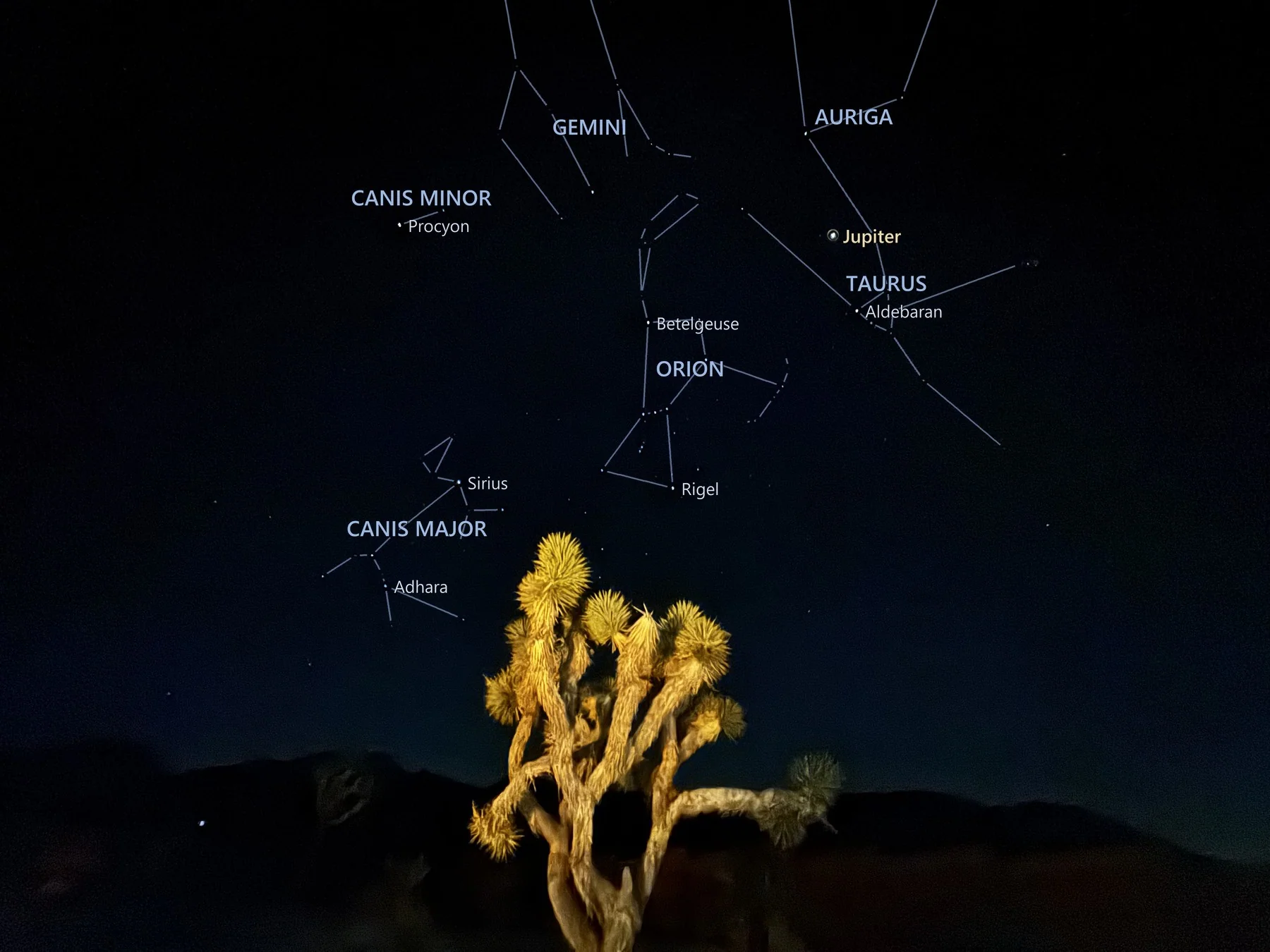
Joshua Tree, 1:22 a.m., December 9, 2024, looking south-southwest. 54 stars matched (an ultrawide lens, so fewer stars per degree).
The bright dot just above Aldebaran is Jupiter, and as with Mars, the overlay drew it from the ephemeris and it lands on the brightest dot in that part of the sky. The timing was good. Jupiter had reached opposition two days earlier, on December 7, so it was as close and bright as it would be all year, and up all night. All the winter landmarks are in the frame together: Orion's belt pointing down to Sirius and up toward Aldebaran, Procyon in Canis Minor (the little dog), and Gemini and Auriga overhead. Taken all together, it is about as much of the winter sky as one phone photo can hold.
July 2025: summer stars through the pines
Summer brings a different sky. At 10:41 p.m. on July 19, 2025, outside the cabin near Running Springs in the San Bernardino Mountains (A Weekend Above the Clouds), the phone looked up past the pine tops, high toward the south-southeast. Orion was gone, lost in the Sun's glare this time of year. In its place were the summer constellations.
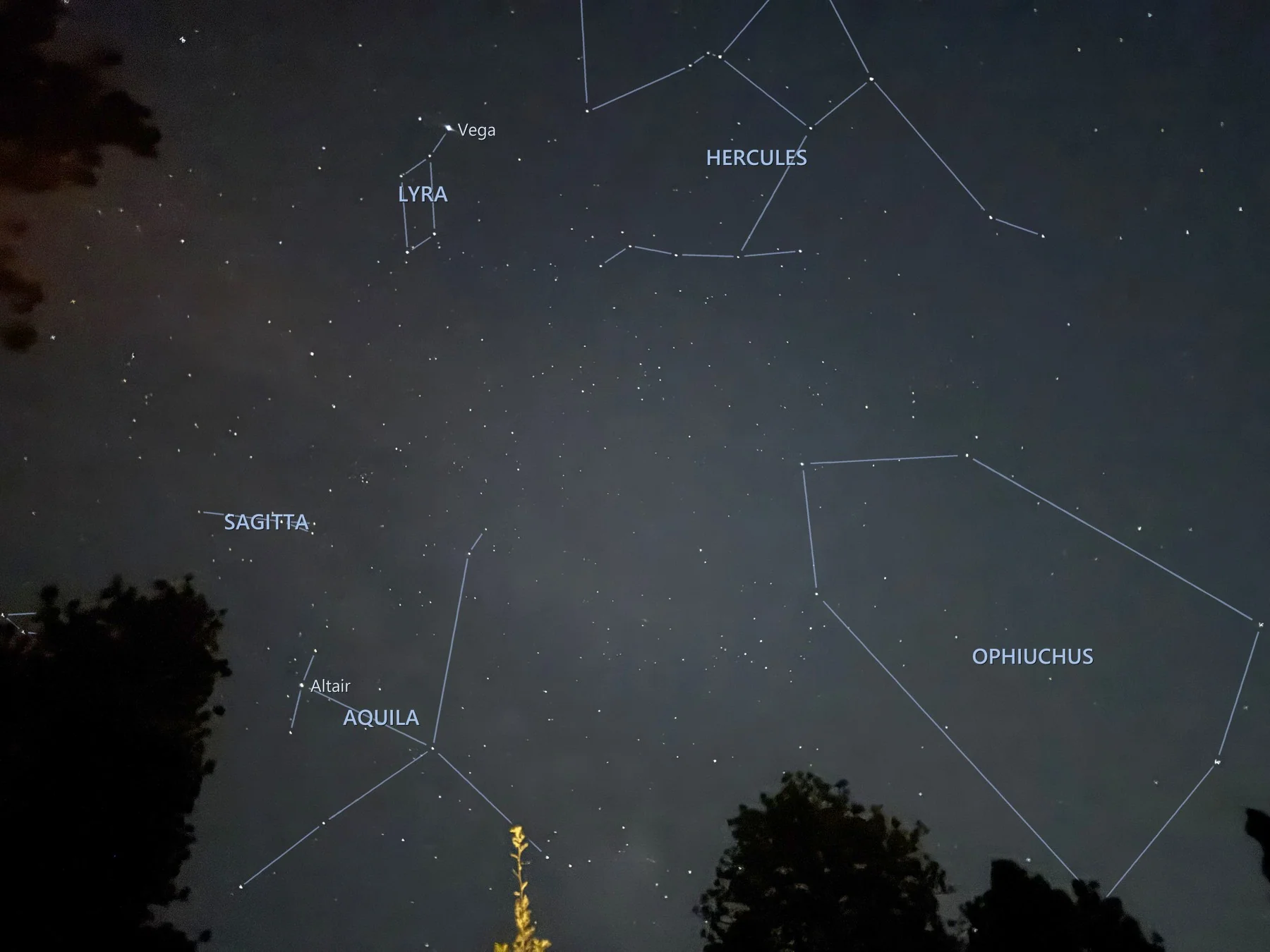
The brightest star here is Vega in Lyra, the lyre of Orpheus, almost overhead. Vega is about 25 light-years away, and because Earth's axis slowly wobbles, in about 12,000 years it will be the pole star. Lower left is Altair in Aquila, the eagle, about 17 light-years away and spinning so fast that it is measurably flattened. Between them, and much fainter, are the little arrow of Sagitta and the dolphin, Delphinus. At the top is Hercules, and the big house-shaped figure on the right is Ophiuchus, the serpent bearer. The Sun passes through Ophiuchus every year even though it is not one of the twelve signs of the zodiac.
September 2025: the middle of the galaxy, from Mauna Kea
The darkest sky in the collection is from the Big Island, at the Mauna Kea Visitor Information Station, at 9,200 feet, on September 13, 2025 (Fishponds, a Crater and the Milky Way). The Moon would not rise until late, and the clouds were below us. By 7:45 p.m. the Sun was about 19 degrees below the horizon, which means the sky had only just become fully dark. The Milky Way crossed it from one side to the other. This is the one photo where the plain version deserves a look of its own, so the lines can be switched off.
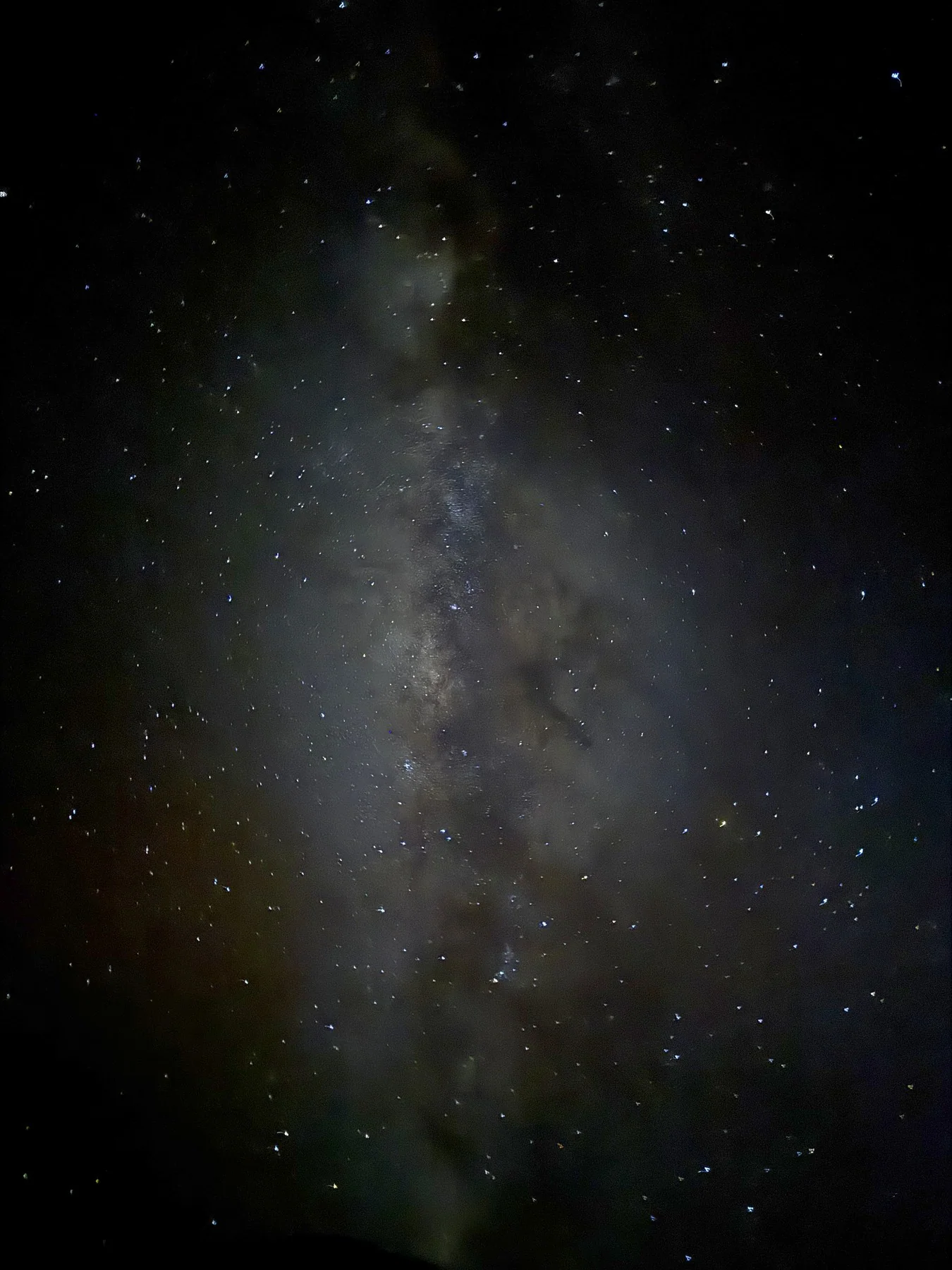
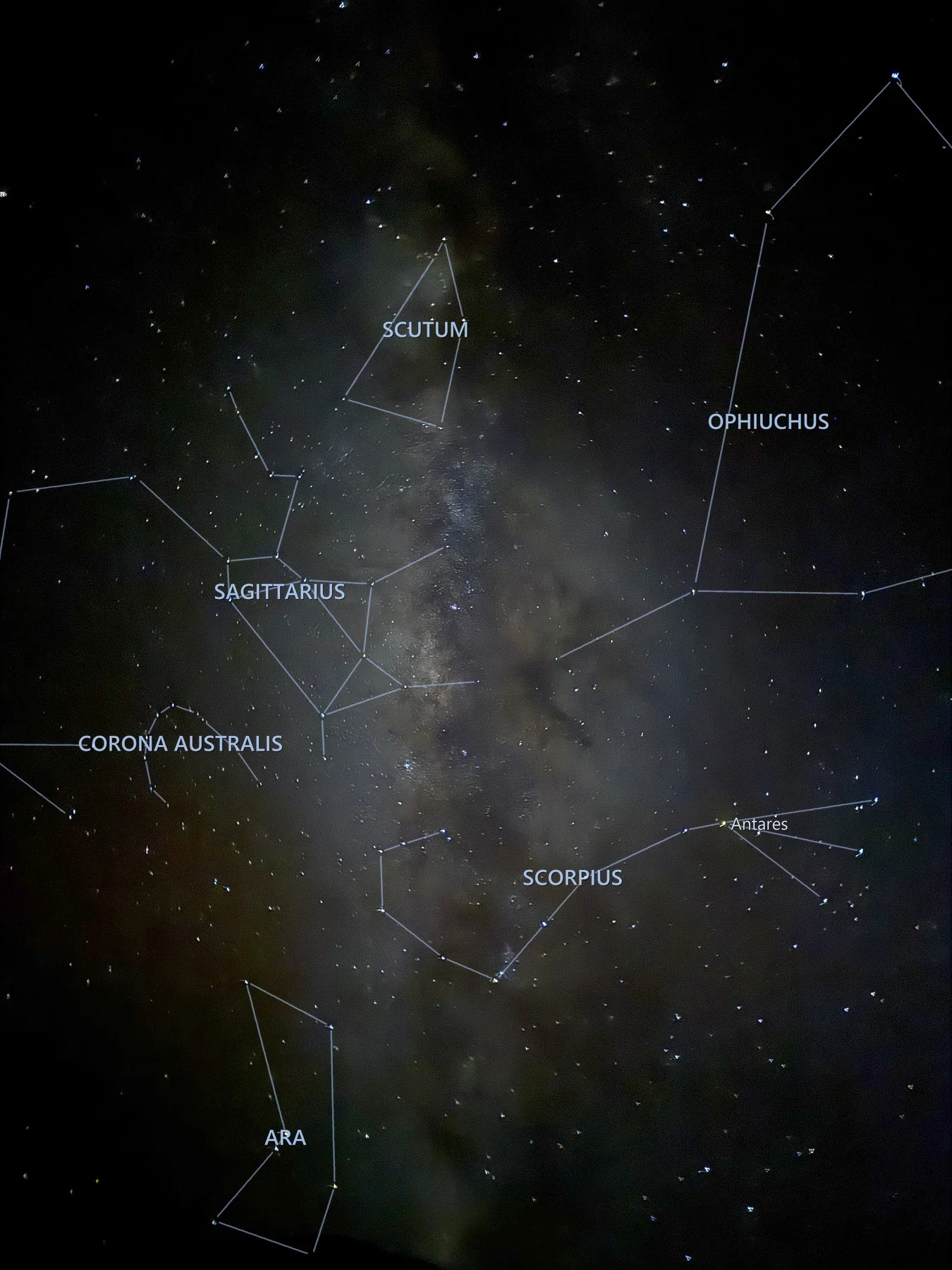
Mauna Kea, 7:49 p.m., September 13, 2025, looking south-southwest. 265 stars matched.
The brightest, densest part of the band is in Sagittarius, the archer, whose brightest stars are better known as the Teapot. That is no accident. When you look toward Sagittarius you are looking toward the center of our galaxy, about 26,000 light-years away, where a black hole of about four million solar masses sits hidden behind the dust. (Half of the 2020 Nobel Prize in Physics was for showing it is there.) The dark lanes in the photo are that dust. To the right is Scorpius, with the red supergiant Antares at its heart. The name means "rival of Mars," for its color. Below are two small southern constellations that never rise very high from California: Corona Australis, the southern crown, and Ara, the altar.
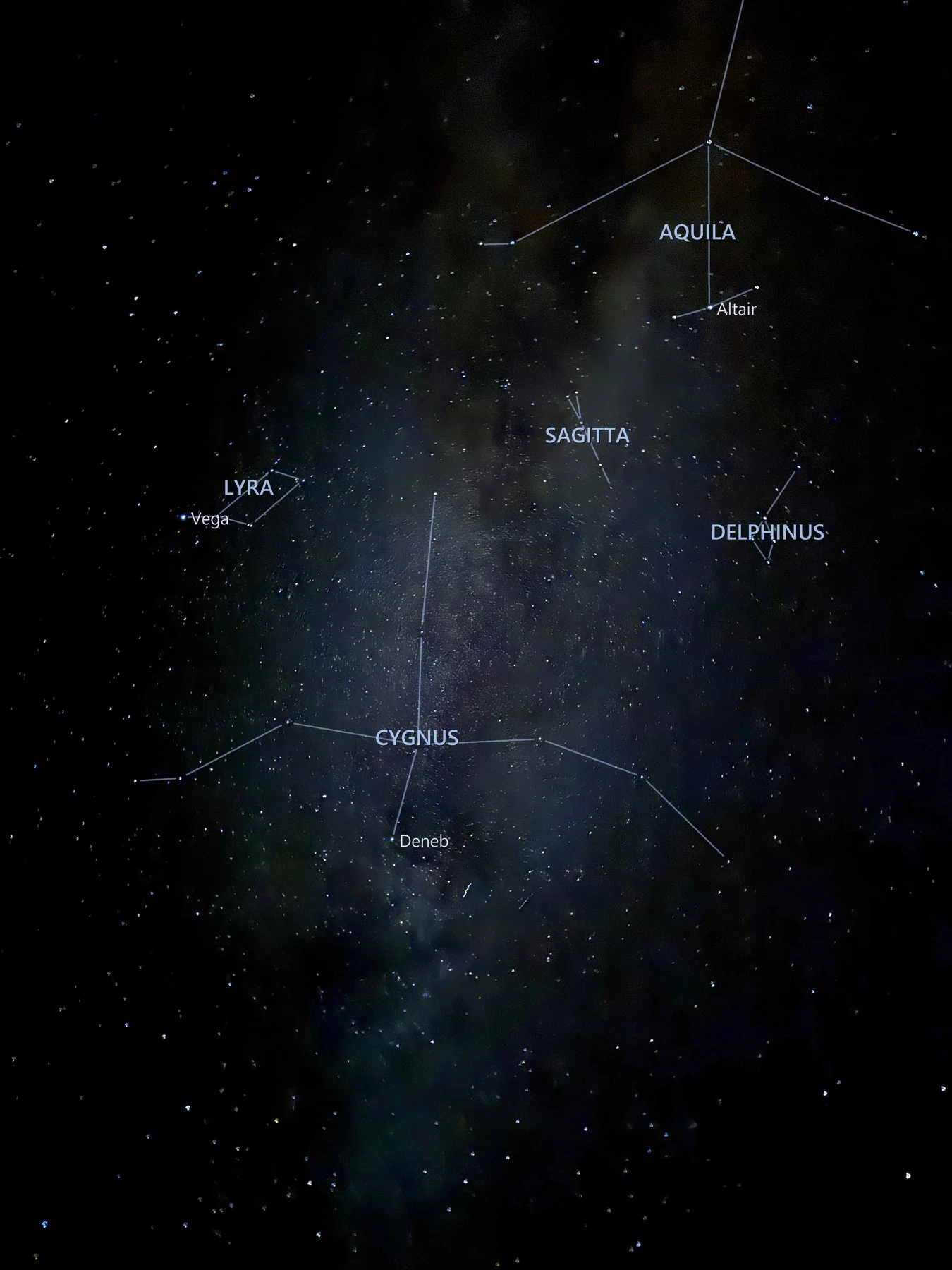
Four minutes earlier, the phone had turned the other way, to the northeast and high up, where the Milky Way runs through Cygnus, the swan, also called the Northern Cross. Its tail is Deneb. Together with Vega and Altair, it makes the Summer Triangle, the same Vega and Altair as in the mountains in July. Deneb looks like their equal, but it is far more distant than either of them and far more luminous: one of the most luminous stars visible to the naked eye. At the other end of the cross, at the swan's head, is Albireo, which a small telescope splits into a gold star and a blue one.
What Hawaii adds: the far southern sky
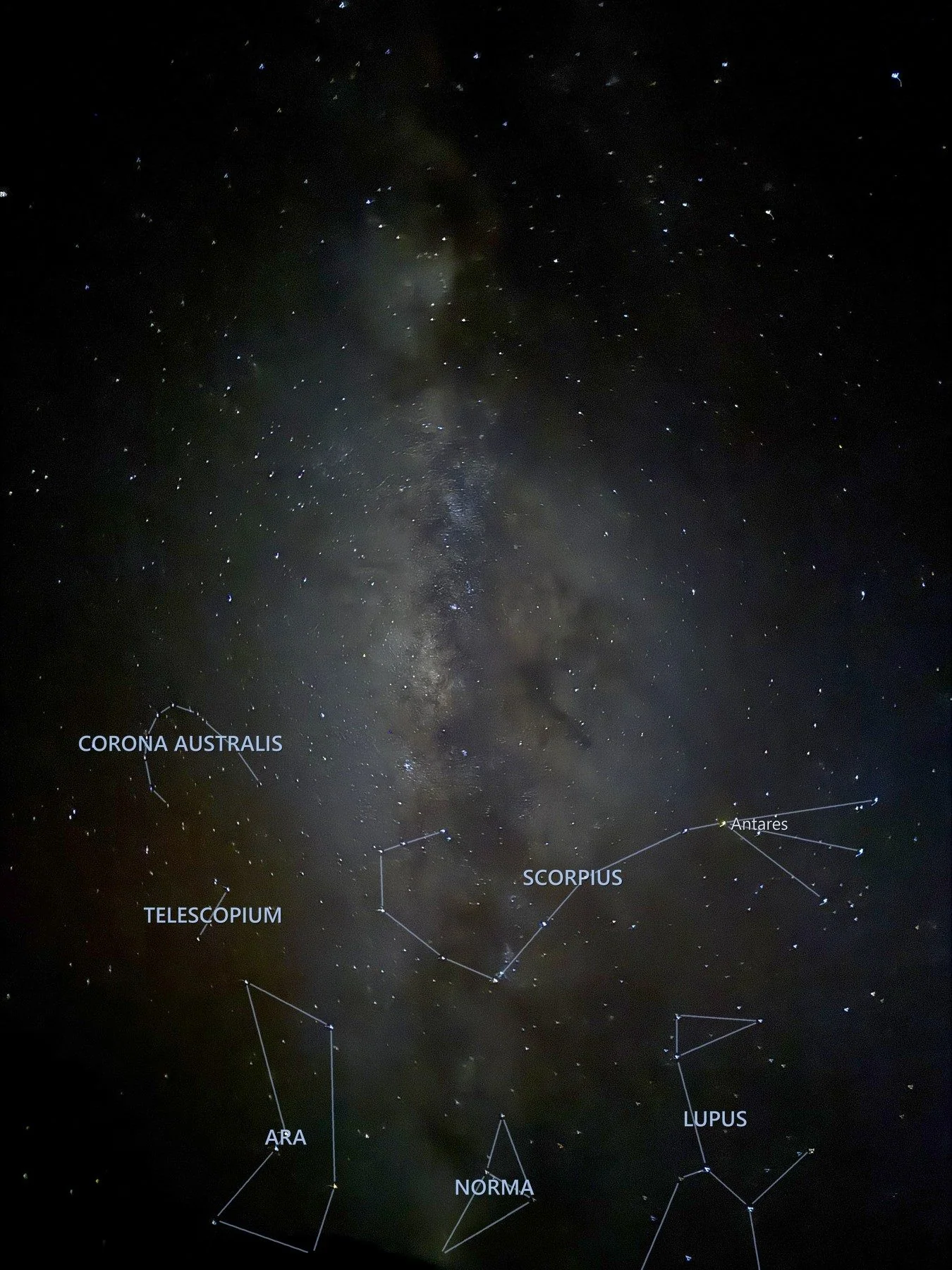
The same photo holds something the California photos never could. Mauna Kea is about 14 degrees of latitude farther south than Los Angeles, and that lifts the whole southern sky 14 degrees higher. Drawn for the bottom of the frame instead of the middle, the photo shows three small constellations that from home barely clear the horizon, if they clear it at all. Ara, the altar, never gets more than about 6 degrees up in Los Angeles, and the bottom of the figure never rises at all; Norma, the carpenter's square, peaks at about the same height, and Lupus, the wolf, at about 9. That is inside the haze and the glow of the city. From Mauna Kea all three reach 20 to 23 degrees, clear of the horizon. Even here Lupus did not fit completely: 7 of its 12 stars are in the frame, the rest were already setting in the southwest. Above them, Scorpius has its whole tail, which from California always drags through the murk.
November 2025: Perseus over the Klamath Basin
The last photo is from just after midnight on November 28, 2025, outside Klamath Falls in southern Oregon, on the overnight drive north at Thanksgiving (Thanksgiving, the Long Way Round). The Klamath Basin sits more than four thousand feet up with very few lights in it, and the Moon had just set. The phone went almost straight up, and this frame matched more stars than any other in the set.
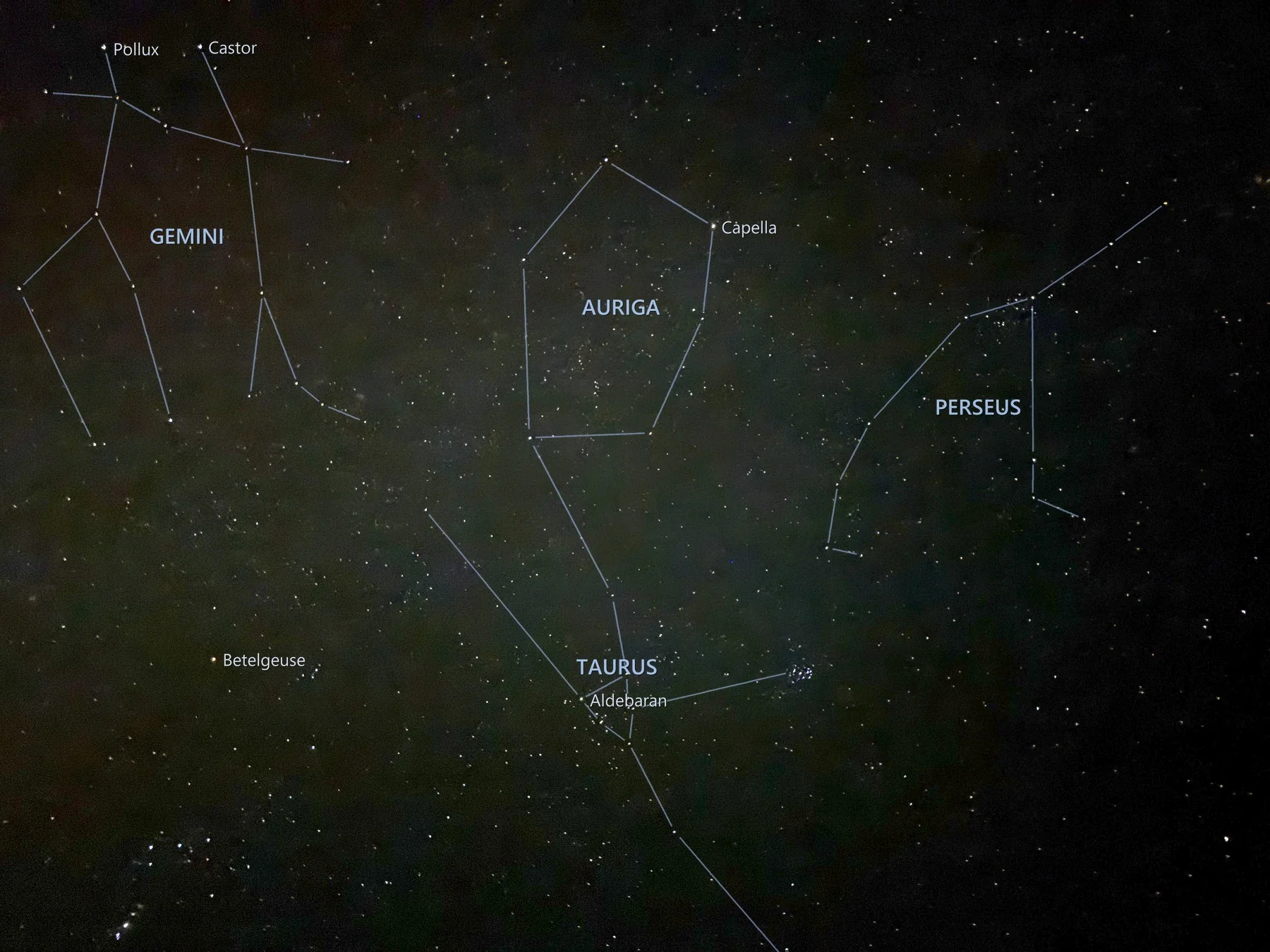
By late November the winter sky is back in the evening. In the middle is Auriga again, and Capella, which looks like one star but is really two yellow giant stars orbiting each other, too close together to split in any ordinary telescope. On the right is Perseus, the hero who cut off Medusa's head. One of his stars, Algol, the "demon star," marks the gorgon's eye. It is really a pair of stars that eclipse each other, so it fades noticeably for several hours every 2.87 days. Upper left are the twins of Gemini, Castor and Pollux. Pollux is the brighter of the two even though Castor carries the "alpha" label, and Castor, seen through a telescope, turns out to be a system of six stars. Below them, Taurus is back again, with Aldebaran and the Pleiades, the same bull we saw rising over Keys View three years earlier.
Which sky you get
Putting all of these nights side by side, two things decide what you see: how far south you are, and how dark it is. The globe below shows both. Pick a place, and it shades the part of the sky that never gets more than 10 degrees above the horizon from there, and fades the stars too faint to see.
From Los Angeles, the city glow leaves only the stars brighter than about magnitude 4: some 450 of them, in 63 of the 88 constellations. Drive out to the desert, to Joshua Tree or Death Valley, and the range of the sky is exactly the same, since it is the same latitude, but the count jumps to about 7,400 stars. That is the difference between the Keys View and Dante's View photos and anything taken at home. Mauna Kea changes the other thing. At 19.8 degrees north instead of 34, the shaded cap shrinks, and twelve more constellations clear the horizon, among them Ara and Norma from the photo above, and Crux, the Southern Cross.
Coda: the Moon in Earth's shadow
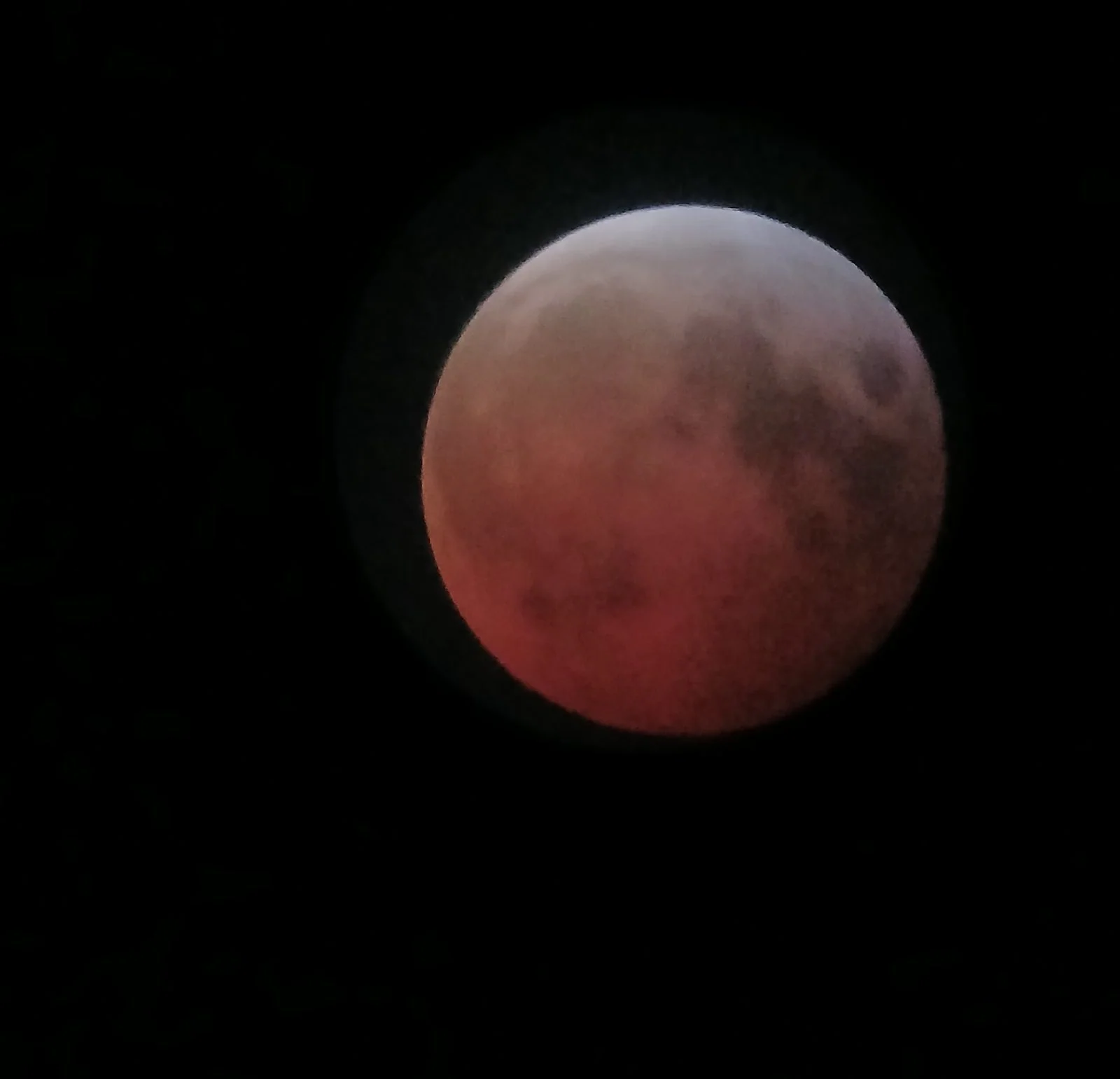
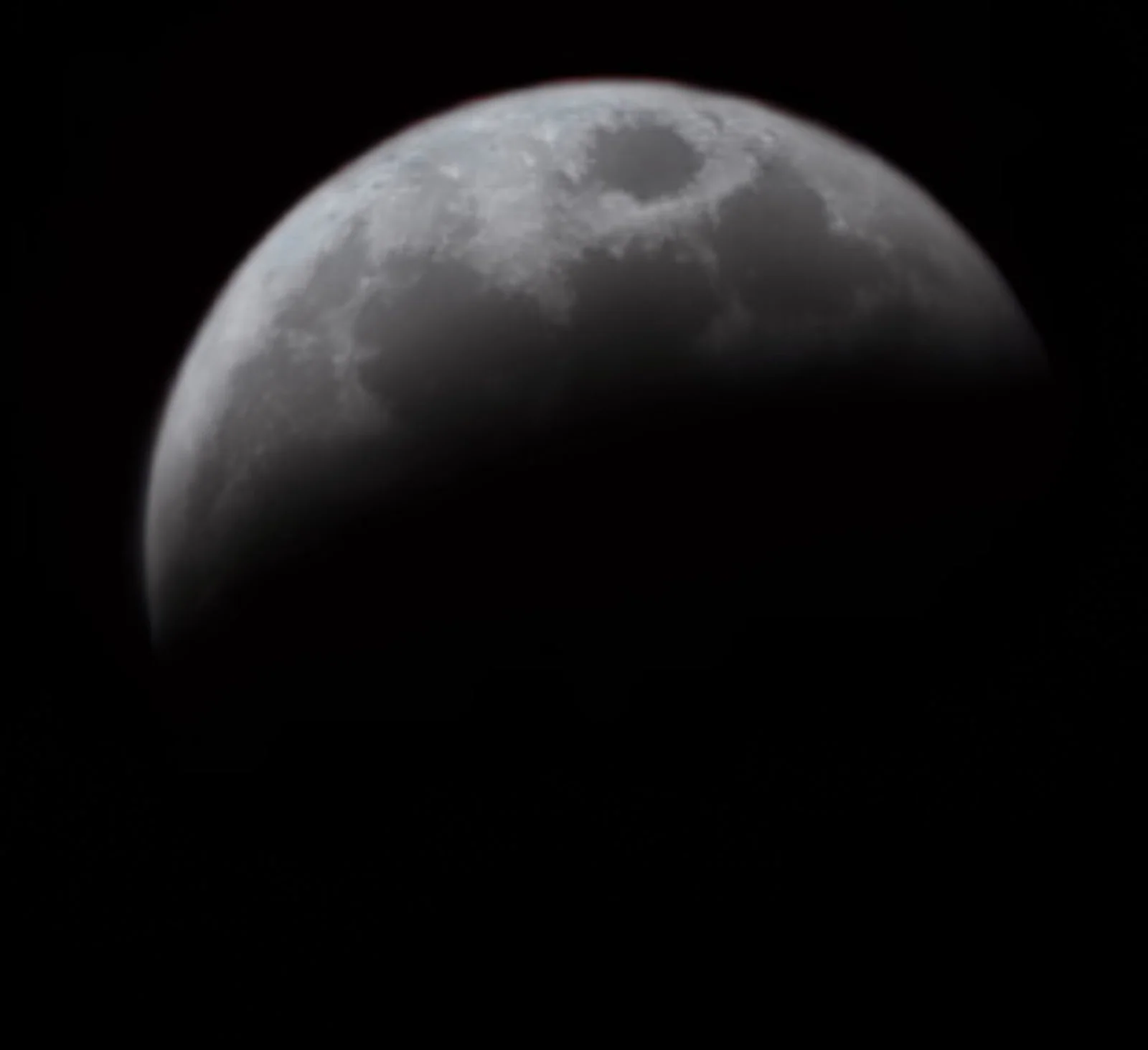
One more night, with no stars in it at all. On March 14, 2025, there was a total lunar eclipse over North America, the first in more than two years. During totality the Moon sits entirely inside Earth's shadow, and the only light that reaches it has passed through Earth's atmosphere, which filters out the blue and bends the red inward. Every sunrise and sunset on Earth at that moment, all at once, is what turns the Moon that dark copper color. Later, as it moved out of the shadow, its edge came back into direct sunlight, bright and gray again.
How the lines were drawn
Each overlay started from the photo alone. A short program found every point of light in the frame, then used the photo's timestamp and location to work out where every catalogued star brighter than about magnitude 6.5 stood in the sky at that moment. It then searched for the camera pointing, focal length and lens distortion that lined up the two, and kept the fit only when the result was convincing. The matched stars ranged from 54 in the ultrawide Joshua Tree frame to 322 over the Klamath Basin, most landing within a pixel or two of where the catalogue said they should be. The constellation lines were then drawn through the fitted lens, and the planets were added from the ephemeris without any reference to the photo. Mars and Jupiter landing on real bright dots is a nice independent check that the fit is right. Some of the darker frames are lightly brightened. Otherwise they are as the phone took them.
Star positions: HYG database v4.1 (CC BY-SA 4.0), based on the Hipparcos catalogue. Constellation figures: Stellarium's "modern" sky culture. Planet positions: JPL DE421 ephemeris, via Skyfield. Photo locations have been removed from the published images.
Likes and comments
React with an emoji or leave a comment. Signing in with GitHub is required.