← Misc · July 2025
A Weekend Above the Clouds
A short weekend trip to Big Bear Lake, with Wangcai and a window full of pines.
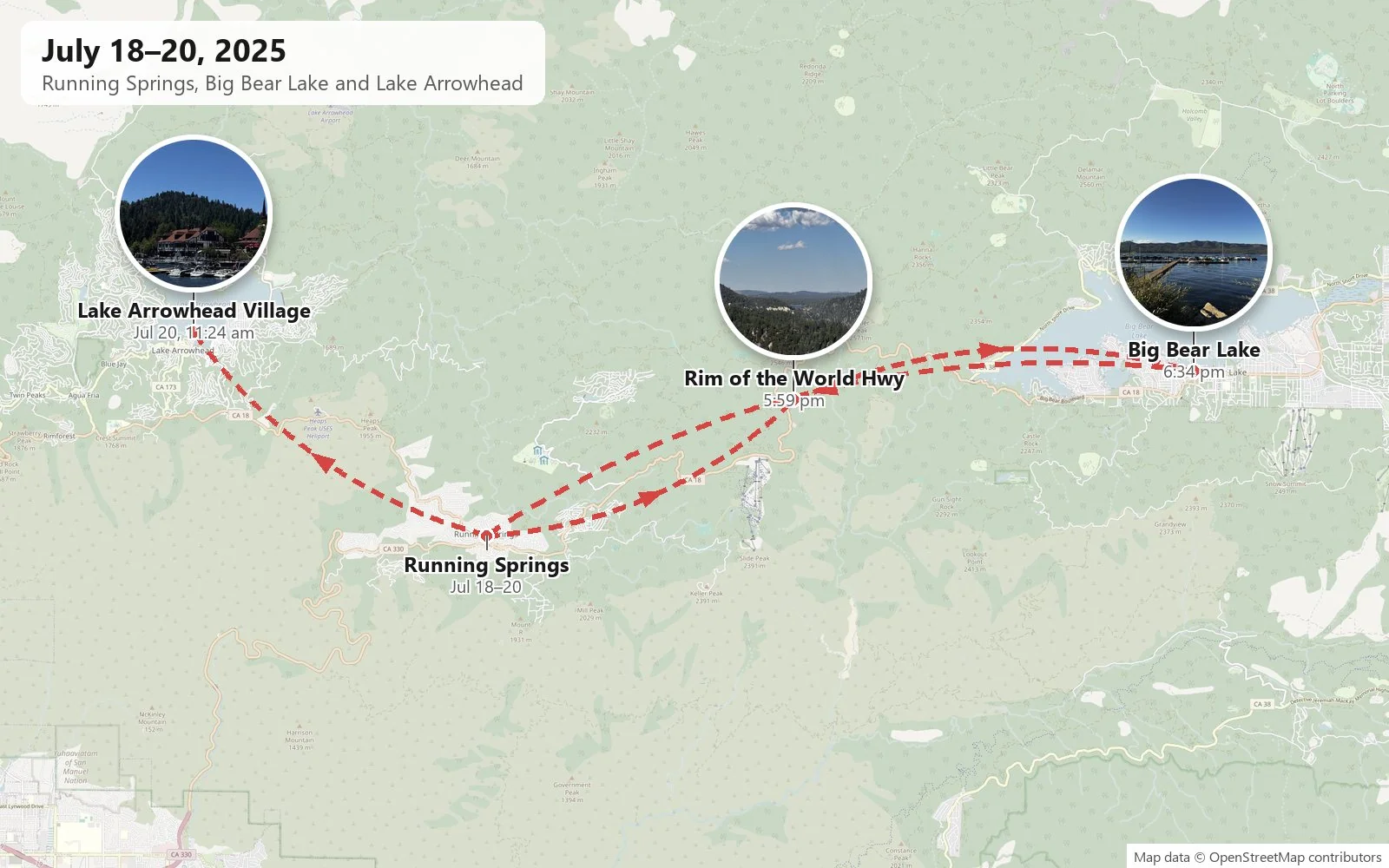
Running Springs → Rim of the World Highway → Big Bear Lake → Running Springs → Lake Arrowhead → home
the San Bernardino Mountains, all by car · two mountain lakes · one cabin in the pines · one dog who was up before dawn
Some trips are an expedition. This one was a weekend. In the middle of July, when the lowlands of Southern California bake, we drove up into the San Bernardino Mountains for two nights in a small cabin in the pines near Running Springs, a mountain town about six thousand feet up. From there, the plan was simple: one evening at Big Bear Lake, one morning at Lake Arrowhead, and as little else as possible in between.
It was also a trip with Wangcai, our cream-colored dog, who had come home that January (her story is here). As with the other trips on this page, what follows is reconstructed from the camera roll. It is a short roll, a few dozen photos on my phone and some more on my wife's, and a surprising share of them are of Wangcai.
Friday night in the pines
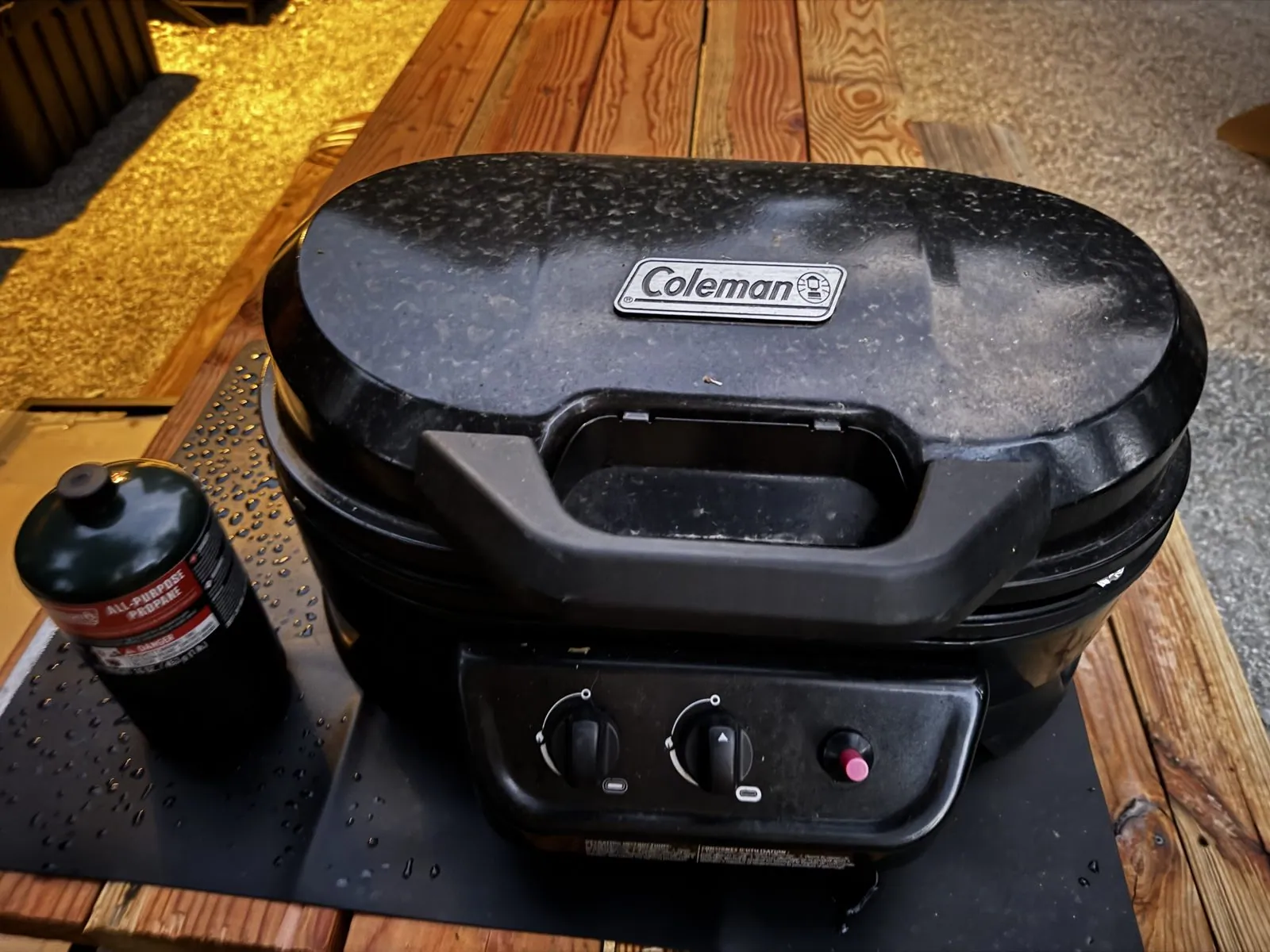
We arrived on Friday evening, just before eight. The first photo on my phone was taken at 8:25 pm, as the light went: a portable gas grill and a green propane canister set out on a weathered wooden picnic table, the mat under them beaded with droplets, and the gravel beyond glowing orange under an outdoor lamp. In the end the grill went unused: dinner that night was skewers, cooked in a grill pan on the stove inside. At this altitude the evening air cools quickly even in July, and the woods around the cabin go quiet and dark within minutes of sunset. It is not a glamorous picture, but it is exactly what the start of a mountain weekend looks like.
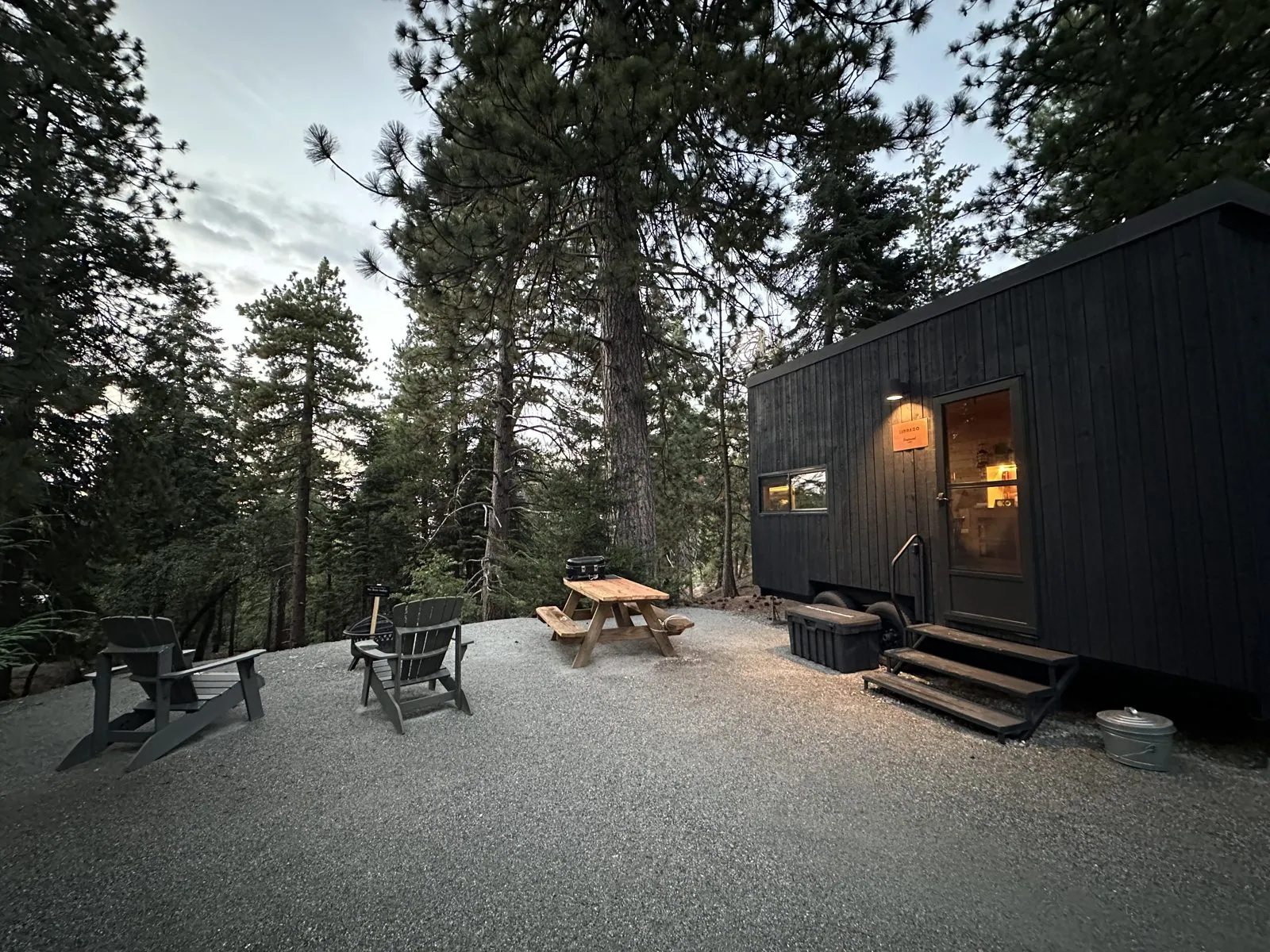
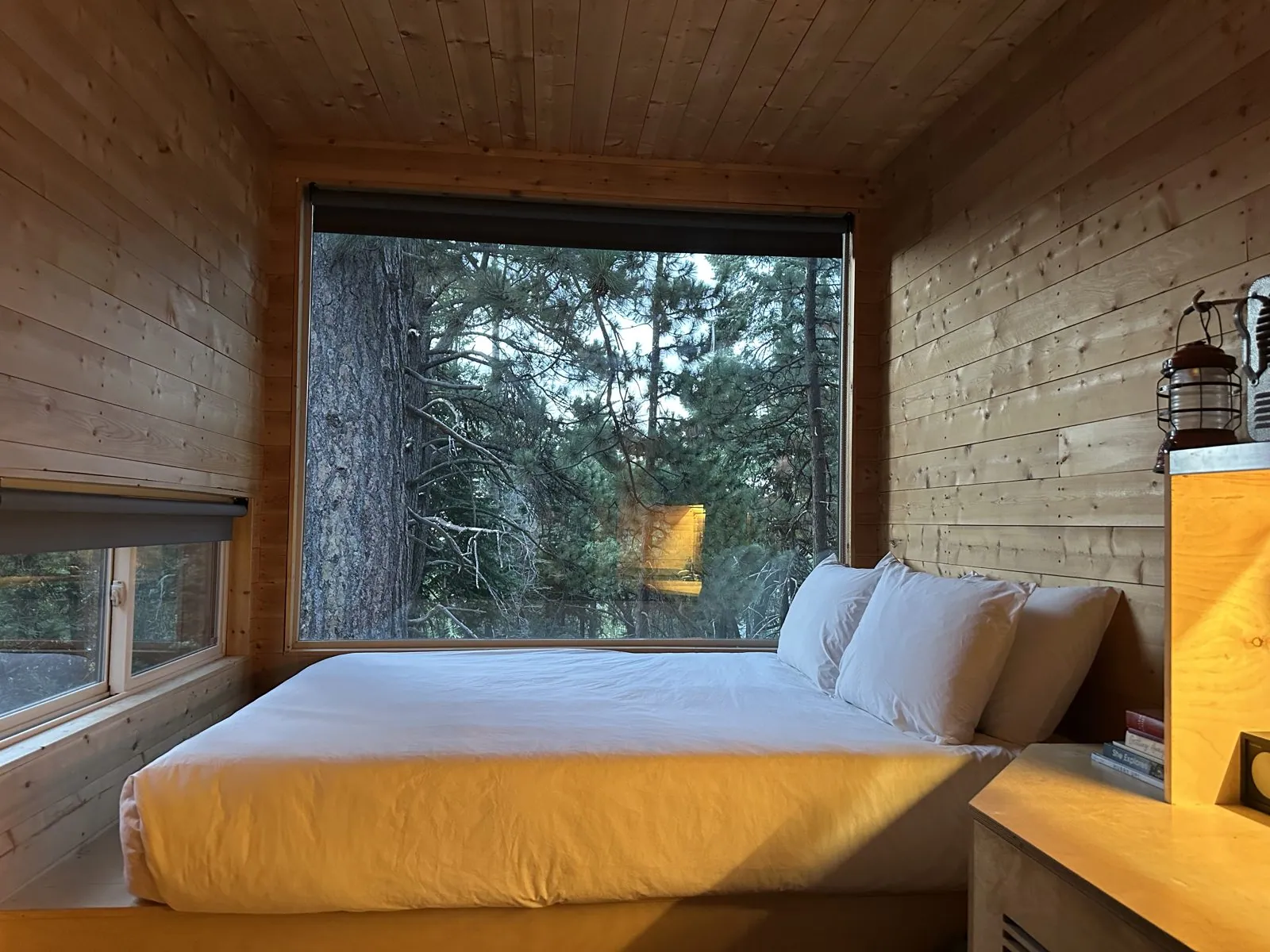
The cabin itself was a small black box on a gravel pad among tall pines, with Adirondack chairs and a picnic table out front, and inside, a bed under a window that took up most of the wall.
Dawn, with a window full of pines
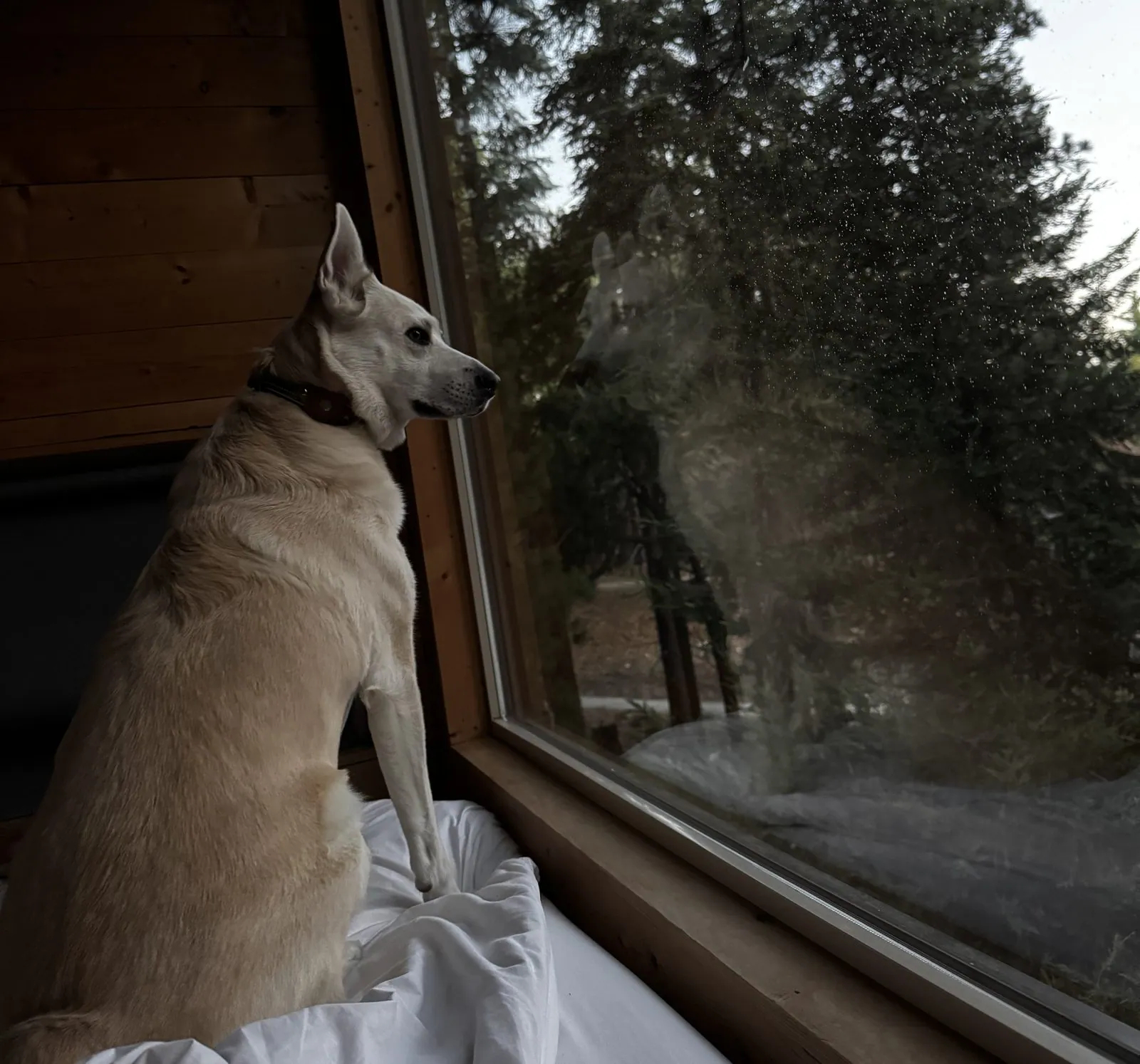
The best part of the cabin was its window, a single sheet of glass that turned one whole wall into a view of the forest. Wangcai found this out first. At 5:40 on Saturday morning, well before anyone else was ready to be awake, she was stretched out along the bottom of that window, paws up against the frame, staring into the trees. Outside, the tall trunks of the pines stood in the blue half-light before sunrise, with the forest floor between them still in shadow and only the sky showing any color.
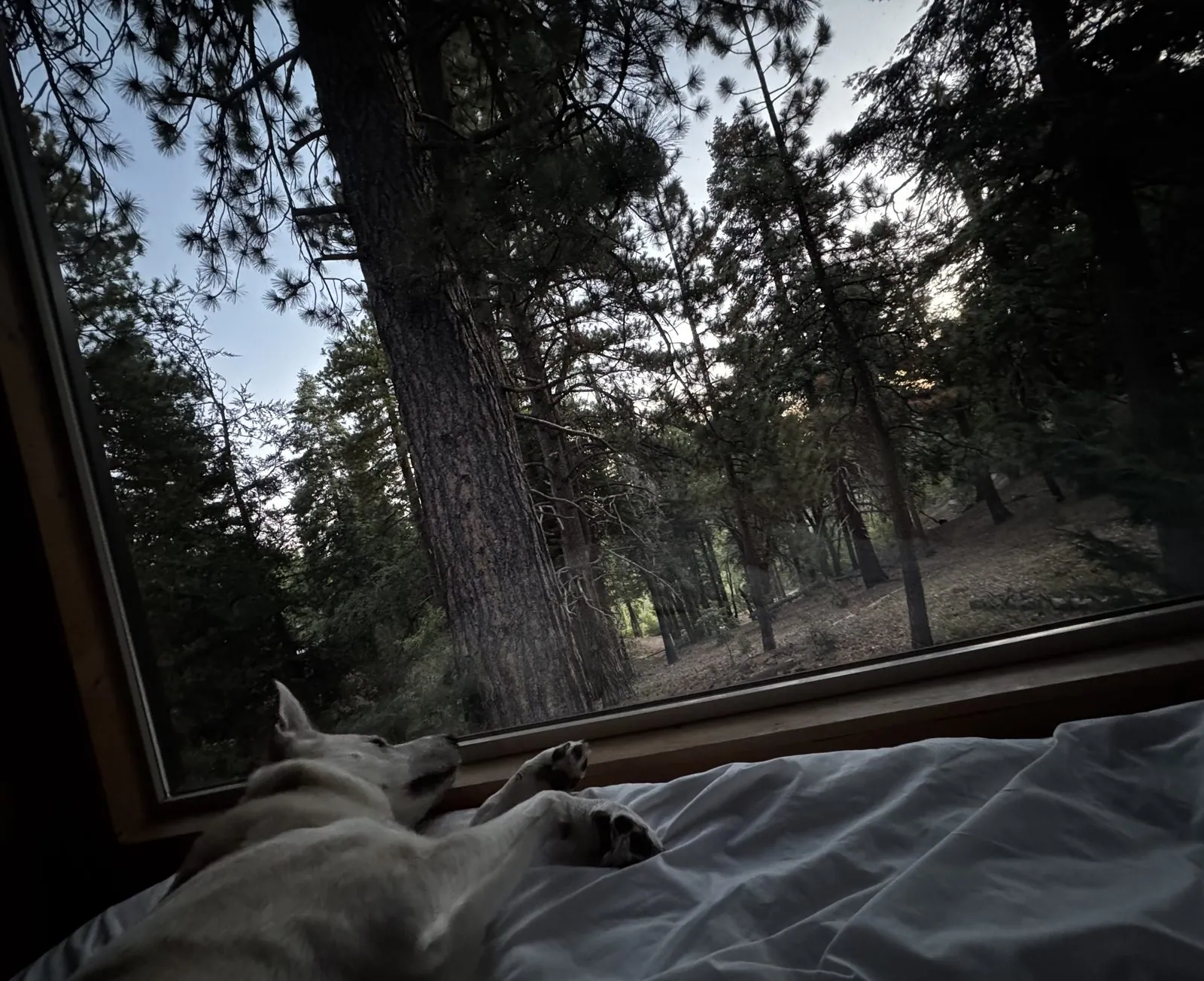
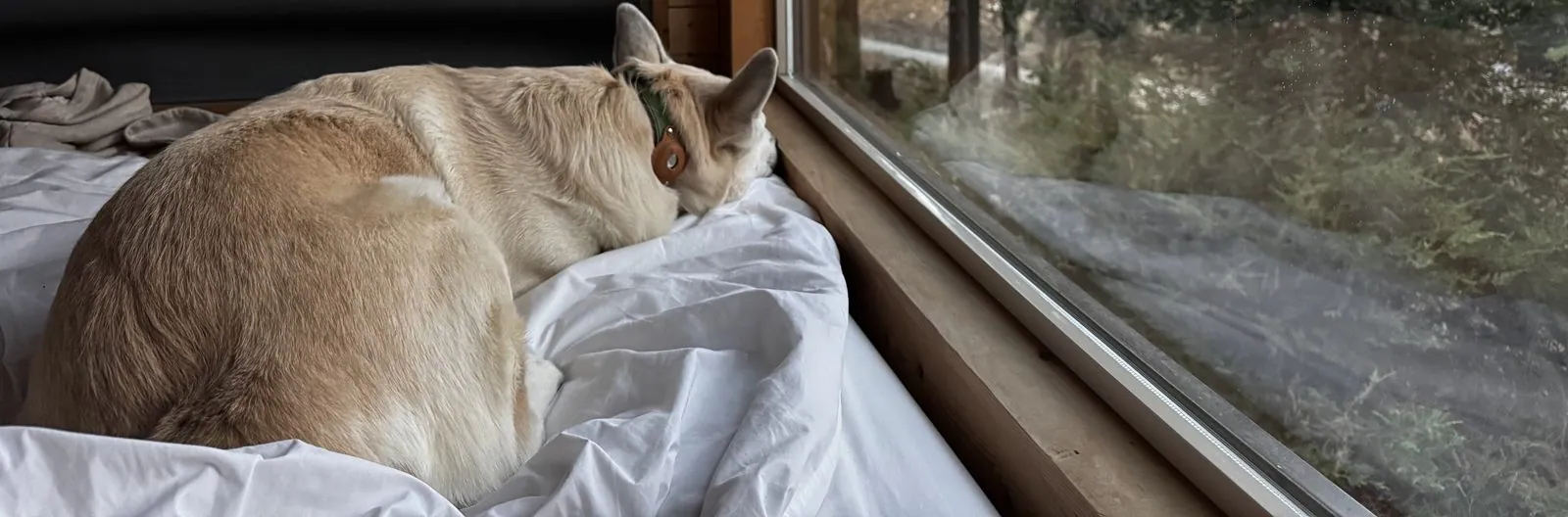
Over the next ten minutes the camera followed her through the whole repertoire. First she sat up, very straight, ears high, and watched the forest like a sentry, her reflection floating faintly in the glass beside the trees. Whatever she was watching for, a squirrel or a jay or just the novelty of a world with no walls in it, she kept at it for a good while. Then, at 5:49, the watch ended the way most dog watches end: curled up in a tight crescent with her nose tucked in, asleep against the glass, the pines still standing guard outside.
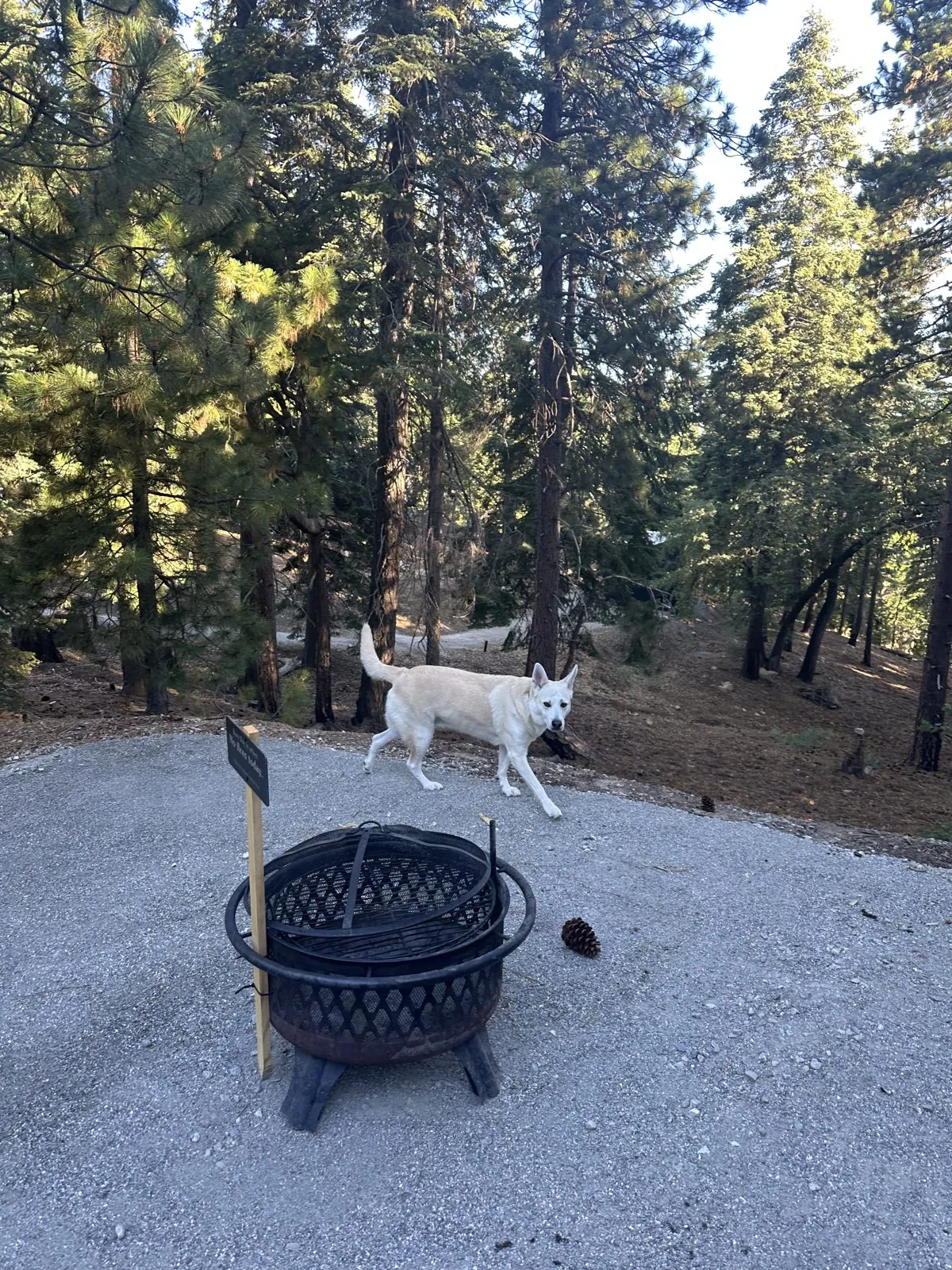
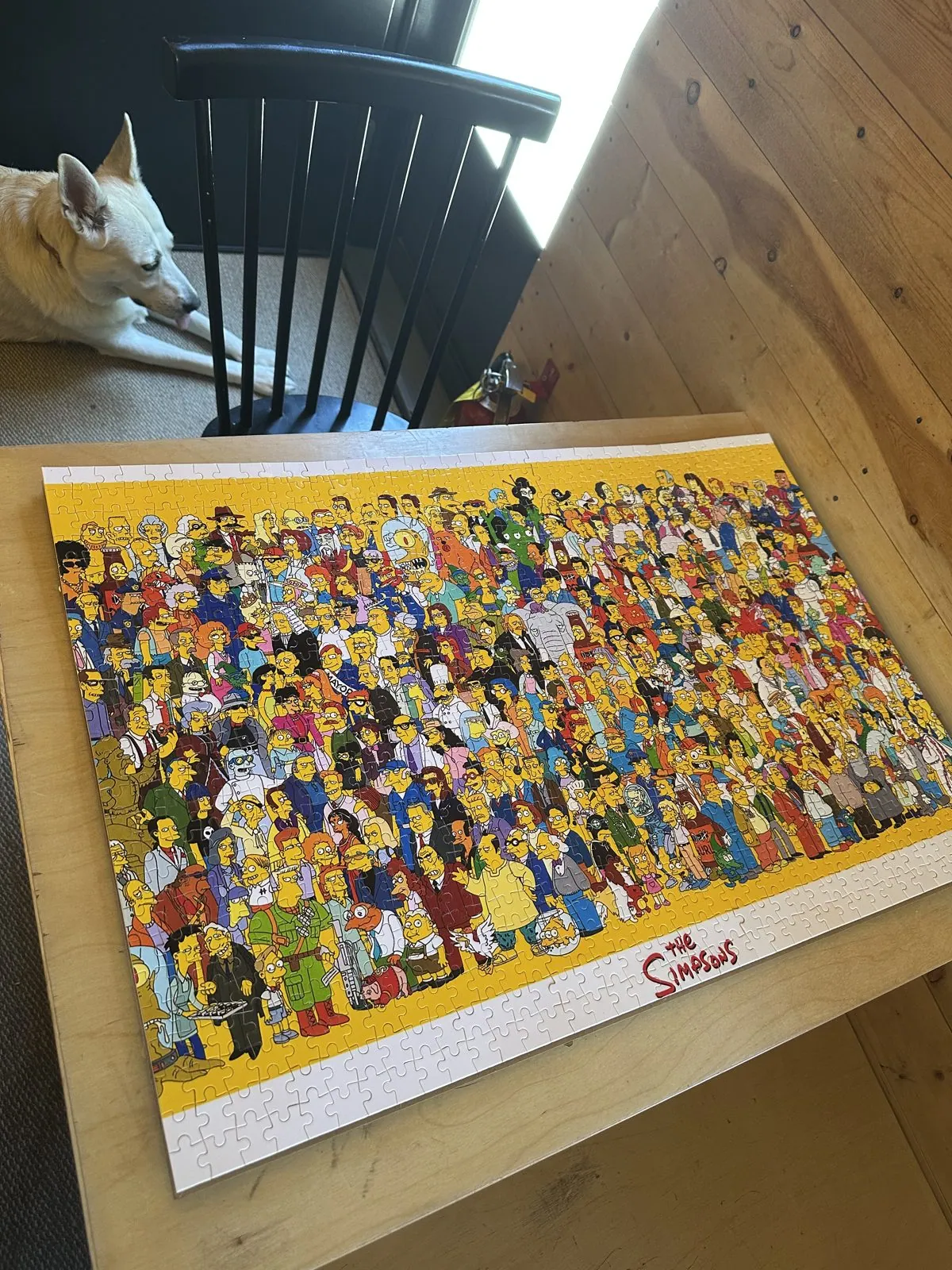
At 7:23 Wangcai was out on the gravel by the fire pit, and by lunchtime a big Simpsons jigsaw puzzle was spread across the table, with Wangcai lying beside it.
The Rim of the World
Late on Saturday afternoon we drove east toward Big Bear on the Rim of the World Highway. This is State Route 18, and the name is not much of an exaggeration: for long stretches the road runs along the crest of the San Bernardino Mountains, with the land dropping away on one side. It is one of the classic mountain drives of Southern California and a designated scenic byway, and from Running Springs eastward it climbs through dense conifer forest toward the high valley that holds Big Bear Lake.
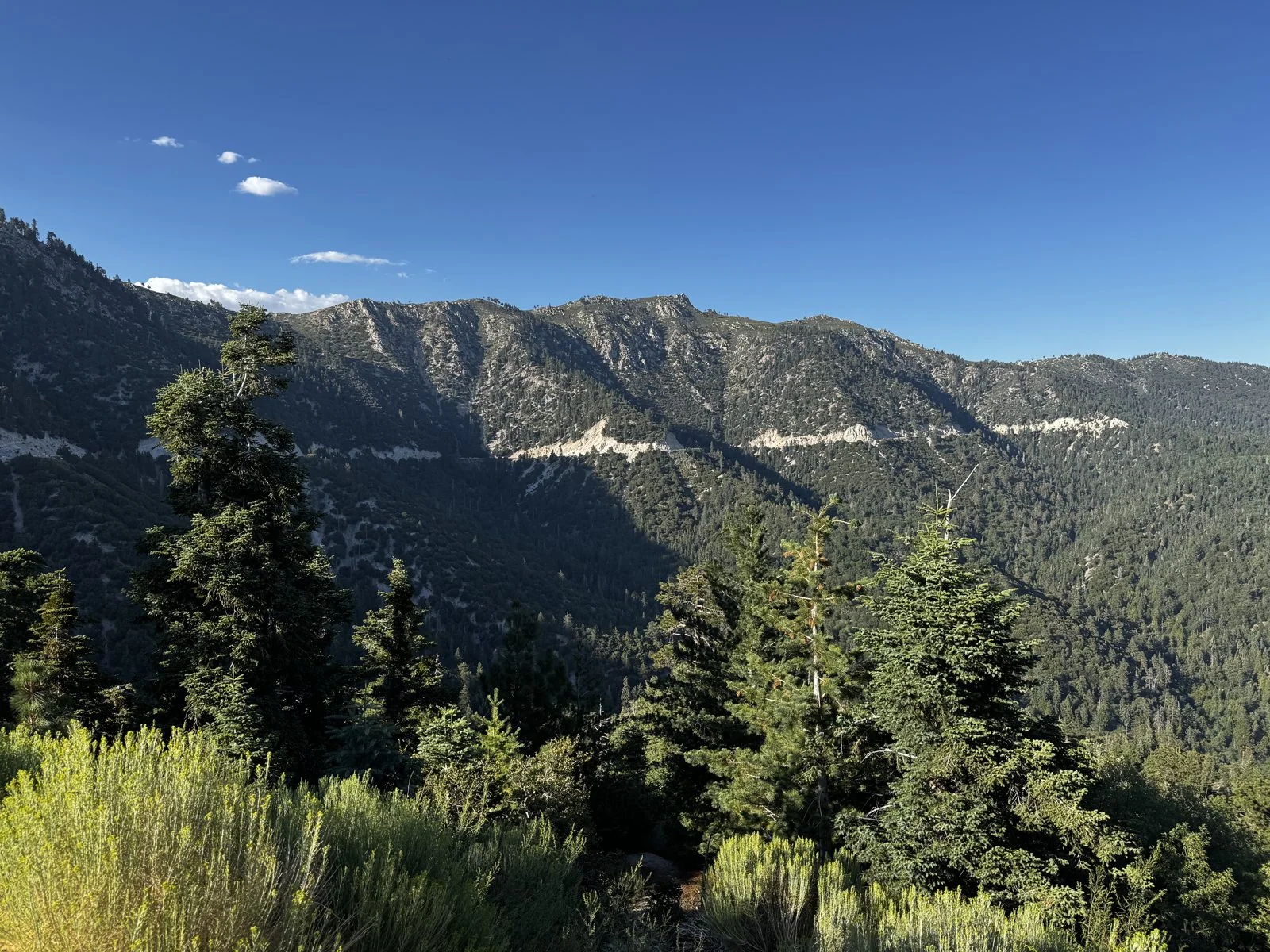
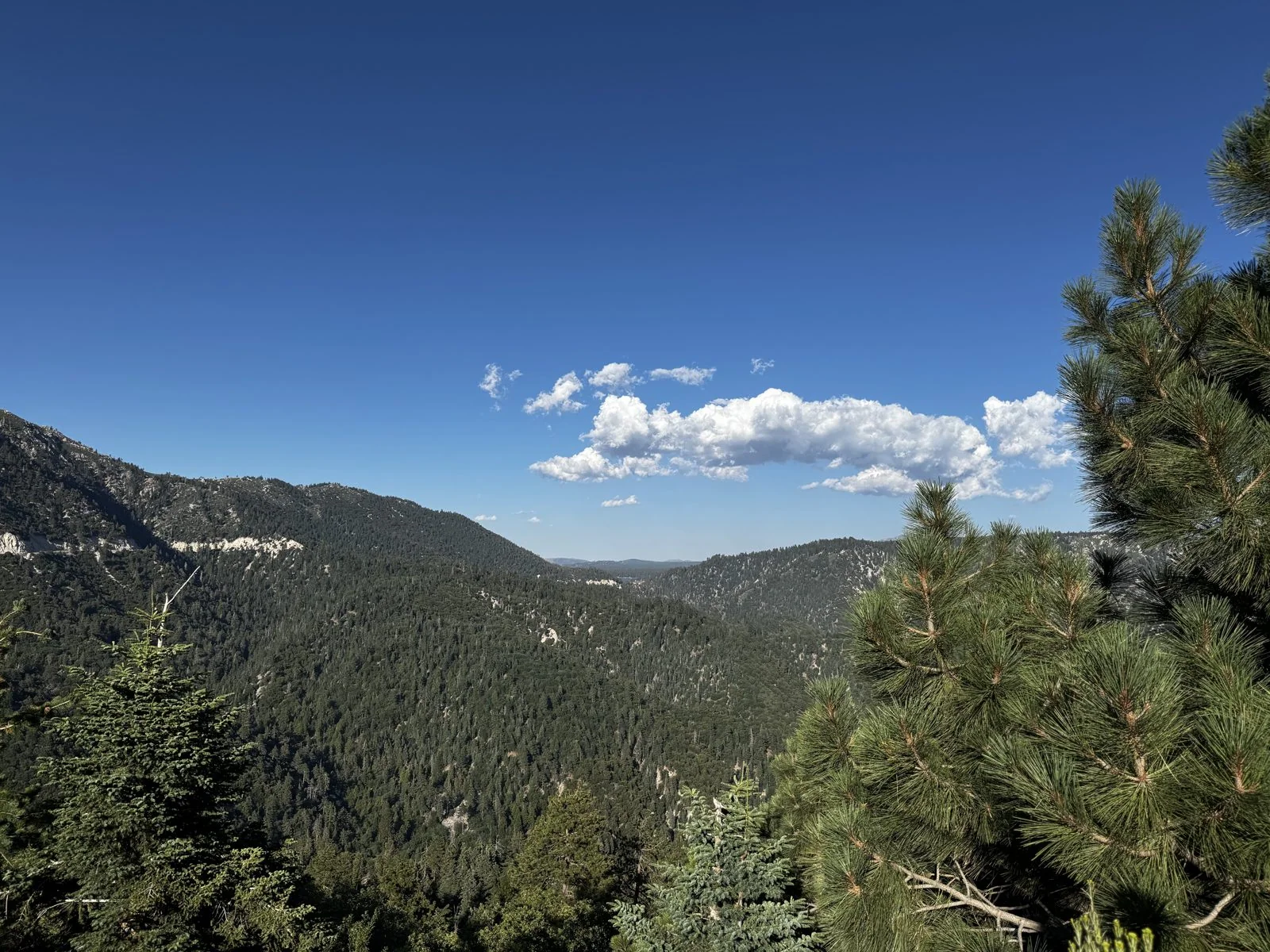
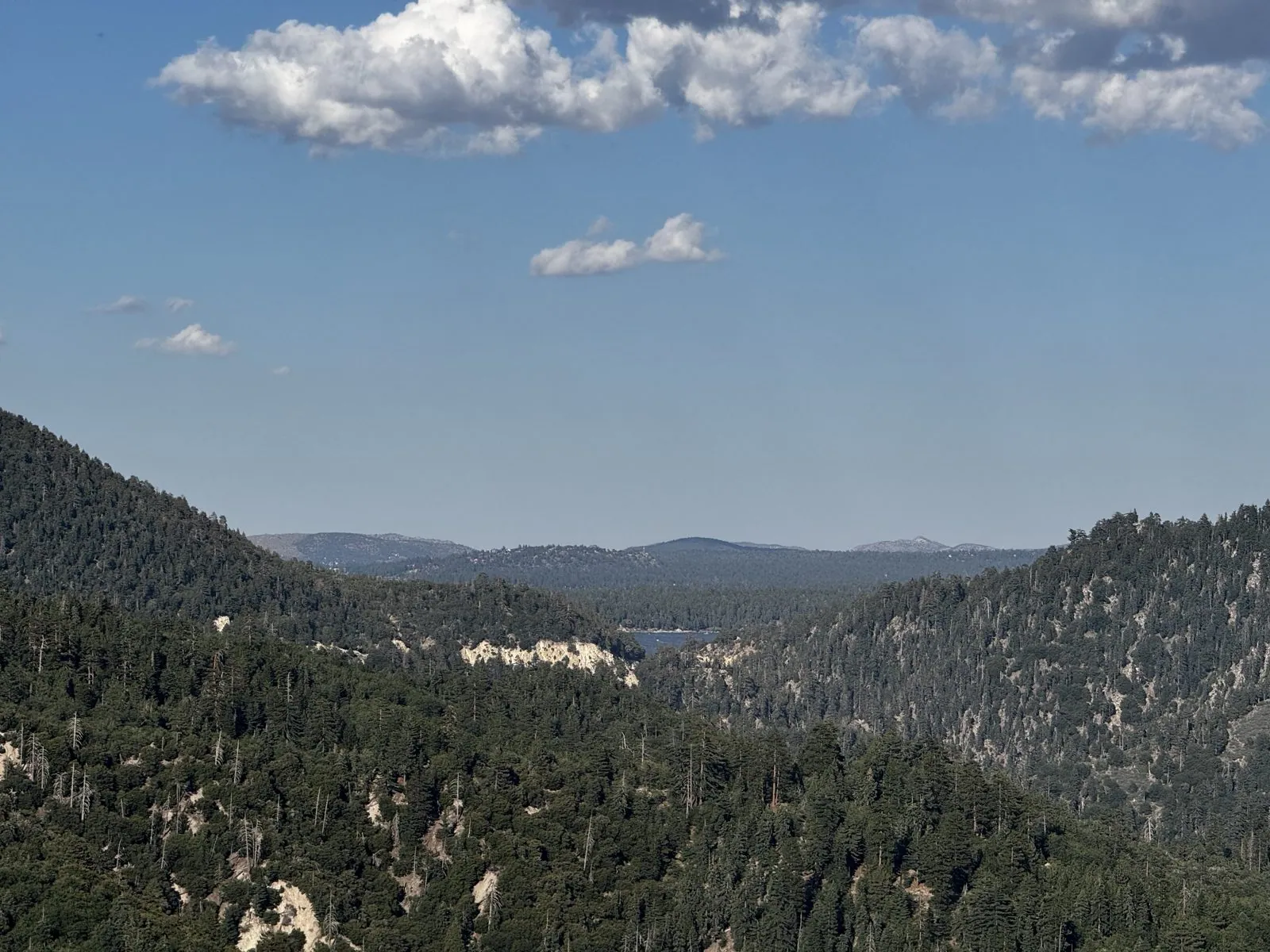
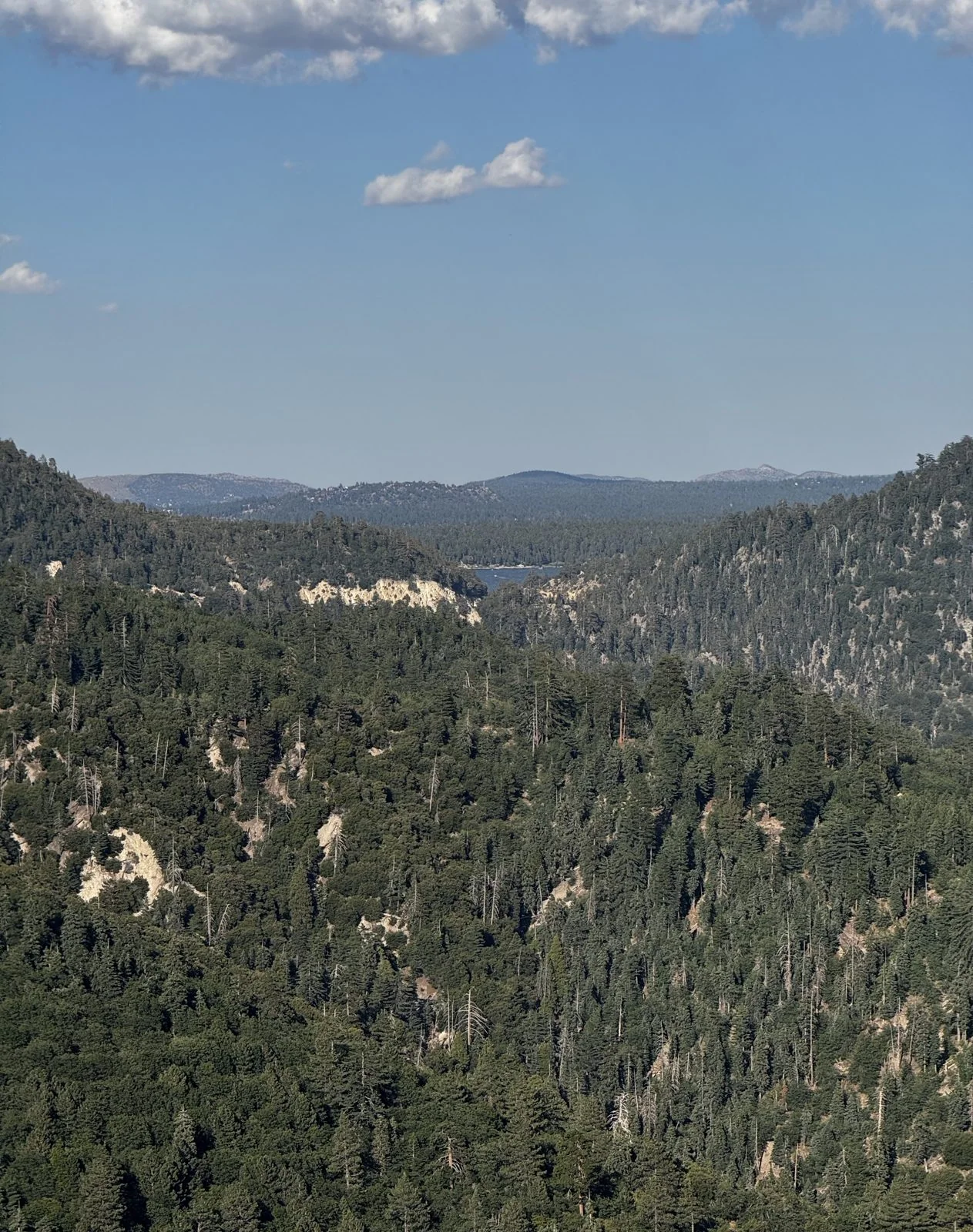
Just before six we pulled over to look. The view was the kind that makes you stop the car: a deep canyon blanketed in pine and fir, ridges stacked one behind another, and a pale band of rock running across the opposite slope. The sky was the saturated blue of high altitude, with a few fat white clouds drifting over. Looking east up the canyon, the trees parted just enough to show a small patch of blue water far in the distance, the first sign of the lakes that sit in these mountains.
Big Bear Lake at golden hour
By a quarter past six we were in Big Bear Lake. The first stop was Tea & Coffee Exchange, a café on Paine Road, whose hand-drawn chalkboard listed a run of cat-themed mochas: a Tabby with white chocolate and caramel, a Tuxedo of white and dark chocolate, a Tortoise Shell (spelled "Tortise" on the board) and a Calico, illustrated with a ball of yarn and a cat stretched out mid-nap. Then, a little before seven, we walked down Paine Road to the water near the marina. Big Bear Lake is a reservoir, made when a dam was built across Bear Creek in 1884 to store water for the orange groves in the valley below, and today it is one of Southern California's favorite mountain escapes.

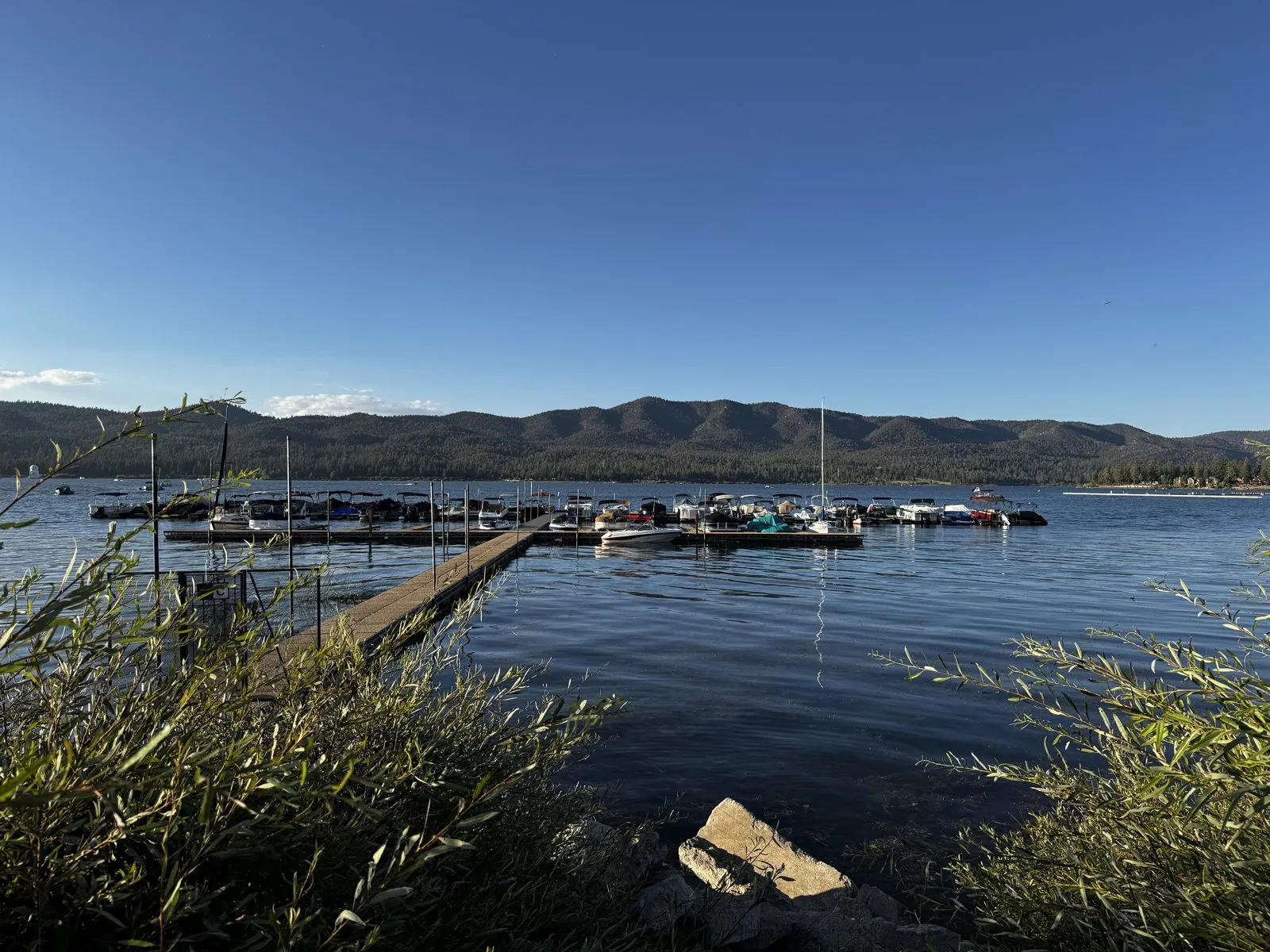
The lake that evening was calm and glassy, and the low sun turned it a deep blue. A long wooden dock ran out to rows of moored boats, and beyond them the far shore rose into dark, forested mountains under a cloudless sky. Willows crowded the edge of the water in the foreground. Lake Arrowhead, as we would see the next day, is tucked in among steep hills. Big Bear, by contrast, sits in a broad, open valley almost seven thousand feet up, and its shore feels wide, bright and unhurried.
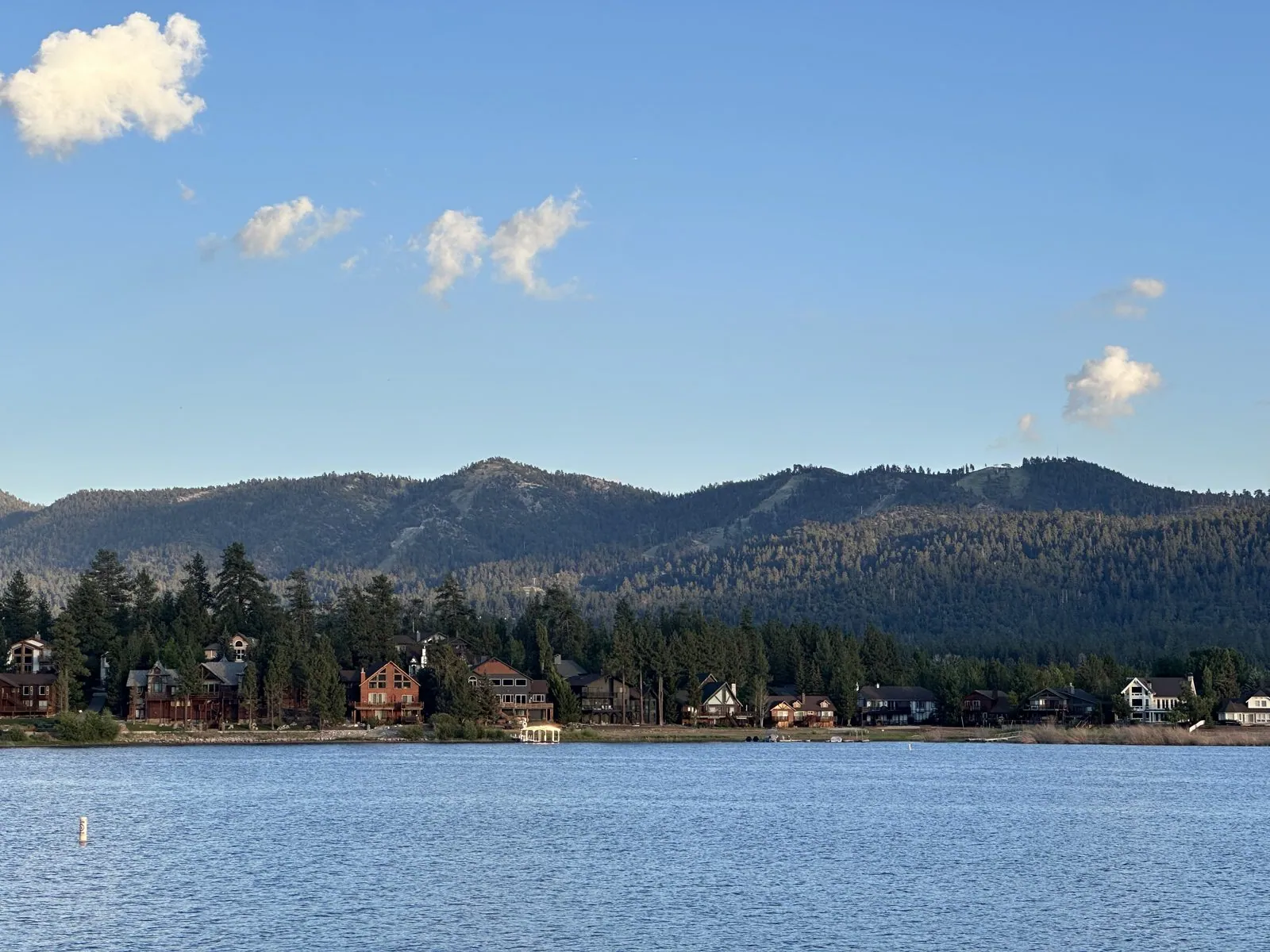
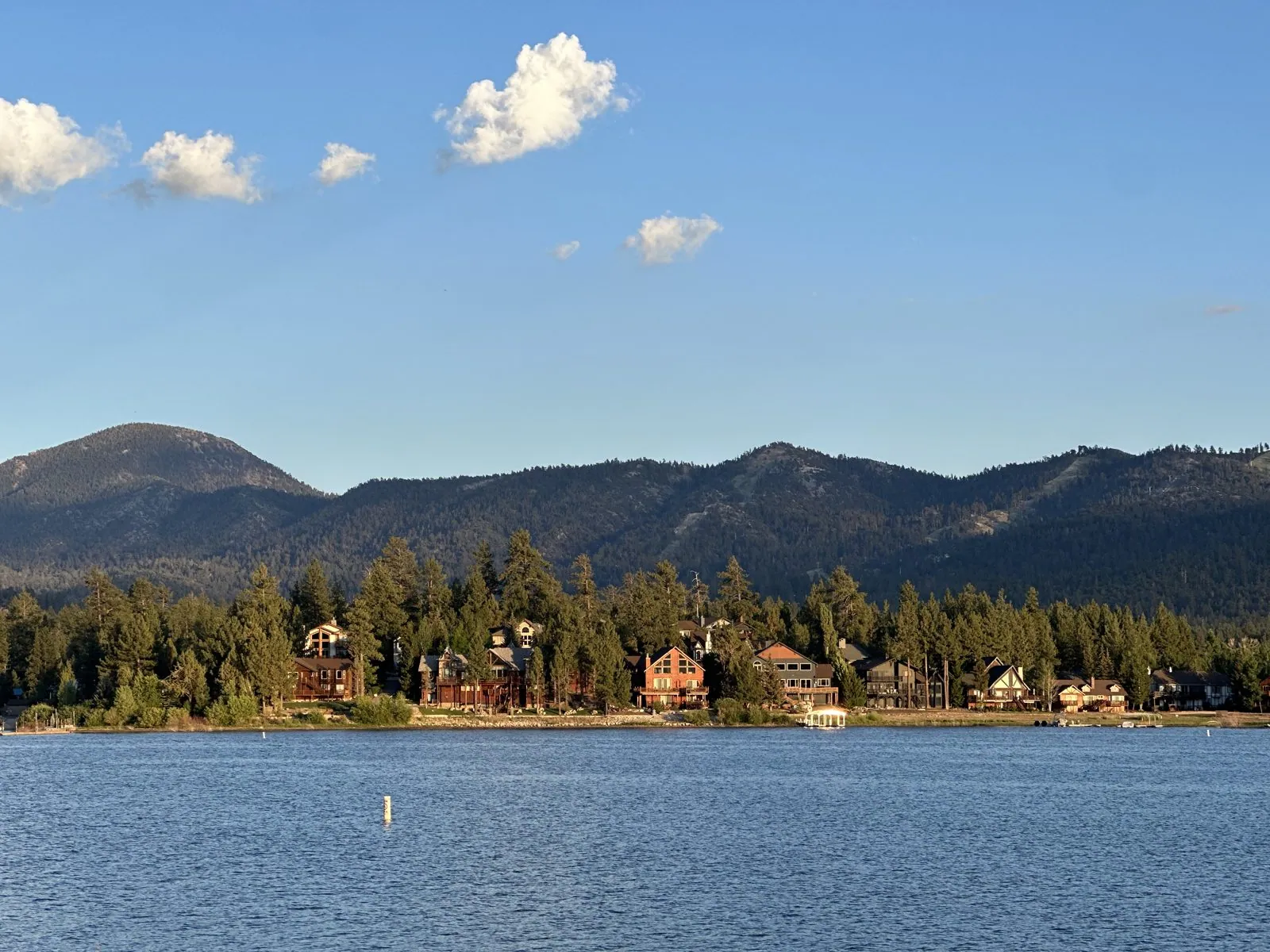
After the marina we drove around to the east end of the lake, where at twenty-five past seven the low sun lit the whole south shore: the houses along the water and the forested mountains behind them.
Stars over Running Springs
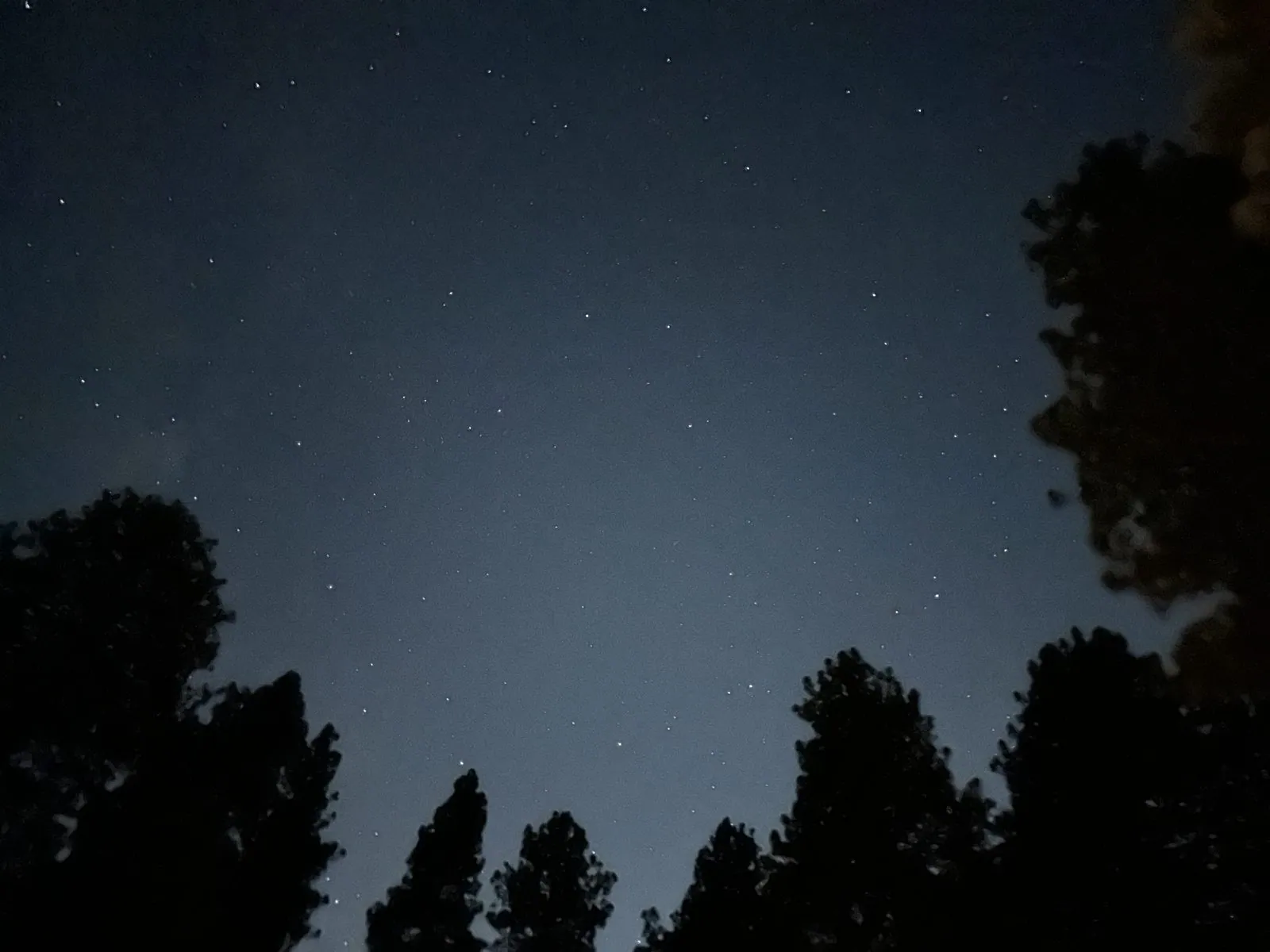
Back at the cabin, at 10:40 that night, the camera pointed straight up. Away from city lights and more than a mile up, the sky over the mountains fills with far more stars than you ever see at sea level.
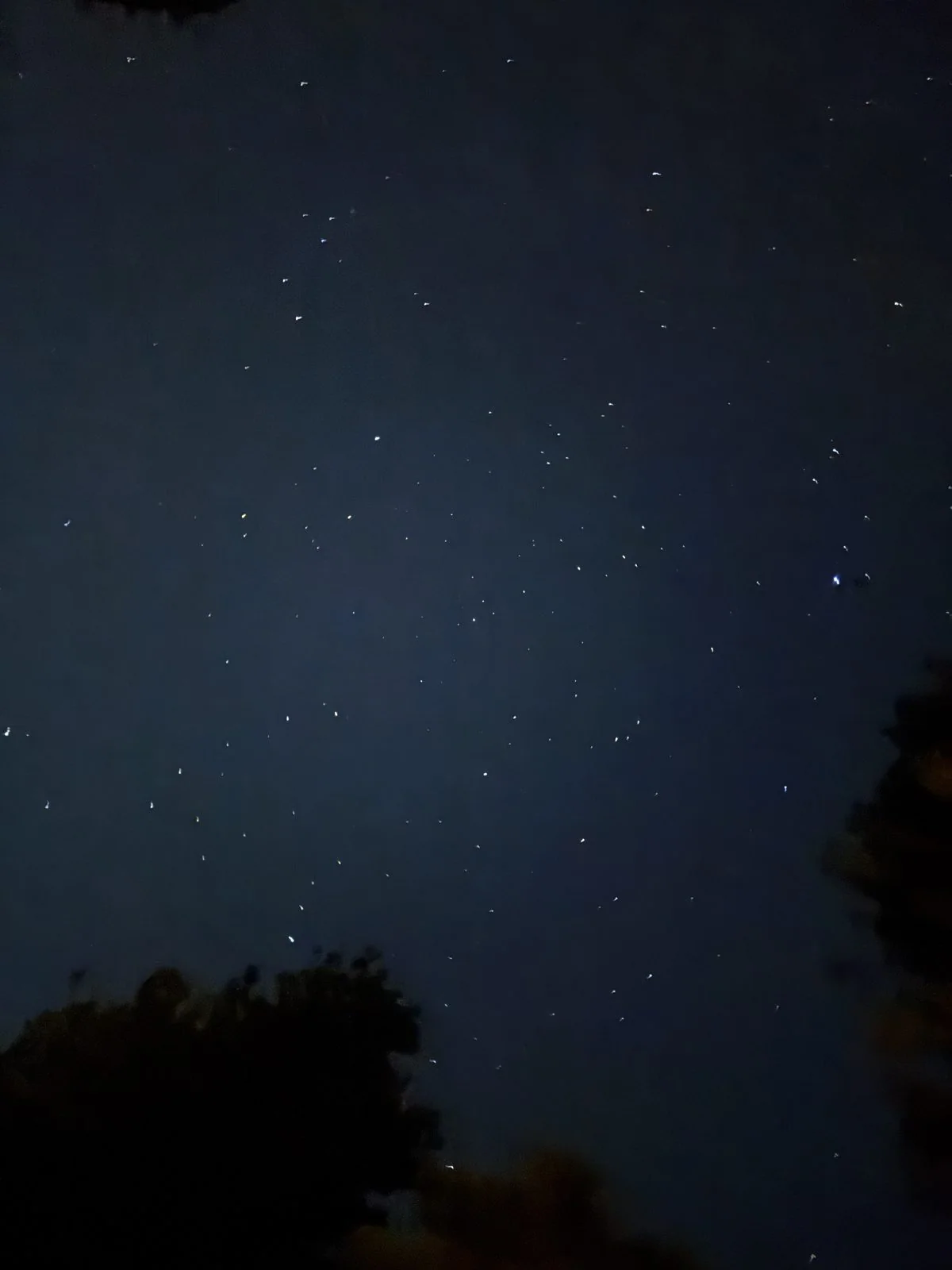
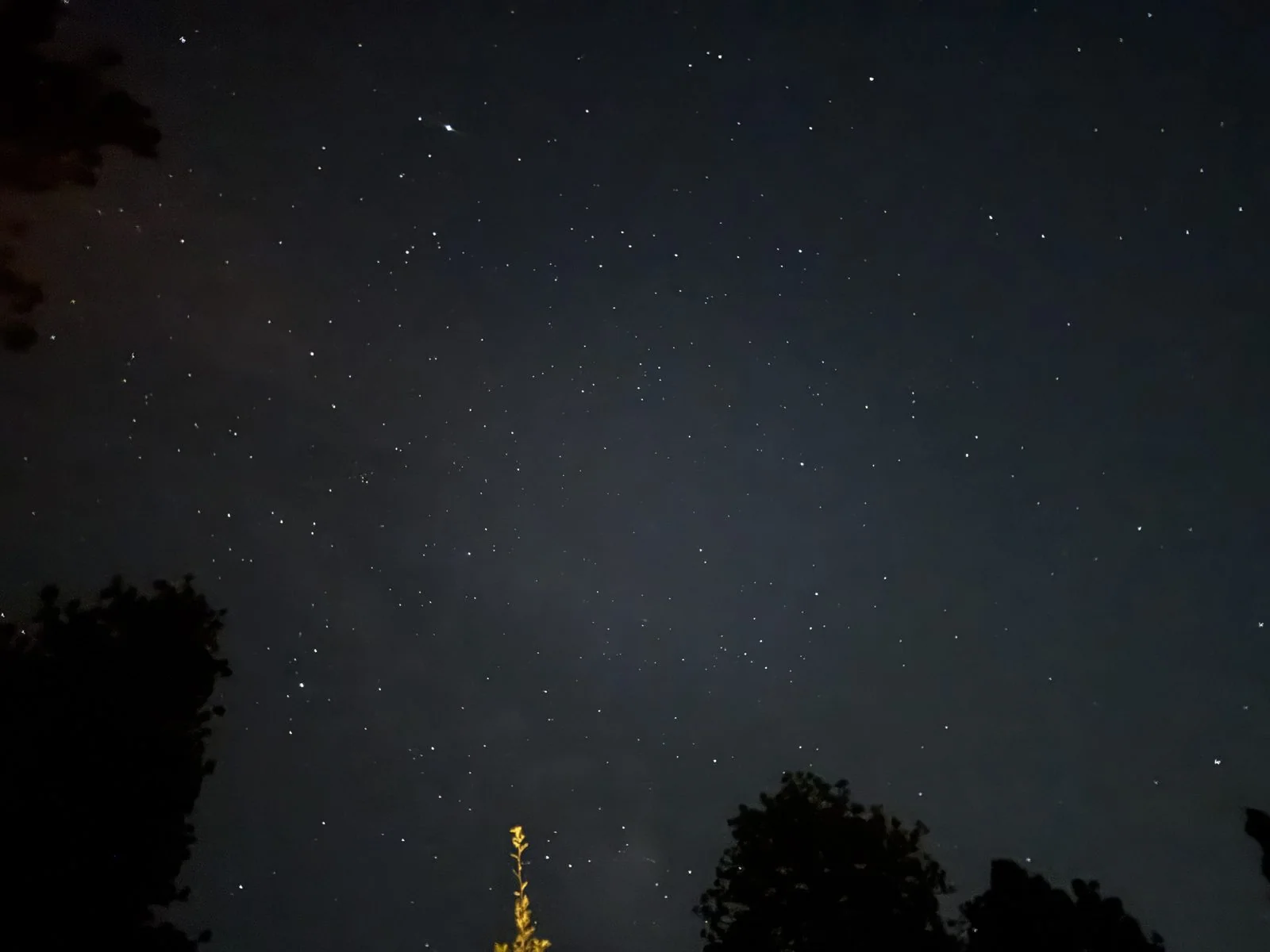
A phone held up in the dark for a long exposure records them as a fine scatter of white points, framed at the edges by the black silhouettes of the pine tops, with one branch at the bottom of the frame lit gold by a lamp. These are not astrophotographs, but they are honest records of what it was like to stand outside and look up that night.
Sunday morning at Lake Arrowhead
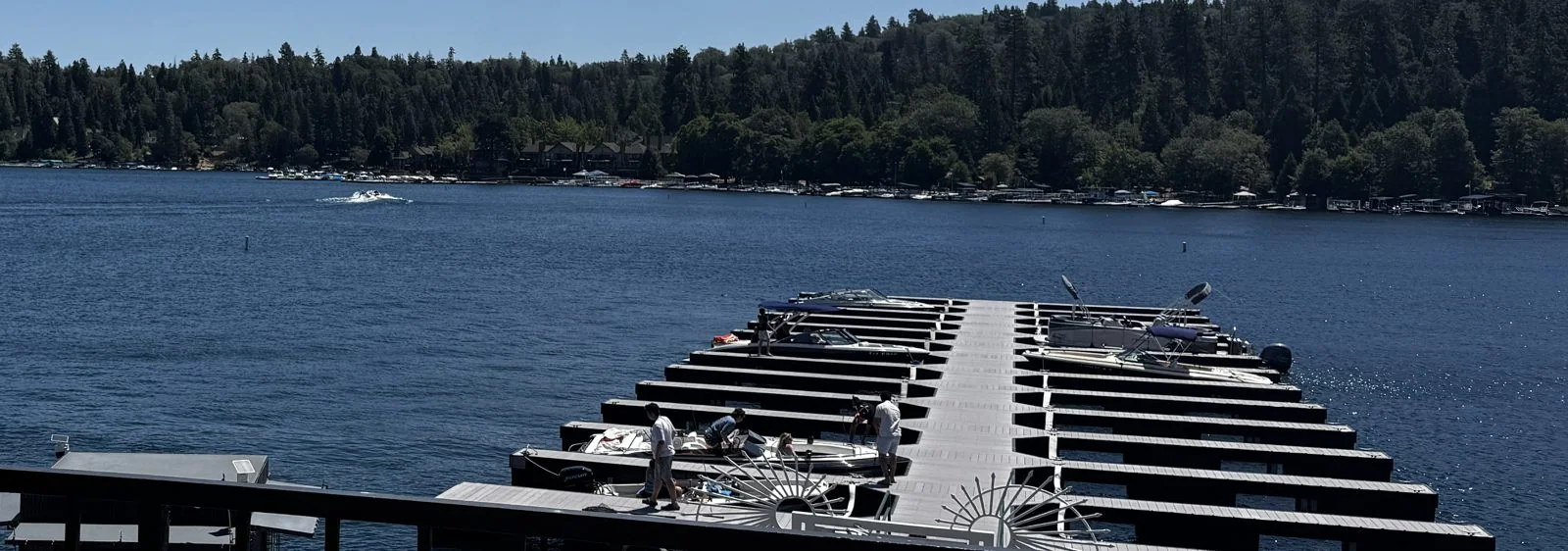
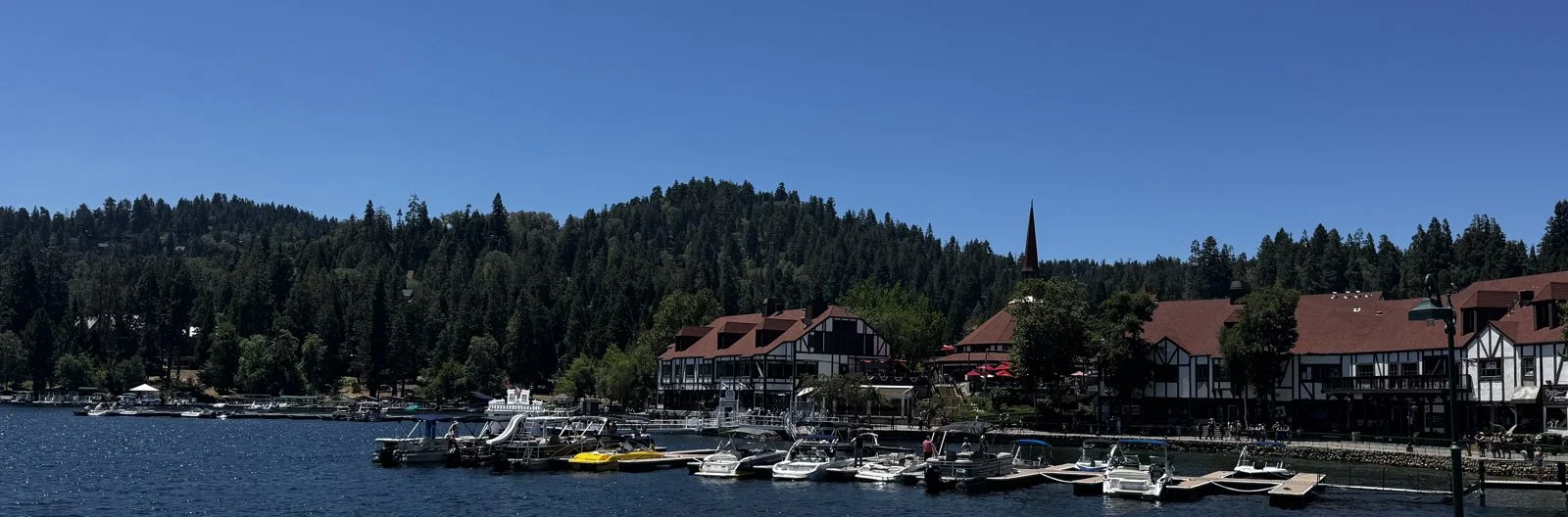
On Sunday we went the other way, west along the mountain to Lake Arrowhead, and by 11:25 we were on the waterfront in Lake Arrowhead Village. Like Big Bear, the lake is a reservoir. It began in the early twentieth century as Little Bear Lake and was renamed in the 1920s after the arrowhead-shaped landmark on the mountainside above San Bernardino. Unusually, the lake itself is private, and boating on it is reserved for members of the local lake association. From the village deck you look straight down on their docks: long rows of boat slips running out into deep-blue water, with forested hills and lakeside houses lining the far shore.
Half an hour later, Wangcai led the way along the lakeside promenade. It was a cloudless midsummer noon, bright enough to make the water sparkle, and the village across the cove looked almost like a stage set: steep red roofs, half-timbered Tudor-style buildings and a slender church spire, with motorboats tied up along the shore. The look is deliberate. The old village was burned down in 1979, famously as a fire-department training exercise, and rebuilt in this storybook alpine style. It is a lovely place to walk a dog before the drive home, and that is what came next: from Lake Arrowhead we headed back down the mountain and drove home on Sunday.
That was the whole weekend: two nights, two lakes and one long look at the forest through a window. It was short by the standards of the other trips on this page, and Wangcai, by Saturday morning, had clearly decided that the best seat in the house was the one facing the trees.
Map built from the trip's photo timestamps and locations. Photo locations have been removed from the published images. Map data © OpenStreetMap contributors; each stop is placed where its photo was taken (Running Springs is marked at the town center), the cabin and home are never marked, and the dashed lines show the order of stops, not the exact roads.
Some photos in this post are my wife's.
Likes and comments
React with an emoji or leave a comment. Signing in with GitHub is required.