← Misc · 2021–2026
Brick, Stone and Concrete
Thirty university campuses we have walked through, region by region.
4 Southern California · 4 Northern California · 3 Pacific Northwest and Vancouver · 3 Texas, Arizona and Las Vegas · 5 New England · 4 New York to Washington · 5 Pittsburgh to Chicago · 2 Australia
Oldest: Harvard, founded 1636 · newest: Cornell Tech, opened 2017 · tallest building: Pitt's Cathedral of Learning, 535 feet · most visited: UC San Diego
The 2024 road trip post ends with a list of ten campuses that we toured without ever planning to. Seen back to back, I wrote there, they make a little history of American campus architecture. Once I went looking, the list turned out to be much longer than ten. There were campuses on holidays, campuses on the way to somewhere else, campuses on work trips, and campuses we went to for a commencement or an event and stayed to look around. A PhD student apparently can't pass a university without walking in.
This post collects them by region, each with a map: Southern California first, then up the West Coast to Vancouver, across the Southwest to Texas, over to New England, down the East Coast to Washington, and back west through Pittsburgh and Ohio to Chicago. Australia comes at the end, and home comes last. Within a region they are in the order we visited. Sorted this way, the styles mix: colonial brick, Collegiate Gothic, arcades and red tile, Beaux-Arts and concrete often stand a few miles apart. Most of these visits already appear in a trip post, and each entry links to it. A few, like Caltech, Pepperdine and Arizona State, appear here for the first time. The first few, in 2021 and the spring of 2022, were mine (one of them with a friend); from then on, "we" means the two of us, and the one campus my wife first saw on her own is marked as such.
By region: Southern California · Northern California · Pacific Northwest and Vancouver · Texas, Arizona and Las Vegas · New England · New York, Philadelphia and Washington · Pittsburgh, Ohio and Chicago · Australia · Home
Southern California
Closest to home. In the West the colleges were younger, and they borrowed from a different past. Instead of Oxford they looked to the missions and the Mediterranean: thick walls, round arches, deep shade and red tile roofs.
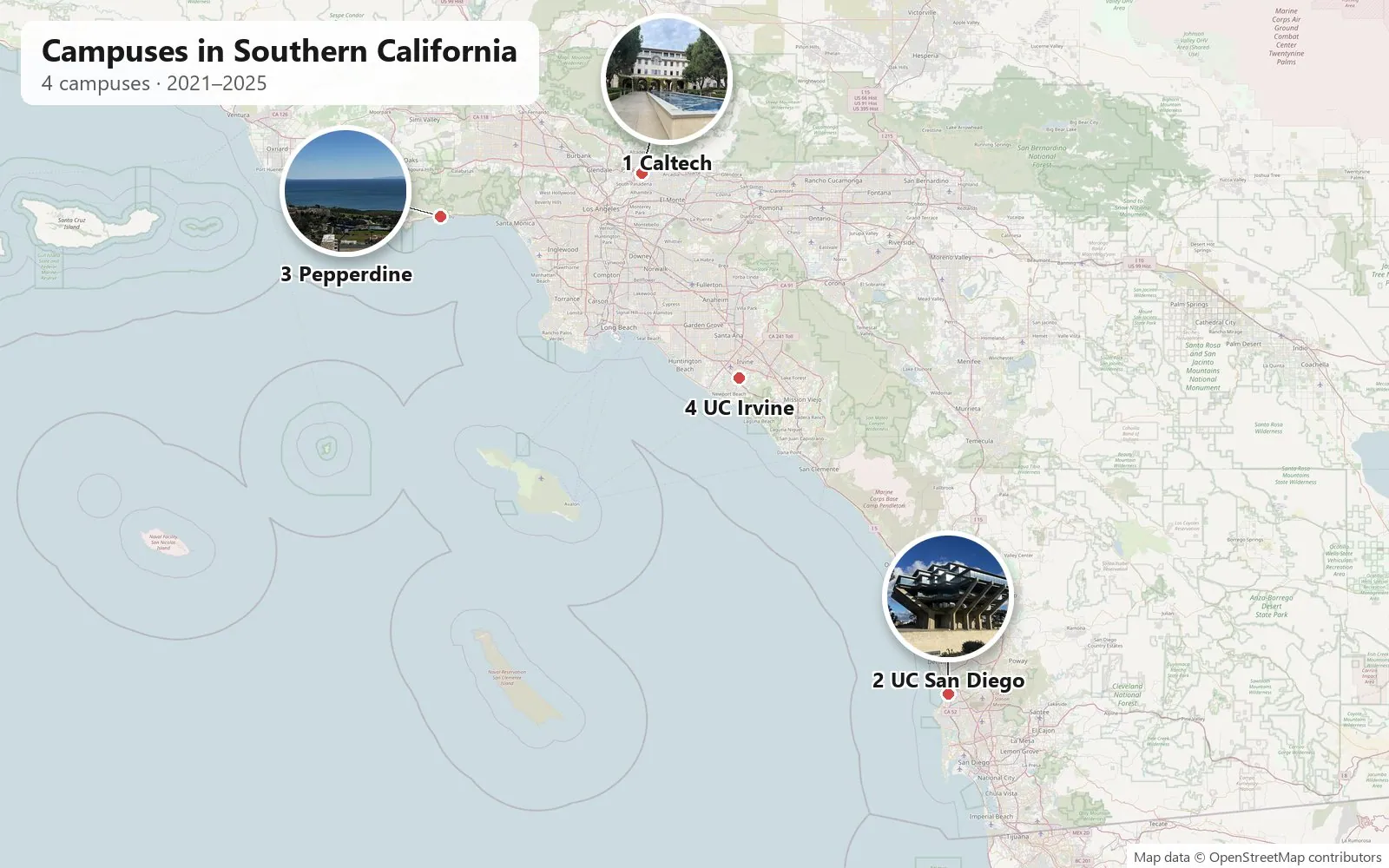
1. Caltech · December 2021
The earliest visit in this post. Caltech began in 1891 as Throop University, a small school in Pasadena, and took its present name in 1920. Bertram Goodhue planned the campus in a Mediterranean style of pale walls, arcades and tile roofs. On the morning of December 22nd, 2021, I walked past the glass Chen Neuroscience Research Building and on to the Beckman Institute, where a long reflecting pool leads up to a row of ivy-covered arches under a carved stone shell.
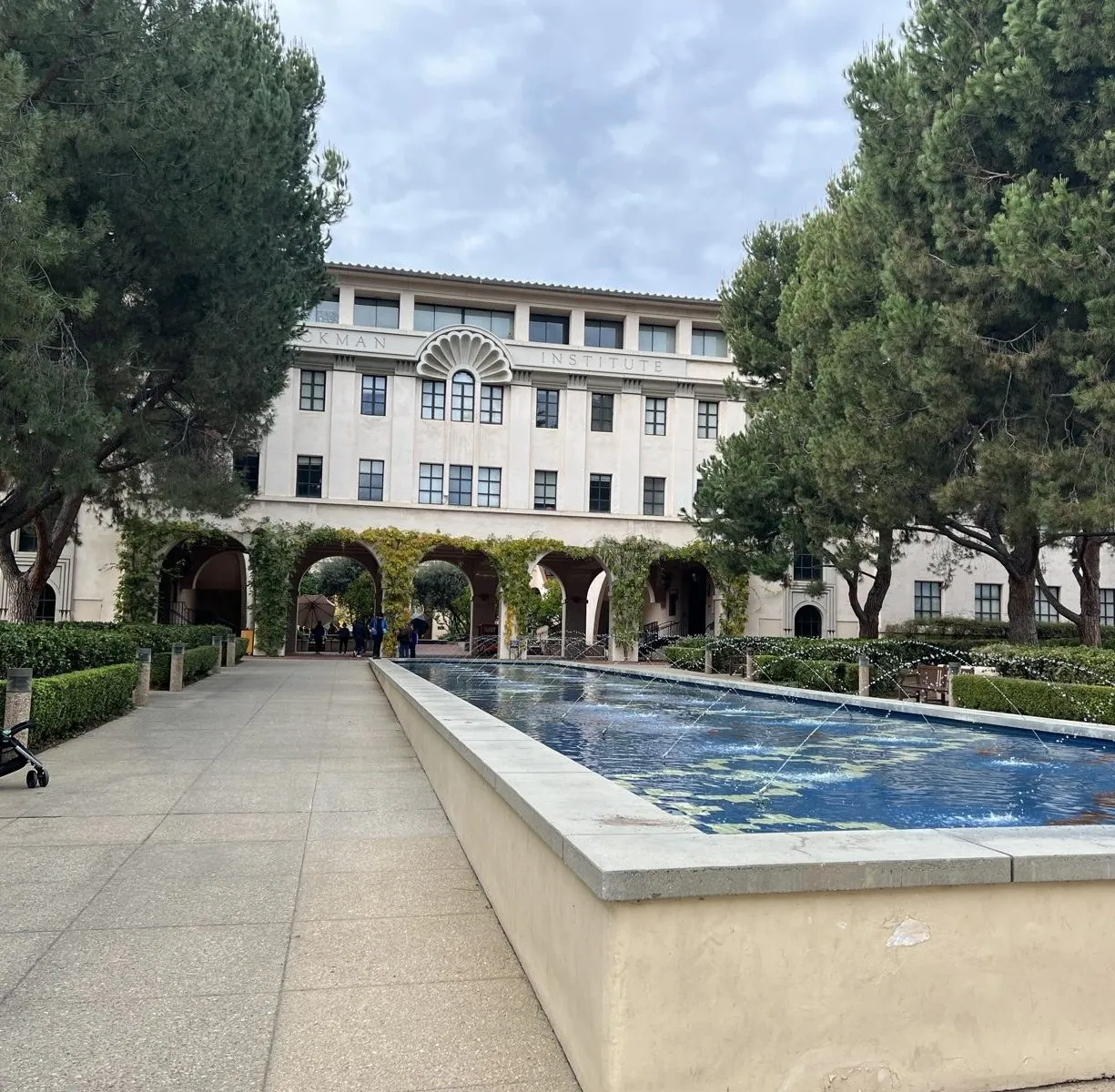
2. UC San Diego · February 2023
The most famous building in this post may be Geisel Library at UC San Diego. It was designed by William Pereira and opened in 1970: a stack of glass floors on huge concrete legs, like a hand holding books up to the sky. It was renamed in 1995 for Theodor Geisel, better known as Dr. Seuss, and his wife Audrey. We walked the campus on the afternoon of February 26th, 2023, under big white clouds. A few minutes away, on the roof of the stepped concrete engineering building, a little blue house hangs off the edge seven stories up. It is Fallen Star by Do Ho Suh, installed in 2012, and it is tilted just enough to make you dizzy.
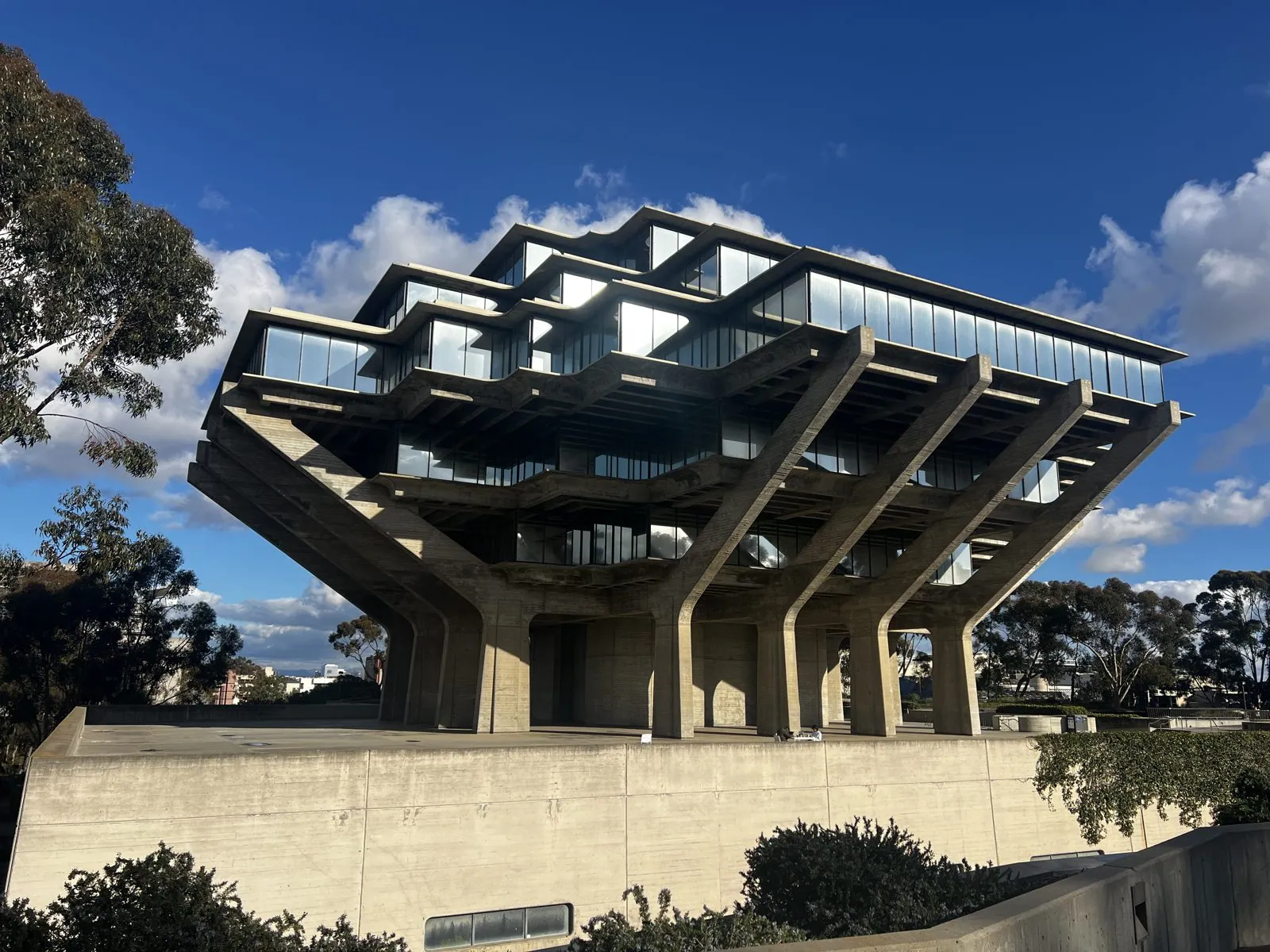
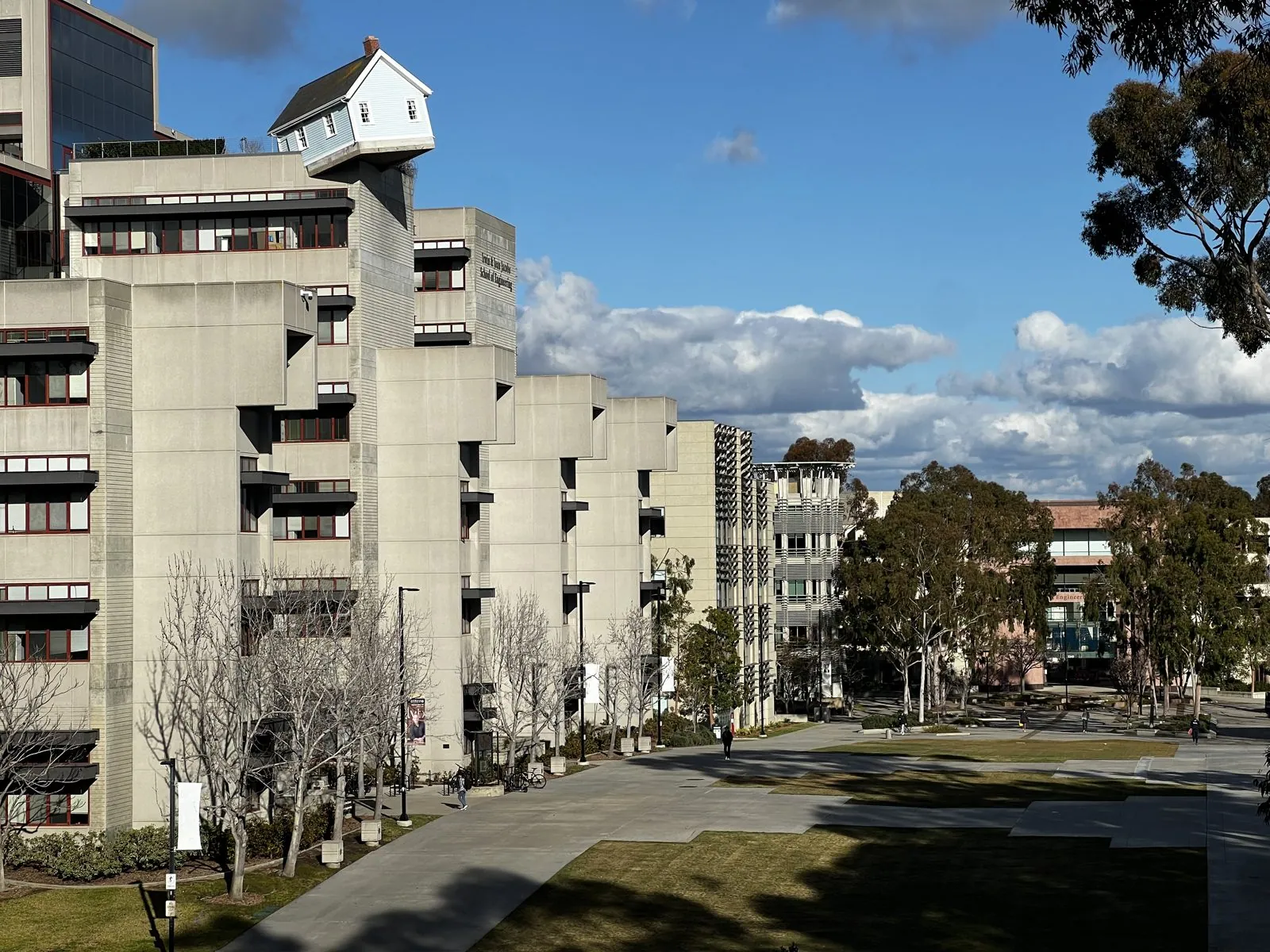
UC San Diego is also the one campus here that keeps coming back: there were two more visits, in 2024 and 2025. Geisel Library even turns up as a LEGO model at Legoland, in San Diego.
3. Pepperdine · February 2024
Pepperdine was founded in 1937 in South Los Angeles and moved in 1972 to a hillside above the Pacific in Malibu, which may be the most unfair campus site in the country. The buildings are cream-colored with red tile roofs, and almost every one of them looks at the ocean. On the afternoon of February 10th, 2024, from the top of the hill, the red roofs and playing fields ran down toward the coast, and the sea went on to a line of hills on the horizon.
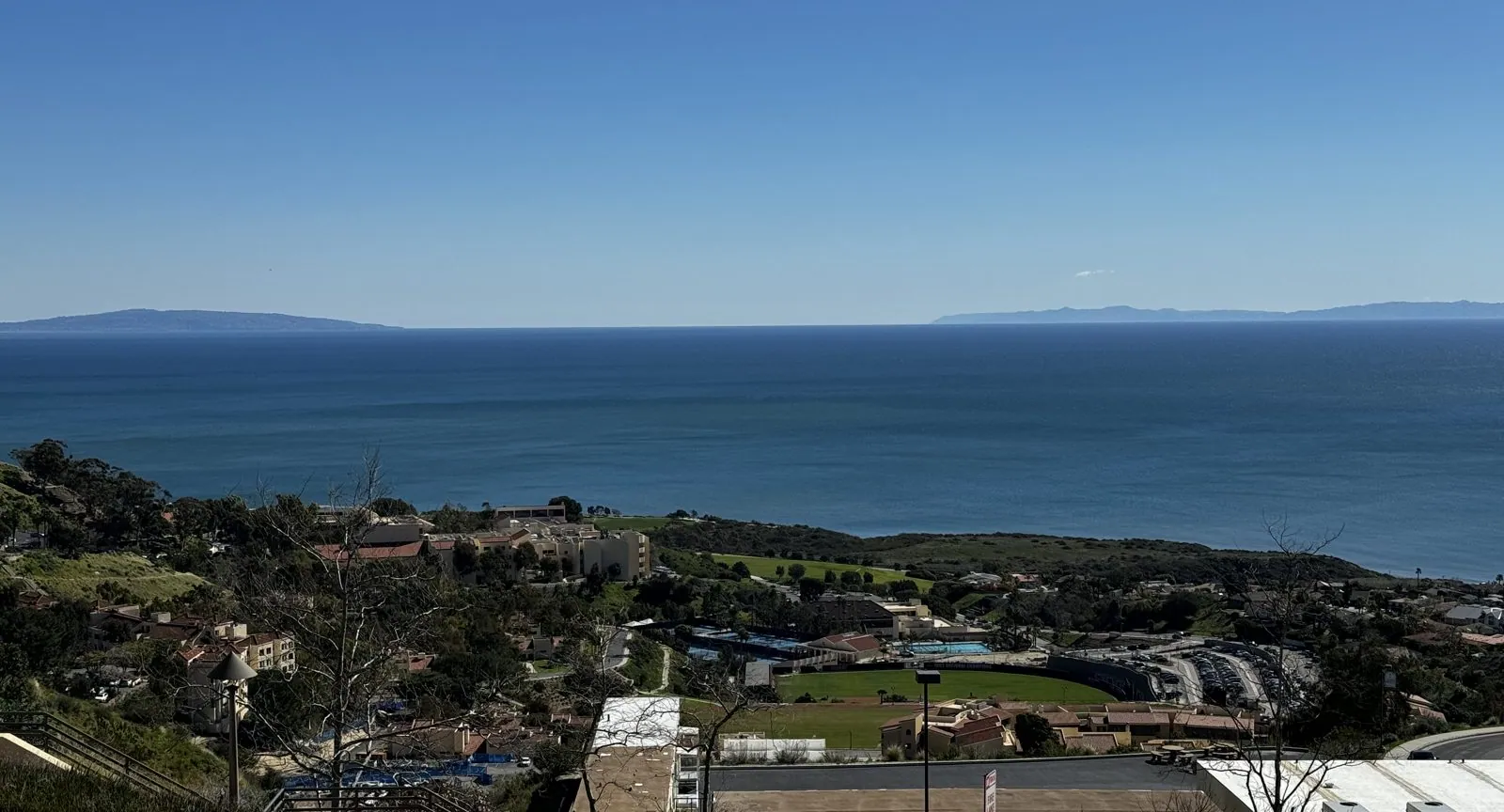
4. UC Irvine · June 2025
UC Irvine I know mainly as the place we went for a family member's commencement at the Bren Events Center in June 2025. UC Irvine opened in 1965, and its campus was planned by William Pereira, the architect of Geisel Library, as a ring of buildings around a central park. That is one architect behind two very different campuses in this post, both of them in Southern California.
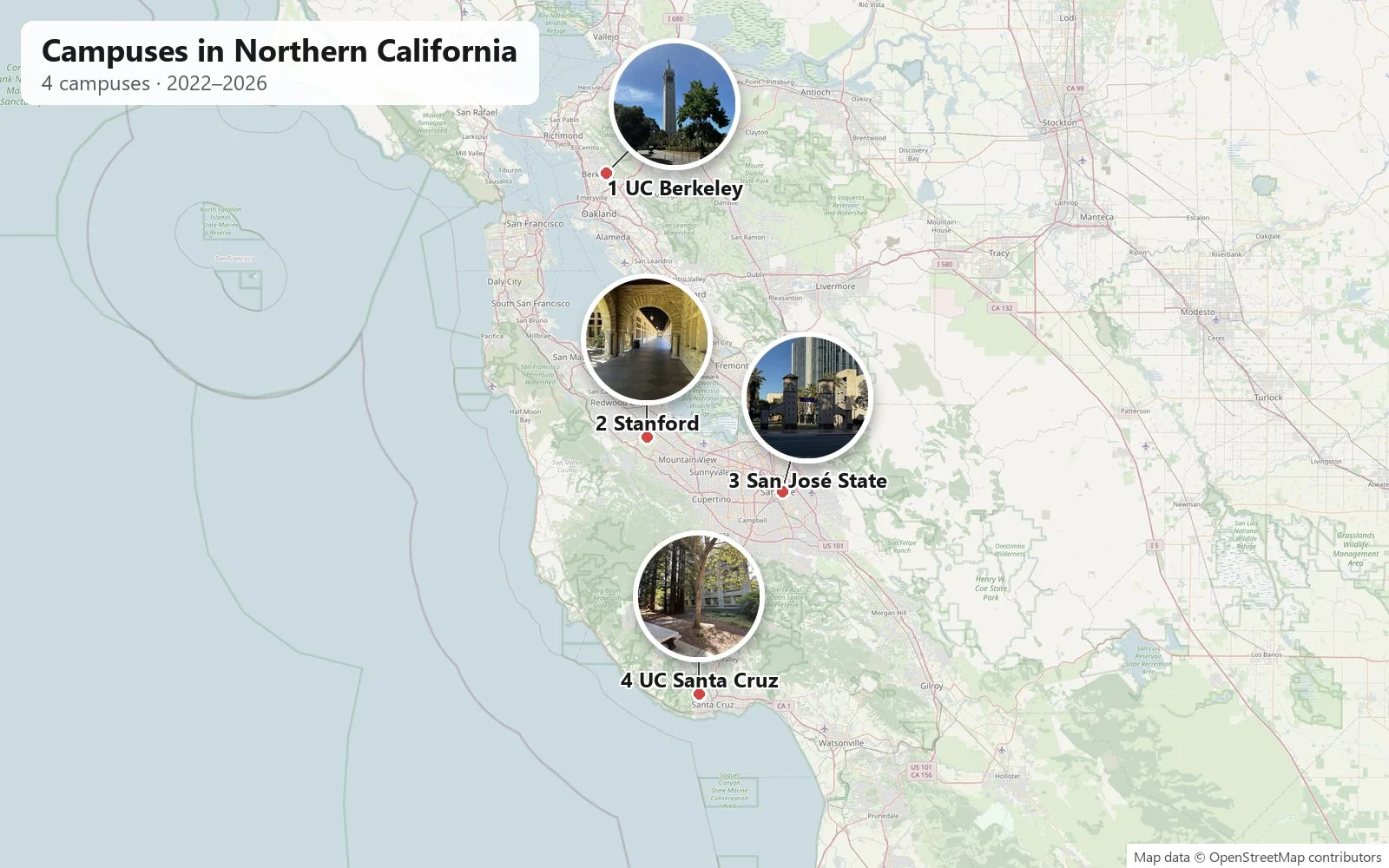
Northern California
Around 1900, American universities started to plan whole campuses at once, in the Beaux-Arts manner: axes, vistas, monumental buildings in white stone, and a tower at the end of the view. Berkeley is one; Stanford's arcades are the other western model; Santa Cruz is concrete in the redwoods.
1. UC Berkeley · May 2022
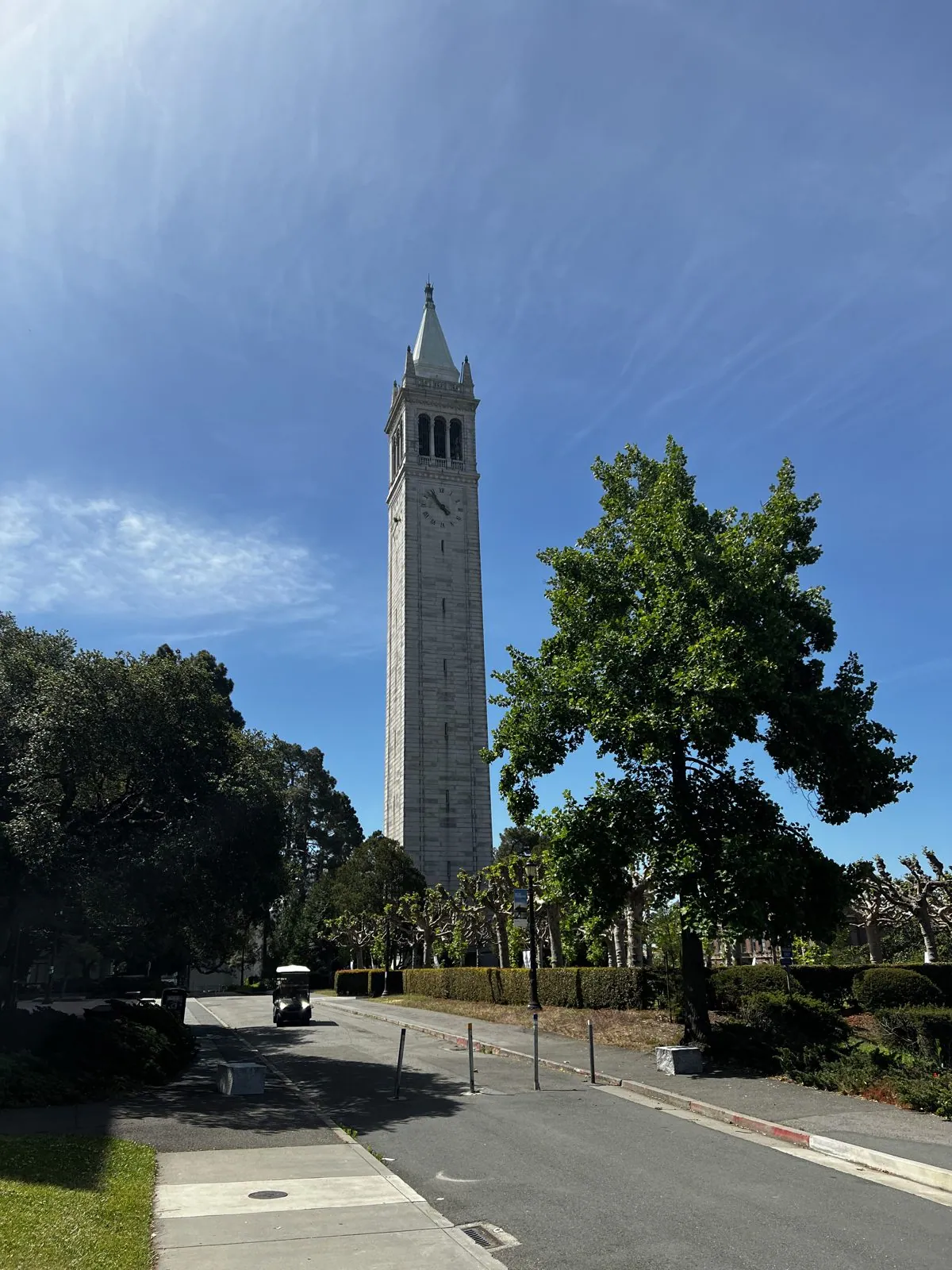
Berkeley was founded in 1868, and John Galen Howard, its supervising architect from 1901, gave it its white granite Beaux-Arts core. At its center is Sather Tower, the Campanile, 307 feet tall and finished in 1914, loosely modeled on the bell tower in St Mark's Square in Venice. Beside it is Doe Library (1911). I walked the campus on the morning of May 18th, 2022, from the stadium past the Campanile to Sather Gate and Sproul Plaza, where the Free Speech Movement started in 1964. More in Road Trips, 2022.
2. Stanford · 2022 and 2023
Stanford opened in 1891. Frederick Law Olmsted did the site plan, and the Boston firm of Shepley, Rutan and Coolidge designed the Main Quad, mixing Romanesque arches with Spanish mission red tile. The result is the campus look that most of the West later copied: long arcades of rough buff sandstone, deep shade under the arches and dazzling sun on the courtyard. I spent a full day there on May 21st, 2022, on a road trip with a friend, and walked from the Quad to Hoover Tower (1941) and the Engineering Quad. The trip is in Road Trips, 2022.
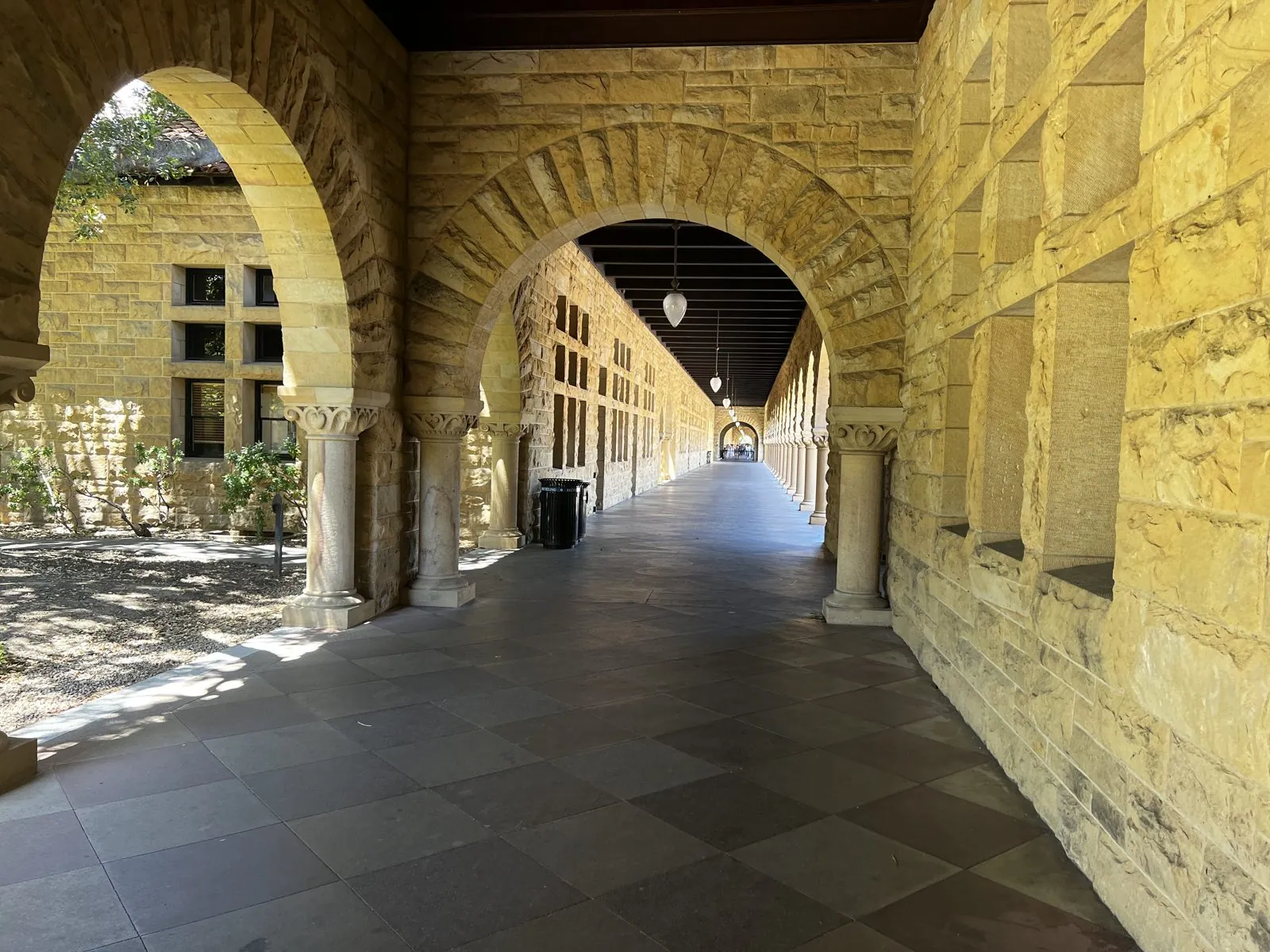
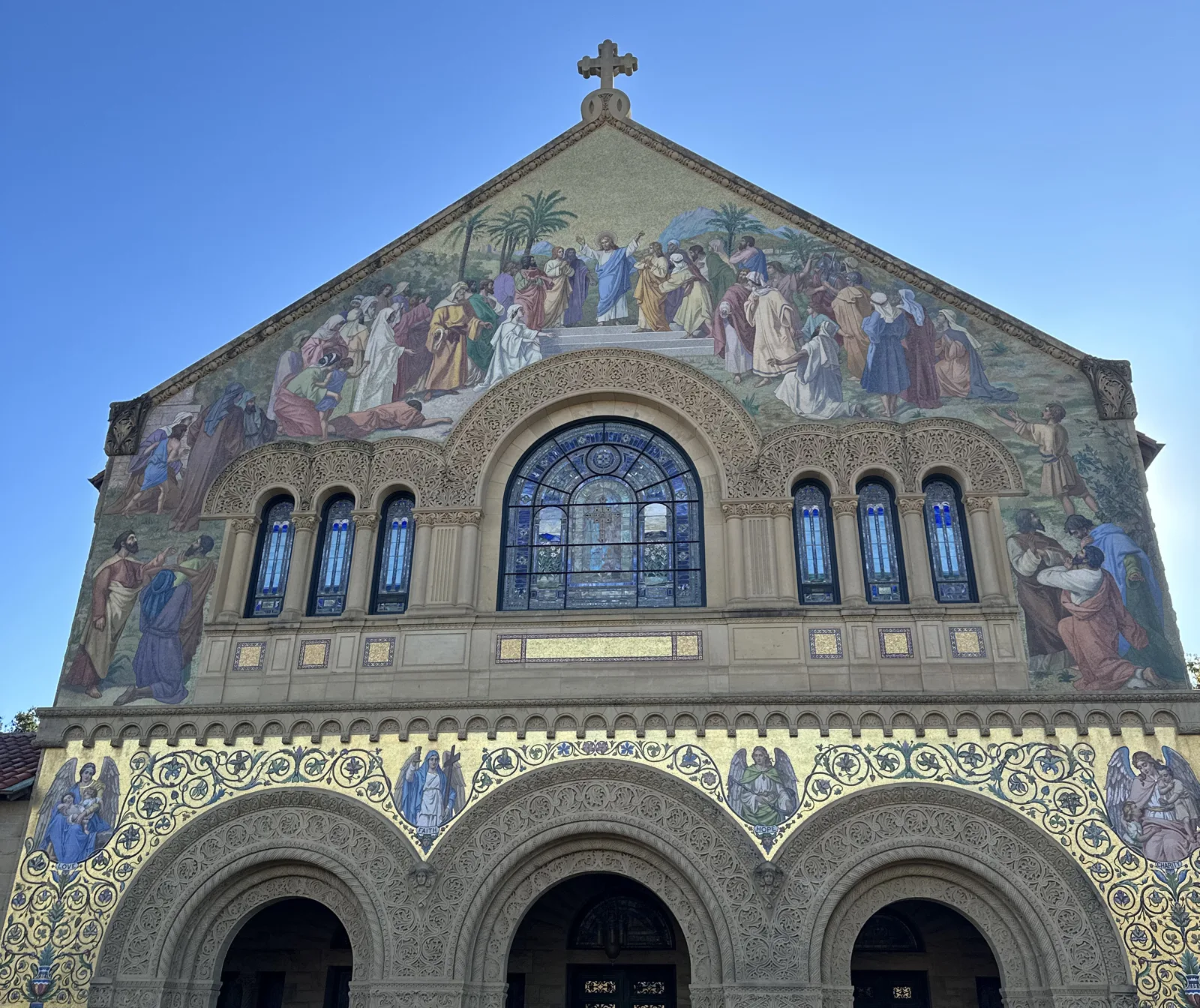
I came back with my wife on the Saturday after Thanksgiving 2023, and we walked from the Main Quad to Memorial Church, whose façade is a gold mosaic, and on to Hoover Tower. That weekend is in The Bay Area, Again and Again.
3. San José State · May 2026
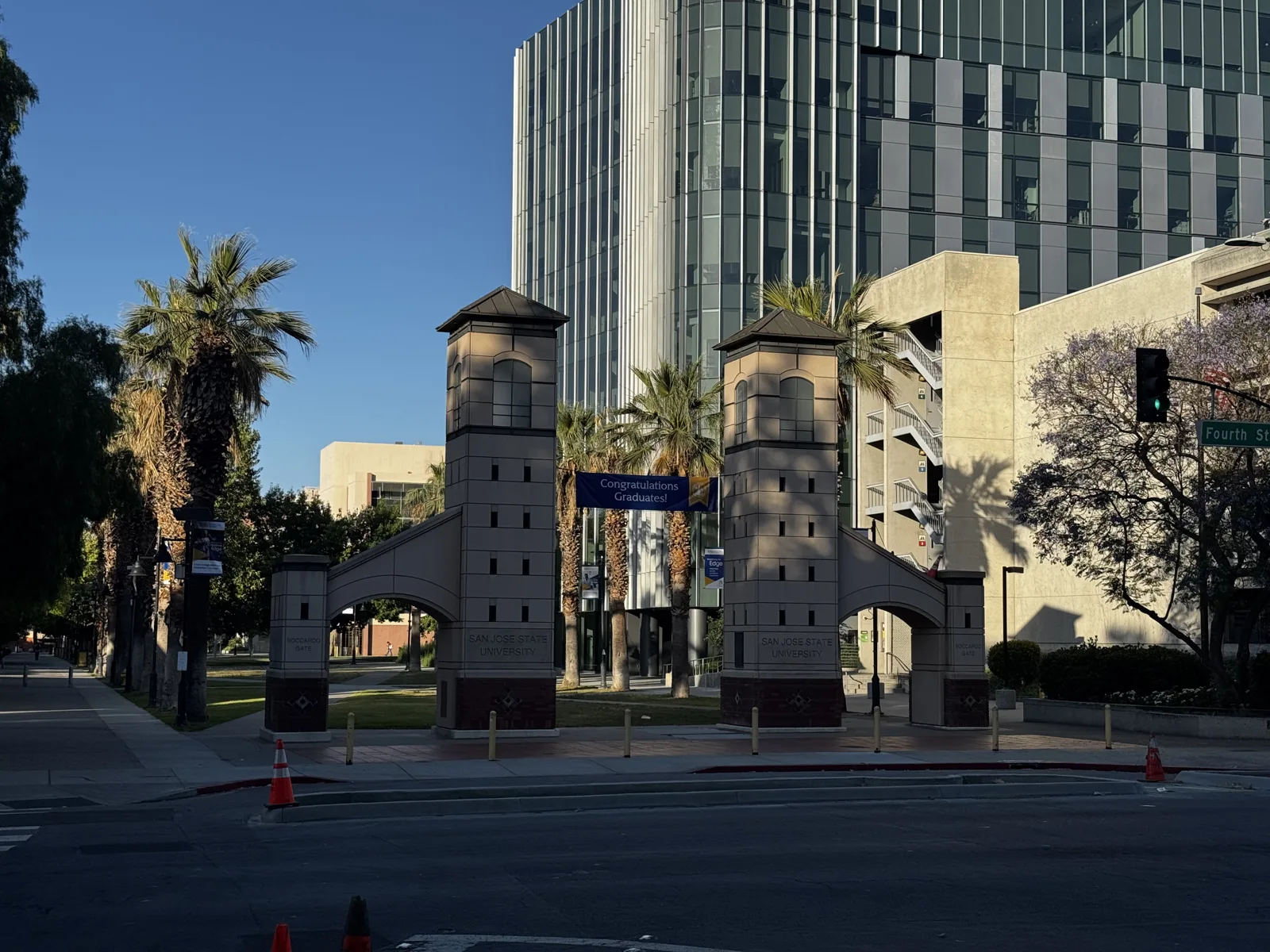
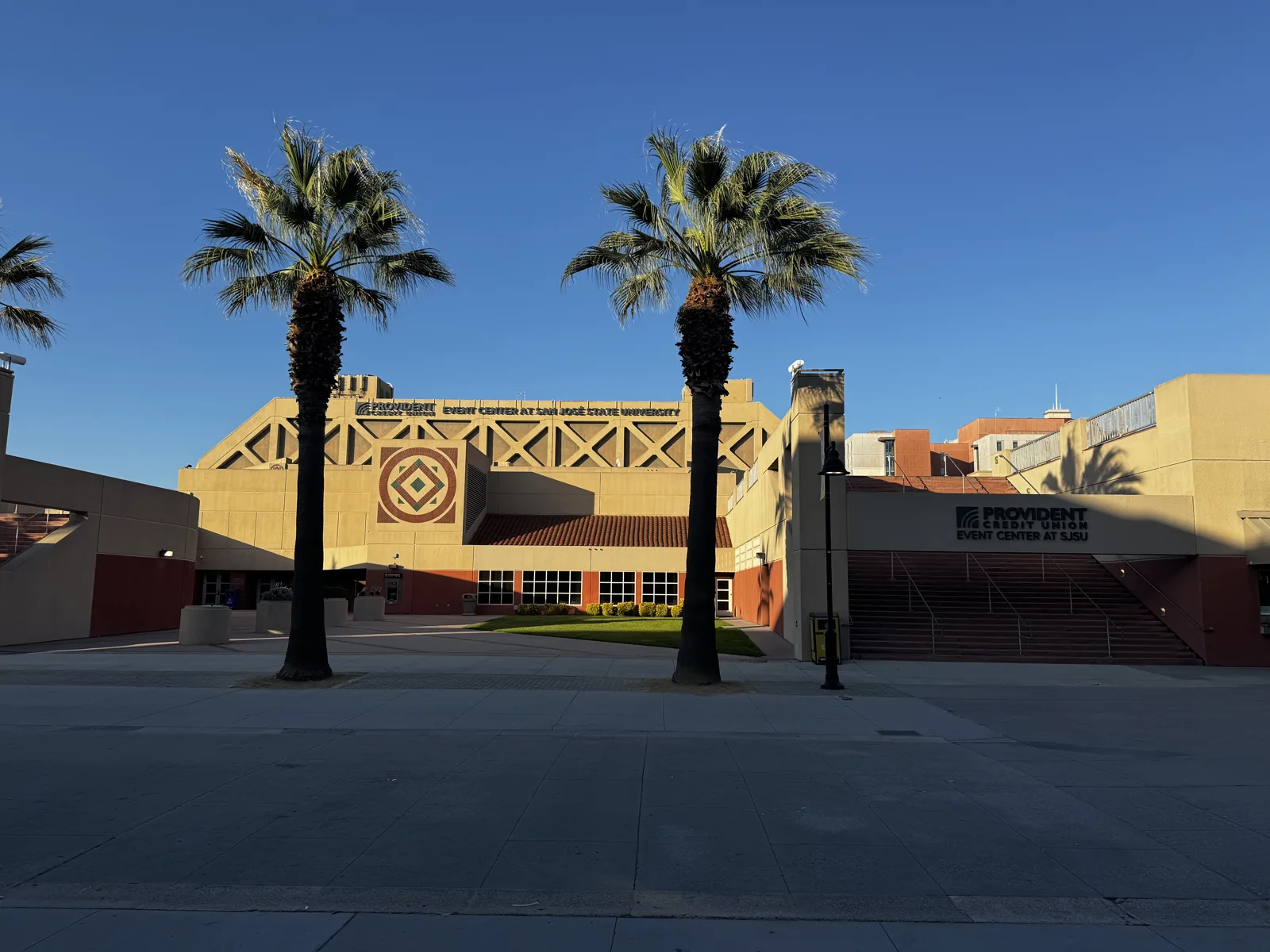
San José State traces its founding to 1857, which makes it the oldest public university in California, and its campus sits in the middle of downtown San Jose. I walked over on the evening of May 23rd, 2026, during my summer in the Bay Area, and came to the pair of gateway towers at Fourth and San Carlos Streets, where a banner across the gate read "Congratulations Graduates!" A few minutes later, at seven, the low sun lit the Event Center between two palm trees.
4. UC Santa Cruz · August 2026
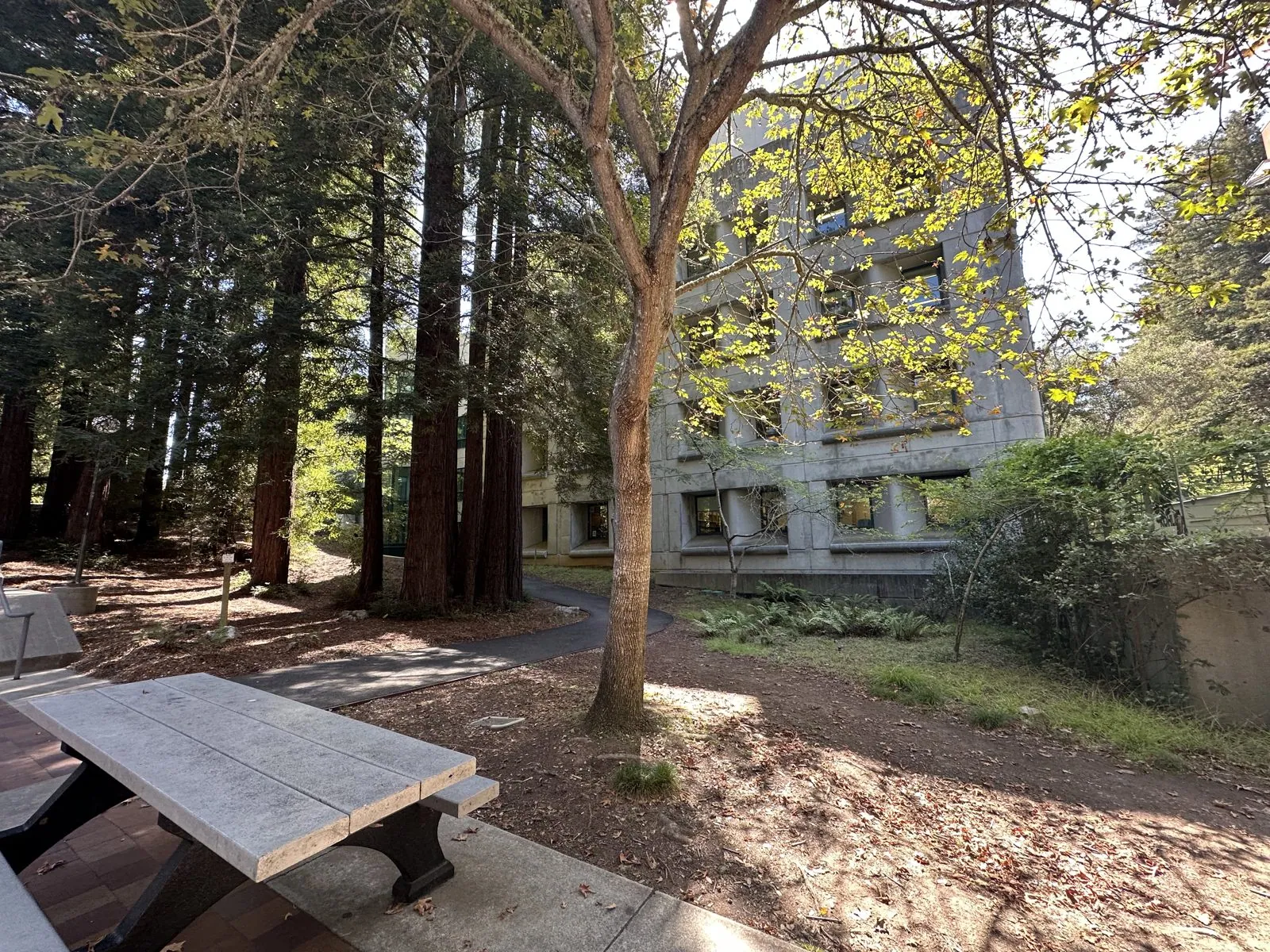
UC Santa Cruz opened in 1965, on the hill above the town, and it was built into the redwood forest rather than in place of it: colleges, labs and libraries stand among the trees, many of them in plain concrete. My wife was there first, on her own with Wangcai, on the afternoon of August 11th, 2026. Her photos show concrete buildings with deep-set windows under redwoods taller than they are. Two weeks later, on the last day of the Tahoe trip, we drove through the campus together, down through the dry grassland with Monterey Bay below, and a plush banana slug, the university's mascot, rode home on the dashboard.
The Pacific Northwest and Vancouver
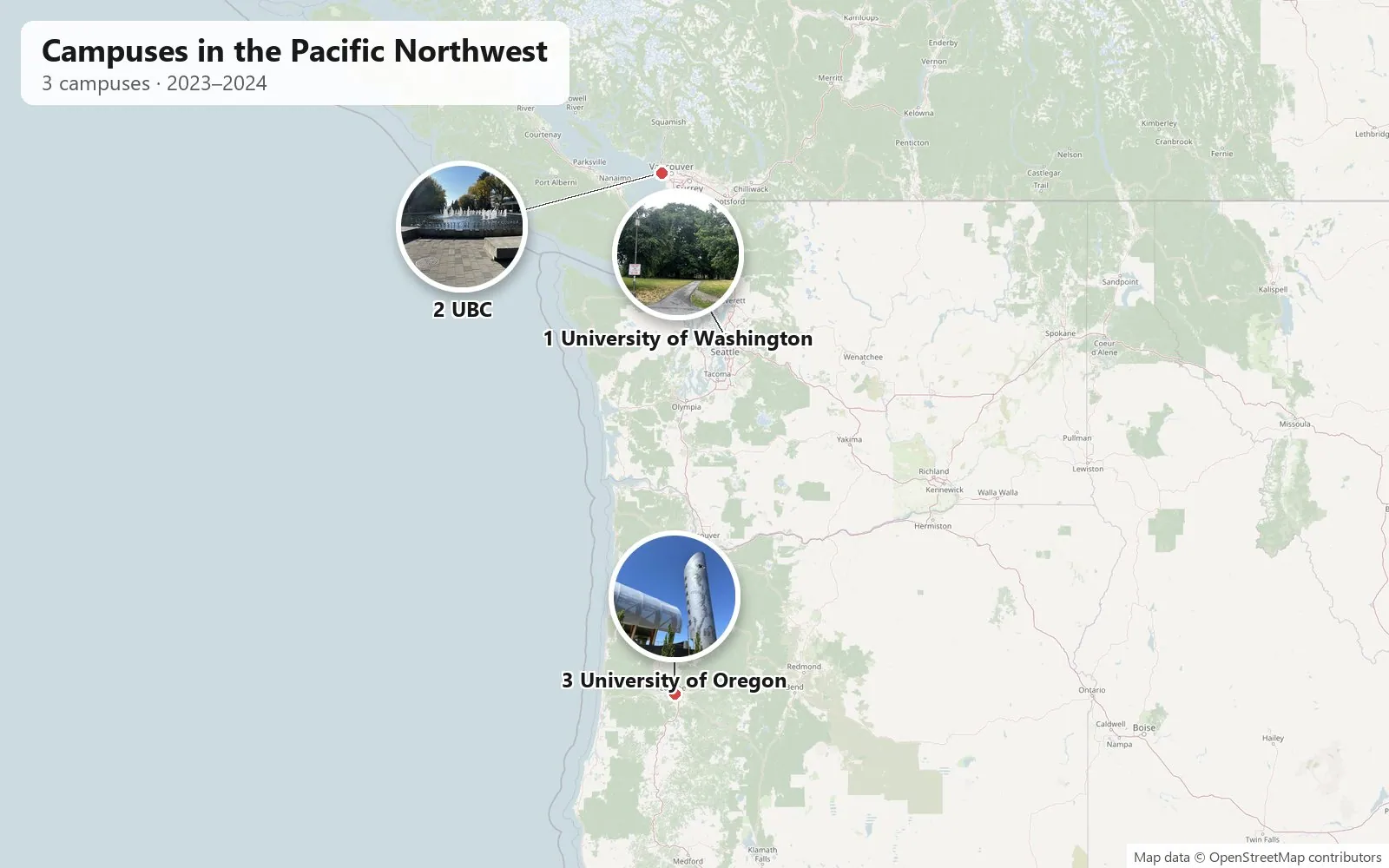
Seattle, Vancouver and Eugene.
1. University of Washington · June 2023
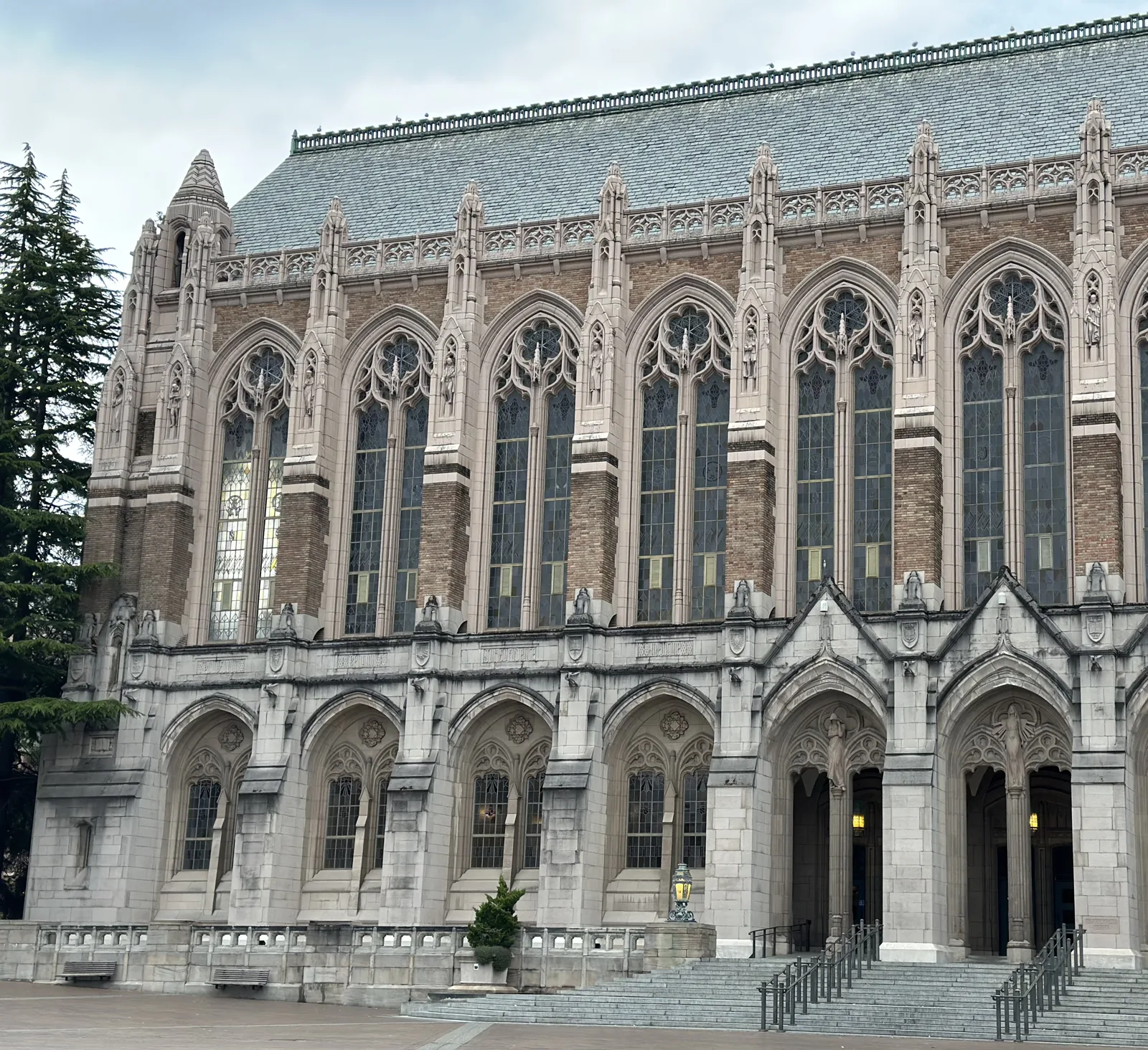
The University of Washington was founded in 1861 and moved to its present site in 1895. In 1909 the campus hosted the Alaska-Yukon-Pacific Exposition, a world's fair, and the Olmsted Brothers' plan for the fair still shapes the middle of the campus. We came through at four o'clock on June 17th, 2023, on a flat gray afternoon, and walked along shaded lawns under huge old trees, then out to University Way, "the Ave", with its queues at the drink counters. On the way we passed Suzzallo Library, with its row of tall Gothic windows over the arched doors. The rest of that trip is in Seattle, the Olympics and Portland.
2. UBC · September 2023
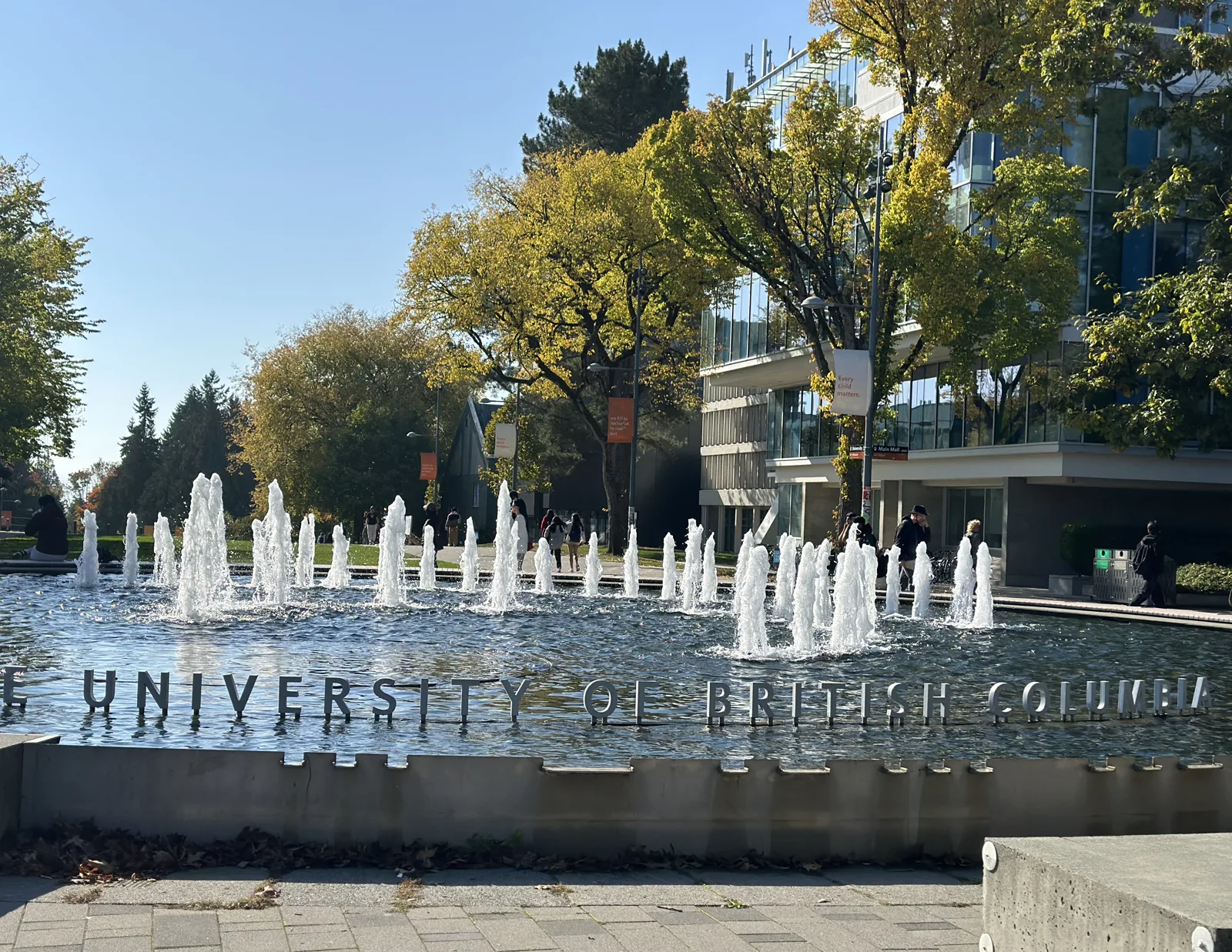
The University of British Columbia was founded in 1908 and moved to Point Grey, at the western tip of Vancouver, in 1925. It is a big, green, spread-out campus with the sea on three sides. We stopped on our first afternoon in Vancouver, September 29th, 2023. In the sun at 3:08 pm, the fountain in Martha Piper Plaza, named for a former president, was throwing up its jets above the university's name carved around the basin, and the first trees were turning yellow. Later, at 3:45, we passed a carved pole by the path, topped by an eagle with spread wings. The rest of that trip is in Fall Colors from Vancouver to Whistler.

3. University of Oregon · May 2024
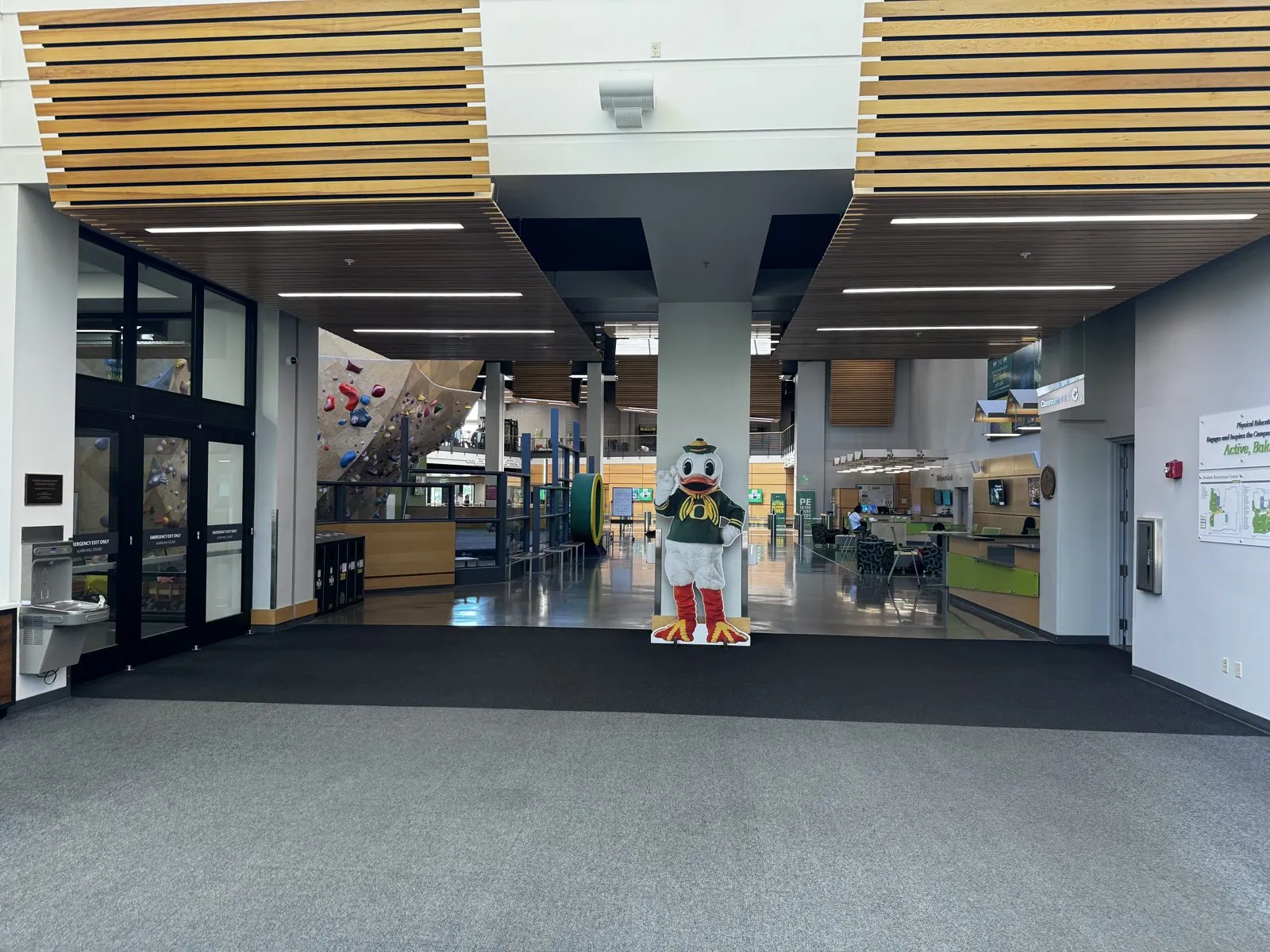
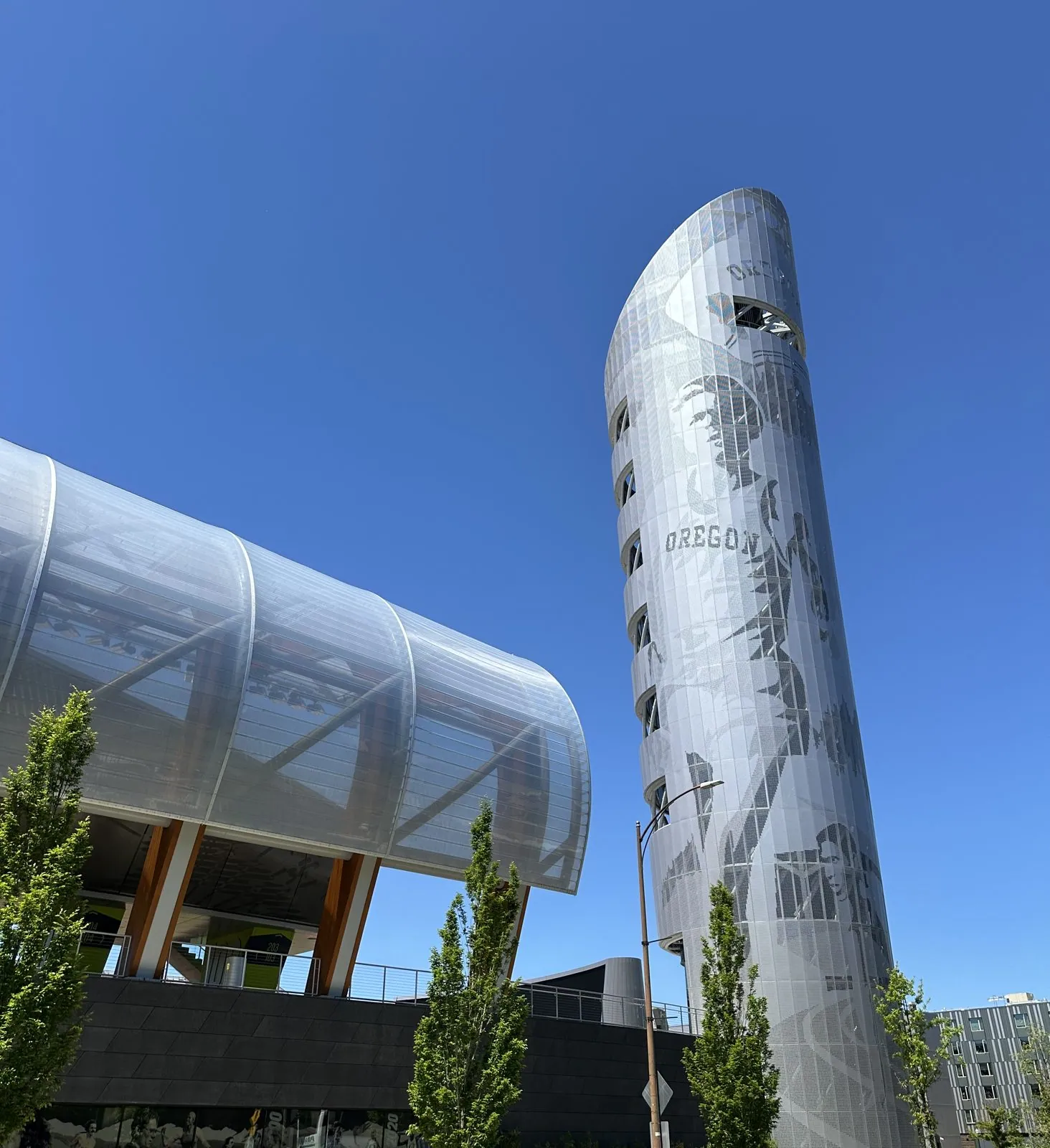
The University of Oregon opened in Eugene in 1876. We passed through around lunchtime on May 12th, 2024, the day after a night drive north to chase an aurora that never came. Our first stop on campus was the student recreation center, where a cutout of the Oregon Duck, the university's mascot, stood guard in the lobby in green and yellow. Ten minutes later we were outside Hayward Field, the university's track stadium, with a translucent curved roof over the stands and a slim tower beside it wrapped in images of Oregon athletes. The rest of the day is in Springfield, Oregon.
Texas, Arizona and Las Vegas
A Beaux-Arts tower in Austin, Victorian brick in Tempe and new architecture in Las Vegas.
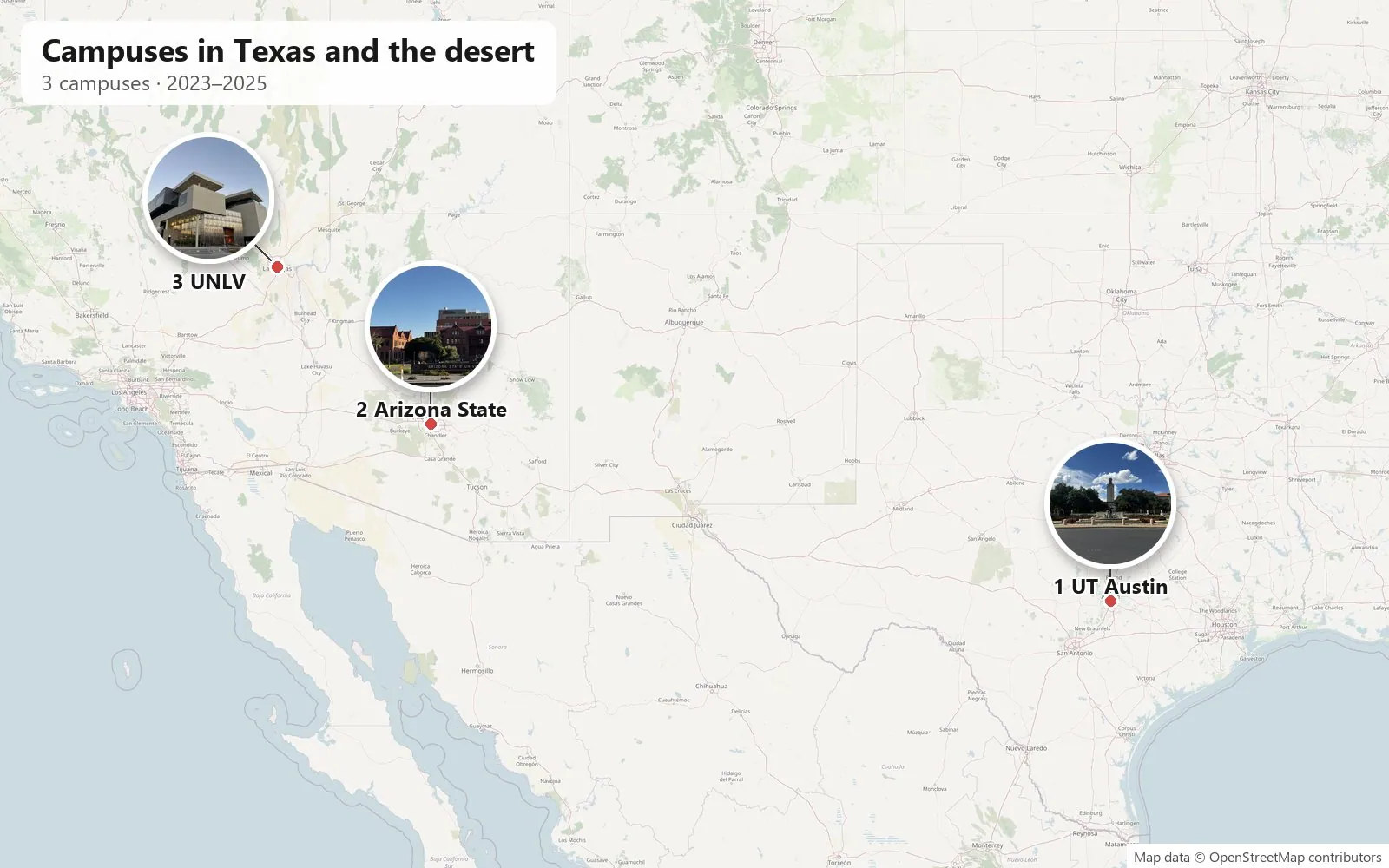
1. UT Austin · July 2023
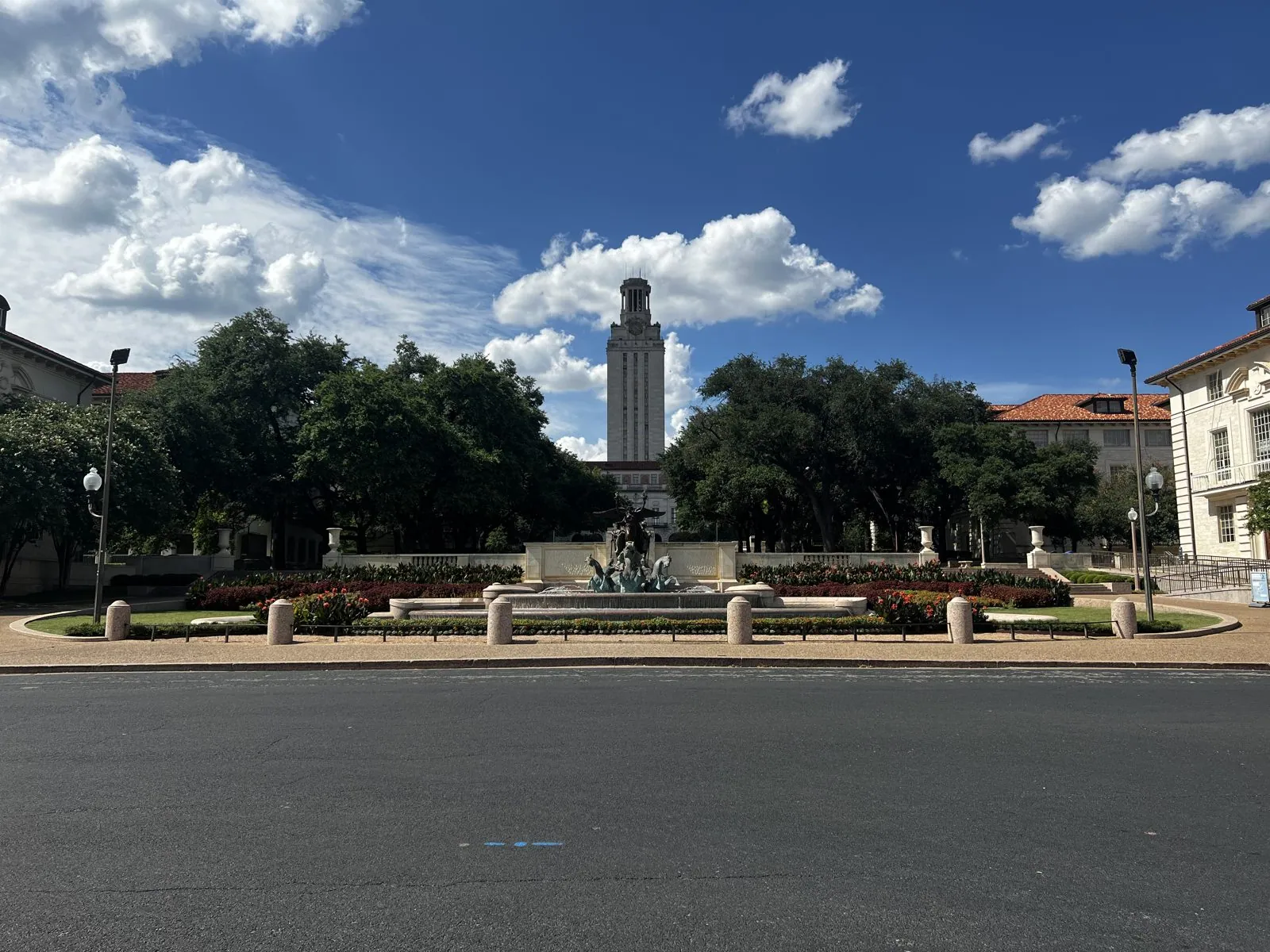
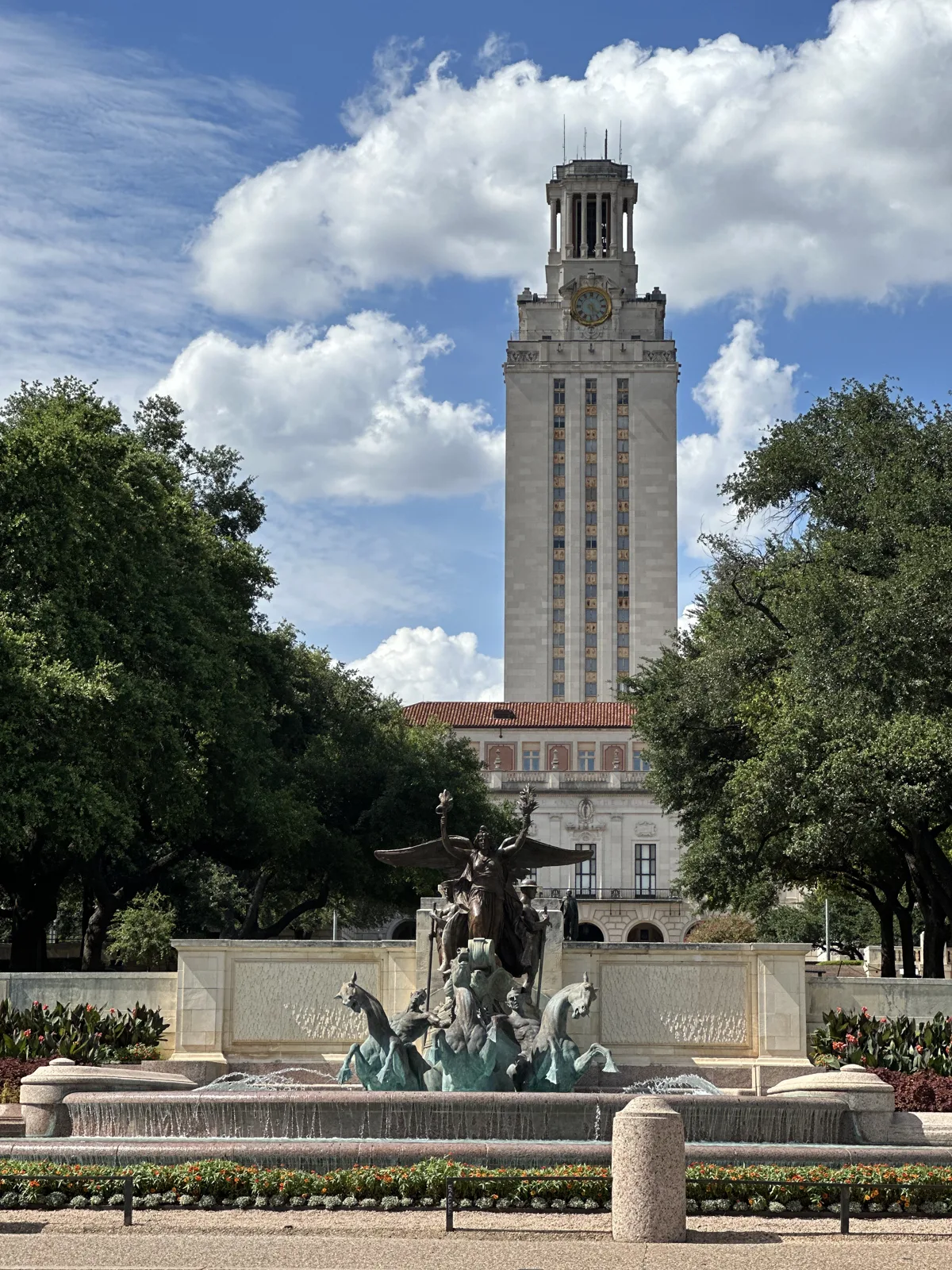
Austin's version of the Beaux-Arts tower at the end of the axis is the University of Texas's Main Building, 307 feet tall, the same height as Berkeley's, finished in 1937 to a design by Paul Cret. We came at it the classic way, from the south, at about half past four on July 1st, 2023. A wide boulevard runs straight toward it and ends at the Littlefield Fountain (1933), with bronze sea horses charging out of a pool the color of a postcard. The trip is in Texas, 2023.
2. Arizona State · March 2025
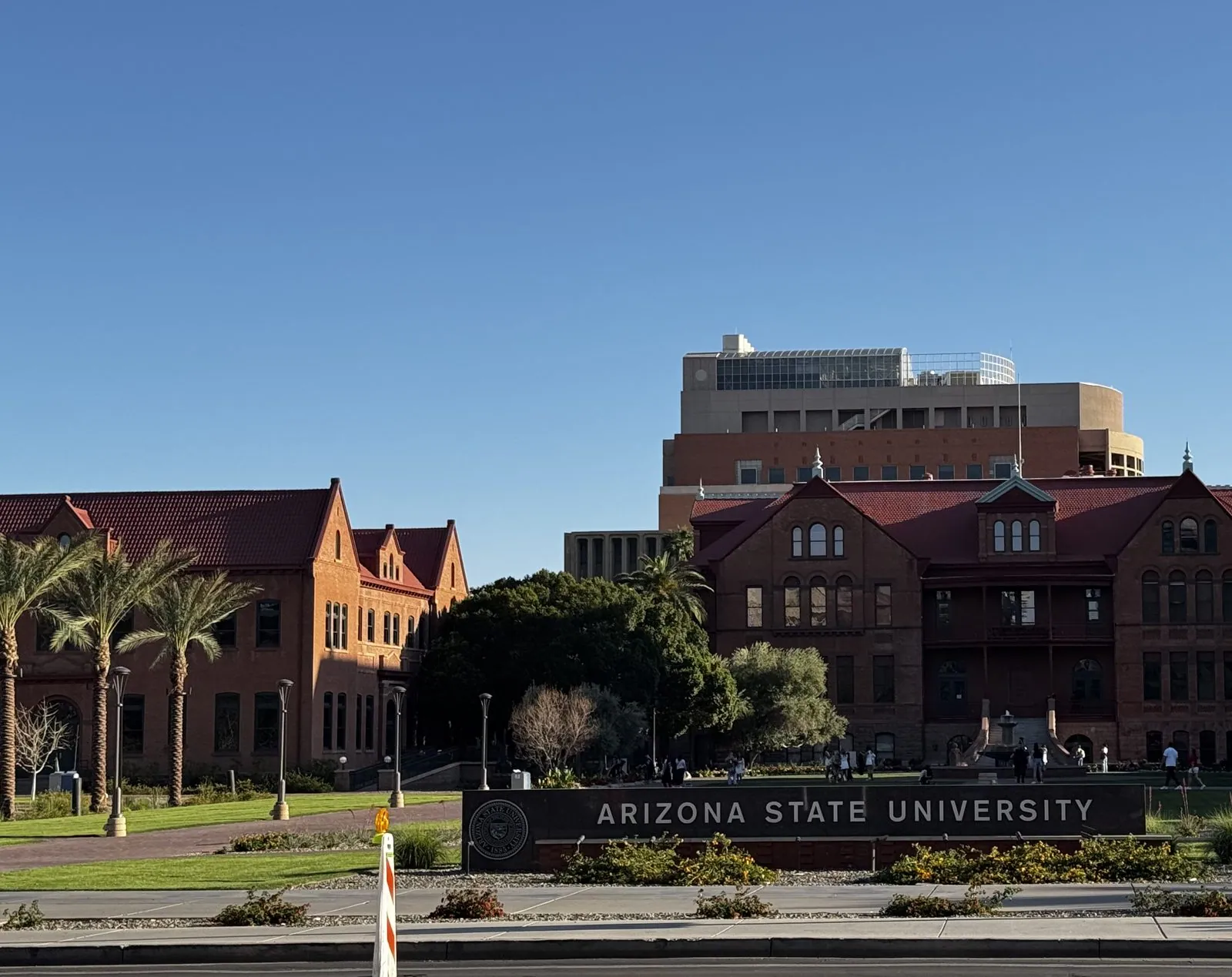
Arizona State started in 1885 as the Territorial Normal School, a teachers' college in the desert town of Tempe. Its oldest surviving building is Old Main, finished in 1898: three stories of red brick with steep gables and a deep porch, now standing in the middle of one of the largest universities in the country. We came by at a quarter past five on March 21st, 2025, when the low sun turned the brick almost orange against a hard blue sky. The rest of that trip is in An Inverted Pyramid, a Waymo and a City of Vaults.
3. UNLV · August 2025
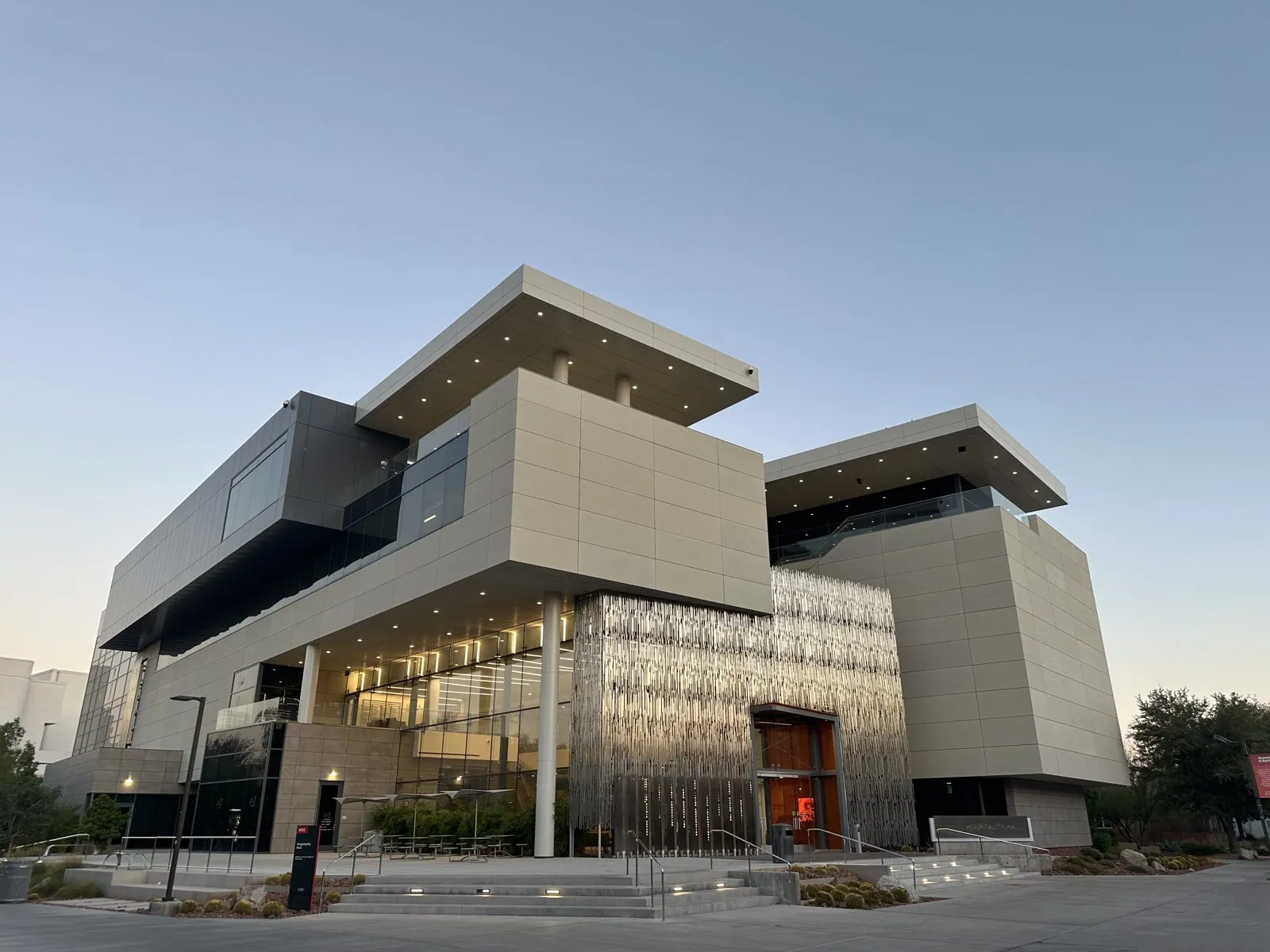
The University of Nevada, Las Vegas began in 1957 as a branch of the state university. We walked across the campus with Wangcai at dusk on August 31st, 2025. The building to see is Hospitality Hall, home of the William F. Harrah College of Hospitality: pale stacked boxes and dark glass cantilevered over the entrance, with a curtain of rippled metal hanging in front of it. Elsewhere on campus the university's initials stand in giant red letters, and Wangcai sat in front of them. More of that weekend is in Las Vegas.

New England
The oldest corner of the list: colonial brick and Gothic stone, and in Boston some of the newest glass. Most of it is from two days of the 2024 road trip.
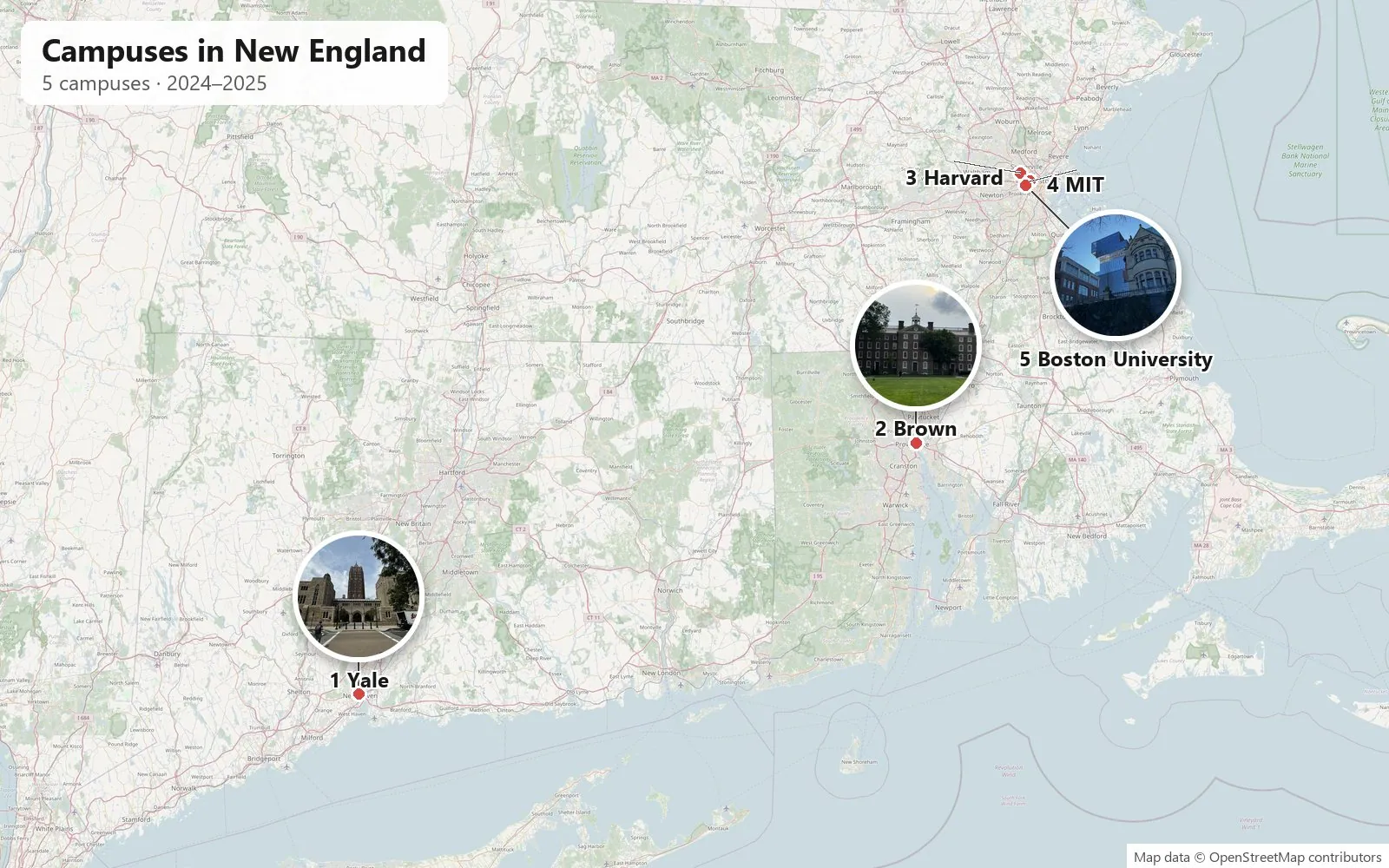
1. Yale · August 2024
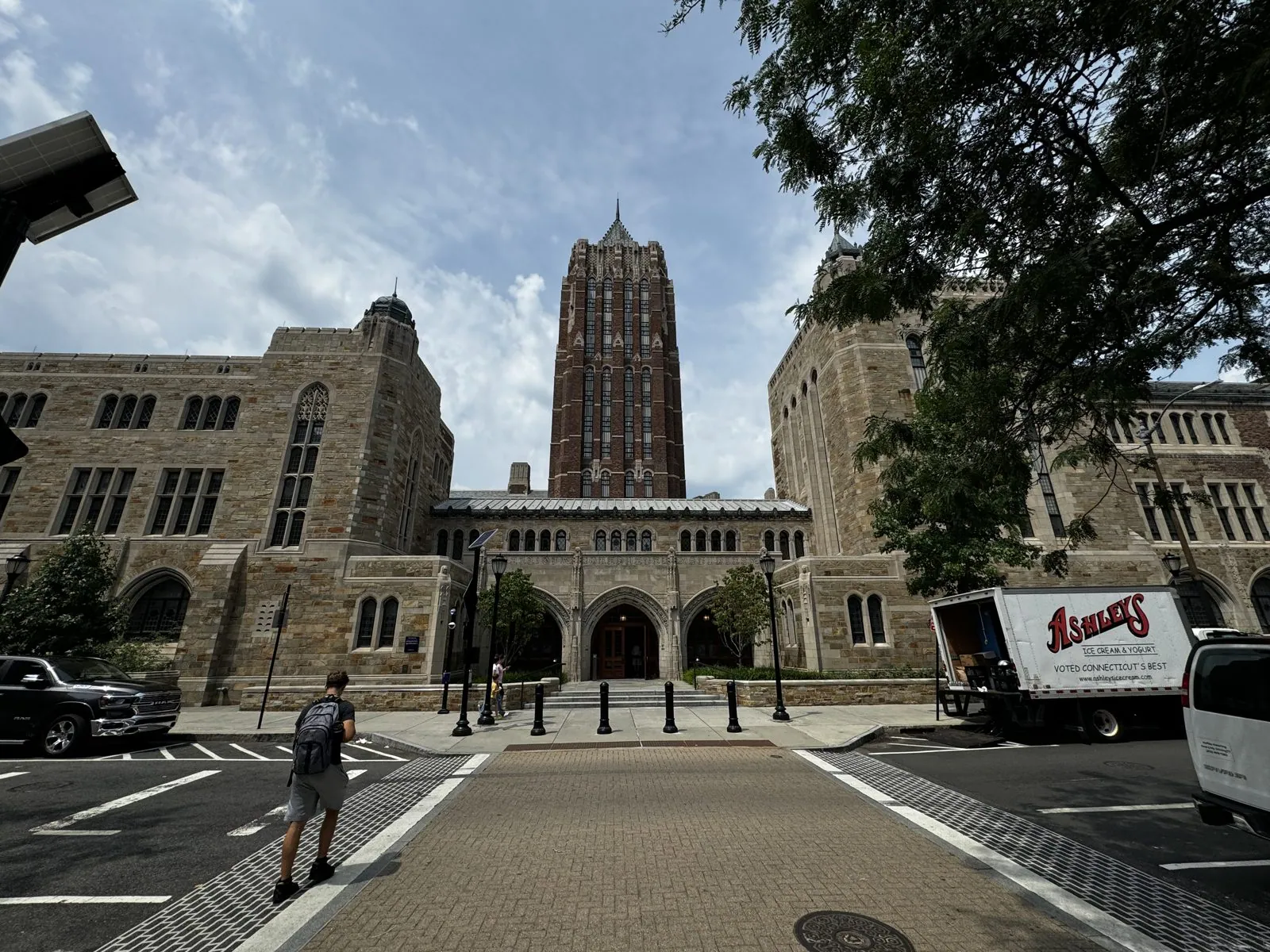
Yale is where the Gothic look of the American campus reached its peak. Much of the central campus was built in the 1920s and 30s by one architect, James Gamble Rogers, who went to great lengths to make new buildings look centuries old. We walked through at midday on August 2nd, 2024, past Sterling Memorial Library, which is essentially a cathedral dedicated to books, and the brick tower of the Humanities Quadrangle above its stone archway.
2. Brown · August 2024
Brown was founded in 1764, the seventh college in the colonies, and it still looks the part. We climbed College Hill late on the afternoon of August 2nd, 2024, came in through Faunce Arch onto the Main Green, and found the whole campus in red brick and white trim, like a New England town common. University Hall, built in 1770, is the oldest building on campus. During the Revolutionary War it was used as a barracks and hospital for American and French troops. Round the corner on Waterman Street, the bronze Brown Bear stands on his hind legs. The full day is in the 2024 road trip.
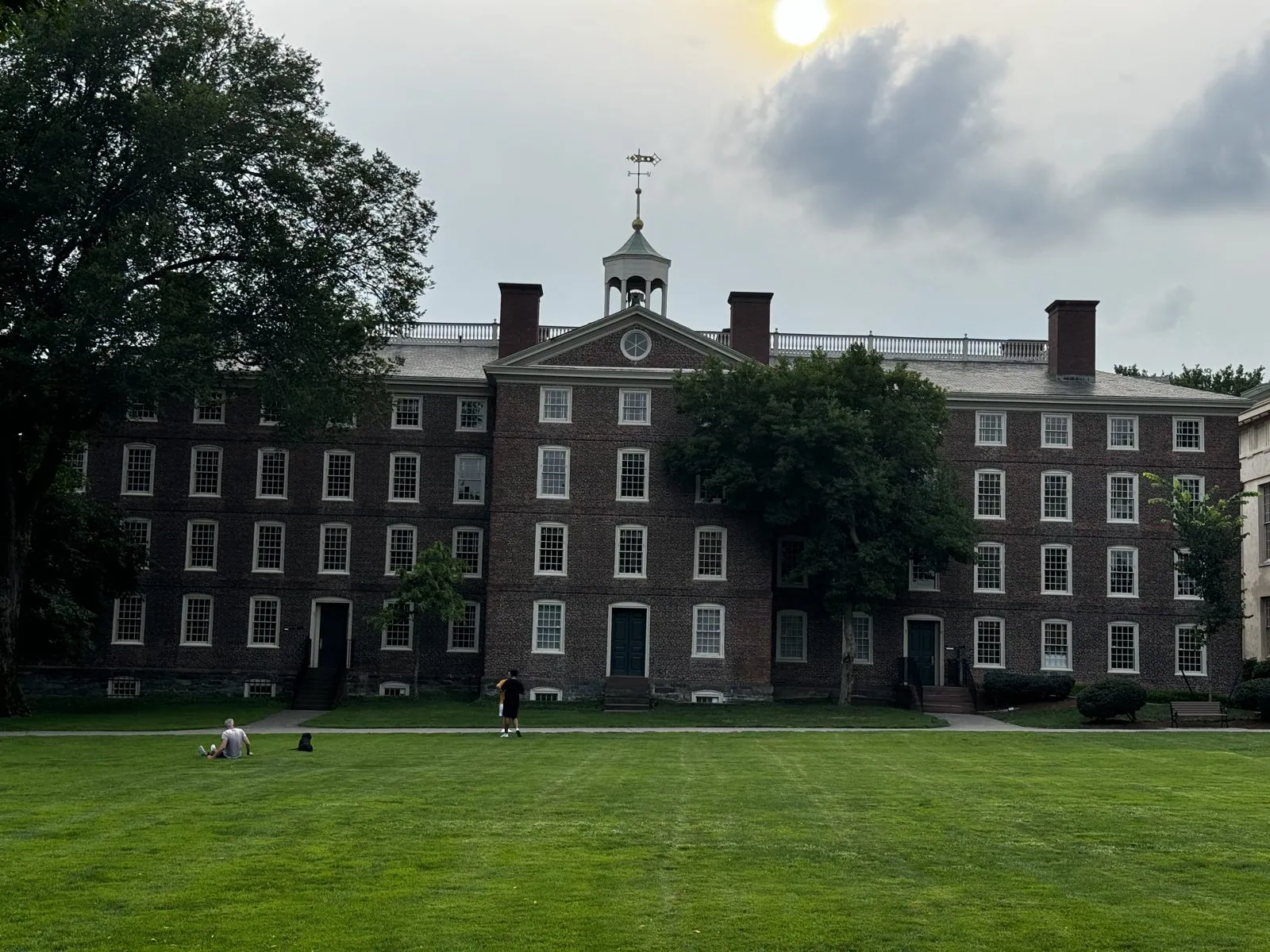
3. Harvard · August 2024
The next morning we were in Cambridge. Harvard is the oldest of them all: it was founded in 1636, and its Yard is still lined with the plain brick halls of the colonial college. We walked around it on August 3rd and had a gelato. I don't have a single photo of the Yard to show for it. It is the one campus in this post that left only a parking charge and a dessert behind, and I have included it anyway.
4. MIT · August 2024
MIT moved across the Charles to Cambridge in 1916, into a single connected complex of white limestone buildings under a great dome, planned as one in the Beaux-Arts manner. We only drove through, on August 3rd, 2024, past the labs and startups of Kendall Square, with the Boston skyline lined up across the river. It was not a proper visit. Six months later, on a freezing January night, we walked out onto the Harvard Bridge, which runs from Back Bay to MIT, and that is a story for another post.
5. Boston University · January 2025
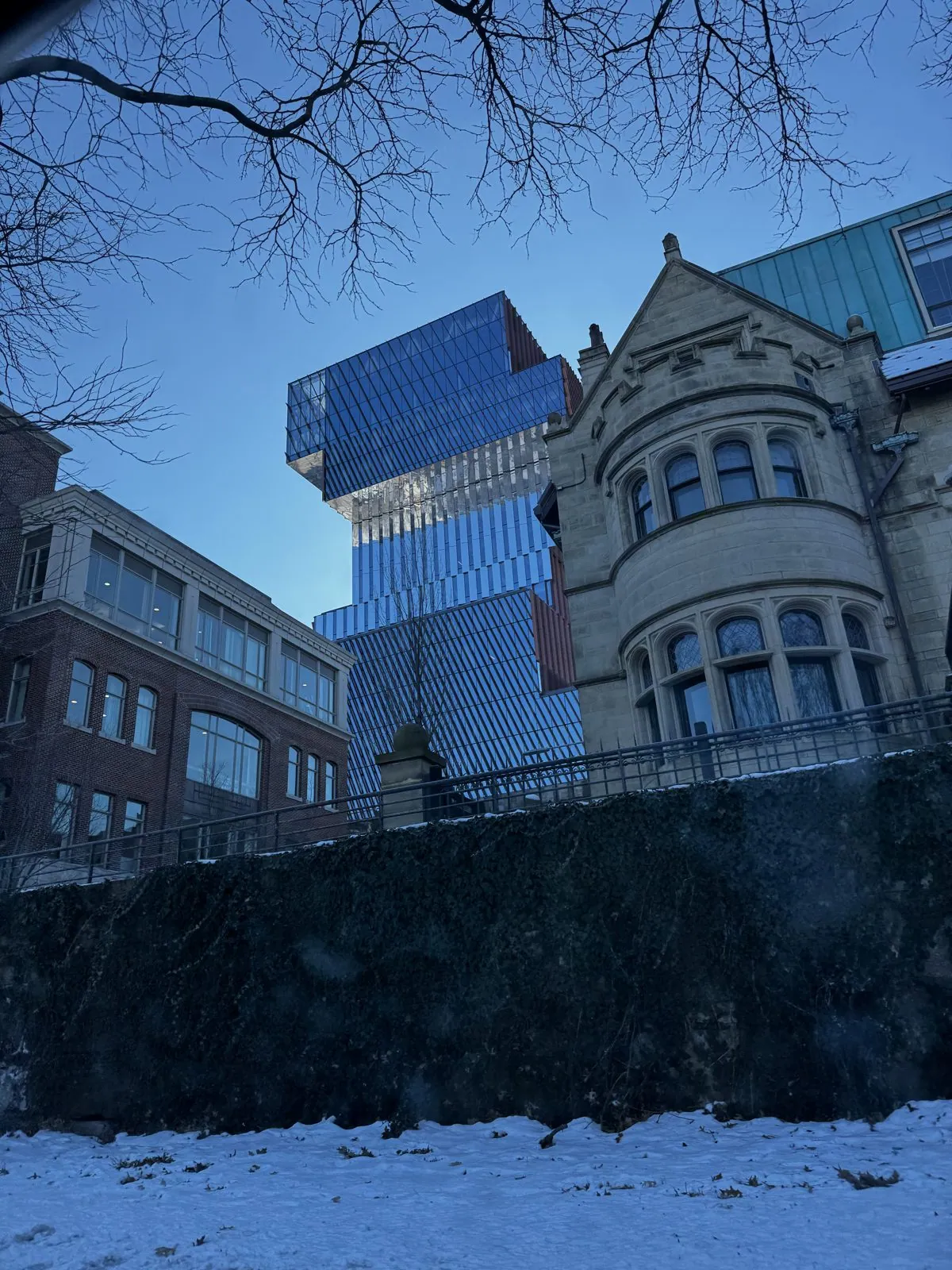
Boston University is strung out for more than a mile along Commonwealth Avenue, with the Green Line trolleys running down the middle of the road. We drove through at eleven in the morning on January 25th, 2025, past the new Center for Computing & Data Sciences, opened in 2022, a stack of glass boxes set slightly off-center like a game of Jenga. On Bay State Road it rises right behind a Victorian stone mansion, the two of them more than a century apart. From the January 2025 trip.
New York, Philadelphia and Washington
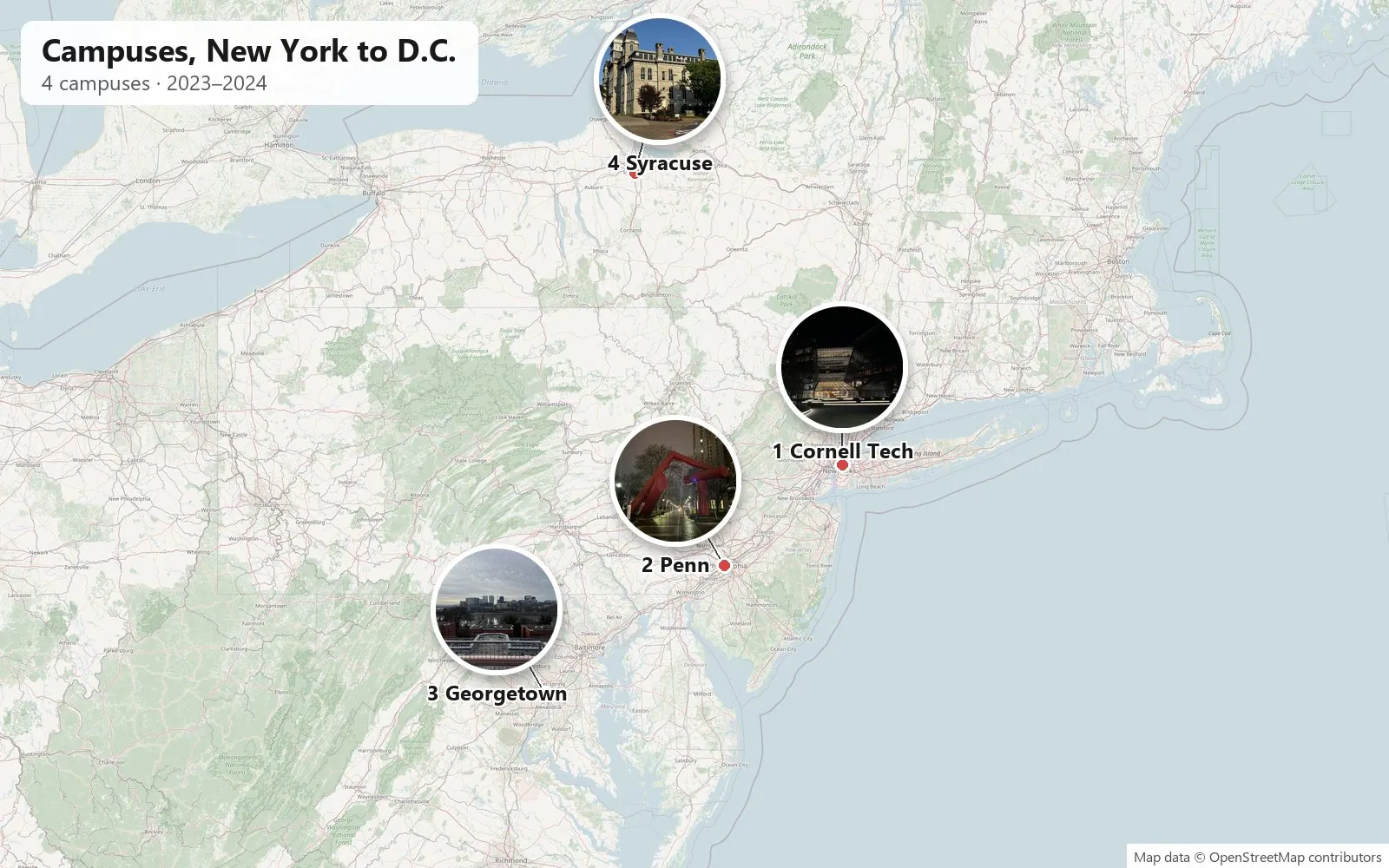
Three campuses from New Year's 2023 on the East Coast, and Syracuse from the 2024 road trip.
1. Cornell Tech · January 2023
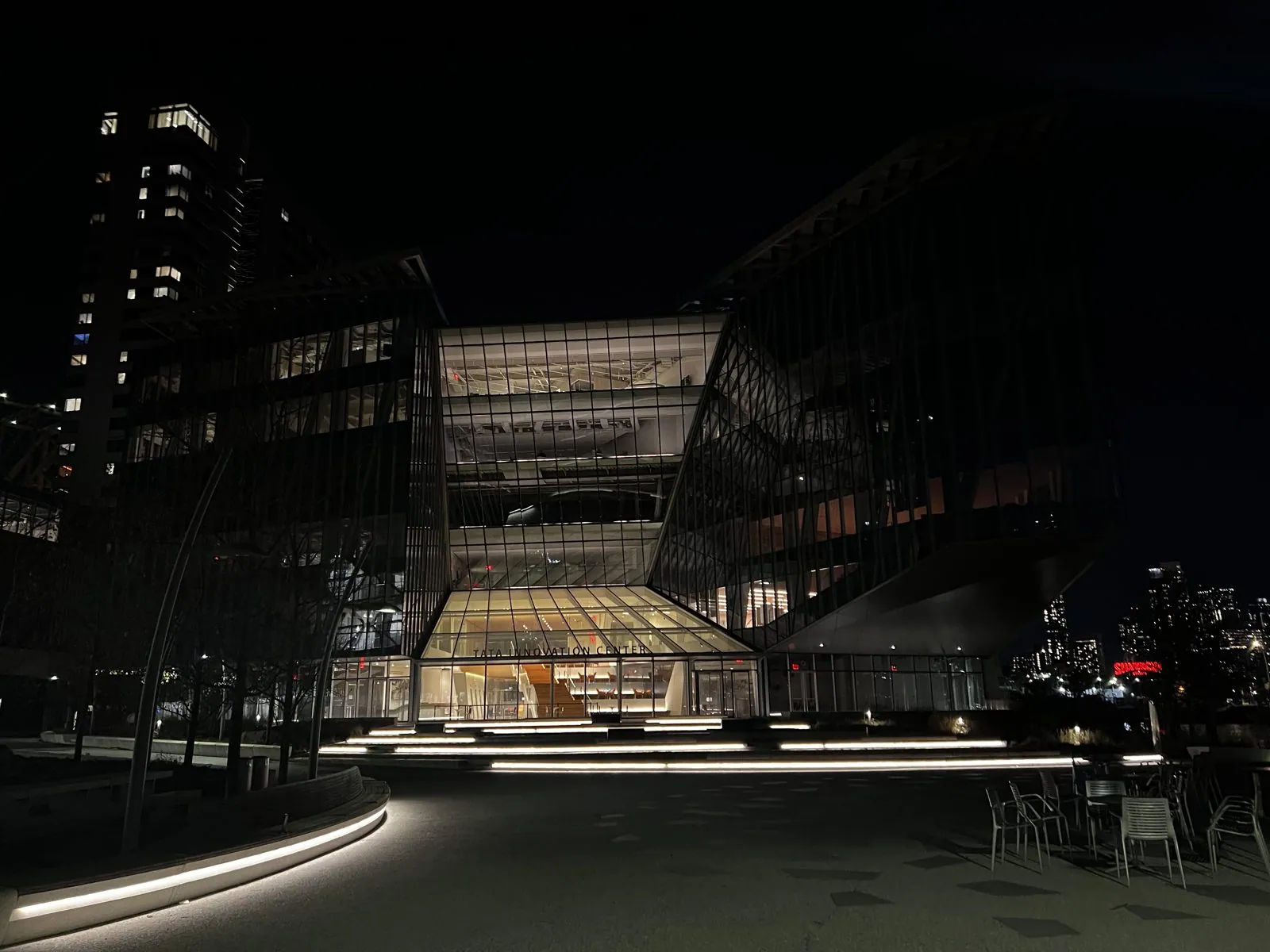
The newest campus in the post. Cornell Tech is a graduate school on Roosevelt Island in the East River, built on the site of an old hospital and opened in 2017. We walked south from the tram station on the evening of New Year's Day, 2023, and found the angular glass Tata Innovation Center lit from inside on an empty plaza, with Midtown across the water. From New Year's on the East Coast.
2. Penn · January 2023
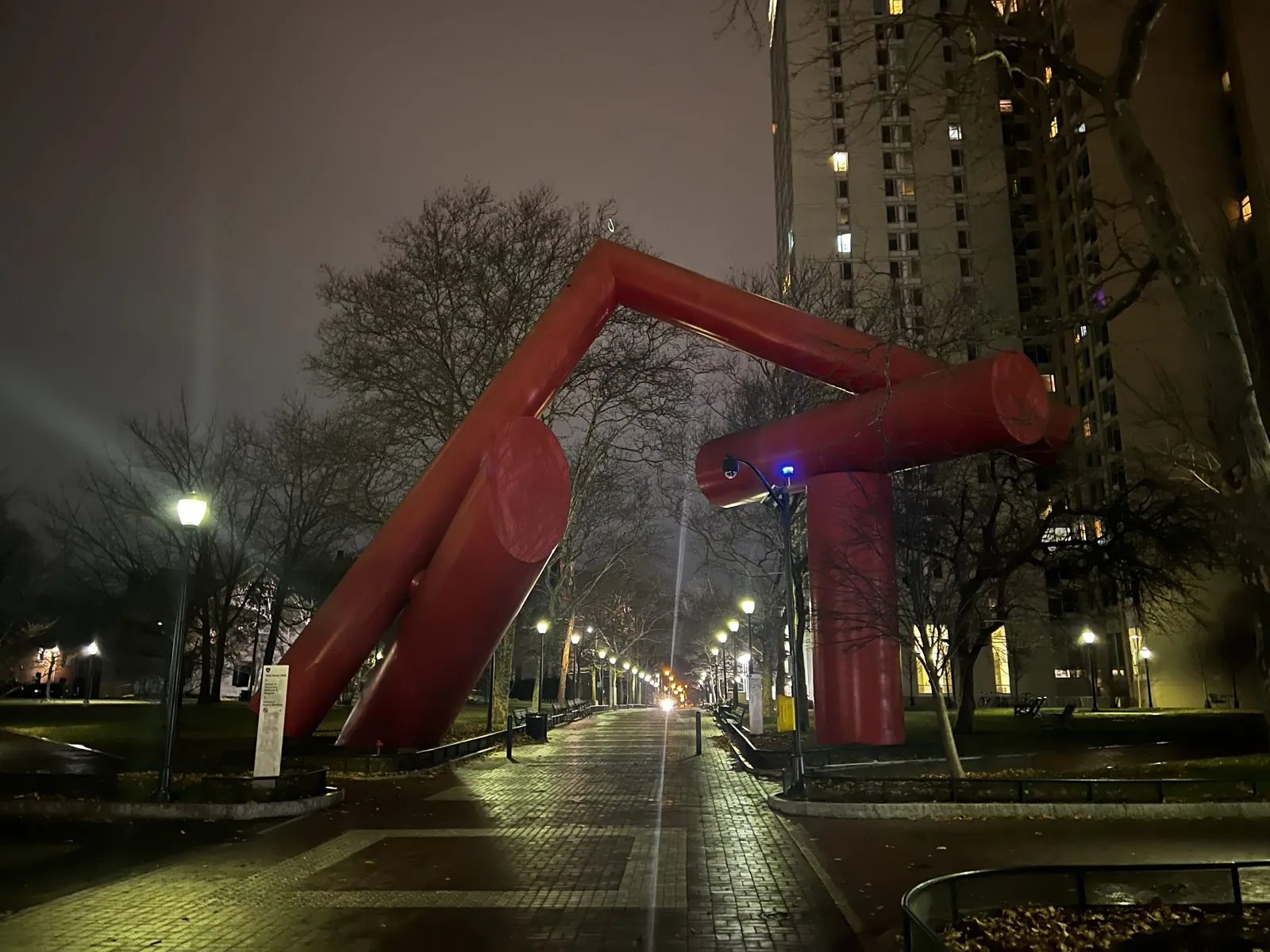
The University of Pennsylvania goes back to Benjamin Franklin's academy of the 1740s. Its spine is Locust Walk, the brick path through the middle of campus. We walked it on the evening of January 2nd, 2023, in the rain, during the winter break, when the campus was almost empty. Strings of lights hung between the trees, and halfway along stood Covenant, a big red steel sculpture of tilted cylinders by Alexander Liberman, from 1975. More in New Year's on the East Coast.
3. Georgetown · January 2023
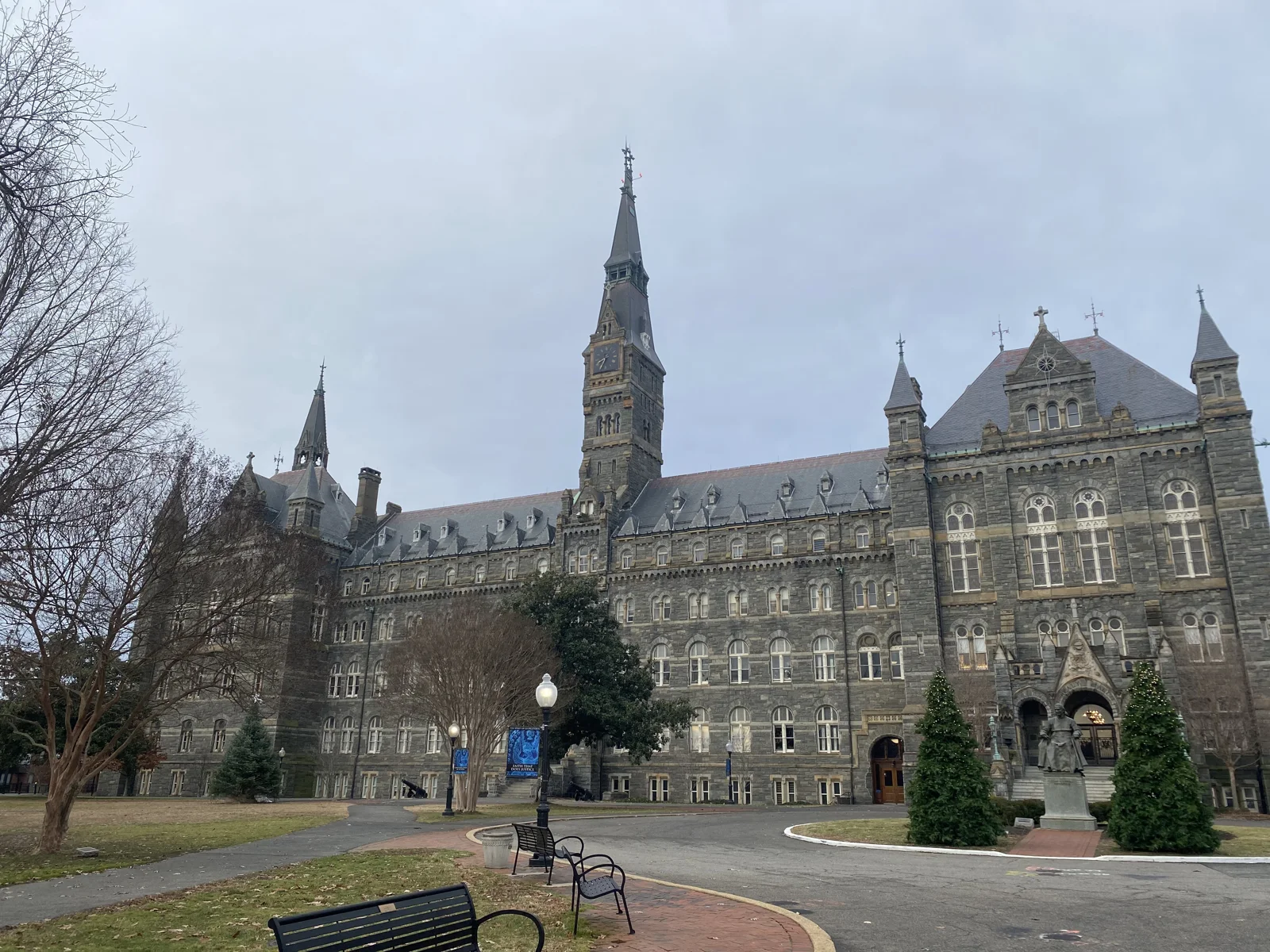
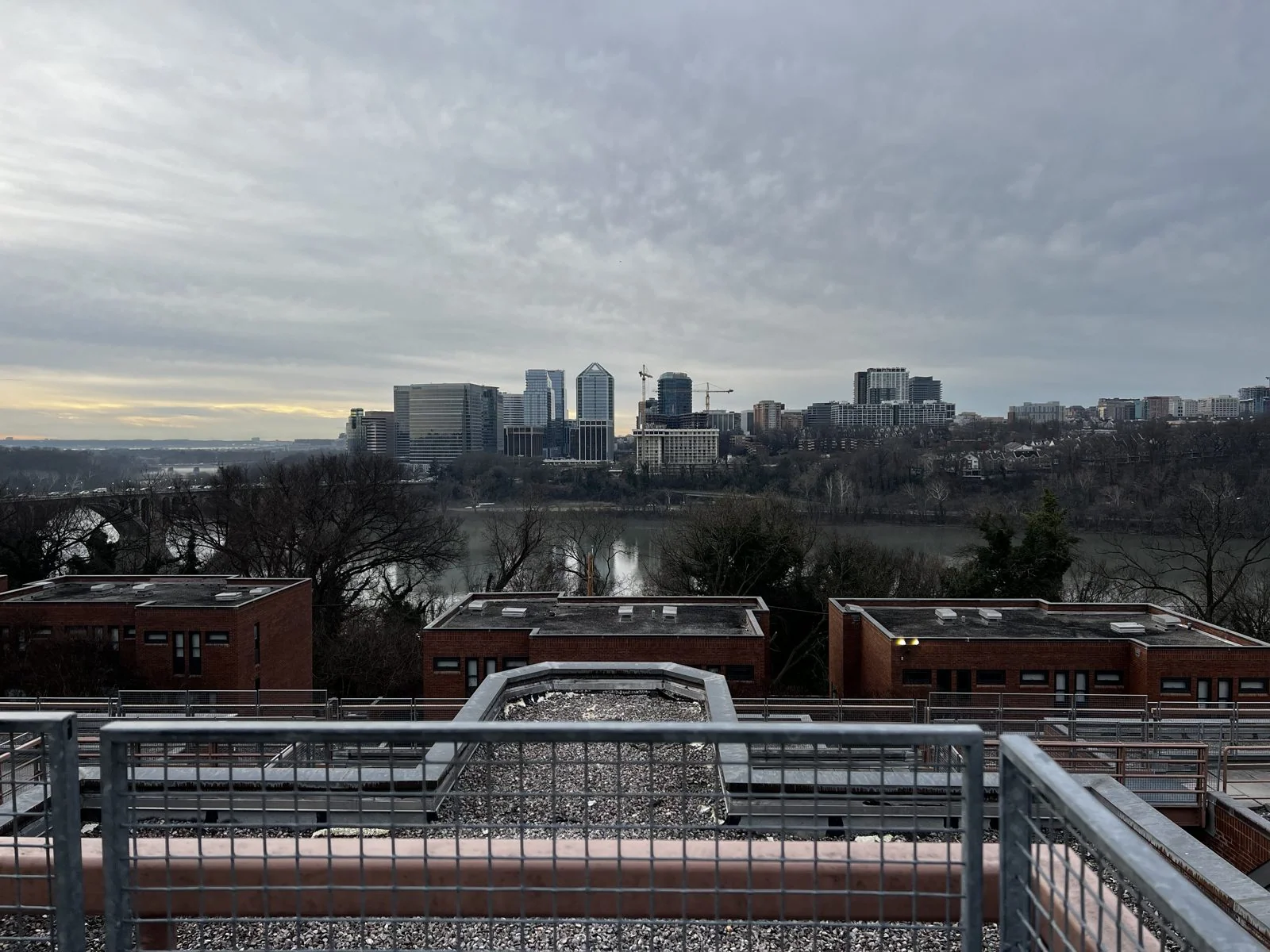
Two days later, on the last morning of the same trip, we walked onto the Georgetown campus. Georgetown was founded in 1789, the same year as the Constitution took effect, and it is the oldest Catholic university in the United States. At 8:32 we were in front of Healy Hall, with its Gothic spire over the lawn. The campus sits on a hill above the Potomac. At 8:49 on a gray January morning, the view from the top went out over brick roofs and bare trees to the river and the glass towers of Rosslyn on the Virginia side.
4. Syracuse · August 2024
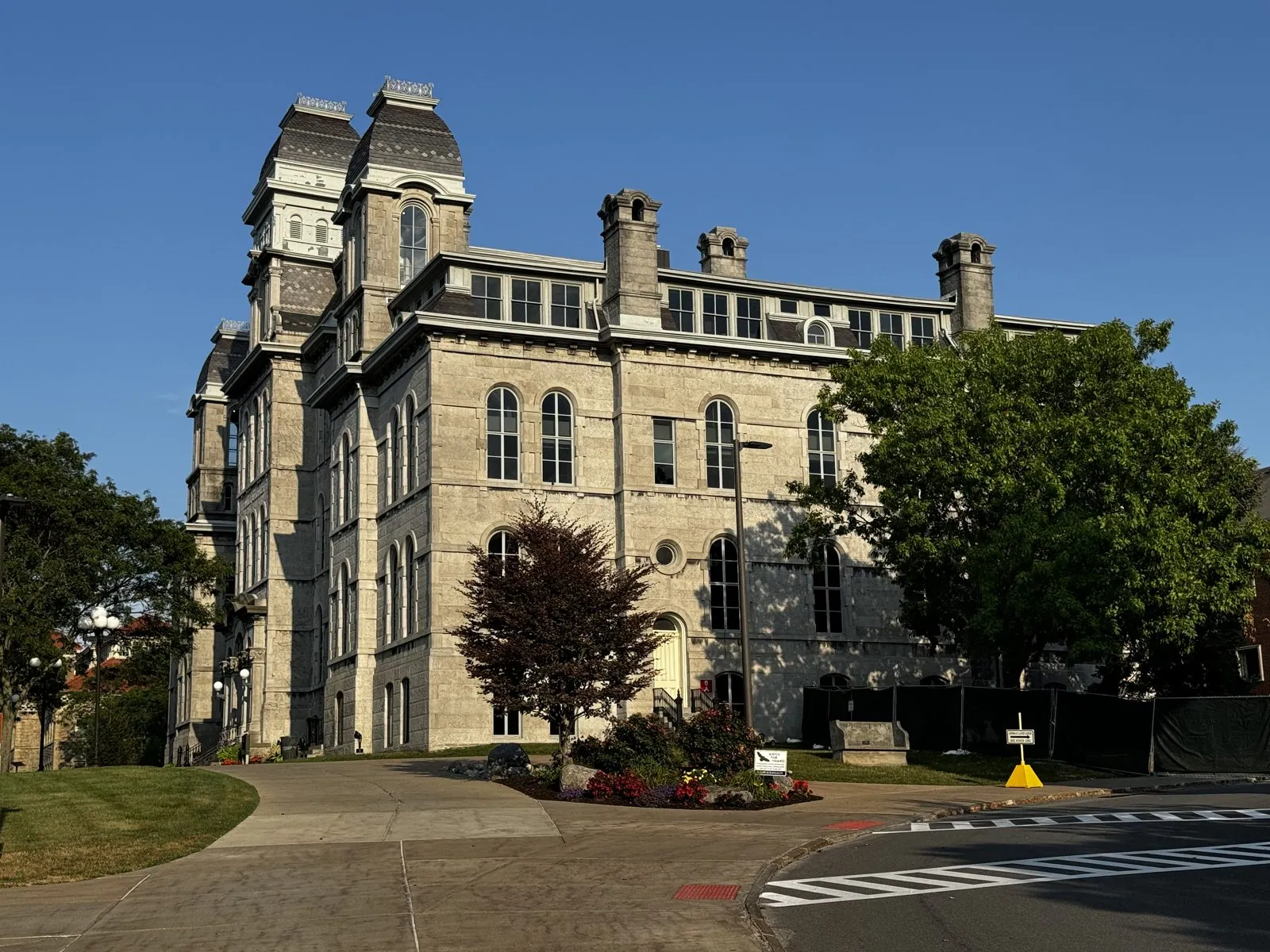
Syracuse University was founded in 1870 and sits on a hill above the city. Its first building, the Hall of Languages (1873), is a pale stone Second Empire building with mansard roofs and towers, the kind of thing Victorians built when they wanted a college to look serious. We crossed the campus at golden hour on August 4th, 2024, with sprinklers ticking on the lawns and the place nearly empty. Hendricks Chapel, domed and red-brick, was catching the last of the sun. From the 2024 road trip.
Pittsburgh, Ohio and Chicago
Four days of the 2024 road trip, from a Gothic skyscraper to a Gehry and back to Gothic again.
1. Pitt · August 2024
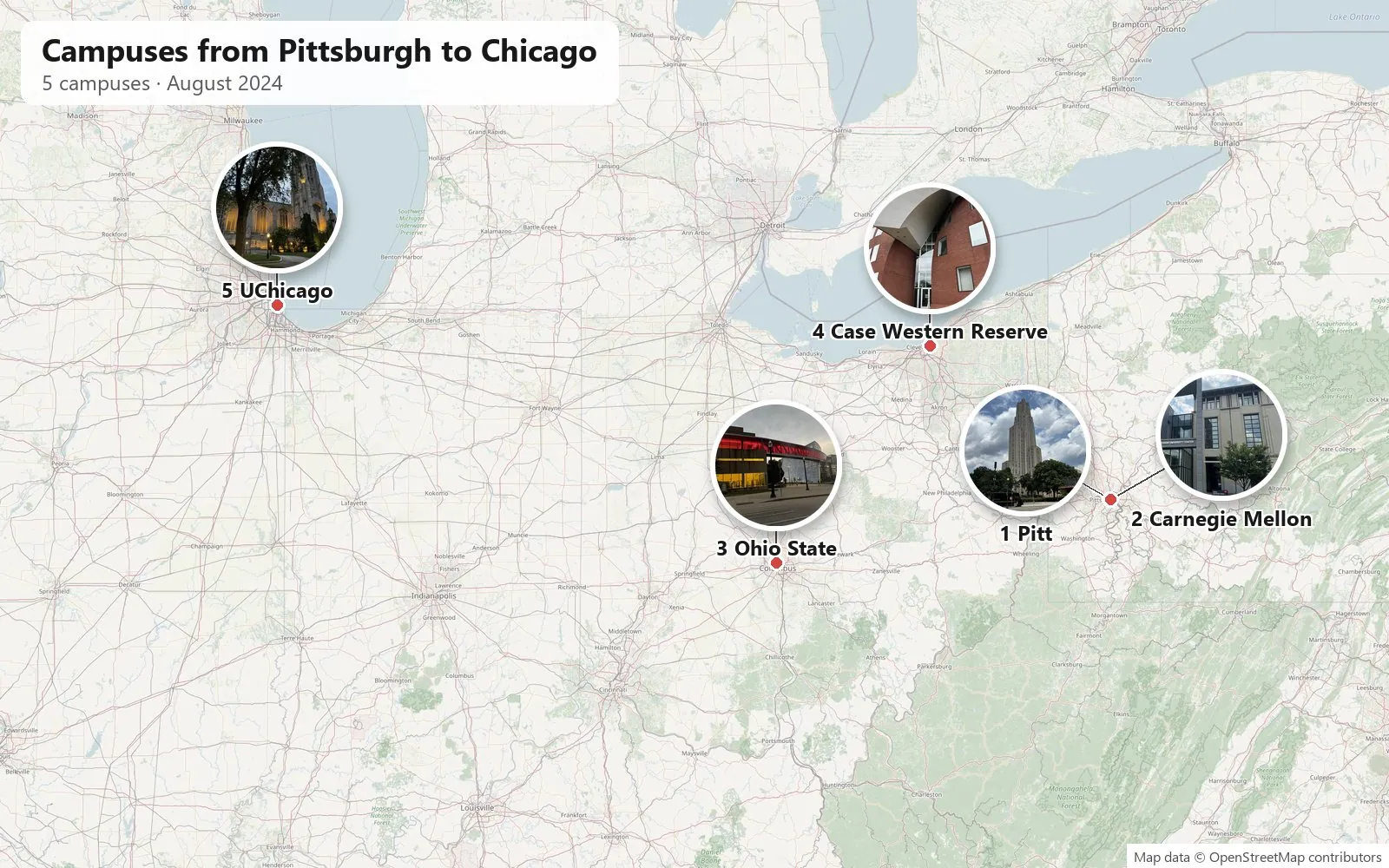
Pittsburgh took Yale's Gothic idea and stood it on end. The Cathedral of Learning at the University of Pittsburgh, designed by Charles Klauder and dedicated in 1937, is forty-two stories and 535 feet of limestone, the tallest educational building in the Western Hemisphere. Its Nationality Rooms are classrooms, each designed in the style of a different country by the city's immigrant communities. We stood under it in the early afternoon of August 6th, 2024, with fast clouds going over.
2. Carnegie Mellon · August 2024
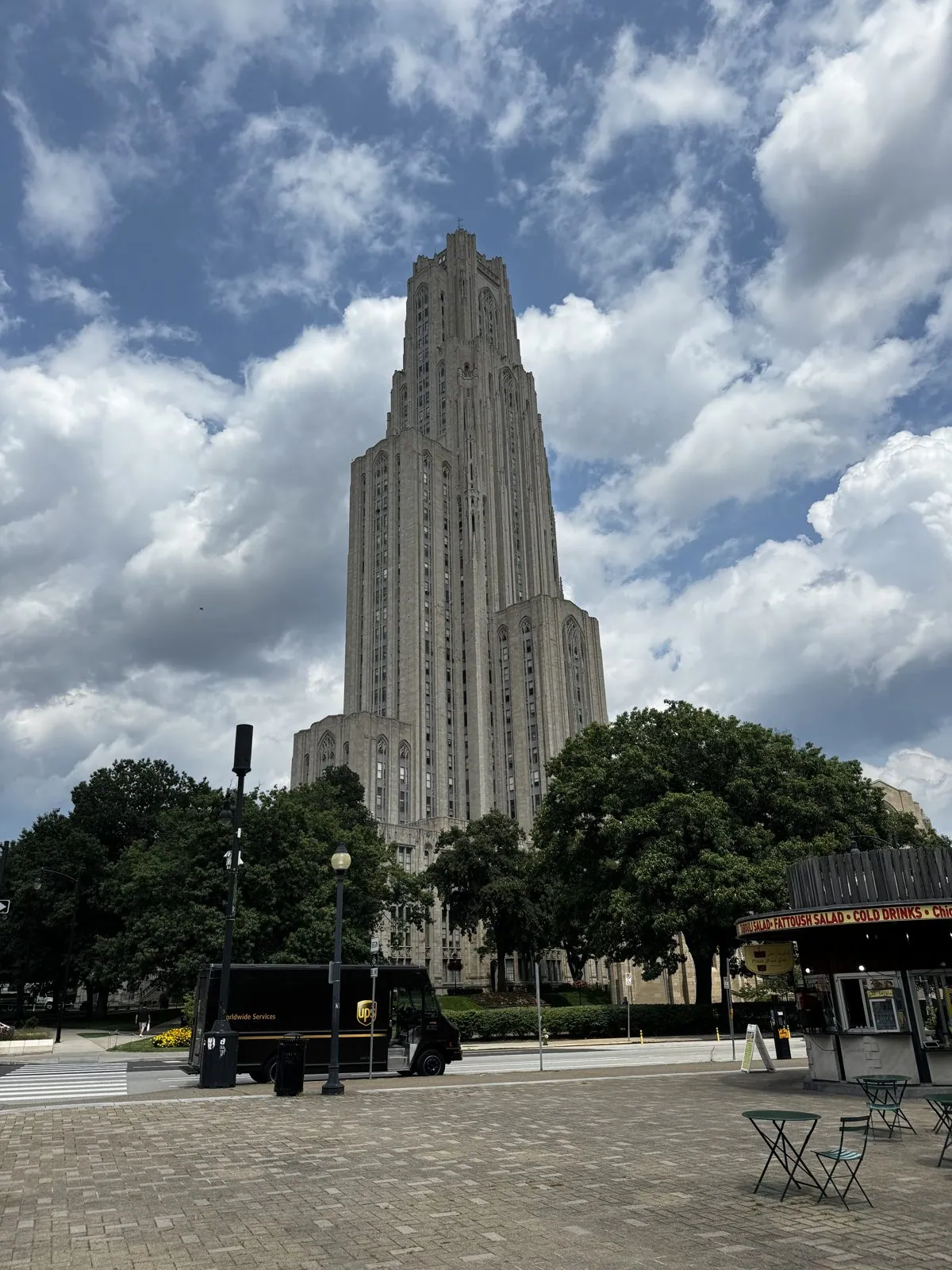
A few blocks from the Cathedral of Learning is Carnegie Mellon, founded by Andrew Carnegie in 1900 as the Carnegie Technical Schools. On August 6th, 2024, its glassy Cohon University Center was quiet in the August heat. In one afternoon in Pittsburgh you can walk from 1930s Gothic to 1990s glass in ten minutes.
3. Ohio State · August 2024
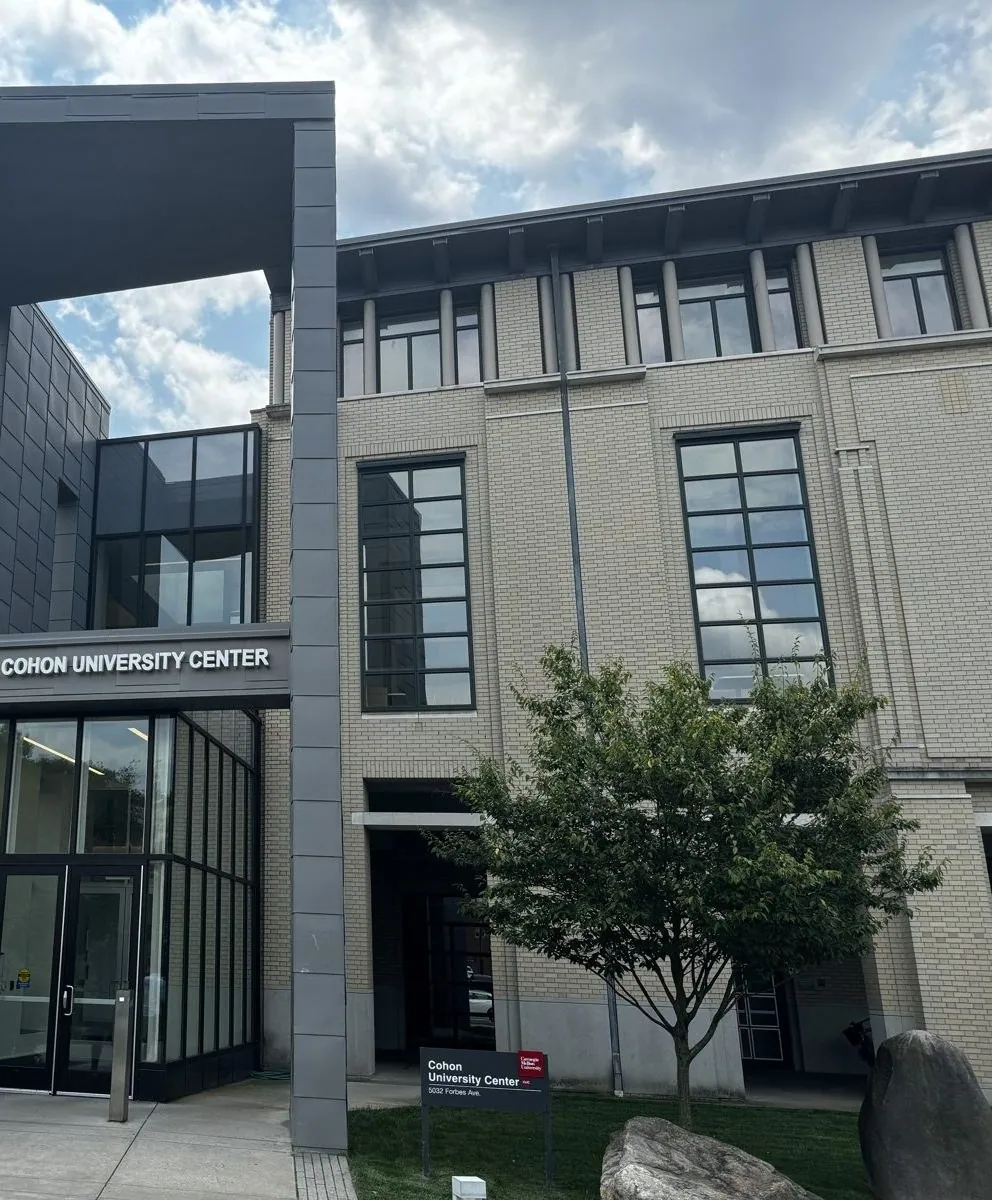
Ohio State was founded in 1870 as a land-grant college and is now one of the largest universities in the country. That same evening, August 6th, we walked up Neil Avenue onto the campus as the lights came on: lit windows, empty paths, and a building whose red glass front and skybridge glowed like a lantern.
4. Case Western Reserve · August 2024
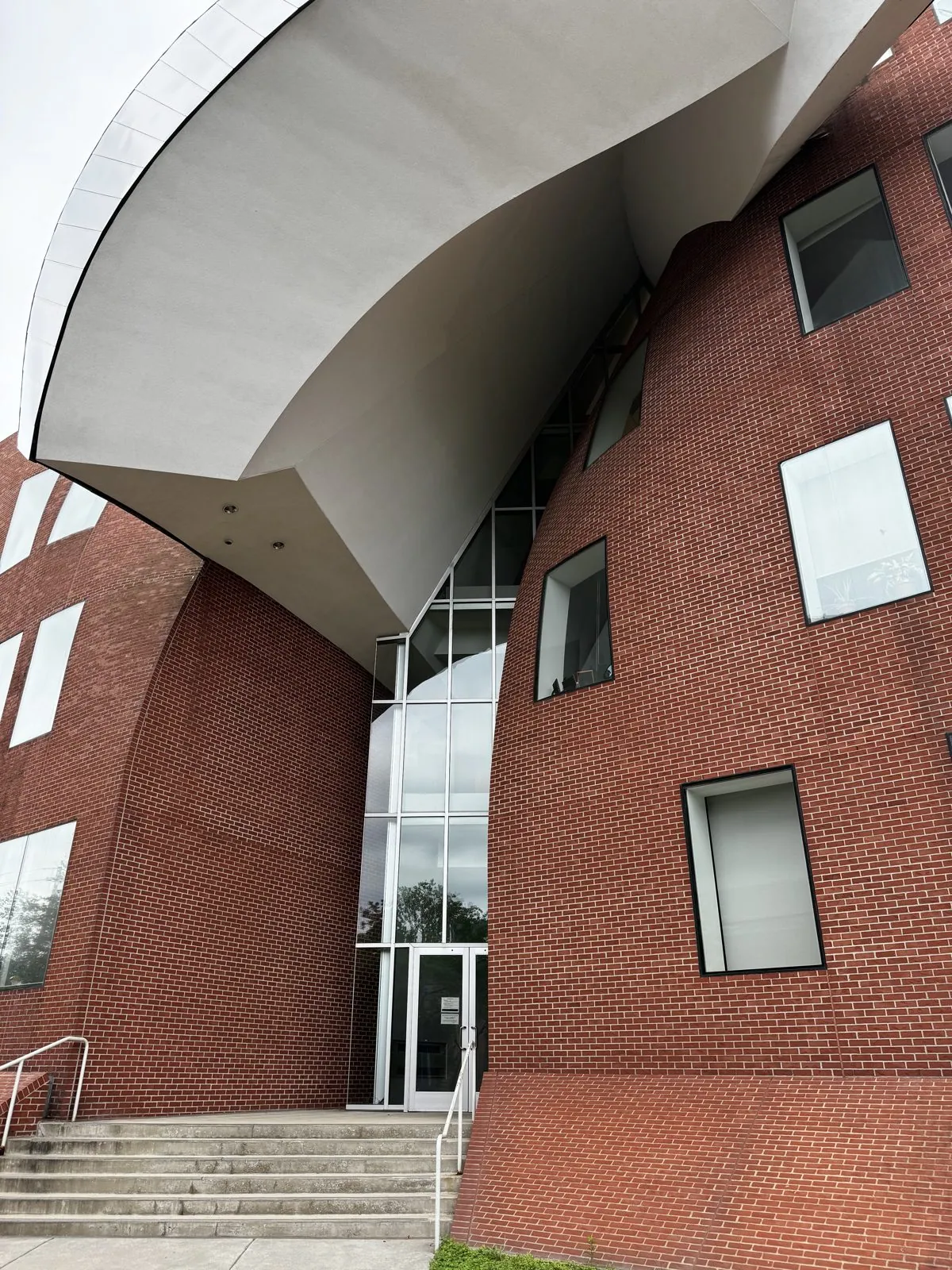
The next morning, August 7th, we walked around Case Western Reserve in Cleveland and found Frank Gehry's Peter B. Lewis Building, the business school, which opened in 2002. Its brick walls bulge and lean, and great sheets of stainless steel pour off the roof as if the building were melting from the top down. It is the strangest building on any campus here, and the closest thing to a sculpture.
5. The University of Chicago · August 2024
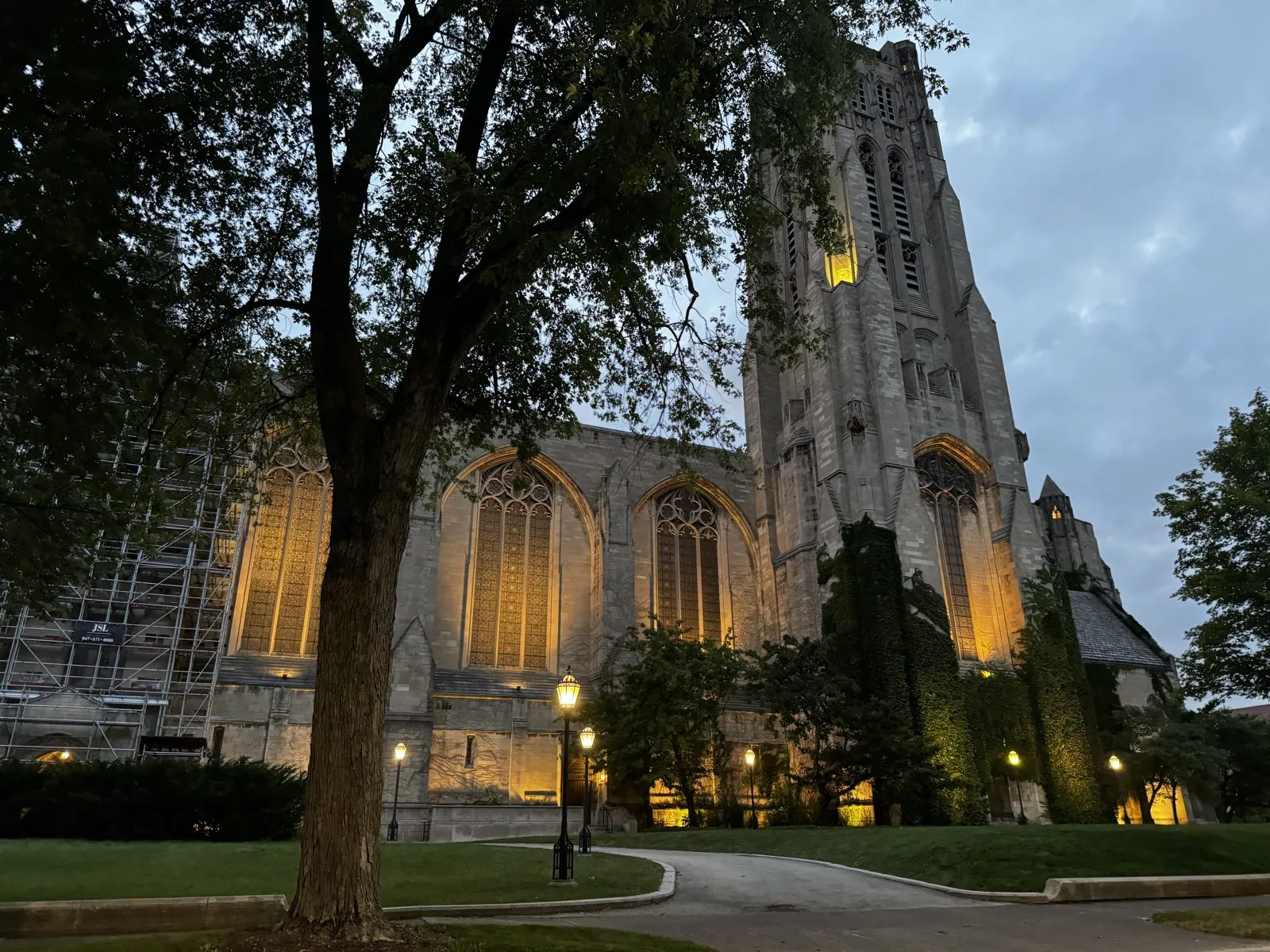
The University of Chicago was founded in 1890 with John D. Rockefeller's money, and it was built from the start as a Gothic campus of gray limestone quadrangles, a piece of Oxford set down on the South Side. We got to Hyde Park just after eight in the evening on August 9th, 2024, in time to see a Gothic chapel on the campus lit up gold by floodlights in the trees.
Australia
Two campuses on two evenings, during SIGGRAPH Asia.
1–2. The University of Sydney and ANU · December 2023
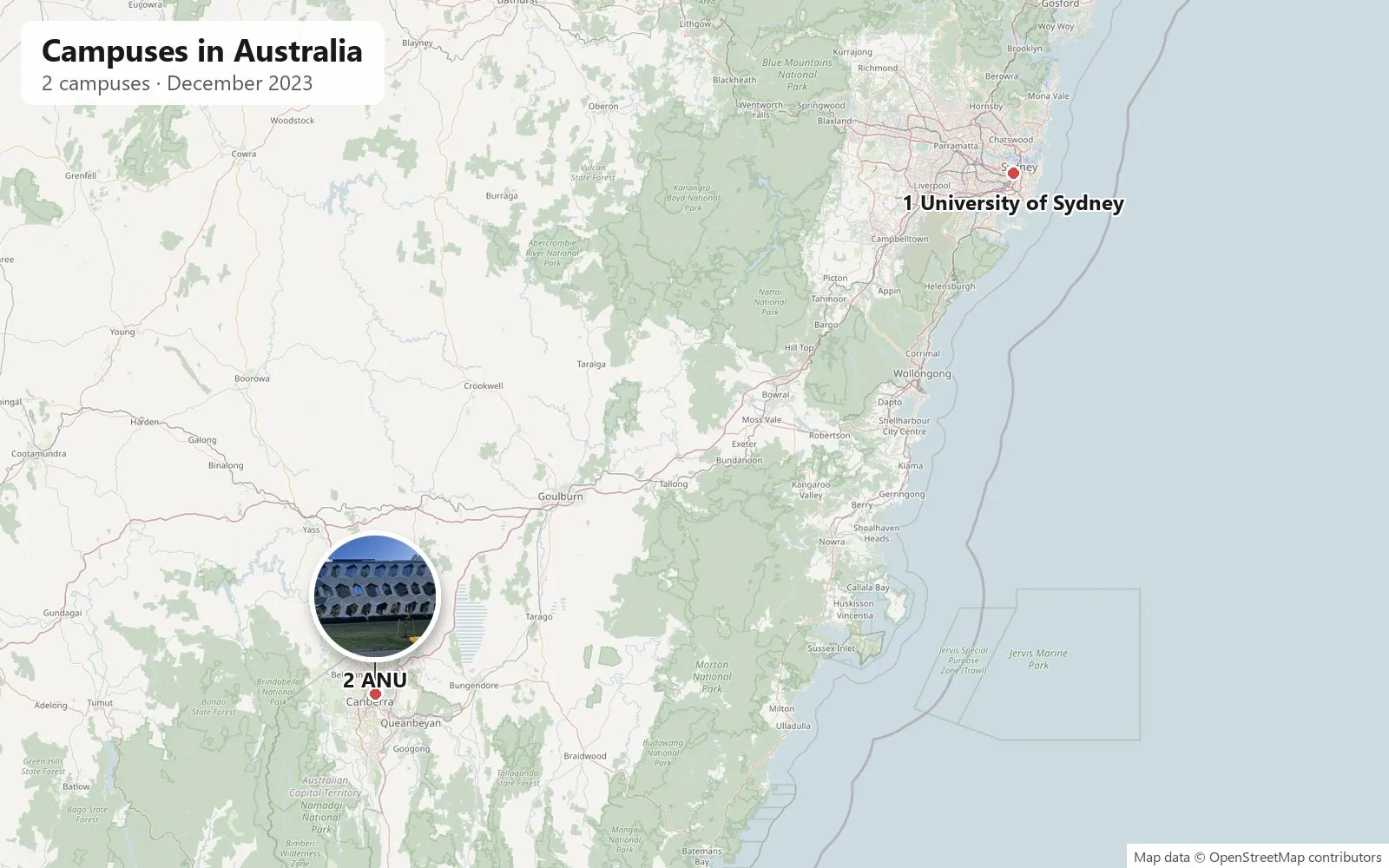
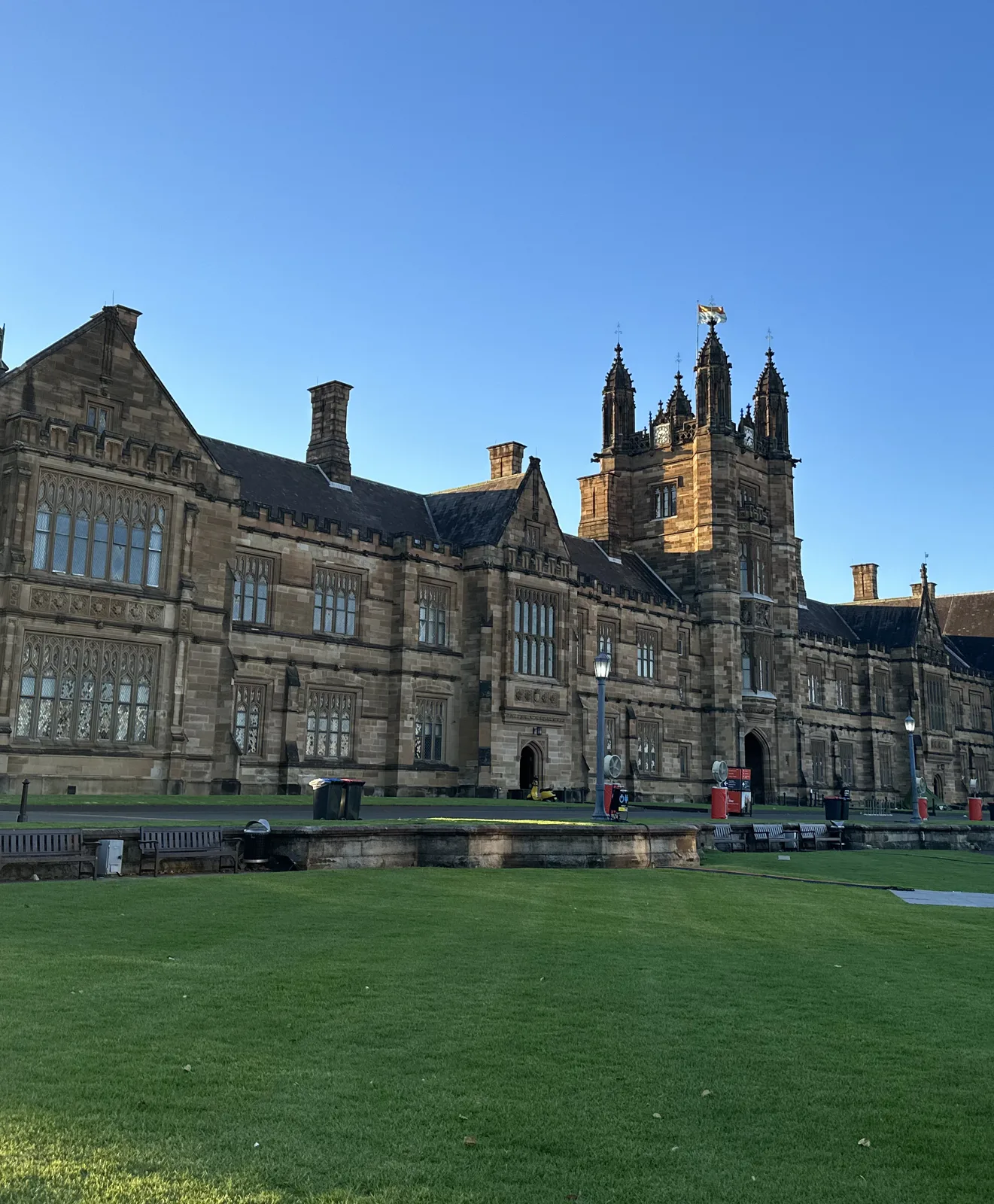
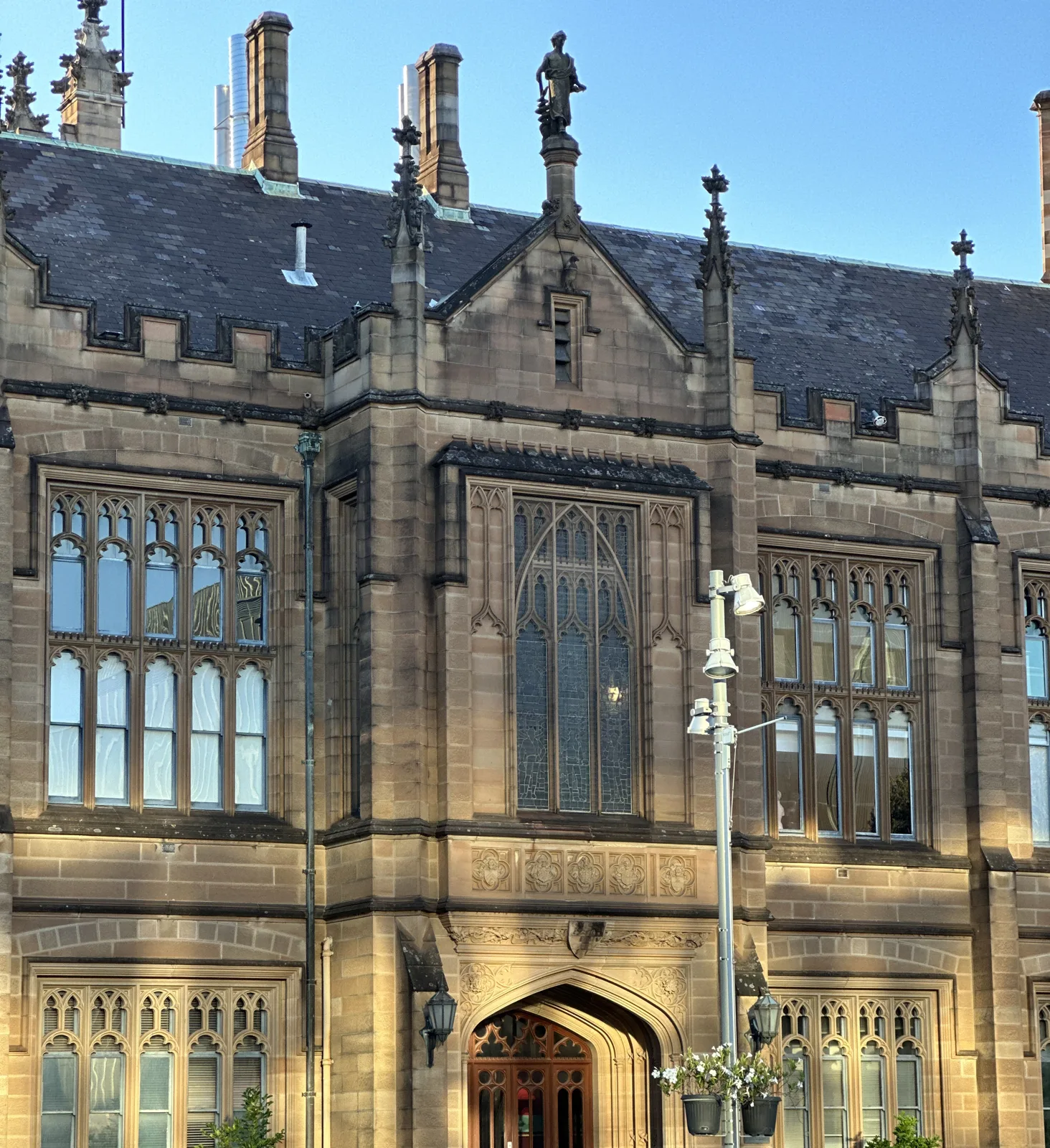
Two campuses in Australia, during SIGGRAPH Asia. On the evening of December 14th, 2023, we walked a couple of kilometers south to the University of Sydney, which was founded in 1850 and is the oldest university in the country. I have no photo of the campus itself, but my wife does. At 7:19 pm the sandstone Quadrangle was gold in the low sun.
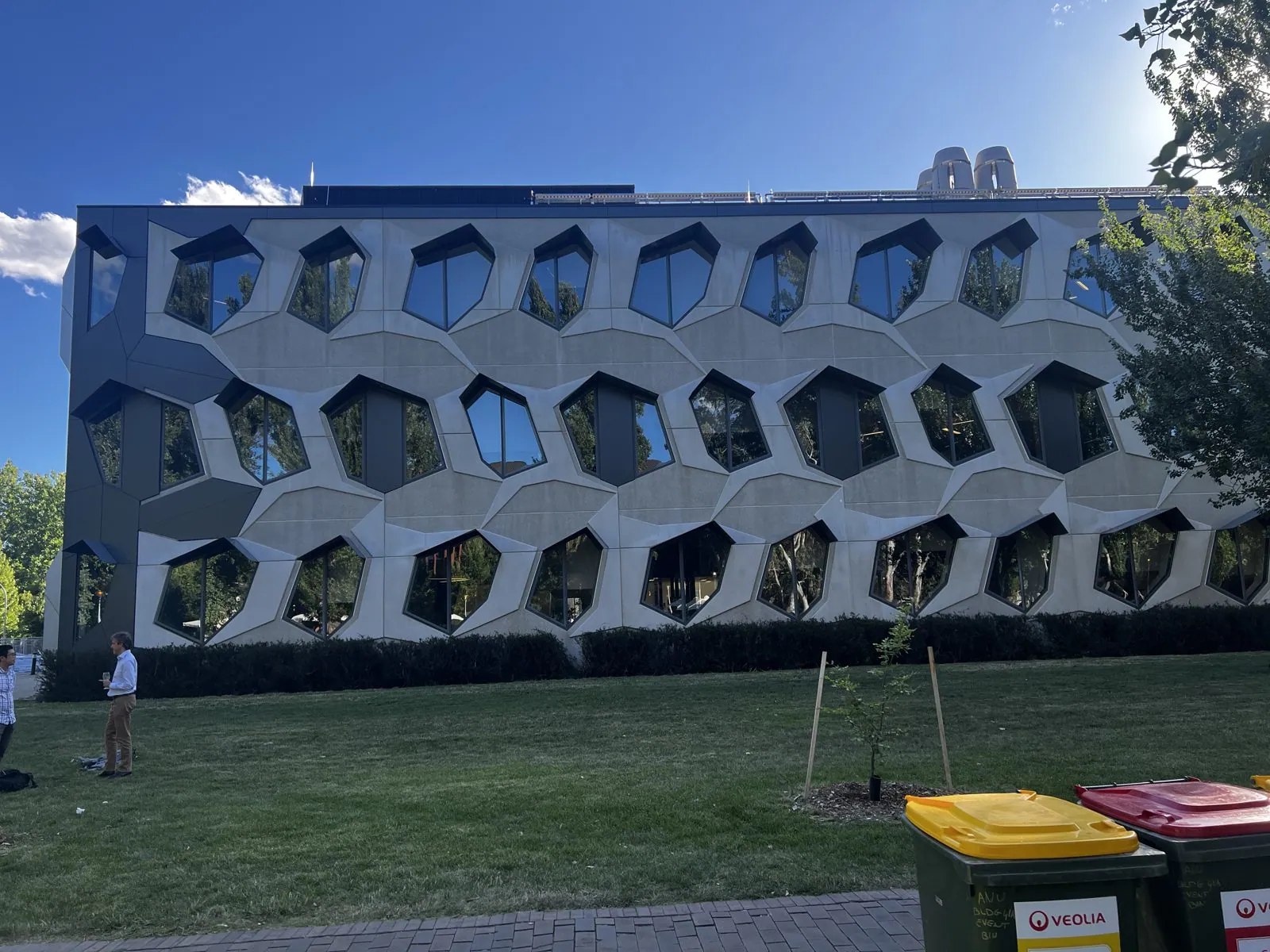
The next evening, in Canberra, we walked across the Australian National University, founded in 1946 as a research university for the new nation and spread out along the lake at the foot of Black Mountain. One new building had a façade of white hexagons, each framing a window, like a honeycomb tipped on its side. More in the SIGGRAPH Asia post.

Coda: home
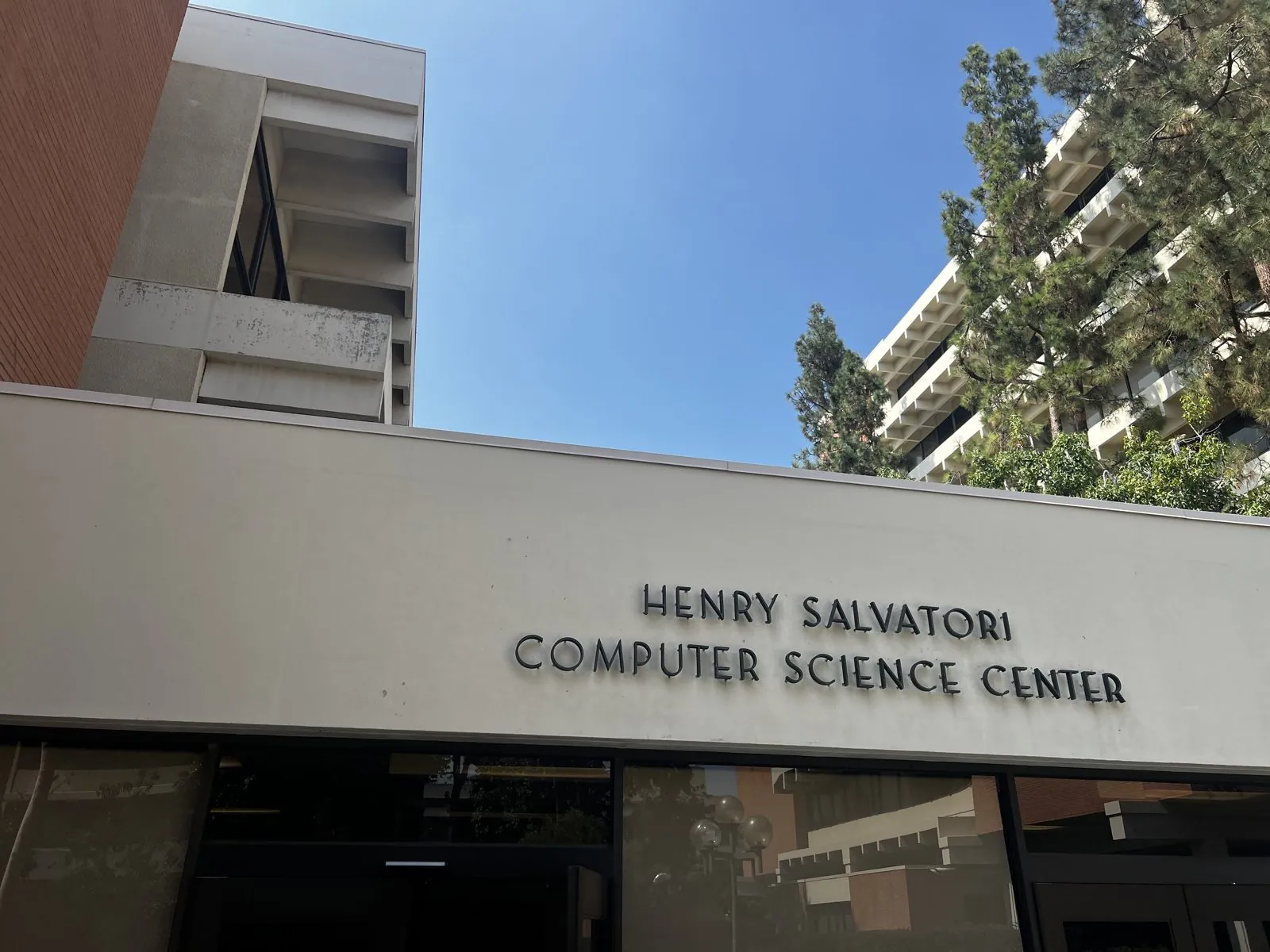
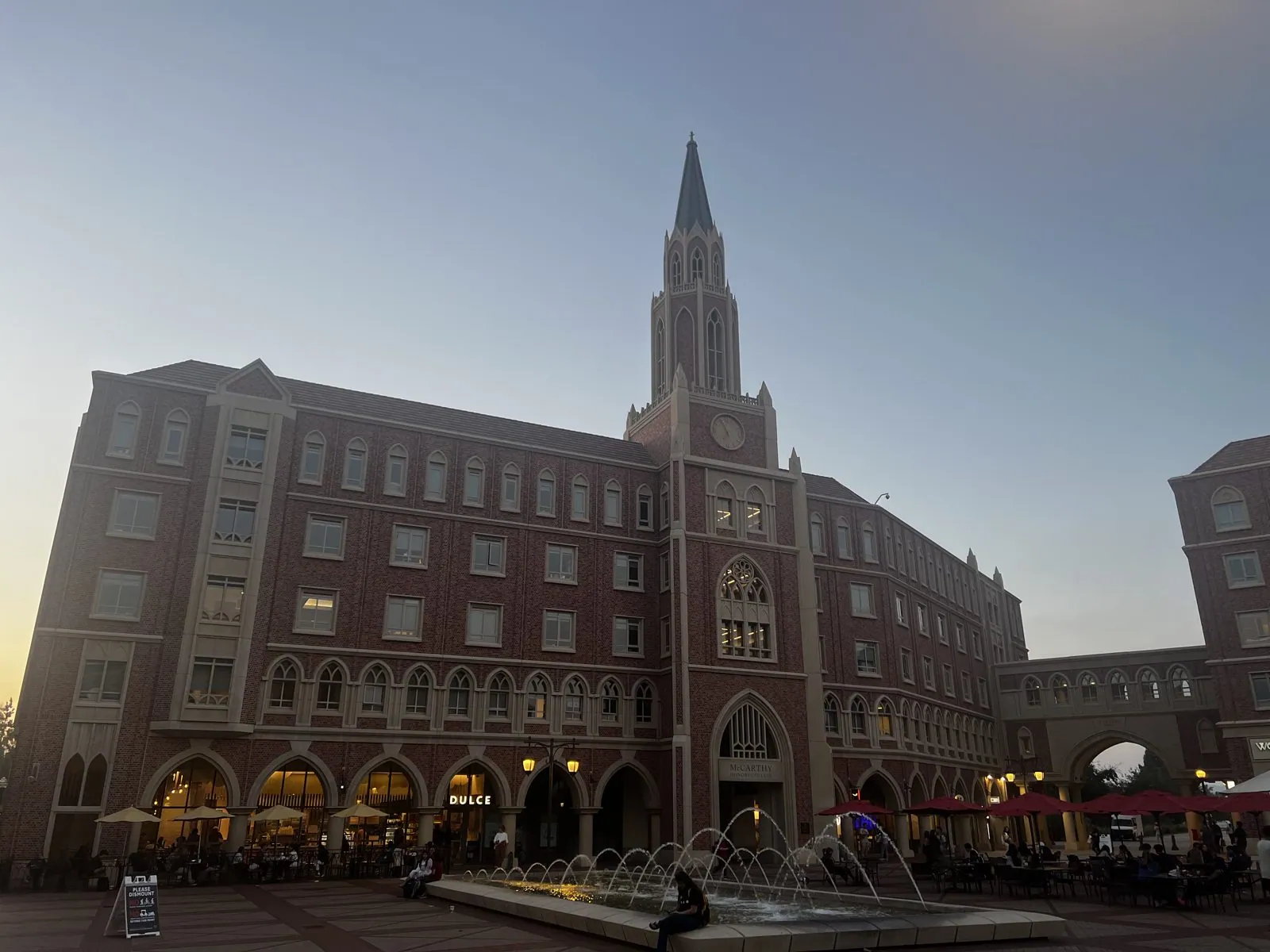
And then there is the campus we see every week. USC was founded in 1880, when Los Angeles was a town of about eleven thousand people, and its core is red brick in a Romanesque style. On September 19th, 2023, the camera came out on campus for once, as if it were somewhere new. In the afternoon it was the Henry Salvatori Computer Science Center, all concrete and brick. In the evening it was USC Village, which opened in 2017 and is built of brick in a Gothic style, with pointed arches, a clock and a spire. Seen at dusk with the fountain running, it is hard to believe it is the same age as Cornell Tech's glass.
That is the history of campus architecture in one walk. A university that is not yet 150 years old built a Gothic village after 2010, and it works for the same reason the rest of the list works: when a university builds, it builds to look as if it has always been there. Yale reportedly aged its stone with acid, Stanford borrowed the missions, and USC borrowed Oxford. Only the concrete ones, Geisel Library and its friends, ever tried to look like the future. Half a century on, they are a period style too.
Writing this, I also noticed how few of these visits were planned. Most of them were in the gaps: an hour before a flight, an evening after a conference, a stop on the way to dinner. A campus is one of the few places you can walk into almost anywhere in the world, without a ticket, and feel at home for an hour. Maybe that is why we keep walking in.
Built from the photos' timestamps and locations; times are local. Photo locations have been removed from the published images. Founding dates, architects and heights are the universities' published figures. Many of the photos also appear in the trip posts linked above.
Maps: © OpenStreetMap contributors; campus locations are approximate.
Some photos in this post are my wife's.
Likes and comments
React with an emoji or leave a comment. Signing in with GitHub is required.